A custom trade show booth quote is more than a price for building an exhibit. It defines what your booth builder will design, fabricate, deliver, install, and dismantle—and which costs remain your responsibility.
A typical quote may include booth design, custom fabrication, graphics, flooring, lighting, transportation, and installation. However, show services such as electrical power, drayage, internet, and rigging may be billed separately.
Understanding these differences helps you compare proposals accurately, avoid unexpected expenses, and choose the right booth builder for your next trade show.
Key Takeaways
- A custom booth quote should clearly define design, fabrication, graphics, logistics, installation, and dismantling.
- Electrical, drayage, rigging, and other official show services may be excluded.
- Compare booth builders based on total project scope, not just the quoted price.
1. What Does a Custom Booth Quote Include?
A useful proposal connects the approved design to the components and services required to deliver it. The following areas belong in the scope review, although not every project includes every item.
| Quote area | What the proposal should specify |
|---|---|
| Booth design | Layout, 3D views, revision allowance, and production drawings included |
| Fabrication or rental | Component quantities, dimensions, materials, finishes, and ownership |
| Graphics | Printed surfaces, sizes, materials, file preparation, proofs, and application |
| Flooring and furniture | Flooring system, counters, seating, tables, storage, and rental period |
| Lighting and AV | Fixtures, screens, mounts, cabling, equipment rental, and testing scope |
| Transportation | Pickup and delivery locations, shipment assumptions, packing, and return route |
| Installation and dismantling | Assembly, graphics application, furniture placement, supervision, and repacking |
| Project management and support | Named contact, schedule coordination, paperwork assistance, and on-site availability |
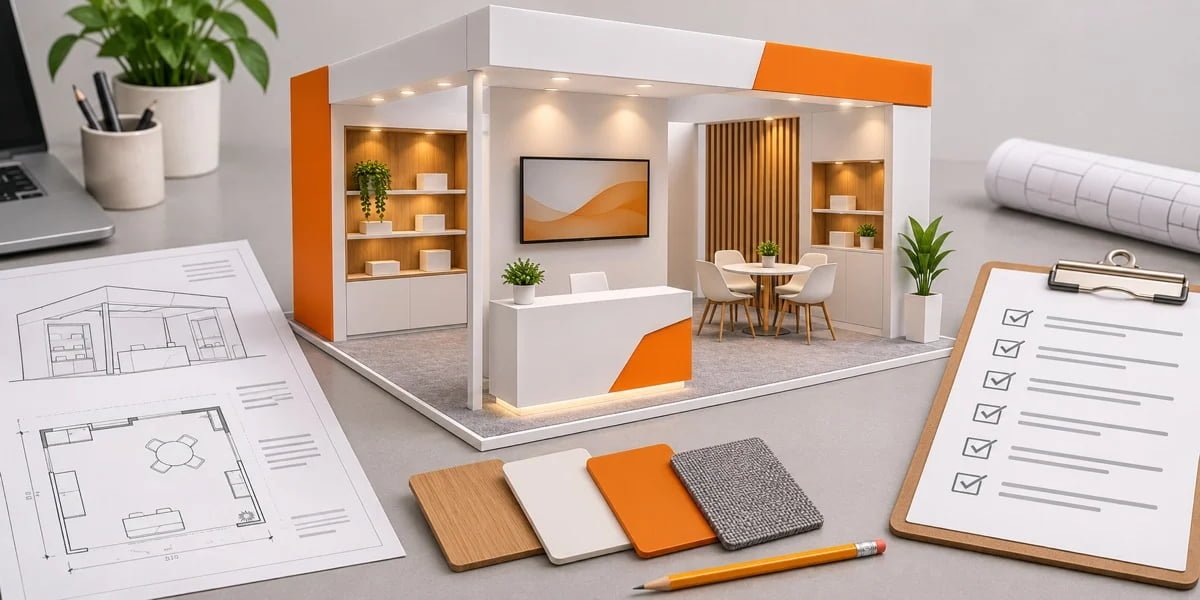
Connect the rendering to a written component list
A rendering helps explain appearance and layout, but it should be accompanied by a written list of what will be supplied. Plants, screens, furniture, products, and accessories may appear for visualization without being included in the price.
For each major feature, confirm its dimensions, finish, quantity, and function. A “branded counter” could mean a rental counter with a printed panel or a custom-built unit with locking storage. A “video display” could mean a monitor mount only, a rented screen, or a complete AV package.
Ask the builder to reference the same drawing revision in the estimate and production documents. If the design changes, the scope and pricing should be updated together. Learn more about the design stage through our Trade Show Booth Design service.
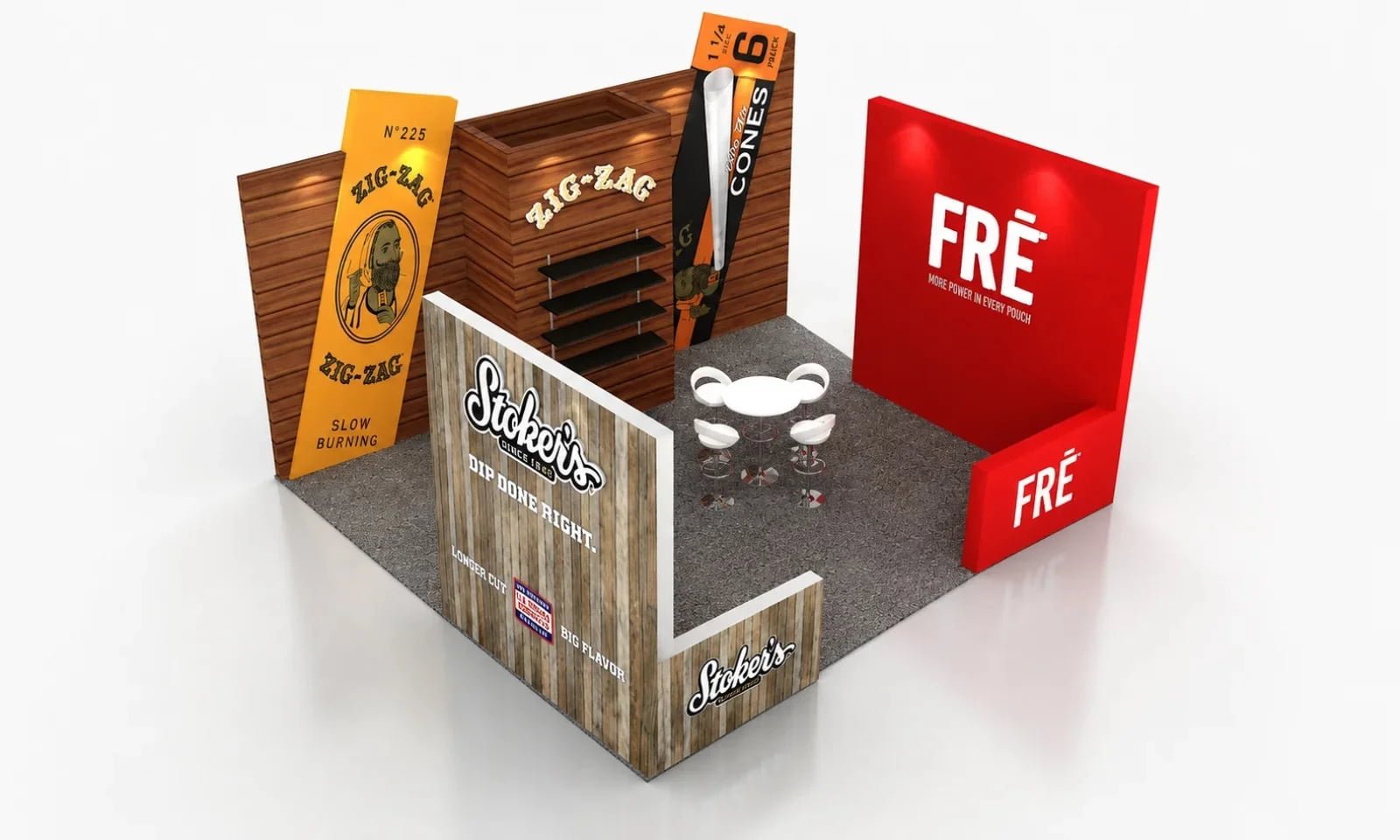
Design reference: Exhibitsmax’s ZIG·ZAG project for NACS 2021 in Chicago. This rendering illustrates layout and components; it is not a quotation or a promise that every depicted item is included in another project.
Separate custom, rental, and client-supplied components
“Custom” does not necessarily mean every item is newly fabricated or becomes the exhibitor’s property. A project can combine branded structures, rented furniture, reusable frames, and client-owned equipment.
Identify what is purchased, what must be returned, and what will be stored after the event. For a reusable exhibit, request packing and storage requirements alongside the build scope. Future graphic replacement, refurbishment, and reconfiguration should not be assumed to be included in the first-show price.
Define graphics and finishes before production
Confirm whether graphic services cover artwork creation, adaptation, file checking, print production, installation, or only some of these tasks. The proposal should identify materials such as SEG fabric, adhesive vinyl, rigid panels, or dimensional logos, with an artwork deadline and proof-approval process.
Material descriptions also make comparisons more useful. Painted surfaces, laminate finishes, aluminum framing, and fabric systems have different fabrication and packing requirements. Choose a specification appropriate for the planned use rather than judging quality from the rendering alone.
For product displays, provide actual equipment dimensions, weight, ventilation needs, and access requirements before the builder prices shelves or counters. A display surface intended for brochures may require a different specification from one supporting working machinery. Identify lockable storage, staff access, and cable routes in the brief so these functional details can be priced rather than inferred from a visual concept.
2. What Is Usually Excluded From the Quote?
Builder proposals may exclude show-site services and exhibitor expenses, or include selected items as allowances. Review these separately from the booth build. Coordinating an order does not necessarily mean paying for that service.
| Item to confirm separately | What needs clarification |
|---|---|
| Electrical service | Power supply, distribution, outlet locations, authorized electrical labor, and service duration |
| Material handling / drayage | Receiving, freight movement, handling classification, minimum charges, and applicable return handling |
| Rigging | Approval documents, points, equipment, authorized crew, installation, and removal |
| Internet | Connection type, devices, required capacity, and service period |
| Cleaning and waste removal | Routine cleaning, installation debris, and post-show disposal |
| Engineering or permits | Required documents, submission responsibilities, review fees, and design changes |
| Exhibitor expenses | Booth-space rental, travel, accommodation, giveaways, lead retrieval, and product shipping |
| Post-show services | Return freight, storage, repairs, refurbishment, or disposal not included in the agreed scope |
Keep three service boundaries clear
Lighting fixtures and electrical service: A lightbox or booth-mounted fixture can be part of fabrication while the event’s power service and electrical labor are separately ordered. Clarify who prepares the power-location plan and who submits and pays for the official order.
Transportation and material handling: A freight quote should state its delivery endpoint. Delivery to an advance warehouse or venue does not, by itself, confirm that the event’s material-handling charges are included. Use the current service kit for the applicable rate basis, shipment classification, minimums, receiving arrangements, and any permitted delivery alternatives. See our Trade Show Booth Transportation service for the transportation scope to discuss with your builder.
Hanging-sign production and rigging: Producing a sign is different from approving, suspending, and removing it. If the design includes an overhead element, identify the required documentation and authorized provider through the current exhibitor manual before finalizing the estimate.
Do not assume one official contractor provides every service. Record the designated supplier, order deadline, payer, and coordination contact for each applicable item. This is particularly useful when the exhibitor, agency, builder, and show-service providers work across different time zones.
3. Example: 20×20 Custom Booth Quote Breakdown
The table below illustrates how a proposal for a 20×20 trade show booth could be organized. It assumes a branded display area, reception counter, small storage area, graphics, flooring, and booth-mounted lighting.
This is an illustrative scope example—not an actual client quotation, a standard Exhibitsmax package, or a price estimate. Final quantities, specifications, services, and responsibilities depend on the approved design and agreement.
| Item | Example of a clearly described deliverable |
|---|---|
| Booth design | Scaled layout and 3D renderings, with drawing deliverables and revision limits identified |
| Custom fabrication | Listed wall sections, reception counter, and storage enclosure, with dimensions and finishes |
| Graphics | Itemized SEG fabric graphics, printed panels, and logos matched to the artwork schedule |
| Flooring | Specified carpet or vinyl, with subfloor, transitions, and disposal addressed where applicable |
| Lighting | Listed booth-mounted fixtures, mounting hardware, and included cabling |
| Furniture / AV | Named items and quantities, with rental duration or client-supplied status |
| Logistics | Packing method and transport to the agreed receiving location, with return freight stated separately |
| Installation | Assembly tasks, graphics application, supervision, and labor-pricing assumptions |
| Dismantling | Disassembly, protective packing, labeling, and handoff for the agreed outbound plan |
| Project coordination | Named contact and defined design, production, freight, and installation coordination tasks |
For this example, official electrical, material handling, and rigging services would remain marked “confirm separately” until the agreement explicitly includes them. A booth-mounted lighting line should not silently absorb those unrelated costs.
The proposal should also state what information the exhibitor must supply. Product dimensions, approved brand files, demonstration requirements, and the assigned floor plan affect both design and cost. If these are incomplete, record a provisional assumption and a confirmation deadline. This makes the example usable as a procurement checklist without suggesting that every 20×20 booth requires the same components.
The same approach applies to furniture and AV. If the exhibitor supplies monitors, record who provides mounts, checks compatibility, transports the equipment, installs it, and tests the content. Assigning these tasks early prevents “client-supplied” from becoming an unresolved handoff at move-in.
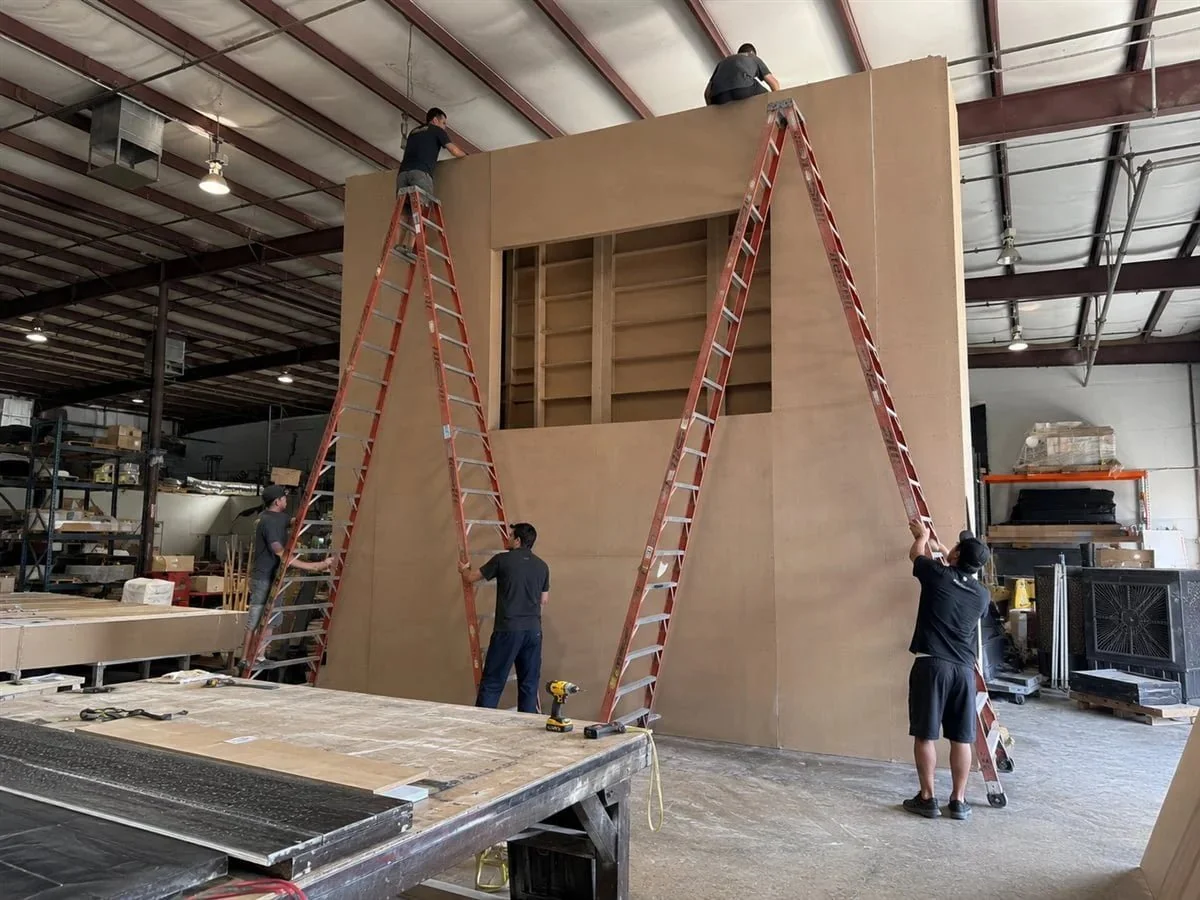
Exhibitsmax fabrication reference. Workshop photos show production capability; they do not represent the illustrative 20×20 quotation above.
4. How to Compare Quotes From Different Booth Builders
Give each supplier the same brief: show, venue, booth dimensions, configuration, functional requirements, equipment list, target budget, and schedule. Then compare the same drawing version and service boundary.
Use the matrix below to record each supplier’s actual answer. Replace “confirm” with a specific scope statement or pricing basis rather than a simple yes/no.
| Comparison point | Supplier A | Supplier B |
|---|---|---|
| Drawing revision and component specifications | Confirm | Confirm |
| Graphic production and artwork services | Confirm | Confirm |
| Furniture and AV quantities | Confirm | Confirm |
| Installation, dismantling, and supervision | Confirm | Confirm |
| Freight endpoints and return arrangements | Confirm | Confirm |
| Included show services and exclusions | Confirm | Confirm |
| Fixed amounts, allowances, and actual-cost items | Confirm | Confirm |
| Approval deadlines and change-order process | Confirm | Confirm |
| Ownership, storage, and future-use costs | Confirm | Confirm |
Distinguish a fixed amount from an allowance
A fixed amount applies to the defined scope and stated conditions. An allowance is a planning amount that may be reconciled later. An actual-cost item depends on the agreed billing basis and supporting records. A missing price is unresolved—not zero.
When one proposal includes a service and another excludes it, obtain the missing estimate before comparing totals. Record taxes and any disclosed coordination or management fees consistently. Keep exhibitor-paid costs visible in the project budget even when they are not on the builder’s invoice.
Read labor assumptions alongside the schedule
For Installation & Dismantling, check the included work, crew assumptions, installation and removal windows, supervision, minimum calls, and applicable overtime treatment. Ask how waiting time or work beyond the estimate is documented and approved.
Review the plan against the current show’s access schedule and service arrangements. A crew cannot complete work that depends on freight or utilities that have not arrived. Design, production, freight planning, and service ordering can overlap, but their dependencies should be visible before the schedule is accepted.
For freight, compare the same origin, destination, shipment contents, delivery window, and return plan. Ask whether packing materials, crates, carrier waiting time, or a second delivery are included or separately charged. If shipment dimensions and weight are still provisional, record when the estimate will be updated. A transportation allowance based on unfinished drawings should not be treated as a confirmed carrier charge.
Compare changes in scope before negotiating price
If a proposal exceeds the budget, ask the supplier to identify options: simplify a finish, reduce custom components, change an AV configuration, or combine rental inventory with branded fabrication. Request a revised component list for each option so the savings are tied to an understandable change.
A lower price can be appropriate when the reduced scope still meets the event’s goals. The useful comparison is whether each proposal delivers the required result with responsibilities and remaining costs clearly identified.
5. Questions to Ask Before Approving a Quote
Use this final review to resolve approvals and handoffs. Keep the answers with the accepted scope, drawings, and schedule.
- Which documents define this proposal? Confirm the quote number, drawing revision, component schedule, and written exclusions.
- What remains an assumption? List unresolved equipment, materials, freight details, labor allowances, and service orders, with a person and date for confirmation.
- Who approves artwork and production? Name the decision-maker and record the proof and design deadlines. For overseas teams, specify the working time zone.
- What triggers a revised price? Address added equipment, design changes, late files, changed shipment details, and show-required modifications before they occur.
- Who can authorize additional work? Agree on a written approval process, including how urgent on-site requests will be handled and documented.
- Who handles official forms and orders? Separate preparation, submission, payment, and confirmation instead of assigning all four through a vague “coordination” line.
- What support is available at move-in? Confirm whether the contact is on-site or remote, the coverage period, and the process for reporting missing or damaged items.
- What happens after dismantling? Confirm ownership, return destinations, storage arrangements, and decisions about reusable or disposable components.
- Which commercial terms require approval? Review the quote’s validity, payment milestones, cancellation terms, and stated conditions before authorizing work.
If an answer changes the scope or price, request an updated written proposal. An email explanation can help clarify intent, but the working documents should remain consistent so marketing, procurement, and the installation team use the same information.
Keep a simple decision log with the open item, responsible person, required information, and approval date. For example, a pending monitor selection should remain connected to its mounting specification and power plan. Closing these linked decisions together helps the production team work from confirmed requirements instead of different versions of the brief.
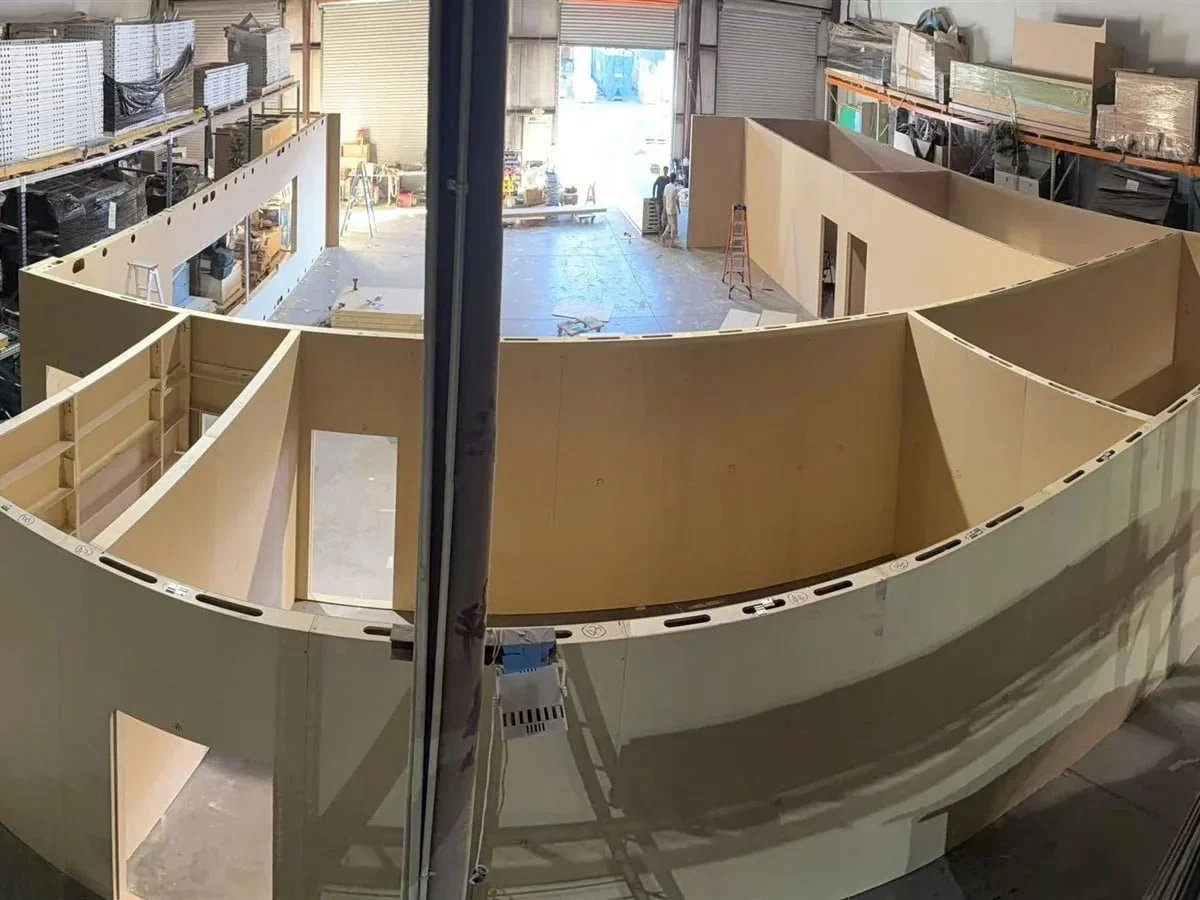
Pre-show assembly reference. Confirm whether a full assembly, selected component checks, or another review process is included in your project.
6. Why Work With a Las Vegas-Based Booth Builder?
Exhibitsmax’s Las Vegas operation brings design, fabrication, graphic production, and project coordination into one production workflow. Our Custom Booth Fabrication service includes capabilities such as woodworking, metalwork, finishing, and pre-show assembly, with the selected scope defined for each project.
For exhibitors coming to the United States, local production can provide an alternative to shipping an entire exhibit internationally. The right approach still depends on the design, product requirements, show location, and freight plan. For events outside Las Vegas, transportation and on-site execution need their own confirmed arrangements.
Real project reference: ZIG·ZAG at NACS 2021
The ZIG·ZAG 20×20 booth at NACS 2021 in Chicago combined distinct brand zones, wood-look structures, product shelving, and branded counters. The published case records design, visualization, fabrication, graphics, transportation, installation, dismantling, rental elements, storage, and pre-show assembly.
It is a useful reference for why a proposal should distinguish structural features, printed surfaces, rental items, and execution services. The case demonstrates delivered work; its contract prices and individual quote inclusions are not reproduced here.
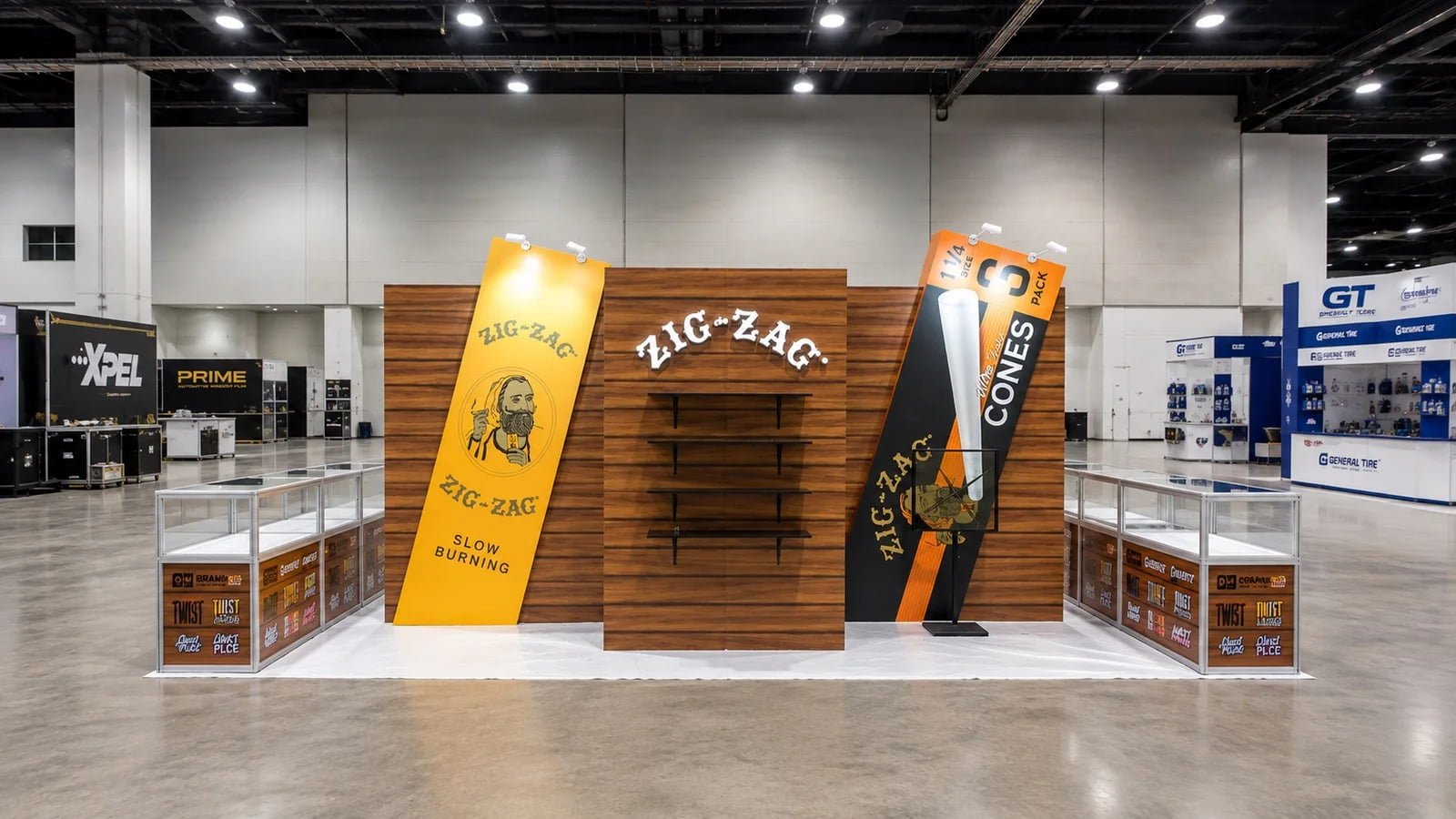
Completed project reference: ZIG·ZAG, NACS 2021, Chicago. Compare the project photographs and rendering for design context; final quoted specifications must always be confirmed separately.
7. Frequently Asked Questions
Can I request a custom booth quote before the design is finished?
Yes. Share the show, booth size, floor plan, functional requirements, equipment list, and target budget. Ask the builder to identify assumptions in the preliminary estimate and explain what must be confirmed before a detailed production quote can be issued.
Does “turnkey” mean every exhibition expense is included?
No. Treat turnkey as a description of the proposed delivery approach and request its written scope. The contract should identify included services, exclusions, allowances, and exhibitor responsibilities rather than relying on the word alone.
Do I own everything in a custom booth?
Not necessarily. The exhibit may combine purchased structures, rental equipment, and client-owned items. Confirm ownership, return obligations, packing, storage, and the cost of adapting the booth for future shows.
Can a final invoice differ from the original quote?
It can, depending on the agreement, approved changes, allowances, and actual-cost items. Ask for the basis and documentation for adjustments. Separately invoiced show services should also remain visible in your overall project budget.
Can an overseas exhibitor manage approvals remotely?
Yes, with an agreed communication and approval process. Identify the decision-maker, time zone, drawing and artwork versions, sign-off deadlines, and on-site contact. Confirm whether photographs, video reviews, or pre-show assembly updates are included in the project scope.
8. Get a Free Custom Trade Show Booth Quote
Planning a custom booth for an upcoming U.S. trade show? Our Las Vegas-based team can help you develop a booth solution based on your brand, exhibit size, and project requirements.
Share your show name, booth dimensions, design ideas, and timeline to receive a personalized consultation and detailed quote.