Last reviewed: October 11, 2026
Planning a booth at Phoenix Convention Center starts with three documents: your assigned floor plan, the current exhibitor service manual, and the venue requirements that apply to your project. Use them together to confirm design approvals, freight receiving, service providers, installation access, and the full project budget.
Start With Phoenix Convention Center Resources and Your Show Manual
Use the Phoenix Convention Center planning resources and official exhibitor information alongside your event's current service kit. Record the show name, year, assigned building or hall, booth number, and configuration before making design or shipping decisions.
| Source | What to confirm |
|---|---|
| Venue requirements | Building access, facility services, applicable fire and structural review, and restrictions affecting the assigned space |
| Show requirements | Booth configuration, height and sightline rules, approvals, receiving dates, move-in and move-out windows |
| Designated service providers | Who supplies each service, what work is restricted, order forms, rates, deadlines, and required drawings |
These responsibilities overlap. Phoenix Convention Center identifies exclusive arrangements for certain utilities and connectivity services. AV Concepts identifies itself as the venue's exclusive rigging provider. That does not make the general service contractor responsible for every service, or mean that every outside booth vendor can perform restricted work. Confirm the current ordering and approval process for your event. Phoenix exhibitor services, AV Concepts at Phoenix Convention Center.
For a concrete example, the Medtrade 2026 exhibitor manual listed Freeman, Commonwealth Electrical Company, Smart City, and AV Concepts separately. Its schedules and vendor instructions apply to that edition of Medtrade; they are not a standing timetable for all Phoenix events. Medtrade 2026 Exhibitor Services Manual, vendor directory and show planner.
If two documents appear to conflict, obtain written clarification from show management and the responsible provider before committing to fabrication or services.
Match the Booth Design to Your Assigned Space
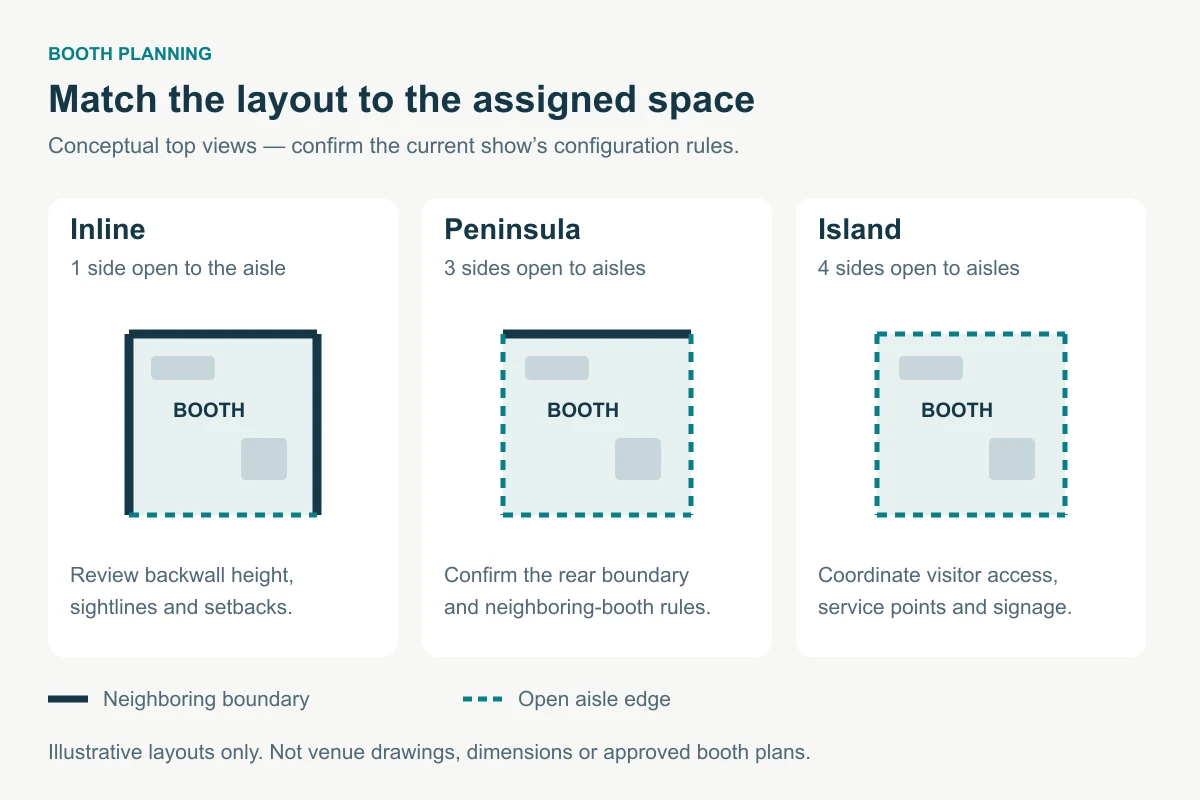
Booth configuration is an important planning factor. The final design also depends on the assigned space, product requirements, show rules, approvals, freight, and installation schedule. Square footage alone does not determine complexity.
| Configuration or feature | Design priorities | Confirm before production |
|---|---|---|
| Inline booth, such as 10×10 or 10×20 | Backwall, product visibility, staff access, and visitor space | Current height, sightline, setback, and neighboring-booth requirements |
| Peninsula booth | Open sides, rear boundary, and visitor circulation | The event's configuration-specific limits; do not assume island rules apply |
| Island booth, such as 20×20 or larger | Access from multiple aisles, product zones, meetings, and service locations | Sign eligibility, structural review, power distribution, and installation sequence |
| Double-deck or other complex structure | Structural design, access, occupancy, and assembly | Whether it is permitted, required engineering documents, review authorities, and approval deadlines |
A double-deck is a structural feature, not simply another open-side configuration. Missing approvals can delay production or prevent installation as designed. Establish the required submission process before fabrication begins.
For suspended elements, confirm both show permission and the provider's rigging requirements. The Phoenix Convention Center rigging policy from AV Concepts addresses drawings and rigging coordination; your sign design still needs to fit the event's rules and assigned location.
Build Your Planning Timeline Backward From the Show
Planning lead time depends on design approvals, production requirements, booth complexity, freight origin, and event deadlines. A simple rental exhibit may require less preparation than a large custom structure, international shipment, or double-deck project.
Use the following sequence as a planning framework. Enter the actual dates from your current exhibitor kit and confirmed supplier schedule.
| Stage | What to complete |
|---|---|
| Early planning | Confirm the space, project scope, budget, responsibilities, and required approvals |
| Design and technical review | Coordinate products, screens, graphics, furniture, power locations, and any suspended elements |
| Approval and production release | Complete required reviews and approve drawings, materials, artwork, and the production schedule |
| Advance service ordering | Submit complete orders and payment before each provider's applicable deadline |
| Pre-shipment | Confirm the receiving route, shipment dimensions and weight, labels, packing list, and carrier instructions |
| Move-in | Coordinate freight availability, utility work, rigging where applicable, booth assembly, and testing |
| Move-out | Confirm dismantling access, empty-container return, outbound paperwork, carrier check-in, and return destination |
Do not treat carrier arrival as confirmation that the booth crew can start. Receiving, delivery to the booth, and service availability are separate dependencies. Place contingency time around the unresolved steps in your actual installation plan.
Plan Freight and Material Handling Together
Material handling, commonly called drayage, covers freight receiving and movement under the event's designated service arrangements. It is separate from the carrier's transportation charge. The handling scope and charges can depend on shipment weight, handling classification, minimums, delivery timing, and other event-specific rate rules.
Some events permit limited hand-carry, personally operated vehicle (POV), or cartload delivery arrangements. Check eligibility, permitted equipment, access points, and charges in the current kit before selecting one. Driving materials to the venue does not automatically establish a fee exemption or permission to unload them yourself.
Advance warehouse or direct-to-show?
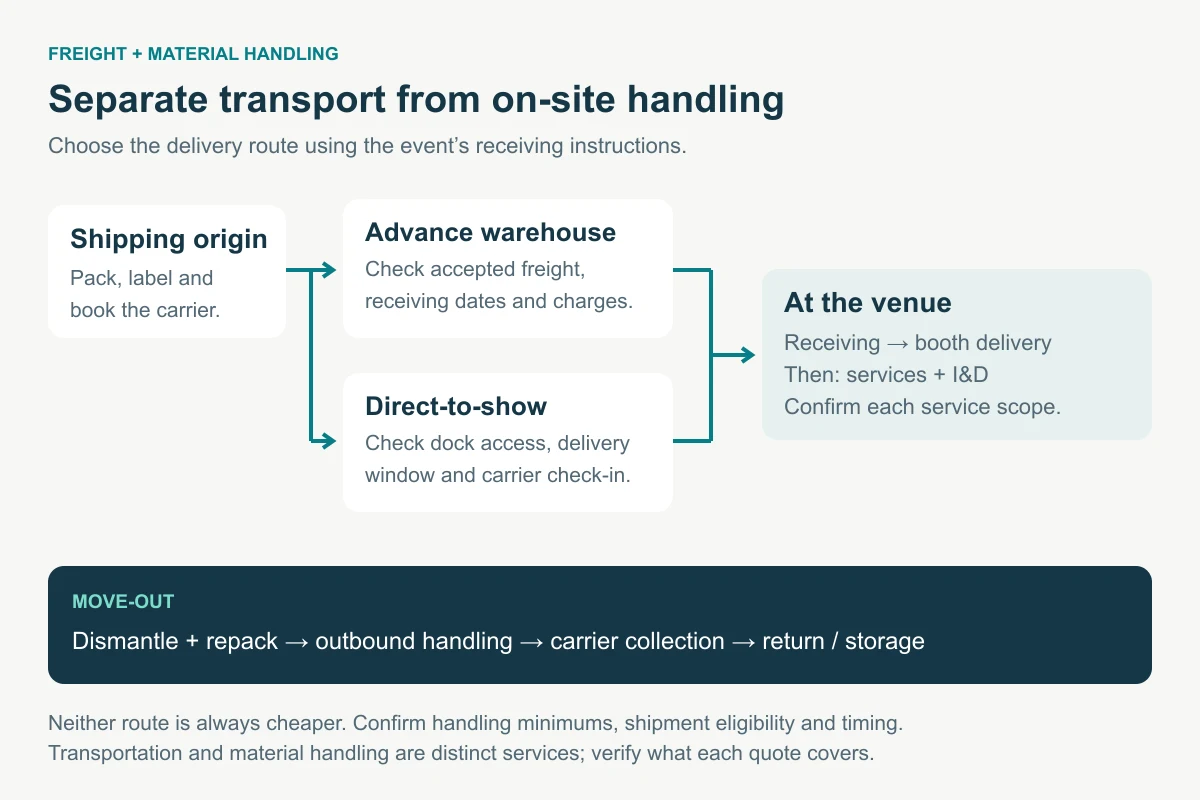
Choose the route using the show's receiving instructions, freight characteristics, carrier capability, and installation plan. An island booth does not automatically require advance warehouse delivery, and neither route is always cheaper.
Compare receiving dates, shipment restrictions, handling charges, transport costs, and the consequences of a missed delivery window. Ask when the freight is expected to reach your booth, not just when the truck reaches its destination.
Phoenix Convention Center states that it cannot accept shipments on clients' behalf and directs exhibitors to their event shipping instructions. Do not use the building's street address as a freight destination without the correct event-specific instructions. Dock access and unloading times also require event coordination. Official Phoenix Convention Center shipping and dock information.
Use Exhibit Transportation Services to coordinate the shipment plan, while confirming official material-handling terms with the event's designated contractor. Plan outbound collection and return or storage at the same time as inbound delivery.
Confirm Service Responsibilities and the Full Budget
Separate the booth supplier's scope from carrier charges and show-service orders. A proposal described as turnkey still needs clear inclusions, exclusions, and responsibility for third-party charges.
Service orders: what should you verify?
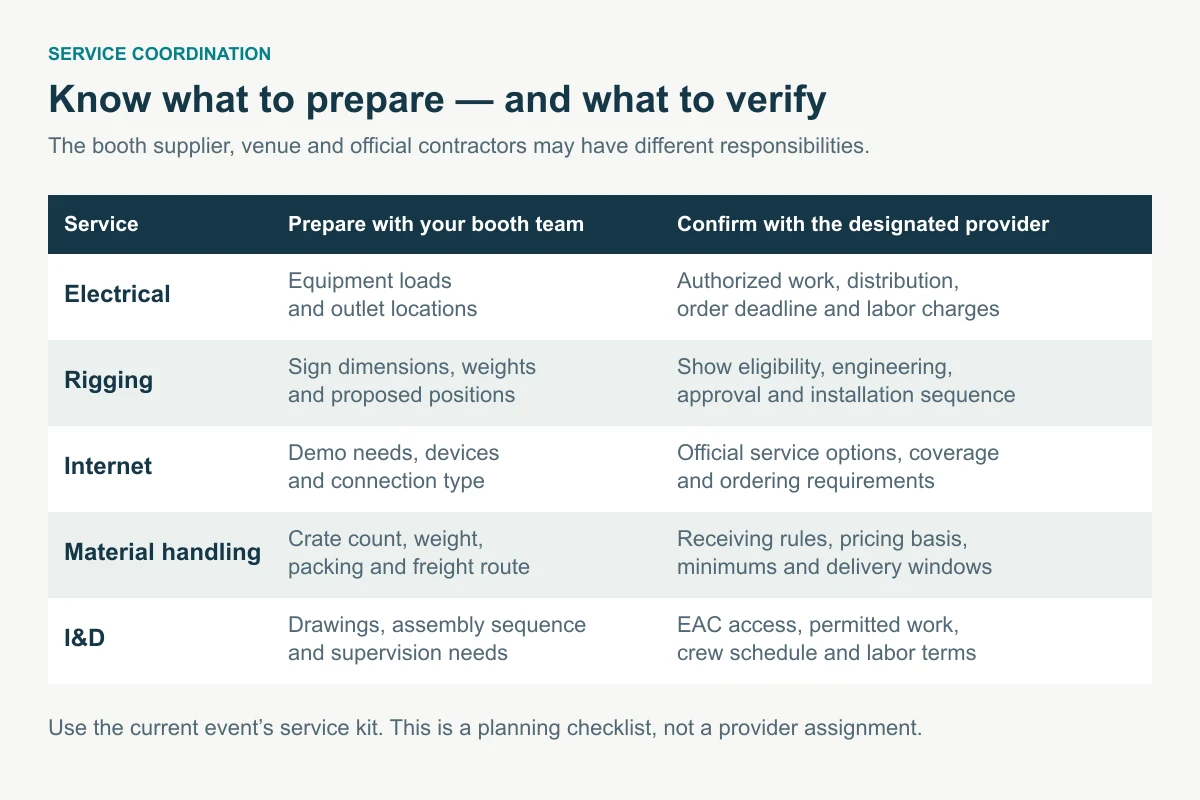
| Service | What to confirm |
|---|---|
| Electrical | Authorized provider, equipment loads, voltage, power locations, distribution work, and order deadline |
| Rigging | Show eligibility, drawing and engineering requirements, authorized provider, approval process, and installation sequence |
| Internet | Official provider, connection type, device requirements, service coverage, and order deadline |
| Material handling | Receiving instructions, handling scope, pricing basis, minimums, classifications, and delivery windows |
| Installation and dismantling (I&D) | Exhibitor-appointed contractor (EAC) requirements, permitted work, crew access, supervision, and labor terms |
| AV, furniture, and cleaning | What the booth quote includes, what must be ordered separately, and any provider restrictions |
Ask the installer to separate assembly work from electrical, rigging, and material handling. Do not assume a hired crew is authorized to perform every task. Review the scope with your Installation & Dismantling team.
Compare costs on the same basis
Budget for design and fabrication or rental, graphics, furniture and AV, inbound and outbound transportation, material handling, installation and dismantling, utilities, storage, and applicable taxes or fees. Assign each item to one responsible party to avoid omissions and duplicate allowances.
Missing advance-order deadlines may lead to higher standard or on-site rates. Use each provider's published schedule rather than a universal surcharge percentage. Likewise, check labor minimums, straight-time, overtime, and any double-time provisions in the applicable order form; the billing periods cannot be inferred from the city alone.
Set a project-specific contingency based on unresolved design decisions, freight risks, labor requirements, supplier terms, and current service rates. There is no single percentage appropriate for every exhibit. Compare these categories with the Trade Show Booth Cost Guides before approving your project budget.
Real Phoenix Example: Nira at CLEANPOWER 2025
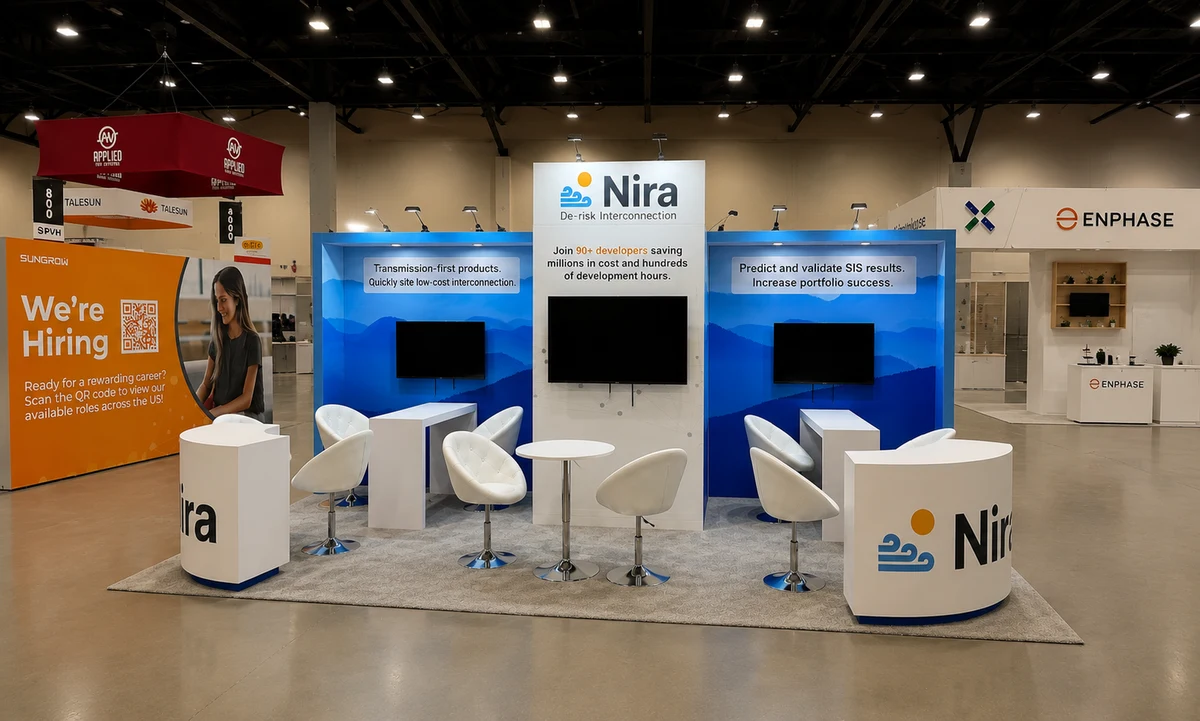
Exhibitsmax's published Nira CLEANPOWER 2025 project documents a 10×20 booth at Phoenix Convention Center. Three screens across the backwall supported software presentations. Curved branded counters at the front ends and white meeting furniture created space for visitor conversations within the 200-square-foot footprint.
The documented scope included design, fabrication, graphics, transportation, installation, rental elements, storage, dismantling, and pre-show assembly. The project combined custom components with rental elements.
For a similar exhibit, confirm screen power and connections, seating clearance, counter positions, packing, and the installation sequence before production. These are planning considerations for a future project; they do not establish that project's service rates or approval requirements.
Explore more 10×20 booth designs and project examples or review our Phoenix trade show booth rental and exhibit services.
Questions to Ask Your Phoenix Booth Supplier
Before approving the proposal, ask for clear answers to five questions:
- Which completed projects support the proposed approach? Review comparable layouts, production details, and documented service scope.
- Who reviews the manual and tracks approvals? Identify who owns each submission and what must be resolved before production.
- Who coordinates freight and show services? Separate transport booking, handling orders, electrical, rigging, and I&D responsibilities.
- Who supervises move-in and move-out? Confirm the contact, scope, access arrangements, and process for resolving site issues.
- How are changes approved and billed? Require written scope and cost approval for revisions, additional labor, or changed logistics.
The production schedule should support the selected receiving route and installation window. It should not assume advance warehouse delivery when another route has been agreed.
Frequently Asked Questions
How early should I start planning a Phoenix Convention Center booth?
Start when your participation and space are sufficiently defined to establish scope. Work backward from the actual approval, receiving, and move-in dates. Complex structures, international freight, and specialized equipment need more preparation than a simple rental display; confirm feasibility with the suppliers involved.
Can I install my own booth?
Check the current show's exhibitor-work rules and venue restrictions. Some work may be permitted, while other tasks require authorized contractors. Confirm the exact work, tools, and personnel allowed before deciding that professional installation is unnecessary.
Can I avoid material-handling charges by bringing materials myself?
Not automatically. The event may offer a qualifying hand-carry, POV, or cartload arrangement, but eligibility and charges vary. Obtain the applicable instructions and confirm whether your shipment and delivery method qualify before arrival.
Does an island booth have to ship through the advance warehouse?
No blanket rule follows from the booth configuration. Choose warehouse or direct-to-show delivery according to event instructions, shipment requirements, receiving windows, and the installation schedule.
Who should answer questions about rules or conflicting instructions?
Start with show management for booth rules and event schedules. Ask venue representatives about facility requirements and the named provider about its service scope and ordering terms. If their instructions differ, request written clarification involving the responsible parties before committing to the work.
Plan Your Phoenix Convention Center Booth
Send Exhibitsmax your show name, hall, booth number, dimensions, floor plan, design requirements, receiving dates, and target budget. Our Las Vegas team can help coordinate booth production, transportation, and installation planning around your Phoenix event's requirements.
Request a Phoenix Booth Planning Review →
Official resources checked October 11, 2026. Confirm the current exhibitor kit and provider instructions for your specific show.