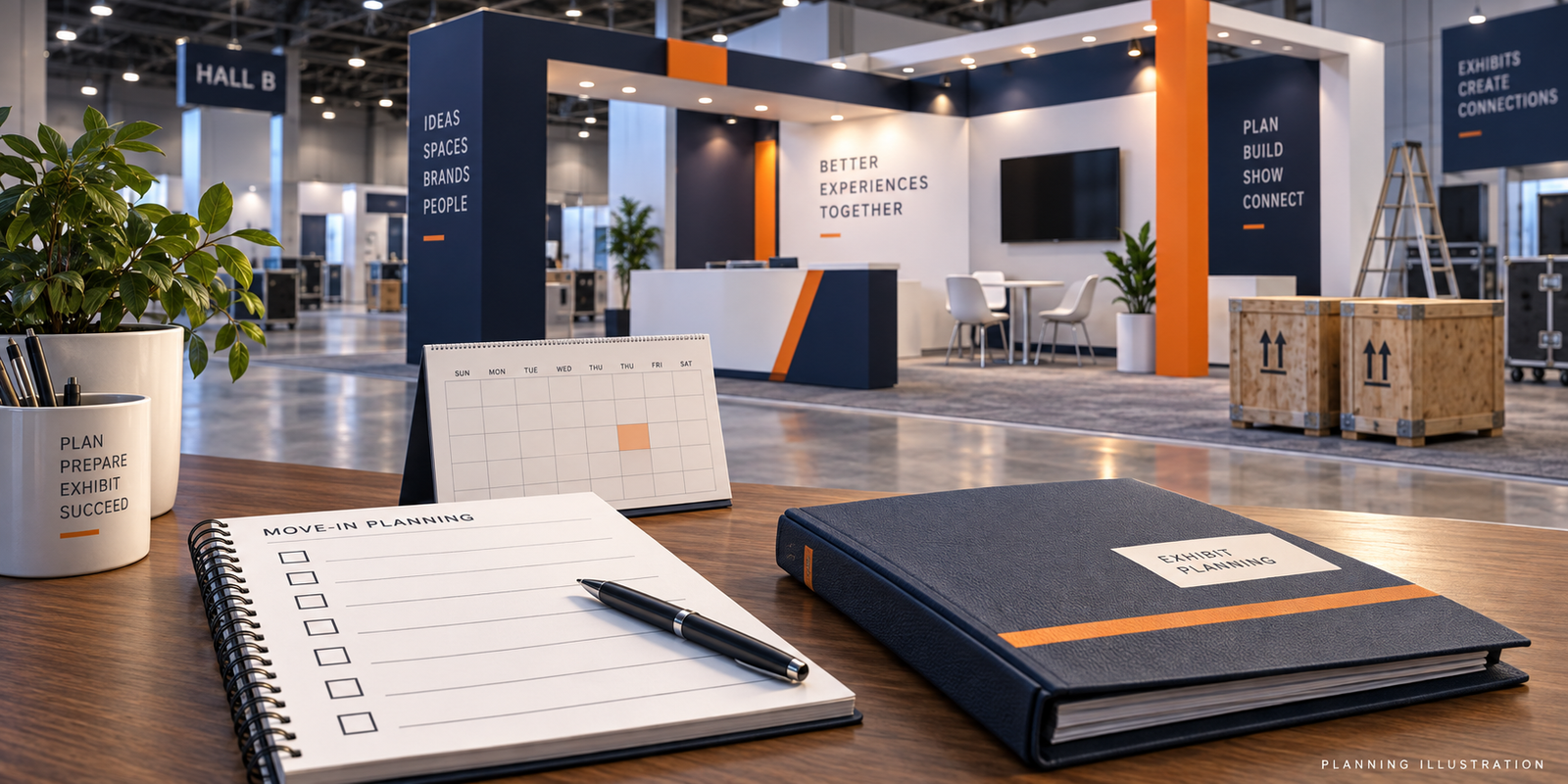
Many U.S. trade shows require exhibitors to carry insurance and provide evidence of coverage. Start with your current exhibitor manual: confirm the coverage, insured entities, dates, and submission process, then ask your insurance agent or broker to arrange the required documentation before move-in.
Trade Show Insurance at a Glance
“Trade show insurance” is not one universal policy. For move-in planning, separate the show’s insurance requirements from the documents used to demonstrate compliance.
| Item | What to confirm | Who can resolve it |
|---|---|---|
| Required coverage | Policy types, limits, and conditions for your event and activities | Organizer and insurance agent or broker |
| Certificate of Insurance (COI) | Accepted format and accurate policy information | Insurance agent or broker |
| Additional insured status | Exact entities and required policy endorsements | Insurance agent or broker, using organizer instructions |
| Coverage period | Required move-in, show, and move-out dates | Organizer and insurance agent or broker |
| Submission | Deadline, portal or recipient, and review procedure | Show management |
| Contractor paperwork | Separate exhibitor-appointed contractor (EAC) registration and insurance requirements | Contractor and show management |
Use this guide to organize the process. Your insurer or licensed broker should confirm coverage; show management should confirm whether your documentation meets its requirements.
Does Your Booth Fee Include Insurance?
Do not assume that paying for exhibit space satisfies your insurance obligations. Check the exhibitor contract and any insurance program offered by the organizer before buying additional coverage or assuming you are already covered.
Space rental, electrical service, material handling, and insurance are different items. Their inclusion depends on your package and contracts. Even a turnkey booth quote should identify which responsibilities remain with the exhibitor.
For a specific example, the ASE 2026 exhibitor COI terms state that exhibitors must arrange insurance at their own expense and that the listed organizer and contractors do not insure exhibiting companies’ property or personnel. Those are that event’s terms, not a universal rule for every U.S. show.
Ask two separate questions: What coverage do I need, and what proof must I supply? A payment receipt, booth contract, or contractor’s certificate does not answer both.
Which Coverage and Limits Should You Check?
Use the current event’s requirements rather than a generic minimum-limit table. The relevant coverage can depend on your employees, vehicles, products, demonstrations, and other activities—not just booth size.
| Coverage category | Question to send your agent or broker |
|---|---|
| Commercial general liability (CGL) | Does the policy meet the show’s limits and cover the planned booth activities, subject to its terms and exclusions? |
| Workers’ compensation | What coverage is required for the staff working at this event under applicable law and the event contract? |
| Employers liability | What limit does the event require, and does the policy meet it? |
| Automobile liability | Do the show’s requirements apply to the vehicles and delivery arrangements we will use? |
| Umbrella or excess liability | Is this required, and how must it interact with the underlying policies? |
| Exhibit property or transit coverage | How are our displays, samples, and equipment protected during transport, storage, and the event? |
A Verified Example: AAPEX 2026
The AAPEX 2026 Exhibit Regulations, Section 11.J specify CGL limits of $1 million per occurrence / $2 million general aggregate, workers’ compensation under Nevada law with employers liability of at least $1 million, and $1 million commercial automobile liability per accident. They also specify additional insured entities and other policy conditions, with the COI available upon request.
These figures illustrate a named event’s requirements; they are not national minimums or recommended coverage limits for every exhibitor. Send the complete current requirements to your agent rather than copying only the dollar amounts.
What Does a COI Actually Prove?
A Certificate of Insurance summarizes insurance information. It does not create coverage or change the underlying policy. New York’s insurance regulator explains this distinction in its guidance on the use of certificates of insurance.
If coverage is insufficient, requesting a certificate with a higher number is not the solution. Your agent must determine whether the policy needs an approved change, an endorsement, or another insurance arrangement before issuing evidence that accurately reflects it.
Certificate Holder and Additional Insured Are Different
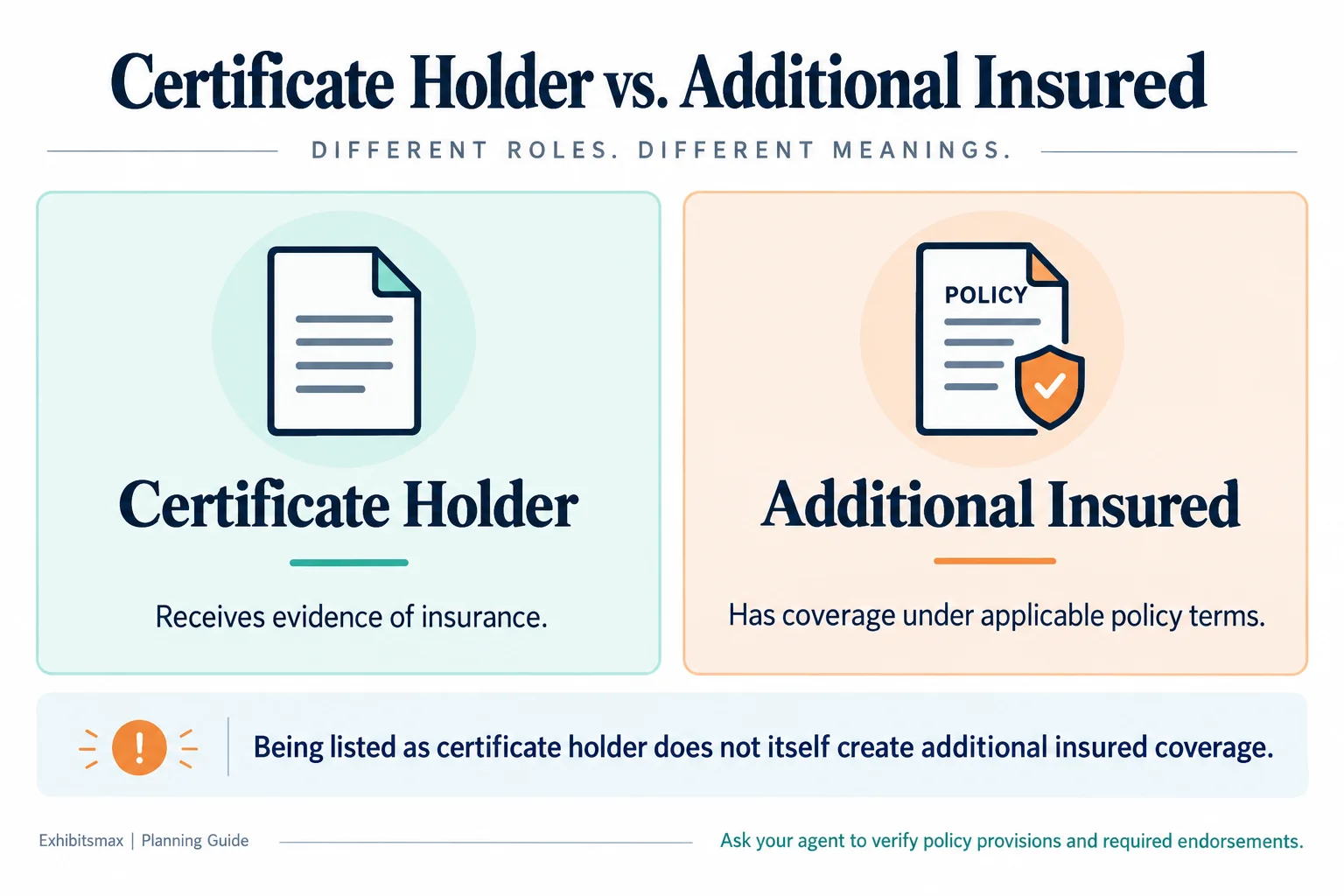
The certificate holder receives evidence of insurance. Additional insured status concerns coverage under the policy. Listing an organizer in the certificate-holder field does not, by itself, establish that it has the required additional insured coverage.
Give your agent the exact legal names and the full insurance instructions. Ask the agent to verify the applicable endorsement or existing policy provision and provide supporting documentation if required. Do not shorten entity names or assume the venue is the only party to list.
Check More Than the Public Show Dates
Compare policy dates with the entire period required by the event, including setup and dismantling. For example, ASE 2026 expressly required coverage through its June 24–30 move-in and move-out period and required exhibitor and EAC certificates to be available in the booth. Check the dates for your own event rather than reusing this historical example.
Can an Existing Business Policy Work for a U.S. Trade Show?
It may, but ask your agent or broker to review the actual event and activities. A business policy issued outside the United States should not be assumed to cover a U.S. exhibition simply because the company participates internationally.
Send the agent your show name, venue, exhibitor legal entity, setup and teardown dates, planned demonstrations, staffing arrangements, and the organizer’s insurance requirements. Ask:
- Does the policy respond to the planned U.S. operations and relevant claims jurisdiction?
- Are the required limits and policy conditions satisfied?
- Are any exclusions relevant to product demonstrations or other planned activities?
- Is the required additional insured coverage already in place, or is an endorsement needed?
- Can the agent provide the accepted certificate format and any requested endorsements?
- How long would a policy change or corrected document take?
Confirm whether ACORD 25 or another format is accepted. An accepted form does not establish that the coverage shown on it is sufficient.
If your policy cannot meet the requirements, discuss alternatives with your agent or the organizer’s designated insurance provider. Verify eligibility, covered activities, dates, exclusions, and documentation before purchasing an event policy.
How Should You Coordinate Insurance With Move-In?
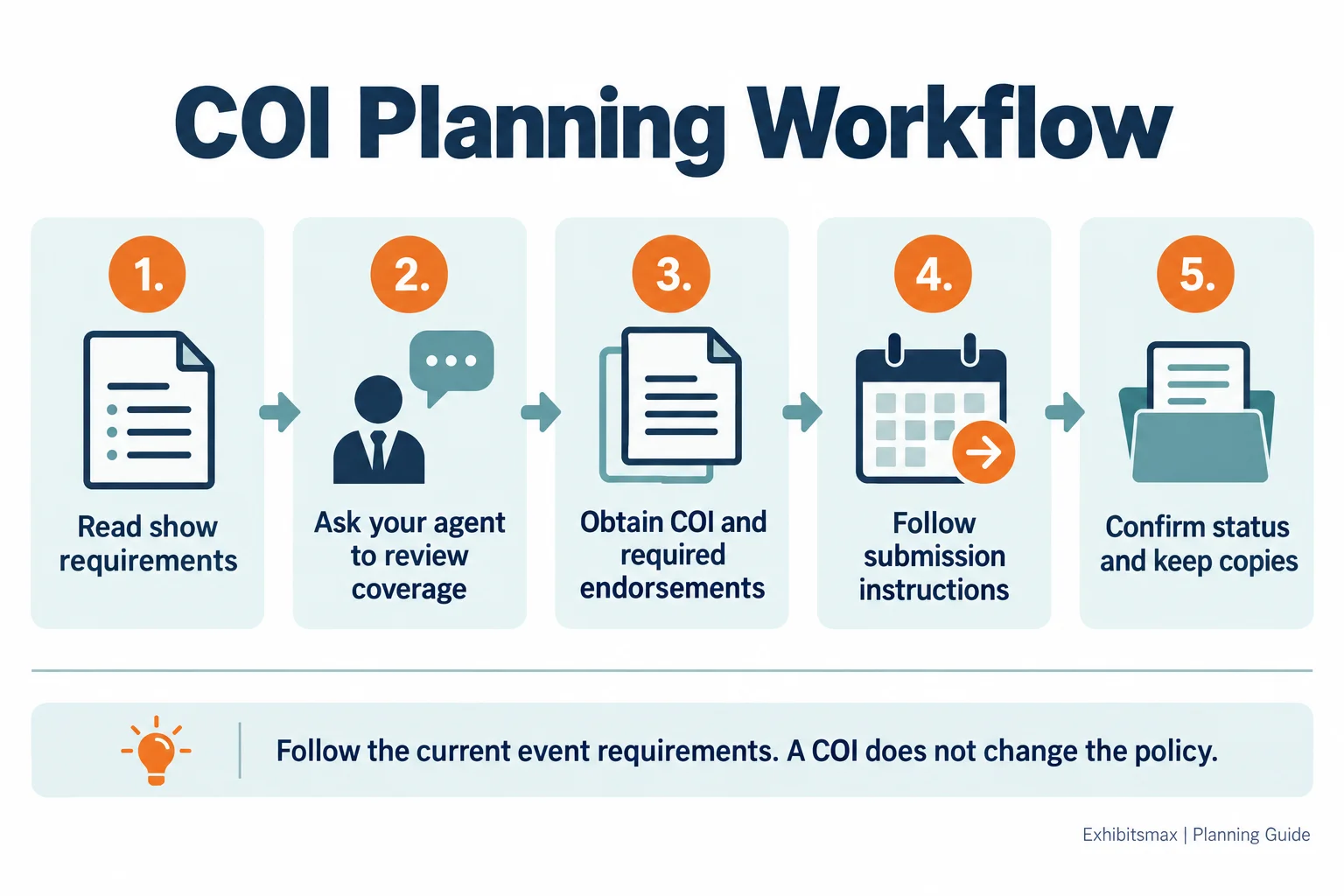
Put insurance documentation on the same schedule as freight, service orders, and installation. Where show rules make insurance compliance a condition of access or participation, an unresolved issue can disrupt the setup plan. The organizer’s actual enforcement procedure governs; a missing certificate does not trigger the same consequence at every show.
Use a simple workflow:
- Collect the requirements. Save the current manual, insurance instructions, and submission details.
- Assign an owner. One exhibitor contact should coordinate with the insurance agent and organizer.
- Arrange coverage and evidence. Allow time for any necessary policy changes, not just certificate preparation.
- Follow the submission procedure. Upload or send documents by the stated deadline, or keep them available when the rules require production on request.
- Confirm status. Distinguish “sent” from “accepted” when the event uses a review process.
- Share operational updates. Tell the booth project manager whether any outstanding requirement could affect installation access.
Keep exhibitor and contractor obligations separate. Your booth builder may have its own EAC registration, insurance, and access requirements; its documentation does not automatically satisfy yours. Agree who submits each item rather than assuming one party handles everything.
At Exhibitsmax, we can help coordinate the booth installation schedule and project dependencies within the agreed scope. Coverage decisions and insurance documentation should remain with your agent and the organizer’s review process. See our installation and dismantling services and booth planning timeline guide for the wider execution plan.
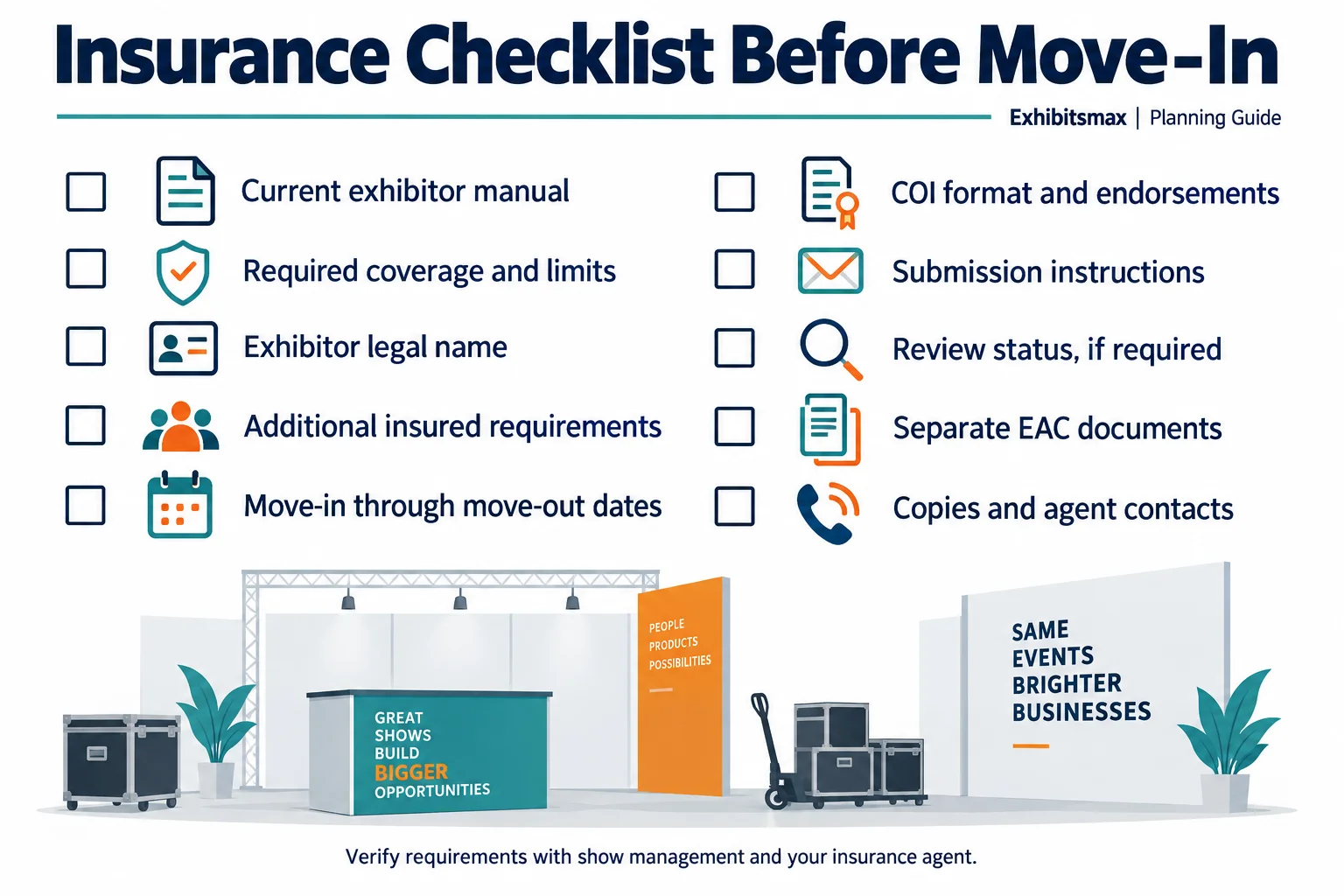
Trade Show Insurance Checklist Before Move-In
| Check | What to verify |
|---|---|
| Exhibitor manual | Locate the current insurance section and any updates |
| Coverage limits | Have your agent match the event’s exact requirements |
| Insured entity | Confirm the correct exhibiting company’s legal name |
| Additional insureds | Use the required legal names and verify supporting policy coverage |
| Policy dates | Include the required move-in through move-out period |
| COI format | Confirm the accepted certificate format and requested endorsements |
| Submission | Follow the deadline and delivery or on-request procedure |
| Confirmation | Verify acceptance when review is required; resolve outstanding corrections |
| EAC documents | Check the contractor’s separate registration and insurance status |
| Backup | Keep accessible copies and agent contact details for move-in |
Planning the Rest of Your Move-In?
Use the insurance checklist above alongside our Trade Show Booth Planning Checklist to organize your booth preparation. Track electrical orders, material handling, warehouse deadlines, I&D labor, graphics, freight labels, and move-out arrangements as separate tasks.
Download the Free Trade Show Booth Planning Checklist →
Frequently Asked Questions
How early should I arrange trade show insurance?
Review requirements when you book the event, then check the current manual when available. Work backward from the organizer’s deadline and your agent’s processing time, allowing for corrections or policy changes. There is no universal two-week or four-week deadline.
Can a short-term event policy replace my business policy?
It may address specific event requirements, but it is not automatically a substitute for every coverage your business needs. Ask a licensed agent to compare the event policy with your operations, existing coverage, and the complete show requirements.
Does a small or portable booth avoid insurance requirements?
Do not assume an exemption based on booth size or self-installation. Check the event contract and ask show management whether an exception applies to your situation. Keep any exception confirmation in writing.
What should I do if my COI is rejected?
Request the specific reason from show management and send it to your agent. The fix may involve accurate documentation, an endorsement, or an actual coverage change. Resubmit through the required process and confirm the review status.
Does exhibitor liability insurance cover damaged freight or stolen products?
Do not assume it does. Ask your agent to distinguish liability coverage from protection for your own exhibits, samples, and equipment in transit, storage, and on-site. Confirm deductibles, exclusions, and claim procedures for the relevant policy.
Can my booth builder handle the COI submission?
A project coordinator may assist with document delivery if authorized and accepted by the organizer. That assistance does not replace coverage review by your agent or transfer the exhibitor’s contractual obligations. Confirm responsibilities separately for the exhibitor and EAC.
Need Help Coordinating Your U.S. Trade Show Move-In?
Share your show, venue, booth size, move-in schedule, and outstanding documentation or service-order tasks. Exhibitsmax can help coordinate booth planning, freight, and installation dependencies within the agreed project scope while your insurance agent handles coverage.