Exhibitsmax Logo
EXHIBITOR GUIDE

What Is Drayage? Common Mistakes Foreign Exhibitors Make

Published on August 10, 2026
What Is Drayage? Common Mistakes Foreign Exhibitors Make

Drayage is the venue-mandated “last mile” material handling inside U.S. trade shows. Many foreign exhibitors underestimate it, then get hit with surprise invoices and delays. The problem grows when budgets rely on general freight costs alone. The fix is clarity: understand how drayage works, why it’s unavoidable, and how to plan it into your program.

Drayage at U.S. trade shows is the mandatory, venue-controlled material handling service that moves your freight from the marshaling yard or advance warehouse to your booth, stores empties during the show, and returns freight for move-out. It is separate from international forwarding and cannot be bypassed1; smart planning focuses on budgeting accurately and avoiding surcharges.

trade show drayage explained at US venues with material handling and marshaling yard

Most exhibitors only discover drayage when bills arrive or deliveries stall. I want to prevent that. Below, I break down the process, cost mechanics, critical timeframes, and practical tactics I use with international clients. The goal is simple: fewer surprises, cleaner budgets, and smoother show days.

How does Drayage work at U.S. trade shows?

Drayage feels opaque because it sits between your freight forwarder and your booth. When the chain breaks, everything else backs up. The stress spikes at check-in, during targeted move-in, and at move-out. The cure is a clear map of the process, the players, and who controls what on site.

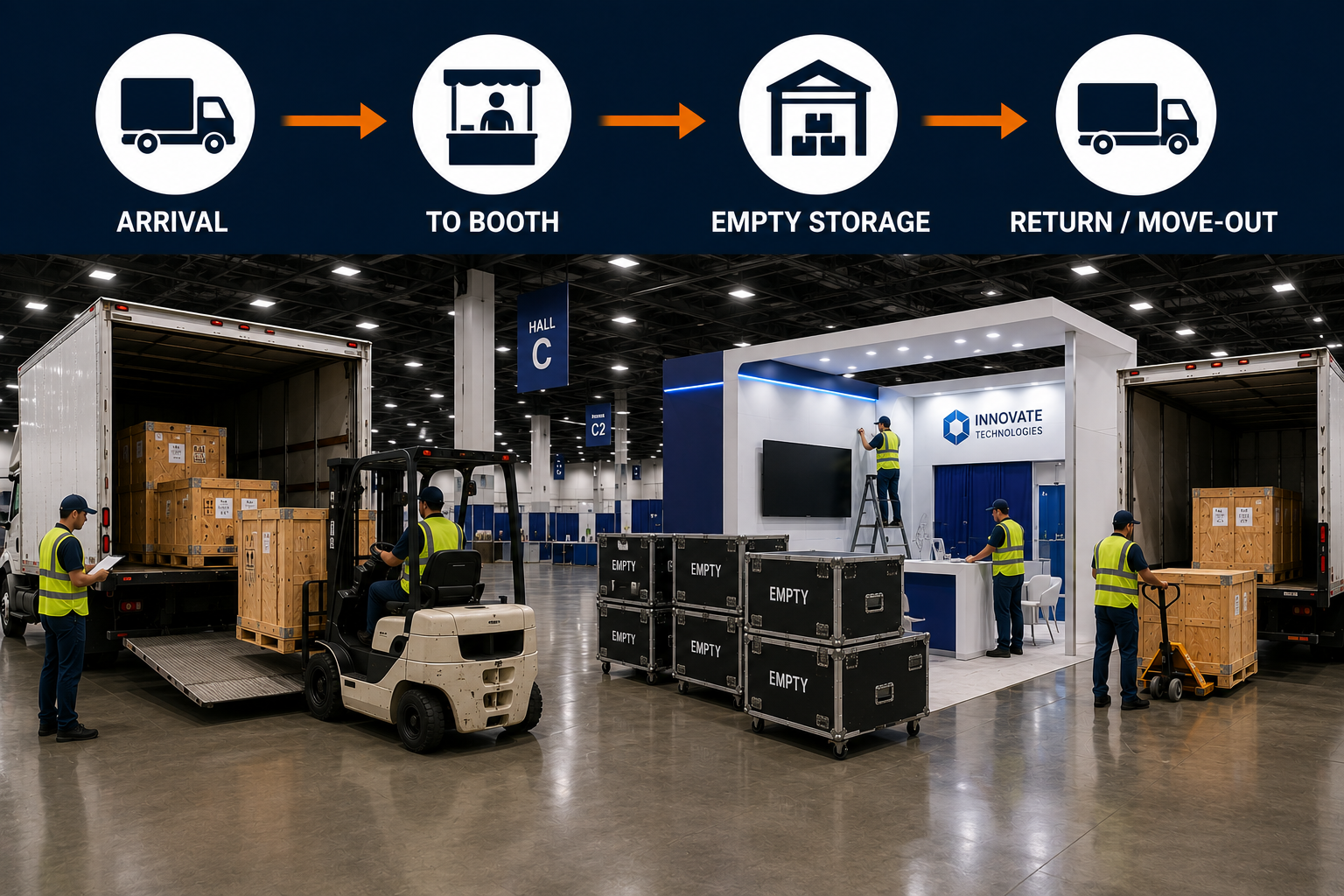
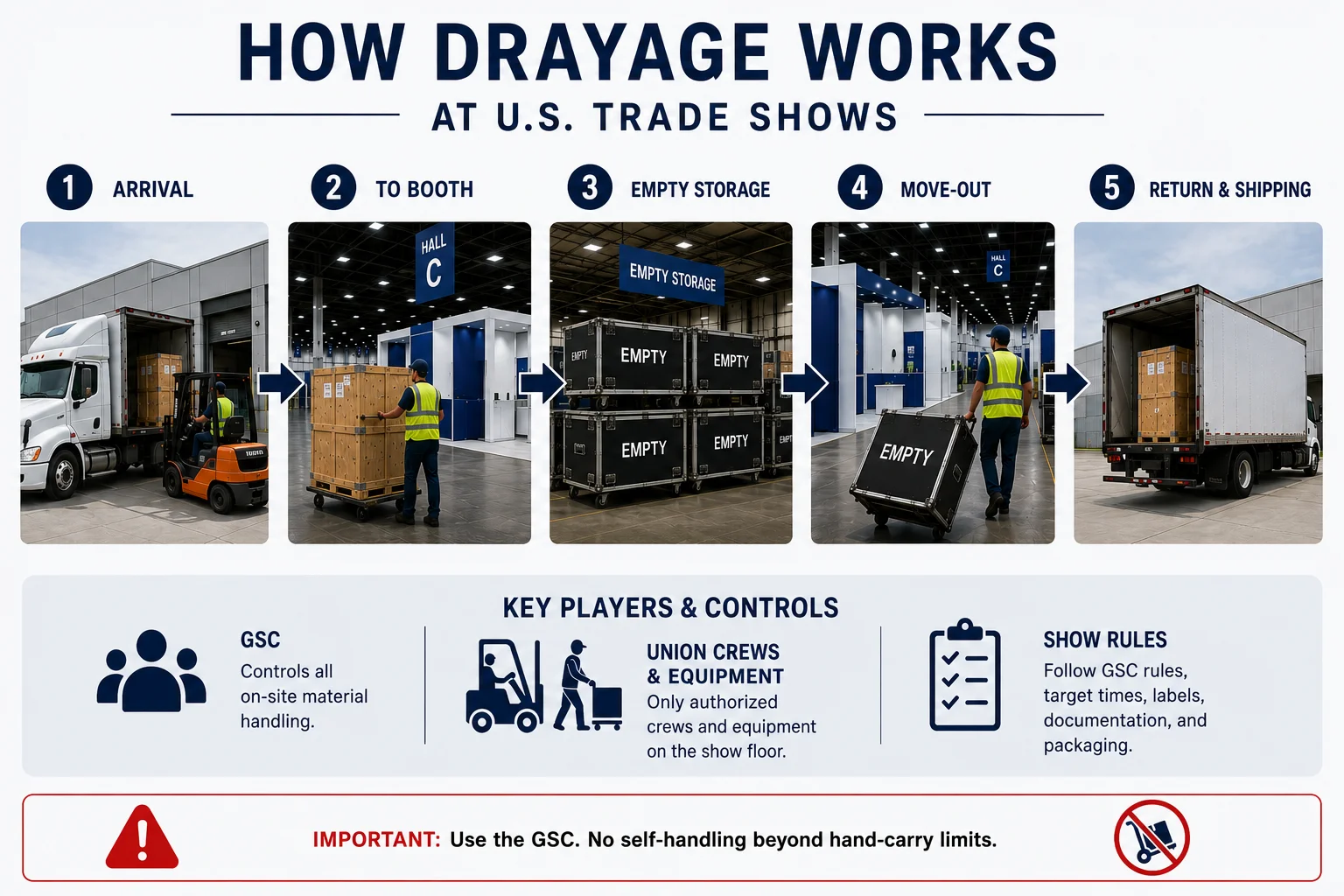
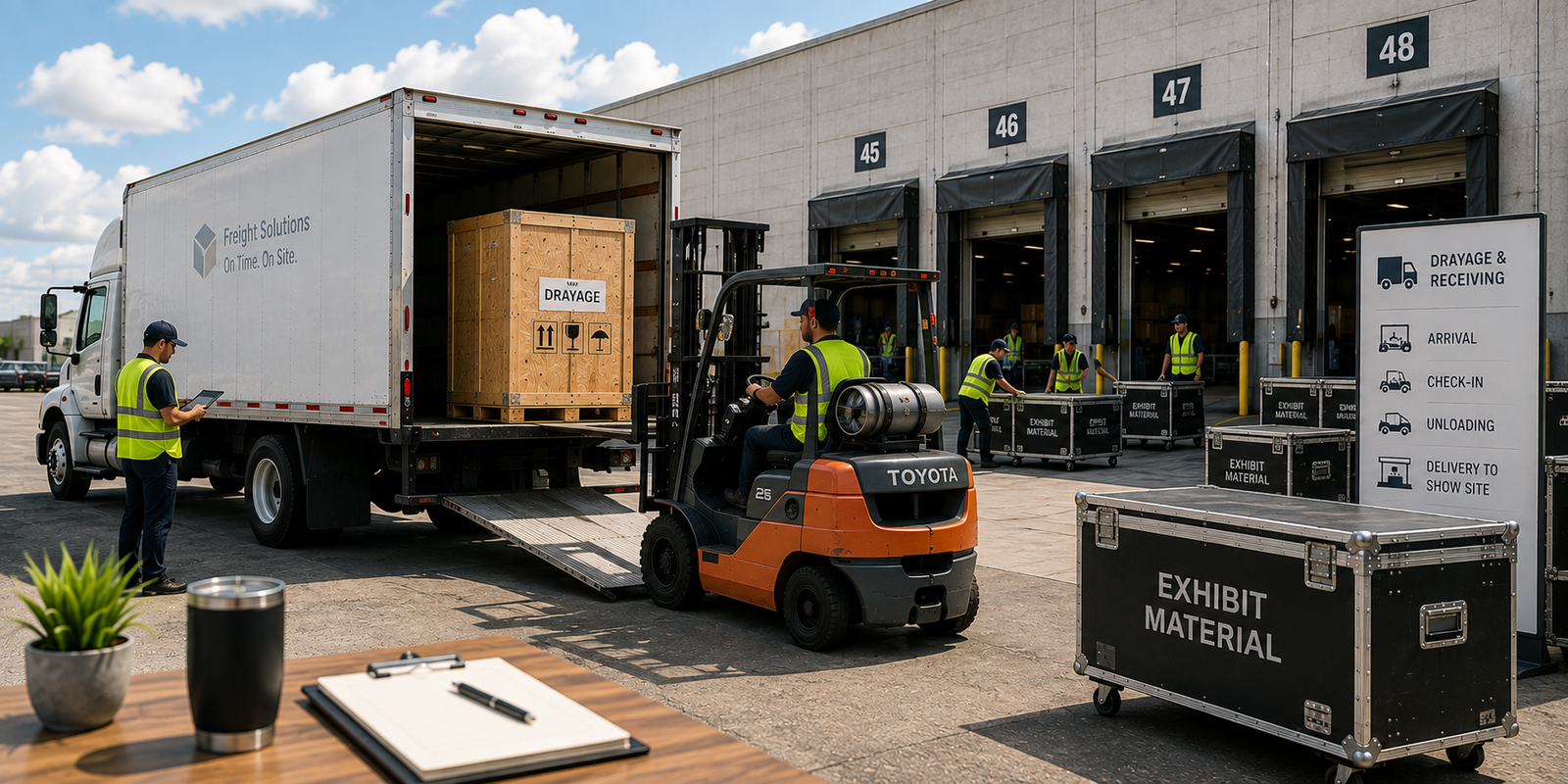
Drayage transfers freight within the show ecosystem: from the marshaling yard or advance warehouse to your booth, with empty-crate storage and return, then to the carrier at move-out. The general service contractor (GSC) controls it, using union crews and specific rules. You cannot self-handle beyond strict hand-carry limits.2

drayage process flow from warehouse to booth with empty return

The drayage flow, simplified

  • Advance receiving or direct-to-show-site
  • Check-in at the marshaling yard (for trucks)
  • Freight acceptance at dock and staging
  • Delivery to booth (material handling)
  • Empty crate pickup, tagged and stored
  • During show: accessible storage if needed
  • At close: empty return, repack, outbound
  • Freight release with Material Handling Agreement (MHA)
  • Carrier pickup at dock; forced freight3 if not released properly

Key roles and documents

  • General Service Contractor (GSC): Freeman, GES, or similar. They control drayage, docks, and labor.4
  • Exhibitor-Appointed Contractor (EAC): Your own installer, separate from the GSC.
  • Freight Forwarder/Carrier: Handles transport to/from city.
  • Marshaling Yard: Staging for trucks awaiting dock times.
  • Material Handling Agreement (MHA): Your outbound release.
  • Bill of Lading (BOL): Shipment documentation from/to carriers.

Practical notes from the floor

I once had a European client arrive with multiple loose cartons and no skids. We re-palletized at the advance warehouse, avoiding a “special handling” surcharge on site and saving a full day of chaos.

Why is Drayage mandatory and how is it different from freight forwarding?

Many teams assume drayage is negotiable or part of freight. It is neither. Confusion grows when international forwarders quote door-to-door, then stop at the show’s receiving dock. The pain point is the handoff. The solution is understanding scope and control.

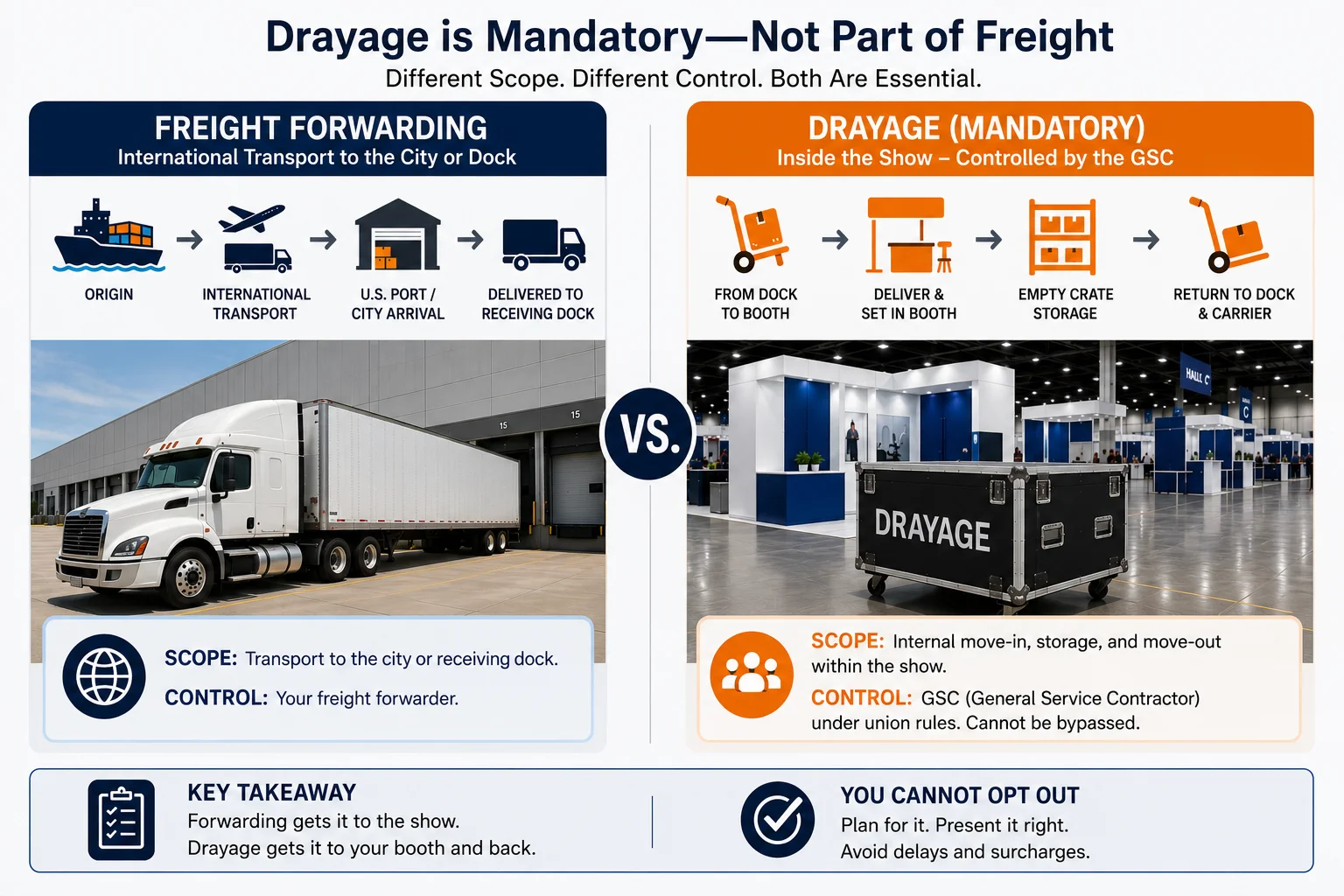
Drayage is a venue-specific material handling service governed by the show’s GSC and union rules. Freight forwarding covers transport to the city or dock. Drayage covers internal movement, storage, and return. You cannot opt out, but you can plan for it and optimize how freight is presented.

difference between drayage and freight forwarding at trade shows

Drayage vs. freight forwarding: scope and control

  • Freight forwarding:
    • International and domestic transport
    • Customs clearance (e.g., ATA Carnet), routing, line-hauls
    • Delivery to advance warehouse or show site
  • Drayage (material handling):
    • Acceptance at dock or warehouse
    • Delivery to booth
    • Empty storage and return
    • Outbound staging and handoff to carriers

Why mandatory? U.S. venues centralize safety, union labor, and dock operations under the GSC to control congestion, liability, and floor coordination. Hand-carry exceptions are narrow (usually what one person can carry in one trip without dollies).8 Everything else goes through drayage.

I remind clients: “The truck reaching Las Vegas isn’t the finish line; it’s halftime. Drayage owns the second half.”

How are Drayage costs calculated and what drives surcharges?

Sticker shock is common because drayage pricing rarely matches general freight logic. The obvious variable is weight, but that’s only the starting point. The hidden variables are classification, timing, minimums, and how your shipment is presented on the dock.

Drayage uses CWT (hundredweight) with minimums per shipment.9 Rates vary for advance vs. direct, straight-time vs. overtime, and “special handling” or “uncrated” classifications. Surcharges apply for late arrivals, small-package accumulations, and off-target deliveries. Optimize by consolidating, crating, and meeting target windows.

drayage cost factors cwt special handling overtime surcharges

Common drayage rate components

Factor Typical Range/Rule Impact on Cost
Base CWT Rate (Advance) ~$110–$180 per 100 lbs Predictable; includes storage before show
Base CWT Rate (Direct-to-Show) ~$95–$160 per 100 lbs Lower than advance but higher risk of target misses
Minimum Charge 200 lbs per shipment10 Each delivery under 200 lbs billed as 200 lbs
Special Handling +20% to +40% Applied to loose, mixed, or poorly packaged freight
Uncrated +40% to +60% Applied to pad-wrapped or machinery not fully crated
Overtime/Double Time +30% to +100% Applies to deliveries outside straight-time hours11
Small Package Handling Flat per carton or 200-lb minimum Multiple parcels can multiply minimums
Late to Advance +10% to +30% Missed deadline to warehouse increases rate
Reweigh/Correction Variable If declared weight is off, expect adjustments

Note: Actual rates are set per show by the GSC; always verify in the exhibitor manual.

A quick example

  • Two skids, each 450 lbs, advance warehouse, straight-time, crated:
    • Billable weight: 900 lbs = 9 CWT
    • $140/CWT x 9 = $1,260
  • If misclassified as special handling (+30%):
    • $1,260 x 1.30 = $1,638
  • If delivered during overtime (+40%):
    • $1,638 x 1.40 = $2,293
  • If shipped as nine small parcels (9 x 45 lbs):
    • Each hits 200-lb minimum: 9 x 2 CWT x $140 = $2,520 (before surcharges)

I have prevented five-figure surprises by consolidating materials upstream and shifting delivery to straight-time windows. It is rarely glamorous work, but it pays off.

What timelines and documents control Drayage — and where do exhibitors stumble?

Delays and “forced freight” usually trace back to missed windows or incomplete paperwork. The worst outcomes happen when inbound arrives outside target times or outbound releases are mishandled. The best defense is a simple, disciplined timeline and document checklist.

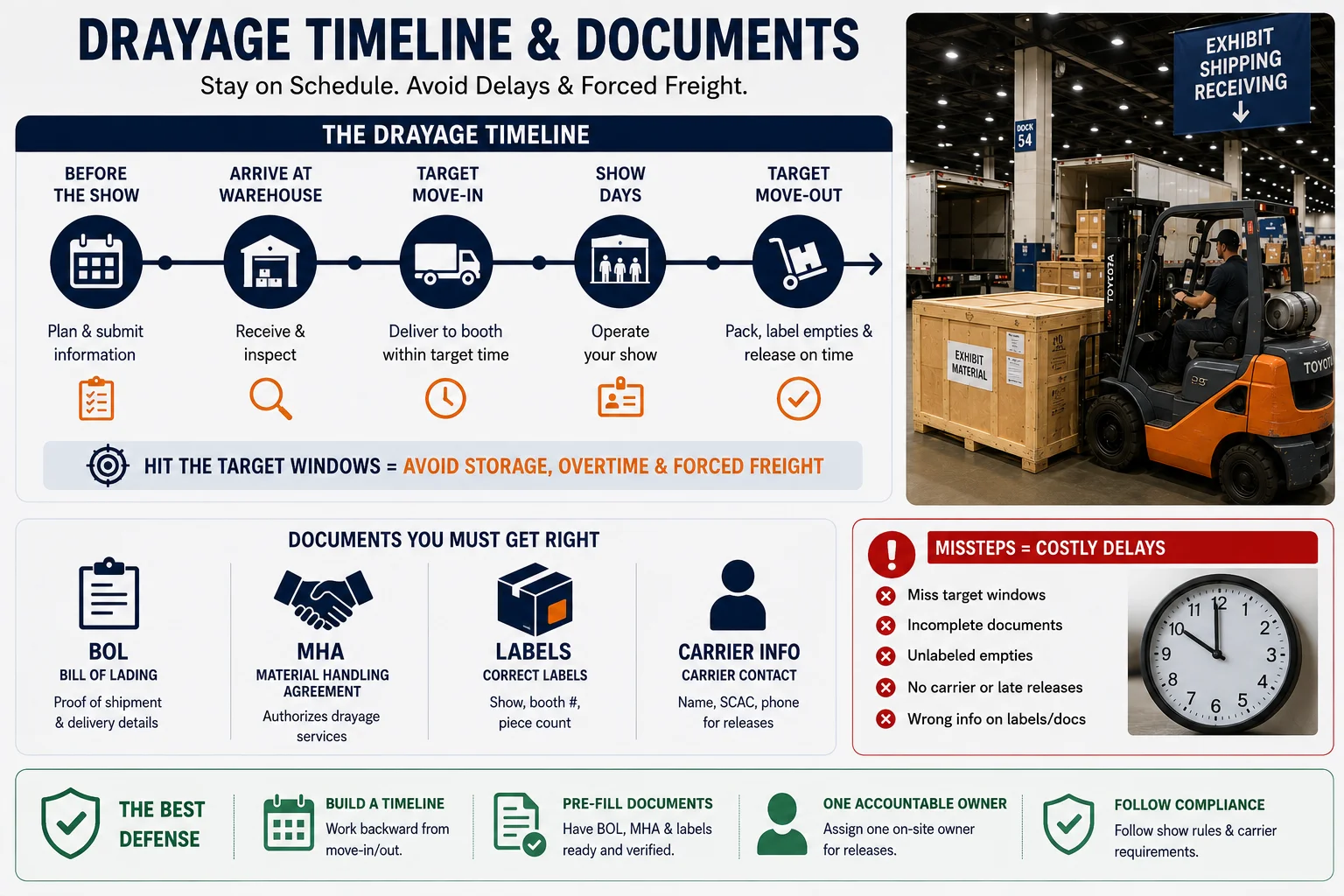
Drayage hinges on target move-in/out times, warehouse cutoffs, and the correct labels, BOL, and MHA. Missed targets, unlabeled empties, and absent carriers trigger storage or forced freight. Build a timeline, pre-fill documents, and assign one accountable on-site owner for releases.

drayage timelines documents mha bol target move in

Critical timeframes to watch

Document and label checklist

  • Inbound:
    • Carrier BOL with show name, exhibitor name, booth number
    • GSC shipping labels (advance or direct) on every piece
    • Crate/pallet count matching BOL
  • On-site:
    • Empty labels for every crate/case
    • Keep a photo of each labeled piece
  • Outbound:
    • Completed MHA with destination and carrier
    • Outbound BOL (pre-filled if possible)
    • Backup labels and contact numbers for carriers

I once saw an exhibitor leave early without signing their MHA. Their freight sat, the carrier left, and the GSC had to “force” it to warehouse storage. The storage invoice exceeded their drayage bill. A five-minute signature would have avoided it.

Which packaging and shipment choices reduce Drayage risk?

Poor packaging is the fastest path to “special handling.” Think loose cartons, mixed pallets, and tall unstable loads. The antidote is disciplined preparation: crate where possible, palletize properly, and label everything. The investment pays dividends in rate class and time.

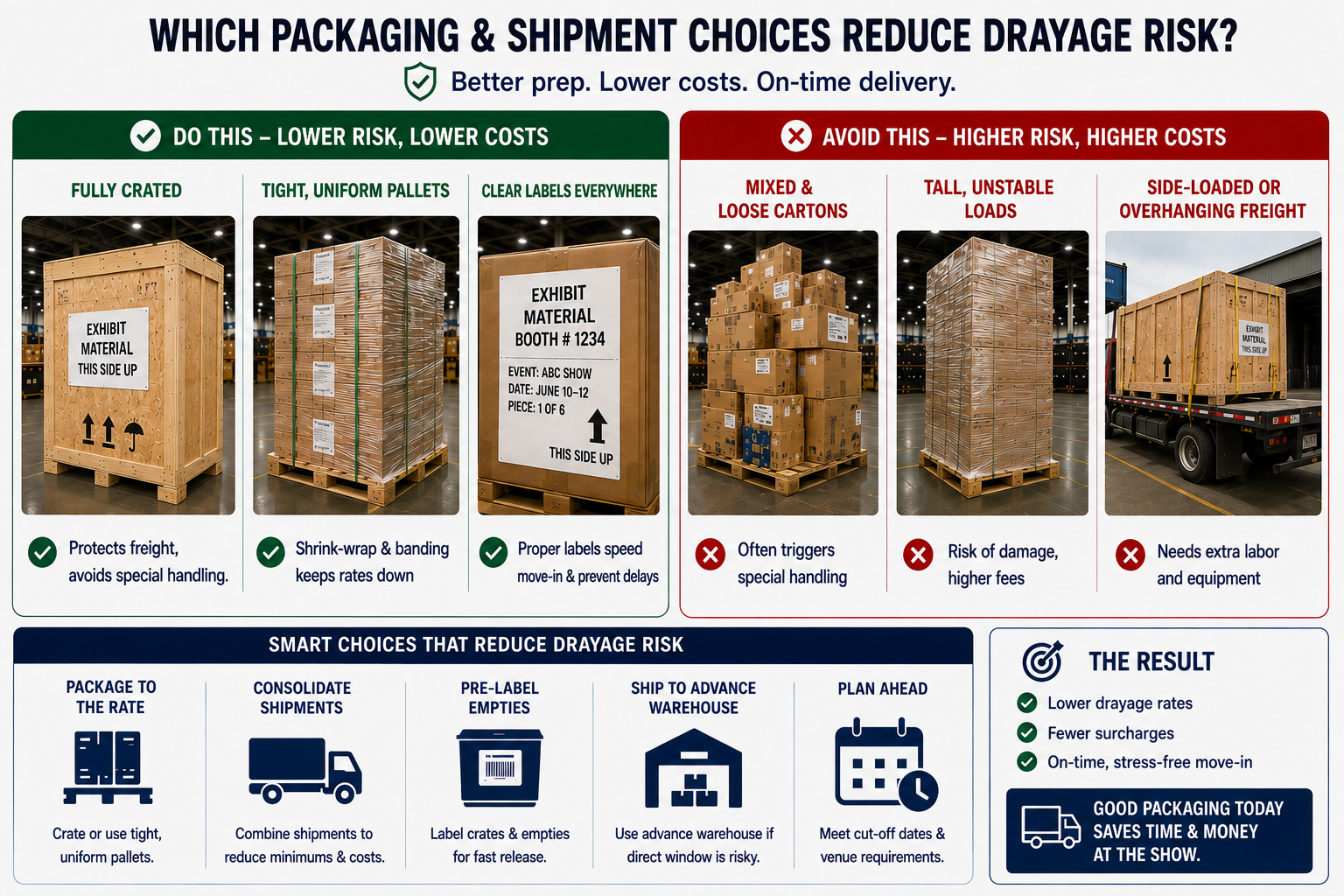
Package to the rate: use fully crated pieces or tight, uniform pallets with shrink-wrap and banding. Avoid mixed, loose, or side-loaded freight. Consolidate to reduce minimums, pre-label empties, and ship to the advance warehouse if your target direct window is risky.

best packaging for trade show drayage crated shrink wrap banded pallets

A drayage-ready packing checklist

  • Crating
    • Use lift points and robust skids for heavy items.
    • Close crates fully; avoid pad-wrapped only.
  • Palletizing
    • Keep footprint standard (40x48 inches when possible).
    • Stack square, shrink-wrap to the base, add two bands.
    • Avoid mixed-height layers and protrusions.
  • Labeling
    • Put show-specific labels on all sides.
    • Pre-print empty labels and keep extras on site.
    • Number pieces (1 of 6, 2 of 6…) and photograph.
  • Consolidation
    • Fewer shipments = fewer 200-lb minimums.
    • Combine small parcels at a consolidation point.
  • Timing
    • If you cannot hit a target direct time reliably, use the advance warehouse.

Practical scenario

A Southeast Asian brand shipped 28 individual cartons via small parcel to save airfreight. The GSC billed drayage using multiple minimums and special handling. The next show, we consolidated into two crated pallets at a third-party in Los Angeles, then shipped to the advance warehouse. Result: lower classification, straight-time delivery, fewer headaches, and a 35% reduction in drayage spend.

How should foreign exhibitors budget for Drayage and avoid surprise invoices?

Budgets fail when drayage is a guess. The fix is a simple model: start with realistic weight, choose advance or direct, set the likely rate class, and apply timing assumptions. Then add contingency for unknowns. Share the model with finance so expectations stick.

Build a drayage model by shipment: total actual weight, convert to CWT, apply the correct rate class and minimums, add likely surcharges for timing, and include a 15–25% contingency. Validate against the show’s rate sheet and keep one owner tracking live weight and delivery windows.

budgeting for drayage with cwt and contingency planning

A simple budgeting framework

  1. Inventory and estimate weight
    • Use last show’s scale tickets or crate specs
    • Add 10% for literature and late adds
  2. Decide intake method
    • Advance warehouse if schedule risk is high
    • Direct-to-show only if target is assured
  3. Pick the likely class
    • Crated vs. special handling vs. uncrated
  4. Choose labor window assumption
    • Straight time vs. overtime; check hall hours
  5. Calculate
    • ((Total lbs ÷ 100) rounded up) x rate
    • Apply minimums per shipment
    • Add surcharges based on assumptions
  6. Contingency
    • 15–25% for unknowns and weight variance
  7. Validation

Example budgets by exhibit type

  • 10x20 booth with light products and graphics
    • 1,200 lbs crated, advance, ST, $135/CWT ⇒ $1,620
    • Contingency 20% ⇒ $1,944 budget
  • 20x20 booth with furniture and demo units
    • 3,000 lbs, two pallets plus a crate, special handling, ST
    • $140/CWT x 30 CWT x 1.30 ⇒ $5,460
    • Contingency 20% ⇒ $6,552 budget
  • Machinery demo (uncrated elements)
    • 5,000 lbs mixed with rigging needs
    • $150/CWT x 50 CWT x 1.60 (uncrated) ⇒ $12,000
    • Add rigging separate, contingency 25% ⇒ $15,000+

I share a one-page calculator with clients before every show. It is not fancy, but it sets expectations and avoids the “we didn’t know” dilemma at invoice time.

When does an expert partner change the Drayage outcome?

You cannot remove drayage from the equation, but you can change the inputs. A seasoned partner reads the exhibitor manual fine print, watches the target grid, coordinates consolidation, and stands at the freight desk when it matters. The result is fewer delays and fewer surcharges.

Expert support audits packaging, aligns delivery windows to straight time, consolidates shipments to beat minimums, and manages MHA releases to avoid forced freight. The value is risk mitigation: you pay for drayage either way; you choose whether it is predictable or chaotic.

drayage management by experienced exhibit partner on show floor

What I (and my team) typically do

  • Pre-show
    • Review the exhibitor manual: rate sheets, target move-in/out, union notes
    • Build a labeled packing plan; pre-print all labels
    • Consolidate parcels where possible; select advance vs. direct strategy
    • Brief the forwarder on target and marshaling requirements
  • On-site
    • Meet drivers at the marshaling yard when needed
    • Verify receiving on the dock; escalate misclassification quickly
    • Supervise empty tagging and photo-document pieces
    • Complete and submit MHA immediately at show close
  • Post-show
    • Confirm carrier check-in and pickup time
    • Intercept forced freight by staying until the release is confirmed
    • Reconcile invoices against expected classifications and hours

Anonymous case: A Latin American pavilion missed its target by four hours due to a delayed truck. We diverted to the advance warehouse mid-transit, re-slotted delivery to straight time the next day, and avoided overtime and special handling. The drayage still applied, but the avoided surcharges saved 28% against the revised scenario.

Exhibitsmax is headquartered in Las Vegas, where drayage nuances vary by venue and GSC. We manage these details daily for international exhibitors across the U.S., from the first label to the last outbound scan.

Frequently Asked Questions

Is Drayage included in my booth rental?

No. Booth rental and drayage are separate. Your booth package may include carpet, furniture, or basic services, but drayage is billed by the GSC based on shipment weight, classification, and timing. Always check the exhibitor manual’s material handling section and budget drayage as its own line item.

Can I avoid Drayage by hand-carrying my materials?

Only within strict limits. Most shows allow one person, one trip, with small items carried by hand (no dollies) through designated entrances. Anything delivered by a carrier, on a pallet, or requiring equipment will incur drayage. Attempting to bypass rules risks delays and penalties.

What is “special handling” in Drayage?

Special handling applies when freight needs extra labor or time: loose cartons, side-loaded trailers, mixed-size pallets, poorly shrink-wrapped loads, or irregular pieces. It typically adds 20–40% to the base rate. Proper crating and tight palletizing usually avoid this classification.

What happens if my freight misses the target move-in?

The GSC may refuse direct-to-show deliveries outside the target window, or assess overtime/late fees. If the schedule is uncertain, ship to the advance warehouse instead. When a miss is unavoidable, contact the GSC immediately to re-slot delivery and minimize surcharges.

How are empty crates handled during and after the show?

After you set up, tag empties with “EMPTY” labels. The GSC removes and stores them until show close. Empties return only after aisles are clear. Plan teardown time accordingly. If empties were not labeled or documented, retrieval can be delayed and disrupt your outbound schedule.

Conclusion

Drayage is the essential, venue-controlled material handling that moves your exhibit inside the hall. You cannot avoid drayage, but you can control how it impacts your budget and schedule. Package to the correct class, hit the right windows, consolidate shipments, and lock down documents. If you want hands-on help, Exhibitsmax can manage drayage planning and execution for your U.S. shows so you focus on customers, not docks.


  1. "Trade Shows - Exhibiting a Product - help.CBP.gov", https://www.help.cbp.gov/s/article/Article1286?language=en_US. The Jacob K. Javits Convention Center’s Hand Carry Policy states that only small items may be brought in by exhibitors without the official contractor, and that all other freight must be handled by the show’s official material handling provider, indicating that drayage is not optional beyond narrow hand-carry allowances. Evidence role: general_support; source type: government. Supports: That venues require official material handling for most exhibit freight and only allow limited hand-carry exceptions, making drayage effectively mandatory.. Scope note: Venue policies vary by show and location; this supports the general practice via one major U.S. convention center’s rules.

  2. "Exhibitors", https://www.mccormickplace.com/exhibitors/. McCormick Place’s hand-carry policy permits exhibitors to carry in small items by hand while prohibiting dollies and carts, and directs that larger materials be managed by the official service contractor, reinforcing that self-handling is restricted to tightly defined hand-carry limits. Evidence role: general_support; source type: government. Supports: That exhibitors may only bring in limited items by hand and cannot use dollies/carts, with larger freight requiring the official contractor.. Scope note: This policy is venue-specific, though similar restrictions are common at major U.S. convention centers.

  3. "What is a Material Handling Agreement (MHA)? - GES", https://insights.ges.com/exhibitor-resources/what-is-a-material-handling-agreement. Convention center and show policies define ‘forced freight’ as the contractor’s authority to remove outbound freight to storage or consign it to a carrier if the exhibitor’s carrier fails to check in or release documentation is not completed by deadline, supporting the article’s warning about forced freight. Evidence role: definition; source type: government. Supports: That if outbound carriers fail to check in or required paperwork is not submitted, the official contractor may remove freight to storage or ship it at the exhibitor’s expense (forced freight).. Scope note: Procedures and deadlines are set per event; this definition reflects standard practice language.

  4. "Administration", https://www.occc.edu/facilities-management/administration.html. Orange County Convention Center operations guidance outlines that the official service contractor is responsible for material handling and dock logistics during exhibitions, including coordinating related labor, supporting the characterization of GSC control over drayage, docks, and labor. Evidence role: general_support; source type: government. Supports: That official service contractors manage material handling and dock logistics, including labor coordination, during events.. Scope note: Responsibilities can vary by show contract; this document reflects a major venue’s standard practice.

  5. "Oregon Convention Center Puts "Good Waste" to Use", https://nepis.epa.gov/Exe/ZyPURL.cgi?Dockey=P100BZMN.TXT. Convention center exhibitor guidelines commonly state that empty containers will be returned only after aisle carpets are removed and aisles are clear at the end of the show, which aligns with the statement that empties return after aisle carpet is pulled. Evidence role: general_support; source type: government. Supports: That empty containers are returned only after aisle carpets have been removed/aisles cleared at show close.. Scope note: Policies are typically published per show by the venue or official contractor; specific timing can vary.

  6. "Las Vegas Convention Center | Official Website", https://www.vegasmeansbusiness.com/meeting-facilities/convention-and-conference-facilities/las-vegas-convention-center/. The Las Vegas Convention Center’s POV/cartload policy specifies the types of vehicles considered POVs and limits cartload services by size and number of trips, illustrating that such programs are narrowly defined and restricted. Evidence role: general_support; source type: government. Supports: That POV/cartload programs define specific vehicle types, load sizes, and conditions under which exhibitors may use them.. Scope note: Exact definitions and limits differ by venue and show.

  7. "Your Guide to Drayage: Including 15 Tips on How to Save", https://www.exponents.com/our-blog/your-guide-to-drayage-including-15-tips-on-how-to-save-on-its-costs/. A major U.S. trade show exhibitor manual specifies that parcels delivered via carriers such as UPS or FedEx are subject to small package handling or material handling fees, supporting the statement that small parcels still incur drayage when processed on site. Evidence role: general_support; source type: institution. Supports: That exhibitor manuals specify small package handling or material handling charges for parcels delivered to the booth.. Scope note: Fee structures vary by show and contractor; this provides representative, not universal, terms.

  8. "FAQ", https://www.paconvention.com/meeting-professionals/faqs. A major U.S. convention center’s hand-carry policy limits exhibitors to small items carried by hand, typically one person in one trip without the use of dollies or carts, illustrating the narrow scope of hand-carry exceptions described. Evidence role: definition; source type: government. Supports: That hand-carry policies restrict exhibitors to small items carried by hand, typically in one trip and without wheeled devices.. Scope note: Hand-carry provisions differ by venue; this reflects one center’s policy language.

  9. "Material Handling FAQs", https://www.exhibitoronline.com/topics/article.asp?ID=2808. Industry glossaries describe drayage/material handling as the receiving and internal movement of exhibit freight, commonly billed by hundredweight (CWT) and subject to minimum charges, aligning with the statement about CWT and minimums. Evidence role: definition; source type: institution. Supports: That drayage/material handling refers to services billed by hundredweight and typically subject to minimums.. Scope note: Exact billing practices are set per show and contractor; the glossary captures common industry usage.

  10. "Custom Trade Show Booth Builder in Las Vegas & USA | Exhibitsmax", https://exhibitsmax.com/trade-show-booth-builder-in-las-vegas/. A large U.S. trade show’s exhibitor manual specifies a 200‑lb minimum per shipment for material handling, providing an example of the commonly cited 200‑lb minimum. Evidence role: general_support; source type: institution. Supports: That some major shows set a 200-lb minimum per shipment for material handling charges.. Scope note: Minimums can differ by event and contractor; this is a representative policy rather than a universal rule.

  11. "Governor Quinn and Mayor Emanuel Announce Historic ...", https://www.illinois.gov/news/release.html?releaseid=9810. McCormick Place labor guidelines define straight-time and overtime periods and indicate that work performed outside straight-time is billed at overtime or double-time rates, supporting the note that off-hour deliveries incur higher charges. Evidence role: general_support; source type: government. Supports: That deliveries or work performed outside defined straight-time hours are billed at overtime/double-time rates.. Scope note: Specific hours and multipliers vary by city, union, and event.

  12. "Exhibitor Service Information", https://www.nacacnet.org/wp-content/uploads/26SLOS-Exhibitor-Kit.pdf. A major U.S. show’s exhibitor manual lists advance warehouse receiving opening several weeks before the event and closing roughly one week prior to move-in, illustrating the typical 30–45 day open and 5–10 business day cutoff described. Evidence role: general_support; source type: institution. Supports: That major shows commonly open advance warehouse receiving several weeks before move-in and close about a week before.. Scope note: Exact windows vary by show and contractor; this is an example of common scheduling.

Related Exhibitor Services

Explore the services that move your booth from planning to successful on-site execution.

Browse all trade show services