Last reviewed: October 6, 2026
Planning a booth at the Kay Bailey Hutchison Convention Center Dallas (KBHCCD) starts with your exhibit goals, assigned floor plan and current show manual. Use those documents to align design, production, freight and installation—and to identify services that need separate orders.
Define Your Booth Goals Before Finalizing the Layout
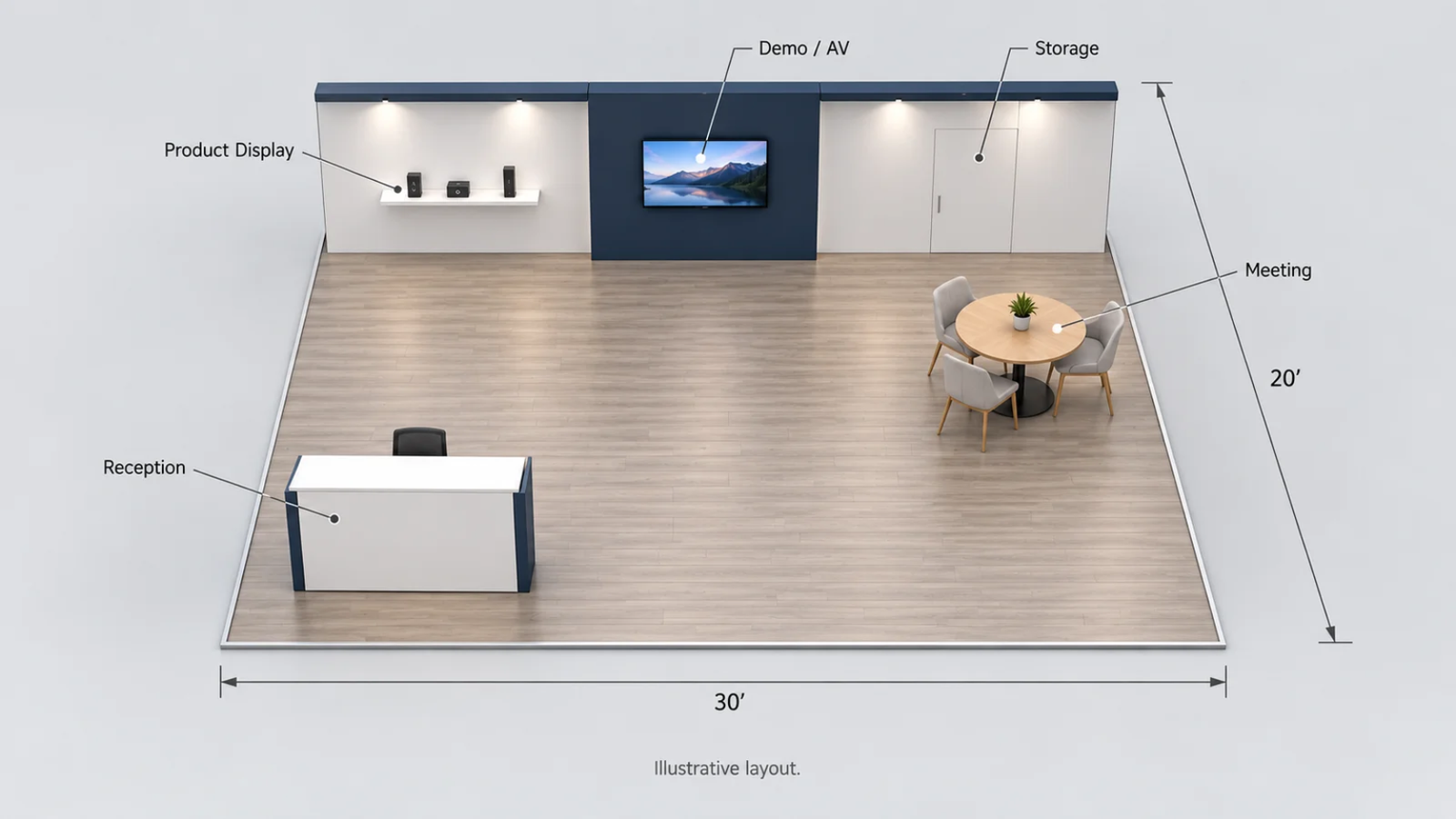
Start with what visitors need to see and do. A product demonstration, a scheduled meeting and a quick introduction require different arrangements, even within the same footprint.
Rank your main activities, then share the product dimensions, staffing needs and expected meeting format with your builder. If your space is already booked, use these priorities to decide what fits and what needs simplifying.
| Booth goal | Layout priority | Items to confirm |
|---|---|---|
| Product or software demonstrations | Clear viewing positions and accessible demo surfaces | Equipment dimensions, power, connectivity and audience space |
| Scheduled meetings | Seating away from busy circulation routes | Furniture count, privacy needs and staff access |
| Lead capture | A visible reception point with open approaches | Counter placement, scanning equipment and queue space |
| Brand visibility | Readable graphics and a clear visual focal point | Sightlines, permitted structure heights and any overhead approvals |
| Storage | Integrated space for supplies and staff belongings | Required capacity, access and replenishment routes |
A meeting area does not automatically require an overhead structure. Likewise, a large screen is only useful when its content, placement and viewing distance support the activity around it.
Confirm Who Is Responsible for Each Show-Site Task
Use a responsibility checklist rather than assuming one contractor handles every service. KBHCCD identifies the event organizer and general service contractor as primary contacts for event-specific exhibitor information. Start with the official exhibitor FAQs, then check your event’s service kit.
| Party | Typical planning role | What to confirm |
|---|---|---|
| Venue | Building requirements, access and facility restrictions | Applicable facility requirements and approval contacts |
| Show organizer | Booth assignments, event rules and exhibitor deadlines | Current manual, floor plan and submission requirements |
| Official or designated service providers | Show-site services under the event’s arrangements | Which tasks are exclusive, separately ordered or available through another approved provider |
| Booth builder / exhibitor-appointed contractor | Design, production and agreed installation work | Written scope, EAC eligibility and permitted tasks |
This is a planning framework, not a fixed responsibility matrix. Electrical, internet, material handling, rigging and installation can involve different providers. Confirm the assigned provider for each task on the current order forms.
Ask your builder to separate work included in its proposal from services it will coordinate and services you must order directly. Our Dallas trade show booth rental and exhibit services overview explains configuration options and the quote scope to review.
Check Current Facility and Access Information
Read the KBHCCD Event Resource Guide alongside the event manual. The venue guide addresses building requirements; the show documents establish event-specific schedules and service arrangements.
The venue’s expansion updates report ongoing work. Confirm your assigned hall, receiving route and access instructions with the event team rather than relying on an older floor plan or a previous show’s delivery instructions.
Example Dallas Booth Planning Timeline
For projects involving custom production, several months can be a useful planning window. Larger structures, overseas freight, approvals, integrated AV or special handling may require more preparation. A simpler rental may need less time, subject to availability and the actual event deadlines.
Build your schedule backward from move-in, using confirmed dates rather than a universal week count.
| Planning phase | Main tasks | Dependency to resolve |
|---|---|---|
| Brief and document review | Confirm booth dimensions, open sides, goals and budget | Assigned floor plan and current exhibitor manual |
| Design and scope | Select a rental, custom or hybrid approach; develop the layout | Product requirements, drawings and approval needs |
| Approvals and orders | Submit required plans and place service orders | Actual submission dates, provider requirements and rate deadlines |
| Production and preparation | Approve graphics, prepare components and review fit | Final artwork, material availability and approved scope |
| Freight and installation planning | Choose receiving method and coordinate crew sequence | Receiving dates, packed shipment details and access arrangements |
| Move-in and move-out | Track delivery, execute the build and arrange outbound freight | On-site contacts, release paperwork and carrier instructions |
This sequence is illustrative. It is not a KBHCCD-mandated schedule or a delivery promise. Record the actual deadlines, responsible person and approval status for each item.
Advance Warehouse or Direct-to-Show Freight?
Compare the available receiving options before booking transportation. Advance warehouse delivery may allow freight to arrive before the show’s move-in period. Direct-to-show delivery uses the event’s designated receiving window. The appropriate choice depends on receiving dates, rates, carrier availability, shipment characteristics and the installation plan.
| Option | Planning benefit | Items to check |
|---|---|---|
| Advance warehouse | Can separate carrier arrival from venue move-in | Acceptance dates, storage conditions, shipment restrictions and handling charges |
| Direct-to-show | Can suit shipments planned around the venue receiving window | Target times, marshaling instructions, access and crew coordination |
Neither option is automatically cheaper or lower risk. Compare the complete receiving and handling arrangements for your shipment.
Transportation vs. Drayage
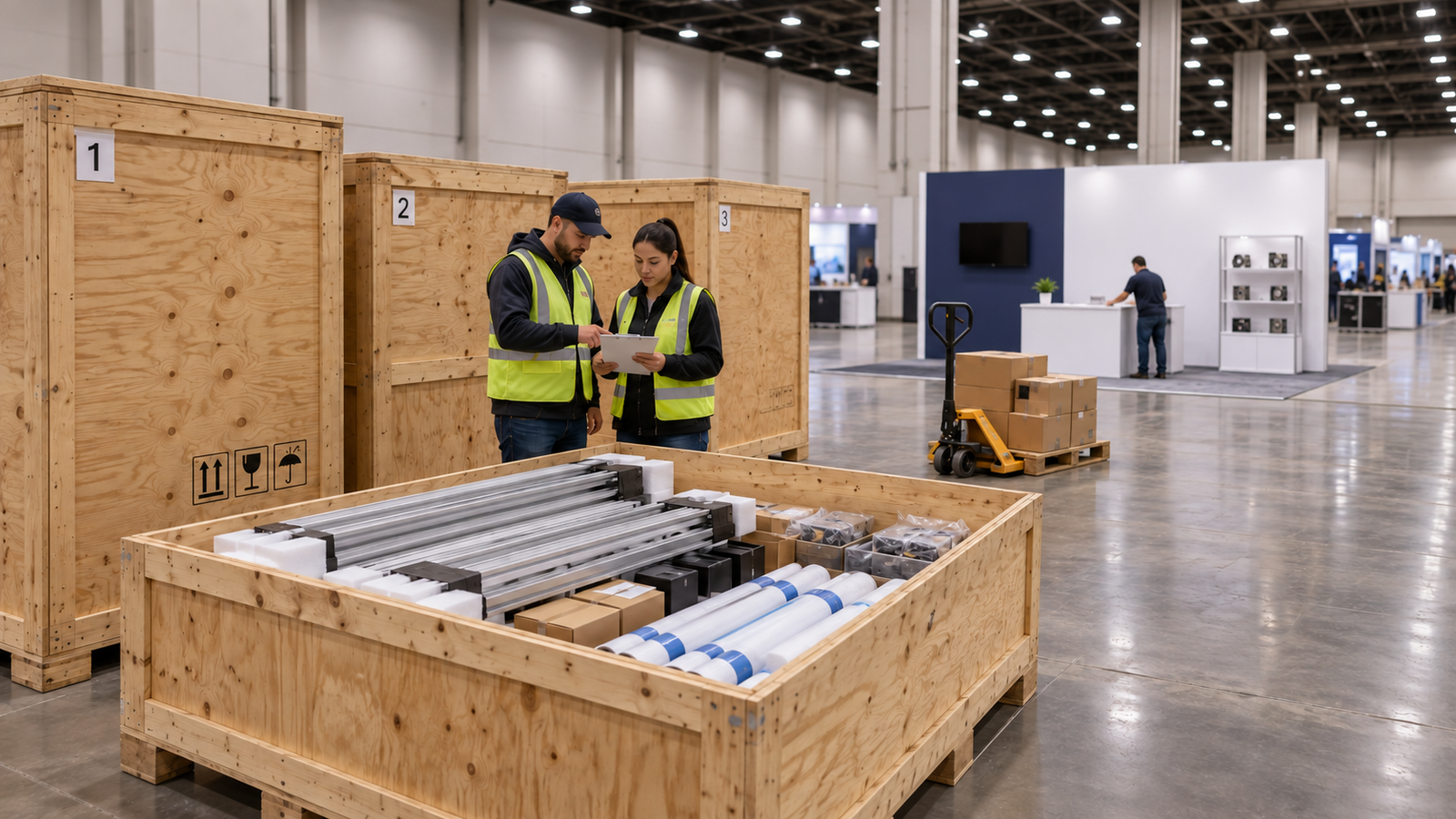
Transportation moves freight between locations. Material handling, often called drayage, concerns the show’s receiving and movement arrangements, such as getting freight to the booth and handling outbound release. These services may be separately priced and supplied.
Check the event’s material handling form for the designated contractor, included tasks, rate basis, minimums, billing increments and special-handling conditions. Do not assume every shipment uses the same weight-based rate. Hand-carry, personally owned vehicle or cartload arrangements may have their own eligibility rules.
Our drayage guide explains the distinction in more detail. For carrier planning, review our exhibit transportation service.
Before dispatch, confirm:
- The event-specific receiving address and required labels.
- Crate counts, packed dimensions, weights and handling requirements.
- Receiving dates and the person authorized to resolve delivery issues.
- Empty-container arrangements and outbound paperwork.
- Carrier check-in, pickup and return-to-storage plans.
For international shipments, ask an experienced freight forwarder and customs broker to confirm documentation, entry requirements and timing. Do not assume an import method or transit allowance based only on the fact that the goods are going to a trade show.
Real Dallas Projects: Different Displays, Different Layouts
These GlassBuild 2024 projects illustrate completed Dallas exhibit approaches. They do not establish rules or service requirements for a future event.
LandGlass — 20×20 at GlassBuild 2024
The LandGlass 20×20 Dallas case study combines branded framing, technical information panels, a screen, reception and meeting space. It provides a reference for organizing product information and buyer conversations within a compact footprint.
For a similar brief, establish which products need physical display and which can be explained through graphics or digital content. If physical samples are included, confirm their dimensions, weights and supports before design approval. Explore more 20×20 booth rental and design options.
GEALAN — 20×50 at GlassBuild 2024
The GEALAN 20×50 Dallas case study shows full-size window and door presentations within architectural framing, with meeting spaces distributed across the exhibit.
For this type of layout, sample positioning and visitor circulation need to be considered together. Future projects should establish packed dimensions, weights, fixing methods and the unloading and installation sequence before quoting. See our 20×50 booth rental and design options for additional planning context.
Control Budget Exposure With a Written Scope
Fabrication or rental scope, freight, material handling, labor, service orders and later changes can all affect the total budget. Compare proposals using the same inclusions and exclusions rather than comparing only the headline price.
Separate builder costs from show and venue services. Then identify costs that remain estimated or depend on on-site conditions. Our trade show booth cost and budget guides explain these categories.
Service Orders
Check each order form’s dates and rate terms. Where advance-order pricing is available, record the qualifying deadline and the information needed to place a complete order. Allow time for design decisions that affect electrical, internet or rigging requirements.
Installation and Dismantling
Confirm the build sequence, crew scope and responsibility for positioning products. Freight delays, missing parts or revised structures can affect labor requirements. Review installation and dismantling support alongside the event’s permitted-work rules.
Graphics and Production Changes
Keep artwork approval separate from structural approval. Record final sizes, file versions and approval dates. Changes after printing or fabrication begins may require a revised quote and schedule.
Storage and Outbound Freight
Plan the return journey before move-in. Confirm empty-container handling, carrier pickup, release paperwork and the destination for reusable components. Do not assume inbound transportation includes every outbound service.
Set a project-specific contingency allowance after reviewing unresolved items, supplier terms and current service rates. There is no single percentage that fits every booth.
Frequently Asked Questions
Do I need a booth builder for a 10×10 inline booth?
Not necessarily. A simple display may suit a team that can manage its own graphics, shipping and permitted setup. A builder can help when you need coordinated production, integrated displays or installation support. Choose based on scope and your team’s capacity, not footprint alone.
Can overseas exhibitors bring their own booth materials?
Potentially, subject to import requirements, event rules and delivery arrangements. Have your forwarder or customs broker review the shipment before dispatch, and have your builder check compatibility, assembly information and any required approvals.
What is an exhibitor-appointed contractor, and does it need registration?
An EAC is a contractor appointed by the exhibitor rather than the show’s official contractor. Your event may require registration, insurance documentation or other approvals. Confirm both eligibility and permitted work in the current manual before scheduling the crew.
What if freight misses the advance warehouse deadline?
Contact the designated receiving provider and your carrier before redirecting the shipment. Confirm whether late acceptance or direct-to-show delivery is available, what charges apply and how the revised arrival affects installation. Do not send freight to an assumed venue address.
How early should I contact a builder for a first-time Dallas show?
Contact a builder once your event and likely footprint are known. Share the move-in date, manual, product requirements and approval deadline so the team can assess feasibility. Custom structures, international freight or specialized displays may need more preparation than a simpler rental.
Planning a Booth at Kay Bailey Hutchison Convention Center?
Share your show, booth size, move-in dates, product or display requirements and current exhibitor manual. We can review the design and execution scope around your event.
Request a Dallas Booth Planning Review
Explore Dallas Trade Show Booth Rental
Official resources checked October 6, 2026. Confirm current venue requirements and your event’s exhibitor manual before finalizing the plan.