
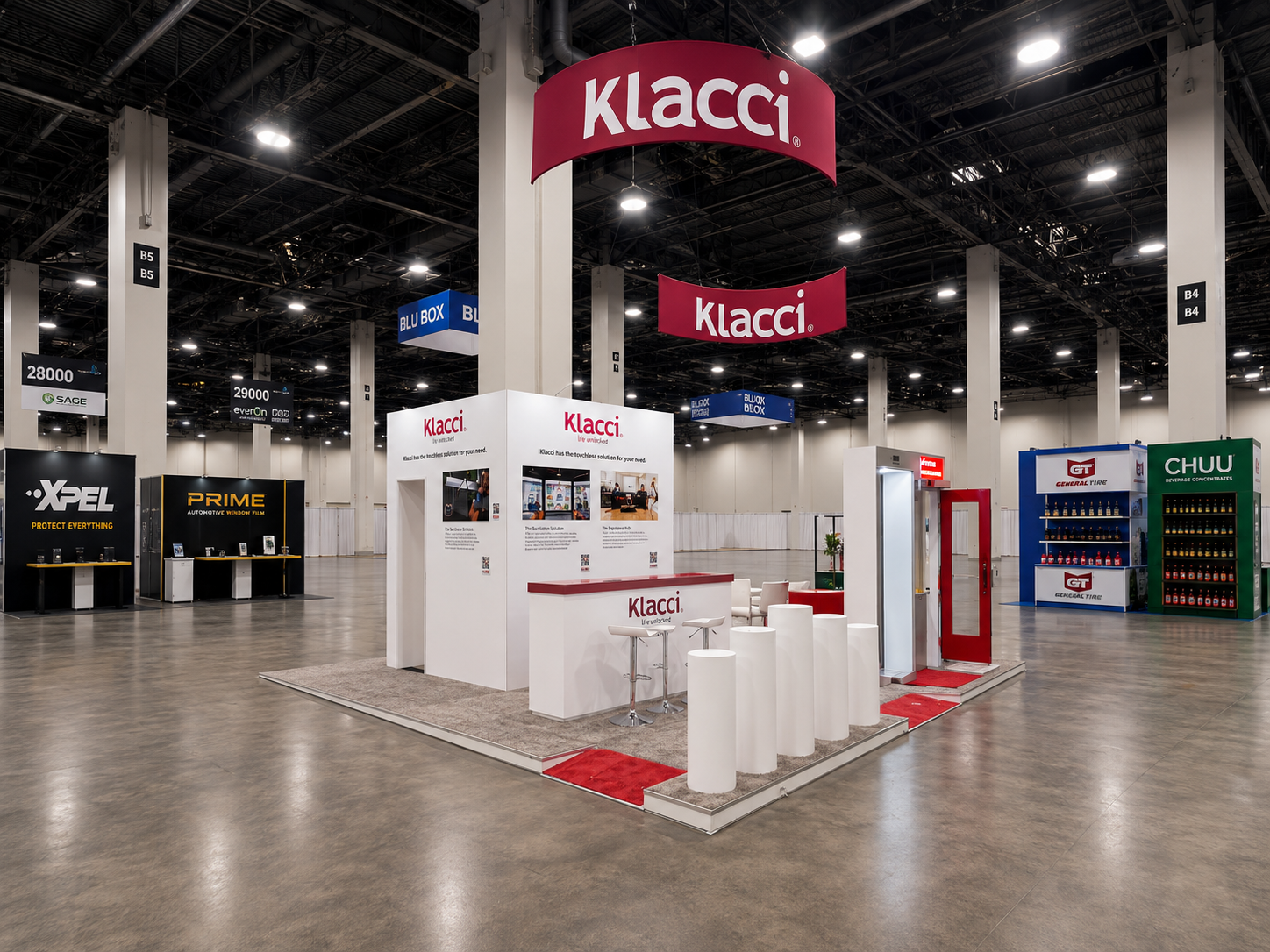
Trade show booth installation time can range from part of a day for a simple modular display to several days for a complex custom exhibit. Plan around the approved design, freight availability, service sequence, and permitted work hours—not booth size alone.
Booth Installation Time at a Glance
Use booth configuration to identify the work involved before estimating a schedule. All dimensions below are in feet.
| Booth configuration | Main installation work | What to confirm first |
|---|---|---|
| Simple 10×10 / 10×20 modular booth | Assemble frames, fit graphics, position furniture | Component inventory, assembly instructions, permitted labor |
| 10×20 booth with AV and lighting | Assemble display, route cables, install graphics, test equipment | Power locations, equipment list, service availability |
| 20×20 custom island booth | Assemble structures and millwork, install finishes, integrate displays | Build sequence, crew plan, electrical and any rigging |
| 30×30+ custom booth | Coordinate larger structures, multiple work zones, specialist services | Approvals, equipment access, contractor handoffs, move-in window |
A rental booth can still require substantial installation when it includes custom finishes or AV. With custom booth fabrication, preassembly and clear component labeling can simplify on-site work. Neither rental nor custom automatically determines the installation duration.
How Much Installation Time Should You Plan?
Use these preliminary scheduling allowances to start a conversation with your installer:
- Simple 10×10 / 10×20 modular booth: Allow approximately half a day to one full day.
- 10×20 booth with straightforward AV and lighting: Start with one full installation day, then check the service and testing requirements.
- 20×20 custom island booth: Allow approximately 1–3 days; complex structures, finishes, or service dependencies can require longer.
- 30×30+ custom booth with rigging, AV, or millwork: Allow approximately 2–5+ days, subject to design review and show access.
These are planning estimates, not measured industry averages, venue rules, or guaranteed Exhibitsmax completion times. They assume complete materials, a suitable crew and equipment, approved drawings, and workable access. A “day” means the show’s permitted working window—not 24 hours of continuous labor. Fabrication, shipping, and dismantling are separate.
Always add contingency time for freight delays, electrical work, rigging, and show-service coordination. Set that allowance with your installer rather than applying the same buffer to every booth.
Turn the Range into a Working Schedule
Start with your required handover time, then work backward through testing, graphics and furniture, structural assembly, and the services that must happen first. Confirm when freight will be available at the booth, not just when the truck reaches the venue.
Your usable installation window must cover the required sequence, service waiting time, final checks, and contingency. Some tasks can overlap; others cannot. Adding more workers will not resolve a missing electrical connection or a rigging dependency.
For a 20×20 booth, ask the installer to map the proposed 1–3-day allowance against the actual design and access schedule. If the show permits less time than the build needs, simplify the booth or obtain an approved alternative before booking labor.
Example Workflow: 20×20 Island Booth Installation
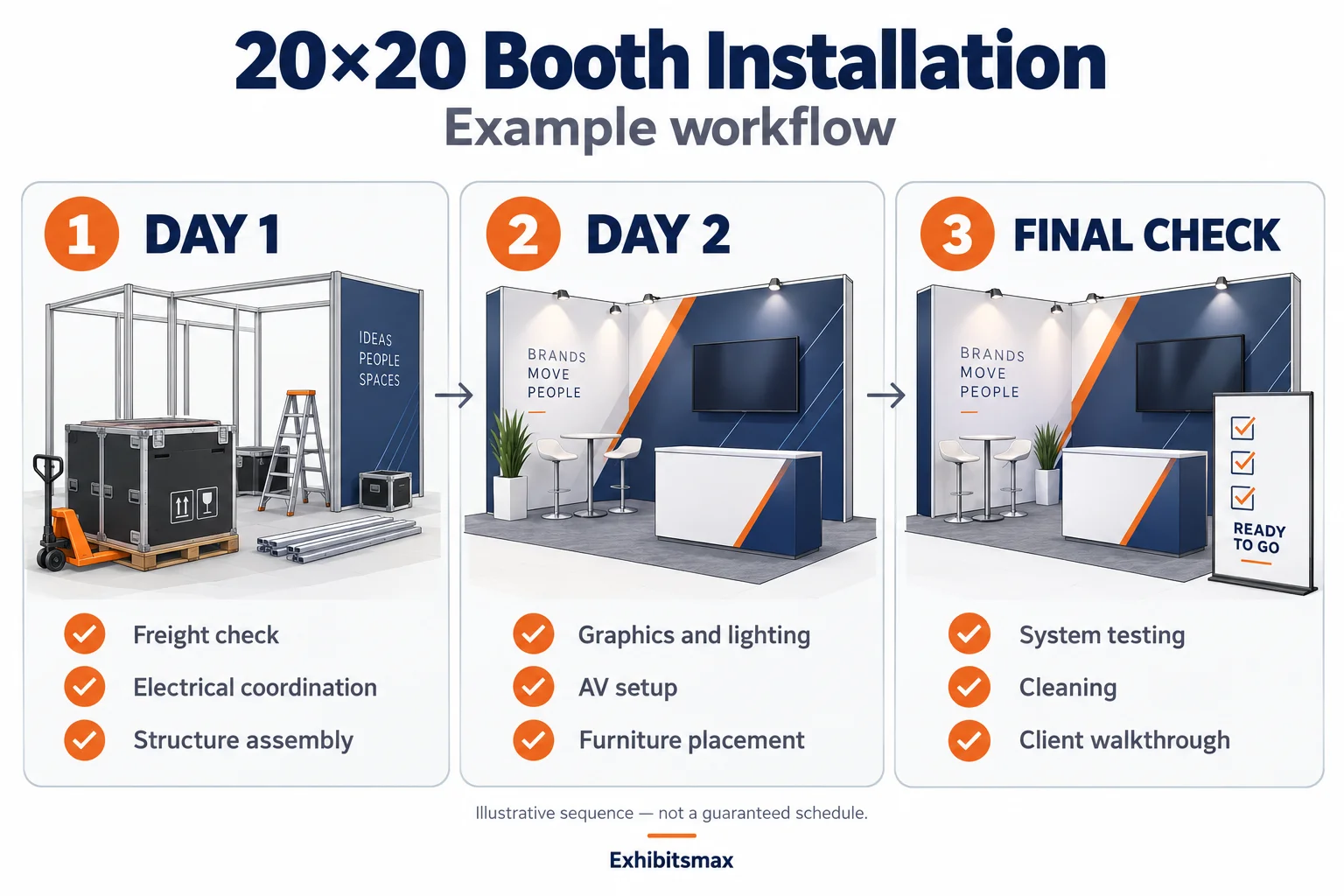
For a booth with an approved two-day installation window, a straightforward structure, and coordinated service availability, the sequence might look like this:
| Stage | Illustrative work sequence |
|---|---|
| Day 1 | Receive and check freight at the booth; coordinate any required underfloor electrical work before covering it; assemble the structure in the approved sequence |
| Day 2 | Install graphics, complete lighting and AV setup with the responsible providers, and position furniture |
| Final check | Test lighting and AV, check finishes, complete cleaning, and conduct a client walkthrough before handover |
This is an example workflow, not a completed-project case study or a guaranteed schedule. Hanging signs, complex AV, delayed freight, or restricted work hours may require a different sequence and more time. Confirm any overhead-work requirements before scheduling assembly below, and retain contingency within the approved access window.
What Factors Add Time to Booth Installation?
| Factor | Potential impact | Planning action |
|---|---|---|
| Hanging sign / rigging | Adds approval, equipment, and sequencing dependencies | Confirm the authorized provider and overhead-work sequence |
| Large LED video wall | Adds assembly, cabling, content checks, and testing | Coordinate AV readiness with power and supporting structure |
| Custom millwork | Adds assembly, alignment, and finishing tasks | Review preassembly options and installation drawings |
| Late freight | Can delay the entire build | Align delivery and material handling with the crew start |
| Electrical service | May require separate authorized labor | Confirm the power plan and work needed before flooring closes |
| Complex graphics | Adds alignment and application time | Check dimensions, labels, surfaces, and installation order |
| Multiple contractors | Increases scheduling dependencies | Assign one coordinator and document each handoff |
For cost implications, see our trade show labor and rigging planning guide. Crew size, work hours, equipment, and service scope should be confirmed together.
What Must Be Ready Before Installation Starts?
Approved Design and a Complete Installation Package
Provide final drawings, component labels, packing lists, graphic layouts, power locations, and AV requirements. Include any required structural or hanging-sign approvals and the contact responsible for resolving questions.
Confirm production and artwork deadlines with each supplier. There is no universal graphic-production lead time that applies to every material, quantity, and finishing method. Late changes can affect printing, fabrication, packing, and the installation sequence.
Freight and Material Handling
Choose advance warehouse or direct-to-show delivery using the current exhibitor manual. Warehouse receiving dates and transfer schedules vary; do not assume freight will reach the booth before all move-in activity begins. Direct deliveries must follow the event’s receiving and target instructions.
A carrier’s arrival confirmation is not proof that the materials are ready for installation. Check the handoff from truck unloading to booth delivery. Our exhibit transportation service connects shipping plans with installation requirements; the drayage guide explains the separate material-handling process.
Confirmed Services and Contractor Responsibilities
Electrical, rigging, internet, AV, and material handling may involve different providers. Use the current show’s official vendor list to confirm who performs each service, what must be ordered, and when.
For example, CES publishes venue-specific exhibitor resources and target freight information. These documents help connect the correct venue, booth assignment, and service requirements; they do not establish a universal installation duration.
Check exhibitor-appointed contractor registration, insurance documents, and access requirements where applicable. Keep order confirmations and on-site contacts in the installation package.
Permitted Access and a Final Handover
Record the booth’s move-in window, permitted work hours, completion deadline, and any restrictions on equipment or access. Schedule crate removal so it does not obstruct remaining work.
Protect time for lighting and AV tests, graphic inspection, furniture placement, cleaning, and a client walkthrough. A standing structure is not necessarily a show-ready booth.
What We Check Before Confirming an Installation Schedule
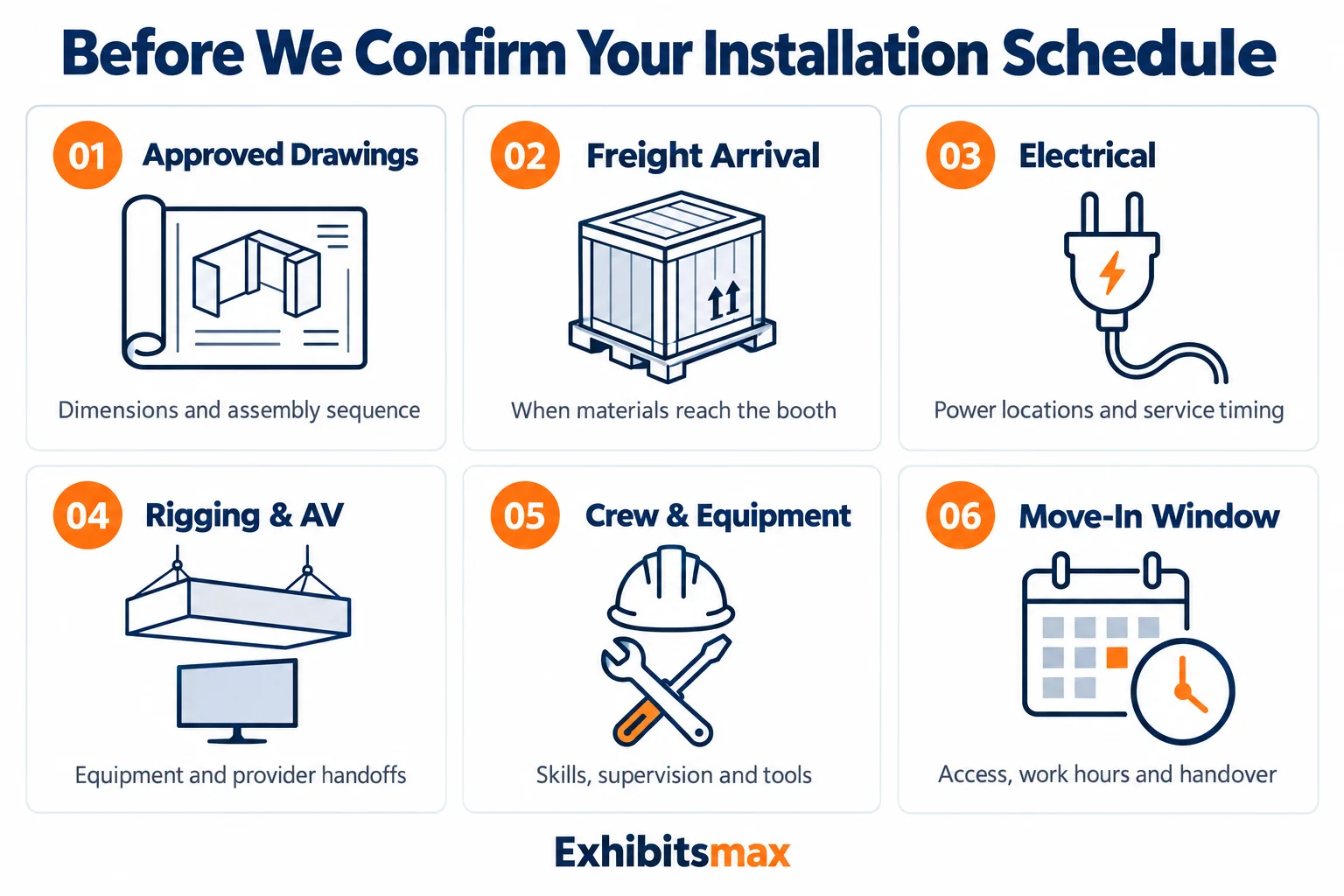
At Exhibitsmax, our team reviews these six items before confirming an installation schedule:
- Approved booth drawings: Dimensions, components, assembly sequence, and any outstanding approvals.
- Freight arrival plan: Delivery route, shipment inventory, and expected availability at the booth.
- Electrical requirements: Power locations, connection needs, and work that must precede flooring or finishes.
- Rigging and AV scope: Hanging elements, equipment, testing needs, and the responsible service providers.
- Crew and equipment requirements: Required skills, supervision, tools, and equipment availability.
- The show’s move-in schedule: Assigned access, permitted work hours, service appointments, and the required handover time.
The purpose is to identify which tasks can overlap and which must wait for freight, services, or another contractor. Unresolved dependencies need to be addressed before the proposed schedule becomes a confirmed installation plan.
Does Booth Installation Take Longer in Las Vegas?
Not automatically. The schedule depends on the show, hall, booth design, and service arrangements—not the city alone.
At the Las Vegas Convention Center (LVCC), Mandalay Bay, and The Venetian Expo, check assigned move-in windows, applicable labor rules, drayage, electrical, rigging, and contractor coordination. Do not carry a rule from one venue or one edition of a show into another project without verification.
The CES exhibitor resources separate venue manuals and target freight plans. SEMA also provides exhibitor guidance on freight and labor through its official exhibitor FAQ; use the current event manual for binding instructions and dates.
A Las Vegas booth builder can help coordinate these handoffs, but local support does not remove official service requirements. For venue planning, see the LVCC booth planning guide.
What Happens If Installation Time Is Too Tight?
A compressed schedule leaves less room to replace damaged graphics, resolve missing components, or test displays. Depending on the service agreement and work schedule, it can also increase exposure to overtime, waiting charges, expedited shipments, and late service orders.
Opening morning is often an important period for exhibitor traffic, scheduled meetings, and first impressions. Aim to hand over a tested, clean, functional booth before staff need to prepare for visitors.
If the schedule begins slipping, identify the task blocking the next stage and contact the responsible provider. Protect required safety checks and approvals. Agree on any scope changes with the exhibitor rather than rushing unapproved work.
Frequently Asked Questions
How far in advance should I schedule my trade show booth installation?
Contact the installation provider when the booth assignment and preliminary design are available. Confirm labor and equipment before the applicable ordering deadlines, then update the schedule after design approval. Custom production, international shipping, and structural approvals need a separate planning window; the on-site installation allowance does not cover those activities.
Can I install my own trade show booth, or do I need a professional crew?
Some shows allow exhibitors to assemble certain displays themselves, subject to the event’s labor and access rules. Confirm who is eligible to perform the work, permitted tools and equipment, and restrictions on electrical or rigging tasks. Do not assume a small booth automatically qualifies. For more complex work, review the scope with an installation and dismantling team.
What is drayage, and how does it affect my installation timeline?
Drayage is show-site material handling, including the movement of exhibit freight to the booth under the event’s service arrangements. Your installer needs materials at the work area before assembly can begin. Confirm receiving, payment arrangements, and delivery procedures with the designated contractor; advance payment and ordering requirements are not identical at every show.
What can delay trade show booth installation?
Late or incomplete freight, missing hardware, unresolved service orders, last-minute design changes, and unclear contractor handoffs can all delay the work. Compare the packing list, approved drawings, service confirmations, and crew schedule before shipping to catch avoidable gaps.
Does installation include graphics, lighting, AV, and furniture?
Only when those tasks are included in the agreed scope. Structural installation, graphic application, electrical work, AV setup, furniture placement, and cleaning may have different responsible providers. Confirm each item in writing and include testing and handover in the schedule, even when separate contractors perform the work.
Planning an Upcoming U.S. Trade Show?
Send us your booth design, show name, venue, booth size, and move-in date. We’ll help you review the installation sequence, labor needs, and schedule before move-in.