
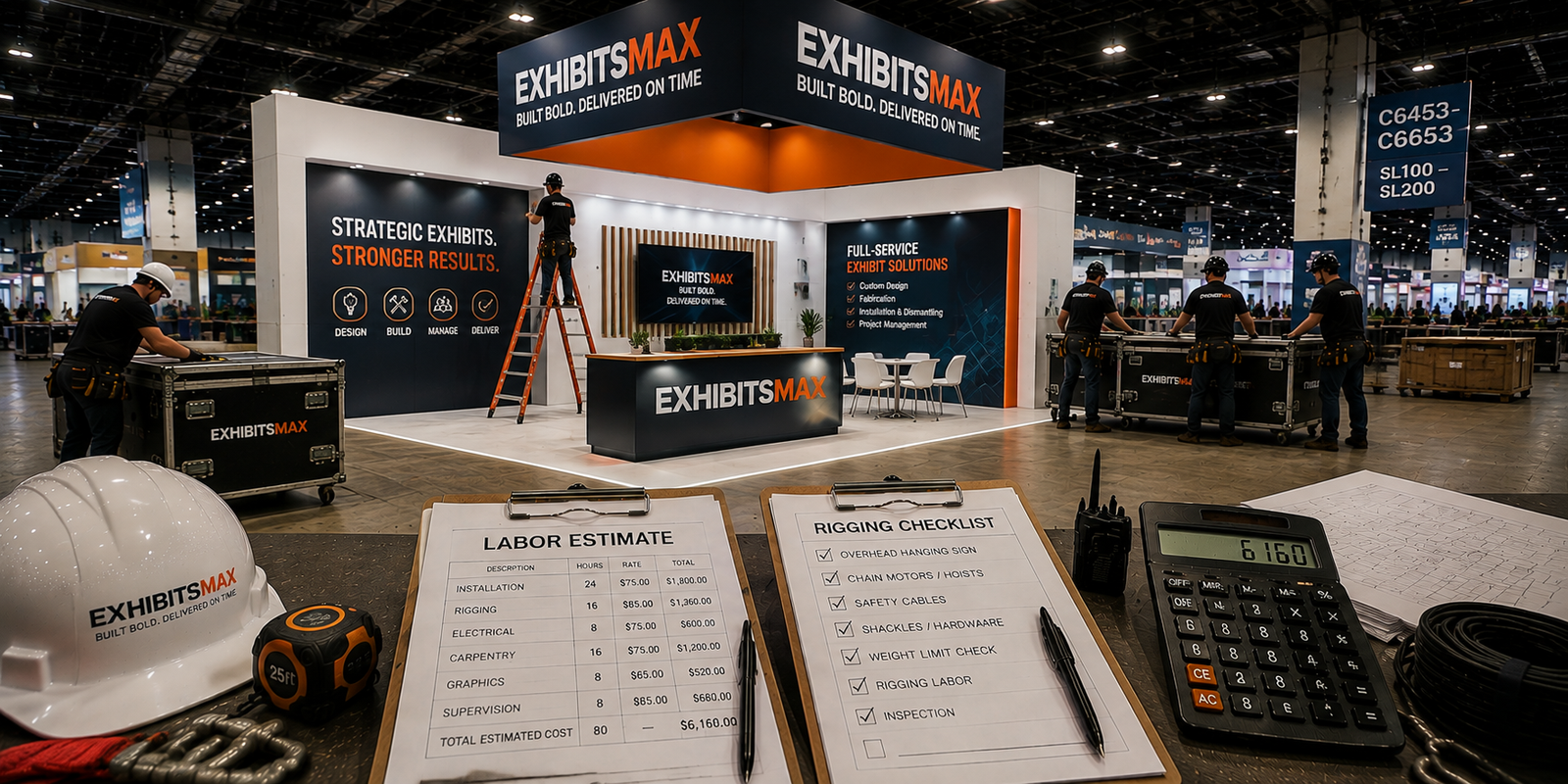
Trade Show Labor and Rigging Costs: What Exhibitors Should Plan For
Trade show labor and rigging costs are not universal rate-card items. They depend on the city, venue, show, appointed contractor, schedule, booth configuration, freight sequence, labor classifications, and current order forms.
The most reliable approach is to define the work first, then obtain the current rate sheet and rigging quote for the specific event. Not every booth needs rigging, but nearly every booth needs some level of installation and dismantling planning.
Labor vs. Rigging: What Is the Difference?
| Scope | What it generally covers | What exhibitors should confirm |
|---|---|---|
| Installation and dismantling (I&D) labor | Assembly of the booth scope, graphics, furniture, packing, and post-show dismantling according to the applicable work scope | Crew size, labor classification, schedule, minimum calls, and move-in or move-out sequence |
| Rigging | Approved overhead elements such as hanging signs, truss, motors, and certain lighting or LED configurations | Point locations, load, engineering, equipment, approval process, and current provider quote |
Labor and rigging are connected on some projects, but they are different cost systems. An island booth with a hanging sign may require both. A smaller inline booth may require I&D planning without any overhead rigging.
Labor and Rigging Cost Drivers at a Glance
| Cost driver | What changes the cost | What exhibitors should confirm |
|---|---|---|
| I&D labor | City, contractor, time band, crew size, and booth complexity | Current labor rate sheet and work scope |
| Overtime | Move-in and move-out schedule, daily hours, and labor definitions | Current straight-time, overtime, and double-time rules |
| Minimum calls | Show, city, contractor, and labor agreement | Current labor order form and minimum-hours requirement |
| Foreman or supervision | Crew size, work type, complexity, and venue requirements | Whether supervision is required and how it is quoted |
| Rigging points | Number, location, weight, and show-specific approval | Current rigging layout and provider quote |
| Motors and truss | Load, configuration, span, and equipment needs | Equipment pricing and availability for the event |
| Lift equipment | Height, access, structural configuration, and installation sequence | Required equipment, delivery, and operating scope |
| Engineering | Structure, overhead load, nonstandard elements, and rigging complexity | Drawing, review, and submission requirements |
| Waiting time | Freight, service, approval, or access delays | Installation sequence and responsibility for readiness |
Use these drivers to build a project-specific estimate. Do not assume that a rate, minimum call, or labor rule from another city or show applies to your event.
How Should You Build a Labor and Rigging Budget?
Start with the current exhibitor manual, labor order form, and official rigging-provider instructions. Then list the quantity to estimate and the source for each rate.
| Budget item | Quantity to estimate | Rate source |
|---|---|---|
| Install labor, straight time | Estimated crew hours | Current show labor rate sheet |
| Install labor, overtime or other time bands | Estimated crew hours by schedule | Current show labor rate sheet |
| Dismantle labor | Estimated crew hours | Current show labor rate sheet |
| Foreman or supervision | Required hours or shifts | Current labor order form or vendor quote |
| Rigging points | Number and location of points | Current rigging provider quote |
| Motors and truss | Required load, configuration, and duration | Current provider quote |
| Lift or specialty equipment | Required equipment and days | Current equipment or labor quote |
| Engineering or drawings | If required by structure or overhead elements | Vendor quote and current approval requirements |
| Contingency | Project-specific exposure | Internal budget based on known risks |
The budget should also identify which items are included in the booth-builder scope and which are ordered separately through the show, venue, or appointed contractor. See How Much Does It Cost to Produce a Trade Show Booth? and Hidden Trade Show Booth Costs Exhibitors Should Know for the broader cost picture.
Design Choices That Can Reduce On-Site Labor
Booth design affects more than appearance. It can influence crew time, access, packing, installation sequence, and the likelihood of onsite changes.
| Design choice | Potential labor impact | Trade-off to evaluate |
|---|---|---|
| Modular frames or repeatable structural components | Can simplify assembly and reuse | May limit some architectural forms or require early standardization |
| Tool-light or repeatable connection details | Can reduce assembly complexity | Must still meet structural and show-specific requirements |
| Pre-fitted graphics | Reduces onsite measuring and adjustment | Requires final artwork, proofing, and packing discipline |
| Lighter or efficiently packed components | Can simplify handling and transport | Material choice must still support finish, durability, and product needs |
| Ground-supported signage | May avoid an overhead-rigging scope in some designs | Can affect sightlines, footprint, and structural planning |
| Fewer nonstandard angles and one-off parts | Can reduce onsite assembly risk | May reduce architectural complexity or require design trade-offs |
| Pre-build and quality checks | Helps identify fit or graphics issues before move-in | Requires schedule and production coordination |
These choices do not guarantee a fixed savings amount. They create a more installable project and make the labor plan easier to estimate. For the design and production scopes that should be aligned early, see Trade Show Booth Design and Custom Booth Fabrication.
How Do Labor Rules and Show Schedules Affect the Plan?
Labor jurisdiction, exhibitor self-work allowances, electrical, rigging, material handling, and I&D procedures vary by city, venue, show, and appointed contractor. Confirm which tasks may be self-performed and which require particular trades using the current exhibitor manual and labor rules for the event.
Minimum labor calls also vary. Confirm the current order form before estimating crew hours or assuming a minimum number of hours per worker. The move-in and move-out schedule matters because the available work windows can affect staffing, time bands, freight timing, and the sequence in which work can start.
A practical planning sequence is:
- Confirm show dates, assigned hall, booth number, footprint, and move-in or move-out windows.
- Review the current exhibitor manual and official service-order deadlines.
- Define the booth structure, graphics, AV, electrical, hanging-sign, and product-display scope.
- Confirm freight arrival, material handling, and storage or empty-container plans.
- Build the labor and rigging quote from the actual work sequence.
For venue-specific planning, see the Las Vegas Convention Center Booth Planning Guide and Mandalay Bay Trade Show Booth Setup Guide.
Where Should You Confirm Current Labor and Rigging Requirements?
Use the current exhibitor manual, service order forms, and official contractor instructions for your specific event as the primary source. These documents identify the applicable services, deadlines, order forms, exclusivities, and submission requirements for that show.
Two useful official-contractor references explain the type of information to look for:
- Freeman's Quick Guide for International Exhibitors explains the role of the Exhibitor Services Manual and notes that some show or venue services may be exclusive.
- GES Rigging Regulations provide one show-specific example of the drawings and information required for a rigging review. Its deadlines and requirements apply to that event; confirm the current instructions for yours.
If a rule, rate, or deadline in a prior event document conflicts with the current manual, follow the current manual and confirm questions with the appointed provider before finalizing production or labor orders.
Rigging vs. Ground Support: How Should You Compare Them?
A hanging sign or overhead element can improve visibility, but it also introduces a separate review, equipment, scheduling, and installation path. Ground-supported solutions can be effective when the footprint, venue requirements, sightlines, and brand objective allow them.
| Consideration | Overhead rigging | Ground-supported design |
|---|---|---|
| Primary purpose | Suspends approved elements above the booth | Creates visible structures from the floor or booth base |
| Approval process | Often involves show-specific rigging review and provider coordination | May still require structural or venue review depending on configuration |
| Key inputs | Point locations, loads, motors, truss, drawings, and schedule | Footprint, height, base support, structure, and access |
| Project coordination | Must align with rigging provider, freight, and I&D sequence | Must align with booth build, floor plan, and installation sequence |
| Potential complexity | Can increase with load, height, and equipment configuration | Can increase with structure, height, or nonstandard engineering |
Choose the approach based on the brand objective and current event requirements, not only on a visual preference. Confirm the current show manual and the provider's instructions before finalizing a design that relies on overhead elements.
What Should You Verify in Labor and Rigging Quotes?
A clear quote should make the work sequence understandable. Before approval, confirm:
- The show, venue, booth number, footprint, and dates used for the quote
- The labor classifications, crew size, estimated hours, time bands, and minimum calls
- Whether the quote covers install, dismantle, packing, or all three
- The party responsible for graphics, furniture, AV, electrical, product displays, and waste removal
- Freight arrival, material-handling, access, and waiting-time assumptions
- Rigging point locations, loads, equipment, engineering, and approval responsibilities when applicable
- What is included, excluded, optional, or billed if the scope changes onsite
- The escalation path for delays, damage, or a change order
For a full explanation of the I&D scope, see What Is Included in Trade Show Booth Installation and Dismantling? and Installation & Dismantling.
How Can You Reduce On-Site Cost Risk?
The best protection is a complete pre-show sequence. Confirm the final floor plan, drawings, graphics, freight details, labor order, rigging approval, service orders, and onsite contacts before move-in.
Avoid assuming that a labor crew can begin before freight, access, services, or required approvals are ready. When different vendors are involved, define the handoff between freight, material handling, electrical, AV, rigging, booth installation, and dismantling. A named project owner can keep those dependencies visible. See Trade Show Project Management for the coordination scope.
Frequently Asked Questions
How much should I budget for trade show labor and rigging?
Use the current show labor rate sheet, official rigging provider quote, booth design, and move-in or move-out schedule to build the budget. Costs vary by city, venue, show, contractor, labor classification, equipment, and time band, so one national rate is not reliable.
Can my team install our booth to save money?
Self-work allowances vary by city, venue, show, and appointed contractor. Confirm the current exhibitor manual and labor rules before assigning work to your team or finalizing the labor plan.
What are rigging points?
Rigging points are approved locations in the venue structure from which qualified providers can suspend approved elements. The required points, loads, equipment, drawings, and approval process depend on the current show and booth configuration.
How can I avoid overtime or schedule-related charges?
Plan the work sequence early, use current move-in or move-out windows, align freight arrival with labor access, and confirm the applicable time bands before ordering labor. Overtime rules and minimum calls vary by event.
What documents may be needed for a rigging approval?
Requirements vary by show and provider. Confirm the current rigging instructions for drawings, point locations, loads, structural information, equipment, and submission deadlines before production.
Not Sure What Your Labor and Rigging Plan Will Cost?
Send Exhibitsmax your show name, venue, booth size, floor plan, booth design, move-in schedule, and any hanging-sign or overhead requirements. We can review the labor scope, installation sequence, and rigging requirements before you finalize the budget.