Exhibitsmax Logo
BOOTH COST

Hidden Trade Show Booth Costs Exhibitors Should Know

Published on July 27, 2026
Hidden Trade Show Booth Costs Exhibitors Should Know

Exhibiting at a trade show offers immense potential for growth, yet many businesses, particularly those new to the U.S. market, face the challenge of unforeseen expenses. These hidden trade show booth costs can quickly inflate budgets, turning an exciting opportunity into a financial strain. Based on our 15 years of experience helping exhibitors navigate U.S. trade shows, we understand the frustration of discovering these unexpected line items late in the planning process.

Hidden trade show booth costs refer to necessary but often overlooked expenses beyond the initial booth space and design, such as drayage, utility services, labor overtime, and potential fines, which are crucial for effective budgeting and maximizing trade show ROI. Understanding these costs early allows exhibitors to proactively allocate funds, avoid surprises, and ensure a smoother, more successful exhibition experience.

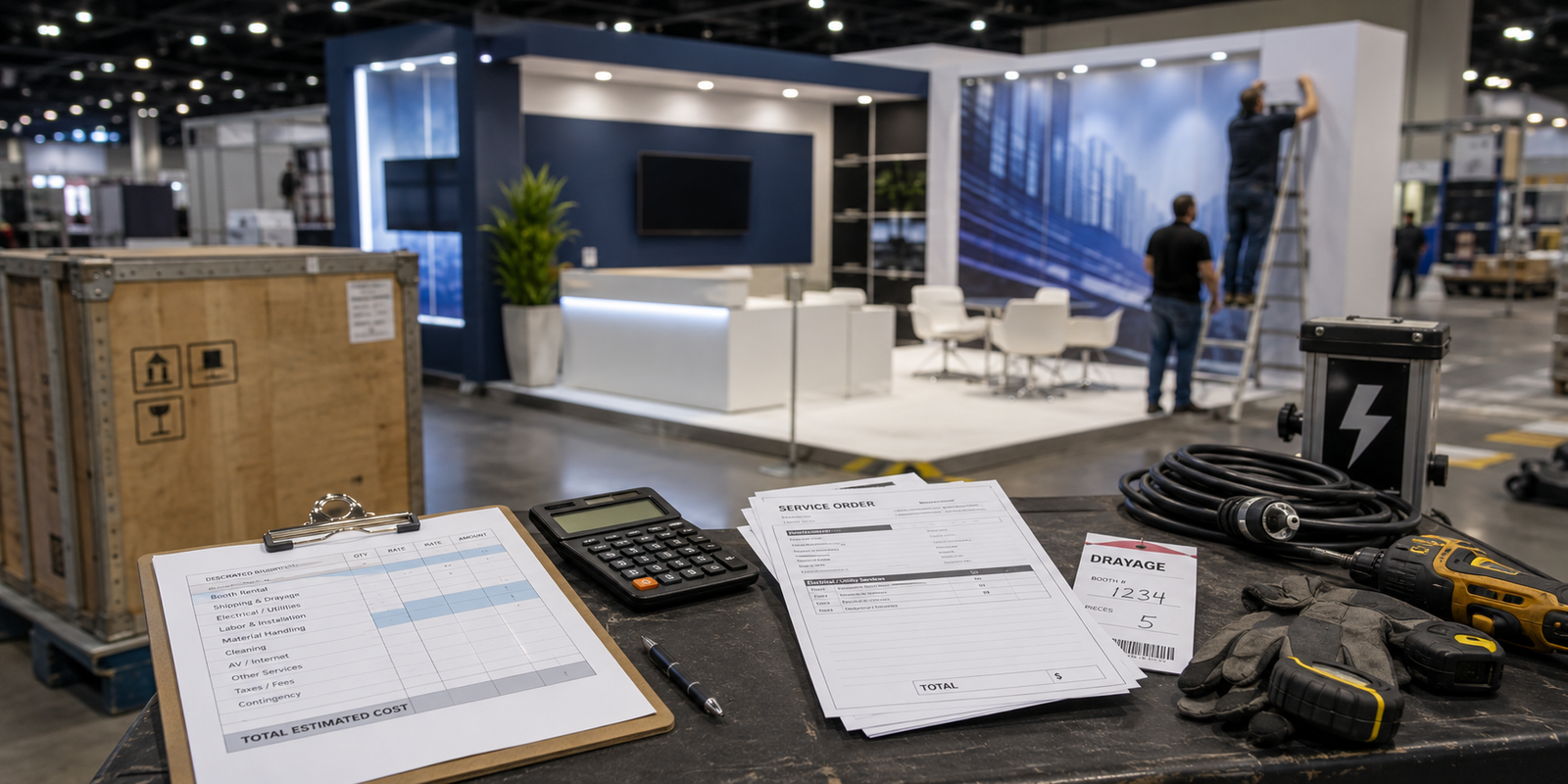
hidden trade show booth costs checklist

It’s easy to focus on the exciting aspects like booth design and marketing materials, but ignoring the operational realities can be costly. Let's delve into these frequently overlooked expenses, uncovering why they exist and, more importantly, how you can manage them.

Drayage: Why Does It Cost So Much?

Many exhibitors are surprised by the significant expense of drayage, often leading to budget shocks when their materials arrive on site. Are you prepared for the complex logistics and pricing models behind getting your booth materials from the dock to your specific exhibit space? This common, yet often misunderstood, trade show booth cost can easily derail an otherwise well-planned budget.

Drayage is the charge for transporting your exhibition materials from the designated freight receiving area at the exhibition venue to your specific booth space, removing empty containers, and then returning them for outbound shipment after the show.1 This essential logistical service is managed by the General Services Contractor (GSC) and covers the critical handling of your freight within the confines of the exhibition hall.

drayage cost for trade show booth

Dive Deeper: Understanding Drayage and Its Impact

Drayage is perhaps one of the most consistently underestimated hidden trade show booth costs. It's not just about moving a box; it involves a complex process within a highly regulated environment. We've seen firsthand how an international client, initially thrilled with their custom booth design, faced a substantial drayage bill they hadn't accounted for, impacting their overall ROI.

How Drayage is Calculated

The calculation of drayage is rarely straightforward. It's typically based on several factors:

The "Why" Behind the Cost

The high cost of drayage stems from several factors unique to the trade show environment:

  • Union Labor: Many exhibition venues operate under union contracts, meaning only authorized union labor can handle materials within the show floor.4 This specialized labor comes at a premium.
  • Specialized Equipment: Moving large, heavy, or oddly shaped exhibit components requires forklifts, cranes, and other specialized equipment, along with trained operators.
  • Logistical Complexity: The GSC manages thousands of shipments for hundreds of exhibitors, coordinating delivery and pick-up within strict timeframes and limited access points. This immense logistical challenge necessitates significant planning and resources.
  • Insurance and Liability: The GSC assumes liability for your freight once it’s in their possession, which is factored into their rates.
  • Empty Storage: A significant part of drayage includes the cost of storing your empty crates and boxes during the show and then returning them to your booth for packing at the end.

Managing and Mitigating Drayage Costs

While drayage is unavoidable, you can proactively manage this trade show booth cost:

  • Consolidate Shipments: Reduce the number of individual pieces and shipments. Every separate shipment might incur a minimum drayage charge.
  • Reduce Weight: Opt for lighter materials in your booth design and construction where possible. Our team at Exhibitsmax often advises on materials that balance durability with reduced shipping weight, helping clients save on drayage.
  • Crate Strategically: Crated shipments are generally less expensive to handle than loose or uncrated items. Ensure your crates are sturdy and clearly labeled.
  • Understand Shipping Options: Evaluate if advance warehousing or direct-to-site delivery is more cost-effective for your specific situation. Advance warehousing can sometimes offer better predictability.
  • Plan Ahead: Obtain drayage estimates from the GSC well in advance. We always recommend getting a clear understanding of these charges during the initial budgeting phase.
  • Work with Experts: Services like Exhibitsmax include project management that helps coordinate logistics, working directly with the GSC to minimize potential drayage overcharges and identify the most efficient shipping methods. We’ve guided international exhibitors through this process, ensuring their materials arrive efficiently and cost-effectively.

Utilities & Internet: Are These Essential Services Really Hidden?

You might assume that power and internet are included with your booth space, but this is rarely the case, making them significant hidden trade show booth costs. Have you factored in the specific electrical requirements of your displays or the critical need for reliable internet connectivity for your product demos? Failing to plan for these services can leave your technology unpowered or offline, severely impacting your presentation.

Utilities and internet connectivity are rarely complimentary with your raw booth space rental; exhibitors must order and pay for these services separately through the venue or its designated providers.5 These essential services are often priced based on usage, location, and installation complexity, adding distinct line items to your overall trade show budget.

trade show booth utility connections

Dive Deeper: Powering Your Presence and Staying Connected

The modern trade show booth relies heavily on technology, from LED video walls and product displays to charging stations and point-of-sale systems. Each of these requires power, and nearly all require internet. We've assisted numerous manufacturers and tech companies whose impressive product launches would have been stifled without adequate power and robust internet, which became unforeseen trade show booth costs.

Electrical Services: More Than Just an Outlet

Ordering electrical services is more complex than simply plugging into a wall. You need to consider:

  • Amperage & Voltage: Different equipment requires different power. A simple laptop might need a standard 120V outlet, but a large LED wall or a heavy-duty product demo machine might require a 208V circuit with higher amperage. Underestimating these needs can lead to tripping breakers or equipment not functioning.
  • Location of Drops: You don't just order power; you order where that power drops into your booth. Each electrical drop has a cost, and if you need multiple drops strategically placed, the cost multiplies.
  • Labor for Installation: While some basic connections might be included, intricate wiring or connections to specialized equipment often require a licensed electrician provided by the venue or GSC, adding to labor costs.
  • Continuous vs. Intermittent Power: Some services are priced for continuous power (24-hour), while others might be for show hours only.
  • Pricing Structure: Costs can vary significantly based on the total wattage required and the number of outlets. It’s not uncommon for a standard 5-amp, 120-volt outlet to cost hundreds of dollars for the duration of a show.

Internet Connectivity: Beyond Basic Wi-Fi

Reliable internet is no longer a luxury but a necessity for most exhibitors.

  • Public Wi-Fi vs. Dedicated Connection: While venues often offer free public Wi-Fi, it’s typically unreliable, slow, and unsecure due to the sheer number of users6. For critical tasks like product demos, lead capture systems, or payment processing, a dedicated wired internet connection or a premium Wi-Fi package is essential.
  • Bandwidth Requirements: Consider how many devices will be connected and what they will be doing. Streaming high-definition video, running interactive presentations, or uploading large files requires more bandwidth, which translates to higher costs.
  • Location and Installation: Similar to electricity, network drops need to be ordered for specific locations within your booth.
  • Security: Public networks are prone to security risks. A dedicated, private connection offers better security for sensitive business operations.

Managing Utility and Internet Costs

  • Detailed Electrical Plan: Before ordering, list every piece of equipment that requires power. Calculate total wattage/amperage needs. Work with your booth designer (like Exhibitsmax) to create an electrical plan that optimizes power distribution and minimizes drops. We often integrate power solutions directly into our custom booth designs, ensuring efficient and cost-effective delivery.
  • Prioritize Internet Needs: Determine which applications absolutely require robust internet. Can some tasks be done offline or with cellular hotspots as backup? For mission-critical operations, invest in a dedicated line.
  • Order in Advance: Like many trade show services, utilities and internet come with early bird discounts. Ordering on-site can incur significant surcharges.
  • Consider Alternatives: For light internet use, a secure, reliable cellular hotspot might be a cheaper alternative to venue Wi-Fi, but check venue regulations on their use.
  • Review Floor Plans: Understanding the venue's electrical grid and internet infrastructure can help plan your booth layout to minimize utility run costs.

Labor Overtime & On-Site Services: When Does the Clock Start Ticking?

The clock starts ticking earlier and runs later than many exhibitors realize, particularly concerning labor for installation and dismantling. Have you accounted for potential overtime charges for union labor or unexpected on-site service fees that arise during the busy setup and teardown periods? These can be significant hidden trade show booth costs that accumulate rapidly.

Labor overtime refers to additional charges incurred when specialized union labor for services like booth installation and dismantling operates outside standard work hours, which are common during compressed setup and teardown schedules. On-site services encompass various last-minute needs, from additional furniture to unexpected cleaning, all of which carry premium pricing due to immediate demand and limited availability.

trade show booth installation labor

Dive Deeper: The Nuances of Labor and On-Site Expenses

Labor is a critical component of any exhibition, particularly in the U.S. where many major venues utilize unionized workers for specific tasks. These trade show booth costs can quickly escalate if not managed correctly. We've helped numerous clients, especially international ones unfamiliar with U.S. labor rules, avoid hefty overtime bills through meticulous planning and coordination.

Understanding Labor Costs

  • Union Jurisdictions: In many U.S. cities, unions control specific services such as:
    • Installation & Dismantle (I&D): For setting up and breaking down your booth structure.
    • Electrical: Connecting power to your booth.
    • Plumbing: For exhibits requiring water.
    • Rigging: Hanging signs or heavy elements from the ceiling.
    • Material Handling: Drayage is executed by union labor.
  • Standard vs. Overtime Hours: Union labor rates have standard hours (e.g., 8 AM - 4:30 PM, Monday-Friday). Any work performed outside these hours – including evenings, weekends, or holidays – is charged at overtime rates, which can be 1.5x or even 2x the standard rate.7 During tight move-in and move-out windows, overtime becomes almost inevitable.
  • Minimum Charges: Even if a task takes only 15 minutes, you might be charged a minimum of one or two hours of labor.
  • Foremen/Supervisors: For larger installations, a foreman might be required, adding another layer of cost.
  • Jurisdiction Overlap: Sometimes, different unions claim jurisdiction over the same task (e.g., who connects the computer to the power). This can lead to delays and additional costs if not properly coordinated.

On-Site Service Costs

Beyond labor, a myriad of other services can become unexpectedly costly if ordered on-site:

  • Furniture & Accessories: Forgot a chair, a reception desk, or a wastebasket? Ordering these on the show floor will cost significantly more than if pre-ordered.8
  • Audiovisual Equipment: Last-minute projector, screen, or microphone rentals are subject to inflated on-site pricing and limited availability.
  • Cleaning Services: While basic aisle cleaning is often included, specific booth cleaning needs to be ordered separately and is more expensive if requested last-minute.
  • Storage: If you have extra boxes or items that don't fit in your booth, on-site storage can be expensive.
  • Shipping Materials: Need last-minute packing tape, bubble wrap, or shipping labels? The show site service desk will have them, but at a premium.

Managing Labor and On-Site Service Costs

  • Detailed Project Management: This is where an experienced partner like Exhibitsmax truly shines. We provide comprehensive project management, scheduling I&D labor during standard hours whenever possible and anticipating potential overtime needs to factor them into your budget. We work to optimize build schedules to minimize premium labor hours.
  • Early Planning & Ordering: Order all necessary furniture, AV, and special services well in advance through the exhibitor services kit. This secures better rates and ensures availability.
  • Comprehensive Packing List: Ensure everything you need for your booth (down to pens and paper clips) is packed in your shipment to avoid expensive on-site purchases.
  • Supervision: If you are managing your own I&D, have a knowledgeable supervisor on-site who understands the scope of work and can efficiently direct labor to avoid unnecessary hours.
  • Understand Your Build: For custom exhibits, having detailed instructions and pre-fabrication (which we do extensively) reduces on-site build time and labor hours, directly impacting your trade show booth costs.

Fines & Unexpected Fees: How Can I Avoid Penalties?

The dense rulebooks of trade shows contain numerous clauses that can lead to unexpected fines and penalties, turning a small oversight into a costly mistake. Are you aware of the regulations regarding exhibit height, fire codes, or even the disposal of waste that could incur significant unexpected hidden trade show booth costs? Avoiding these pitfalls requires careful attention to detail.

Fines and unexpected fees are penalties levied by show management or the venue for non-compliance with exhibitor rules and regulations, fire safety codes, environmental guidelines, or specific material handling procedures. These charges are often a result of overlooking fine print in the exhibitor service manual or making last-minute changes without proper approval.

trade show booth compliance officer

Dive Deeper: Navigating the Rulebook to Prevent Penalties

The exhibitor services manual (ESM) is a treasure trove of information, yet it's often overlooked. Ignoring its contents is one of the quickest ways to incur unforeseen trade show booth costs. We’ve seen international clients, unfamiliar with the nuances of U.S. regulations, face fines for issues that could have been easily avoided with proper guidance.

Common Sources of Fines and Fees

  • Exhibit Height Restrictions: Every venue and show has strict limits on booth height.9 Exceeding these without prior approval will result in a fine and potentially the forced modification or removal of your exhibit components.
  • Fire & Safety Codes:
  • Waste Management: Not properly disposing of construction waste (e.g., wood, plastic wrap, cardboard) into designated containers can lead to fees for special handling.
  • Vehicle Access & Loading Dock Rules: Staying past allotted loading dock times or parking in unauthorized areas can incur immediate penalties.
  • Floor Plan Deviations: Altering your booth layout or footprint without show management approval can lead to fines.
  • Sound & Noise Violations: Exceeding decibel limits for presentations or music.
  • Permit Fees: For certain types of exhibits (e.g., those involving food/beverage sampling, live demonstrations, or large structures), specific permits might be required, incurring fees.
  • Damage to Venue Property: Causing damage to the convention center floor, walls, or equipment.

The "Why" Behind the Penalties

Fines aren't levied arbitrarily. They exist to:

  • Ensure Safety: Many rules, particularly fire and safety codes, are in place to protect all exhibitors and attendees.
  • Maintain Order & Fairness: Regulations help manage the flow of traffic, ensure all exhibitors have a fair chance, and prevent one booth from negatively impacting another.
  • Venue & Contractor Operations: Rules surrounding logistics (e.g., loading dock times) are essential for the smooth operation of a massive event with hundreds or thousands of participants.

Preventing Fines and Unexpected Fees

  • Thoroughly Review the Exhibitor Services Manual (ESM): This document, provided by show management, is your bible. Read it cover to cover, paying close attention to deadlines, regulations, and forms.
  • Work with Experienced Booth Builders: Exhibitsmax is intimately familiar with U.S. venue regulations and common show rules. We design and build exhibits that comply with height limits, fire codes, and structural integrity requirements from the outset. This pre-emptive approach prevents costly on-site modifications or fines.
  • Plan for Waste: Budget for waste removal services, especially if you have significant build-out materials or packaging.
  • Adhere to Schedule: Stick to move-in and move-out schedules provided by the show. Being late for freight pick-up, for instance, can lead to forced freight costs.
  • Communicate Changes: If you need to make any significant changes to your booth design or operations on-site, always consult with show management first to get approval and understand any associated fees.
  • On-Site Project Management: Having an experienced project manager (like those at Exhibitsmax) on-site during move-in and move-out can be invaluable. They act as your advocate, ensuring compliance, preventing issues, and resolving problems quickly before they incur penalties. We help clients, particularly those without a local presence, navigate these complexities seamlessly.

Frequently Asked Questions

What is the average percentage of hidden costs in a trade show budget?

While highly variable, hidden trade show booth costs can account for anywhere from 20% to 50% of an exhibitor's total budget if not properly planned.11 Drayage, utilities, and labor overtime are commonly the largest unexpected expenses, underscoring the need for a detailed and comprehensive budgeting approach.

How can Exhibitsmax help us budget for these hidden costs?

Exhibitsmax provides comprehensive project management and detailed cost breakdowns from the outset. We help identify and estimate potential hidden trade show booth costs like drayage, utilities, and labor, integrating them into your budget plan. Our expertise minimizes surprises, ensuring you have a realistic financial projection for your U.S. trade show participation.

Are "all-inclusive" booth packages truly all-inclusive?

"All-inclusive" often refers to core elements like space, design, and basic structure, but typically excludes many hidden trade show booth costs like drayage, dedicated internet, specialized electrical drops, or on-site labor overtime. Always review the specific inclusions and exclusions of any package carefully.

What should an international exhibitor know about U.S. trade show costs?

International exhibitors should be acutely aware of U.S. union labor regulations, specific venue rules, and the pricing structures for drayage and utilities, which often differ significantly from other countries. Partnering with a local expert like Exhibitsmax is crucial to navigate these unique "hidden trade show booth costs" and ensure compliance.

Is it possible to completely avoid all hidden trade show booth costs?

While completely avoiding every single unexpected cost is challenging due to the dynamic nature of trade shows, you can significantly mitigate their impact by thorough planning, early ordering, and working with an experienced exhibition partner. This transforms potential "hidden" costs into predictable, managed budget items.

Conclusion

Understanding and proactively planning for hidden trade show booth costs is paramount to achieving a successful ROI from your exhibition efforts. From the complexities of drayage and the necessity of proper utilities to the nuances of labor overtime and the risk of fines, these expenses, if ignored, can quickly undermine your budget and impact your overall experience. Based on our 15 years of supporting exhibitors, we’ve seen how foresight and detailed project management can transform these "hidden" costs into manageable line items.

Don't let unexpected expenses diminish your trade show success. At Exhibitsmax, we specialize in helping businesses, especially international exhibitors and those new to the U.S. market, meticulously plan and execute their trade show strategies. Contact us today for a comprehensive consultation to ensure your next U.S. trade show budget is robust, realistic, and free from costly surprises. Let us help you maximize your impact while minimizing unforeseen expenses.


  1. "What Is Drayage for an Exhibitor?", https://arktransportation.com/what-is-drayage-for-an-exhibitor/. An exhibition-industry definition of drayage describes the receipt and movement of exhibitor freight to the booth, the handling or storage of empty containers during the event, and the return of materials for outbound shipment. Evidence role: definition; source type: institution. Supports: A trade show association or official exhibitor manual should define drayage/material handling as freight receipt, movement to the booth, empty-container storage, and return for outbound shipping..

  2. "drayage and material handling information", http://blasting.outreach.psu.edu/wp-content/uploads/2015/04/Penn-State-Expo-Drayage-Form.pdf. Published exhibitor service manuals commonly state material-handling rates on a per-hundredweight basis and apply a minimum billable weight or minimum charge, supporting the article’s description of how drayage is calculated. Evidence role: mechanism; source type: institution. Supports: Official exhibitor service manuals or rate sheets should show material-handling rates expressed per CWT and subject to minimum charges.. Scope note: Specific rates and minimums vary by show, venue, contractor, and shipment type.

  3. "A CUSTOM BOOTH? SHIPPING Exhibitor Service Manual ...", https://originalmiamibeachantiqueshow.com/wp-content/uploads/2025/12/EXPO-Material-Handling-Rates.pdf. Exhibitor material-handling rate schedules commonly classify uncrated or special-handling freight separately from crated freight and assign higher handling rates, consistent with the additional labor and care required. Evidence role: mechanism; source type: institution. Supports: Material-handling rate schedules should distinguish crated freight from uncrated or special-handling freight and show higher rates for the latter.. Scope note: The source would establish a common pricing pattern, while the exact relative cost depends on the event’s rate schedule.

  4. "Union Labor at Trade Shows", https://www.trisource-exhibits.com/union-labor-at-trade-shows/. Official exhibitor labor guidelines for U.S. trade shows often specify union jurisdictions for material handling, installation and dismantling, electrical work, or rigging, supporting the article’s statement that authorized labor may be required on the show floor. Evidence role: general_support; source type: institution. Supports: Venue or show labor guidelines should document that certain tasks are reserved for official or union labor in many U.S. convention settings.. Scope note: Labor jurisdictions are local and show-specific, so the evidence would support the general pattern rather than a universal rule.

  5. "Contact - Custom Trade Show Booth Builder in Las Vegas ...", https://exhibitsmax.com/contact/. Venue exhibitor-service forms commonly list electrical drops and internet connections as separately ordered services with their own fees, supporting the article’s statement that these services are generally not included in raw booth-space rental. Evidence role: general_support; source type: institution. Supports: Official venue or show service forms should show electrical and internet services as separately ordered exhibitor services.. Scope note: This would document common practice across manuals or venues, but individual booth packages may include limited utilities.

  6. "Securing Wireless Networks", https://www.cisa.gov/news-events/news/securing-wireless-networks. Government cybersecurity guidance warns that public Wi-Fi networks can expose users to interception and other security risks; this supports the article’s caution about using public venue networks for sensitive exhibitor operations. Evidence role: mechanism; source type: government. Supports: Government cybersecurity guidance should support the security-risk portion of the claim, while network-capacity sources can support the performance issue in crowded environments.. Scope note: Government guidance directly supports the security risk, while claims about slowness and reliability require additional network-performance evidence or venue-specific data.

  7. "Overtime - California Department of Industrial Relations", https://www.dir.ca.gov/dlse/faq_overtime.htm. Published exhibitor labor rate schedules commonly distinguish straight time from overtime and double time, with premium rates applied to evenings, weekends, holidays, or other nonstandard work periods. Evidence role: statistic; source type: institution. Supports: Exhibitor labor rate sheets should show straight-time, overtime, and double-time billing categories.. Scope note: The exact multiplier and time windows depend on local labor agreements and the specific show manual.

  8. "EXHIBITOR SERVICE MANUAL", https://njcpa.org/app_docs/EventBrochures/Conv25_ExhibitorKit.pdf. Exhibitor service kits frequently publish separate advance and standard or on-site rates for rentals and services, demonstrating that late orders can carry higher prices than preordered items. Evidence role: statistic; source type: institution. Supports: Official exhibitor service kits should show lower advance-order prices and higher standard or on-site rates for furniture or services.. Scope note: The evidence would show common rate structures, but the size of the surcharge varies by event and service provider.

  9. "Guidelines for Display Rules and Regulations", https://exhibitorpages.com/AMC-2025/AMC-2025-display-guidelines.pdf. Industry display guidelines and exhibitor manuals commonly specify maximum exhibit heights by booth configuration, supporting the article’s statement that booth height is a regulated design parameter. Evidence role: general_support; source type: institution. Supports: Industry display guidelines or exhibitor manuals should show that booth-height limits are commonly specified by booth type and show rules.. Scope note: Such sources support the prevalence of height rules, but the word “every” may overstate variation across all venues and event formats.

  10. "Fire and Life-Safety Group (FLS)", https://www.colorado.edu/firelifesafety/media/11. Fire-code provisions and venue safety rules commonly require decorative materials, fabrics, and similar exhibit components to be flame resistant or flame retardant, supporting the article’s identification of non-fire-rated materials as a compliance risk. Evidence role: expert_consensus; source type: government. Supports: Fire-code or official safety guidance should require decorative materials, fabrics, and certain exhibit components to meet flame-resistance standards.. Scope note: Specific testing standards and enforcement procedures vary by jurisdiction, venue, and event.

  11. "Trade Show Costs: A Complete Breakdown for Exhibitors", https://www.buzzimpressions.com/trade-show-costs/. Exhibitor budget research that reports the share of total exhibiting costs attributable to logistics, material handling, utilities, labor, and on-site services would support the article’s estimate that overlooked operational costs can form a substantial portion of the total budget. Evidence role: statistic; source type: research. Supports: A research report or industry survey should quantify how much logistics, services, labor, and other non-space expenses contribute to total exhibiting budgets.. Scope note: Unless the source reports the exact 20%–50% range, it would provide contextual support for the magnitude of these costs rather than direct verification of the stated range.