Exhibitsmax Logo
BOOTH COST

How Much Does It Cost to Produce a Trade Show Booth?

Published on June 22, 2026
How Much Does It Cost to Produce a Trade Show Booth?

I know booth costs can feel unclear. I see exhibitors worry about budgets, hidden fees, and last-minute changes before the show even starts.

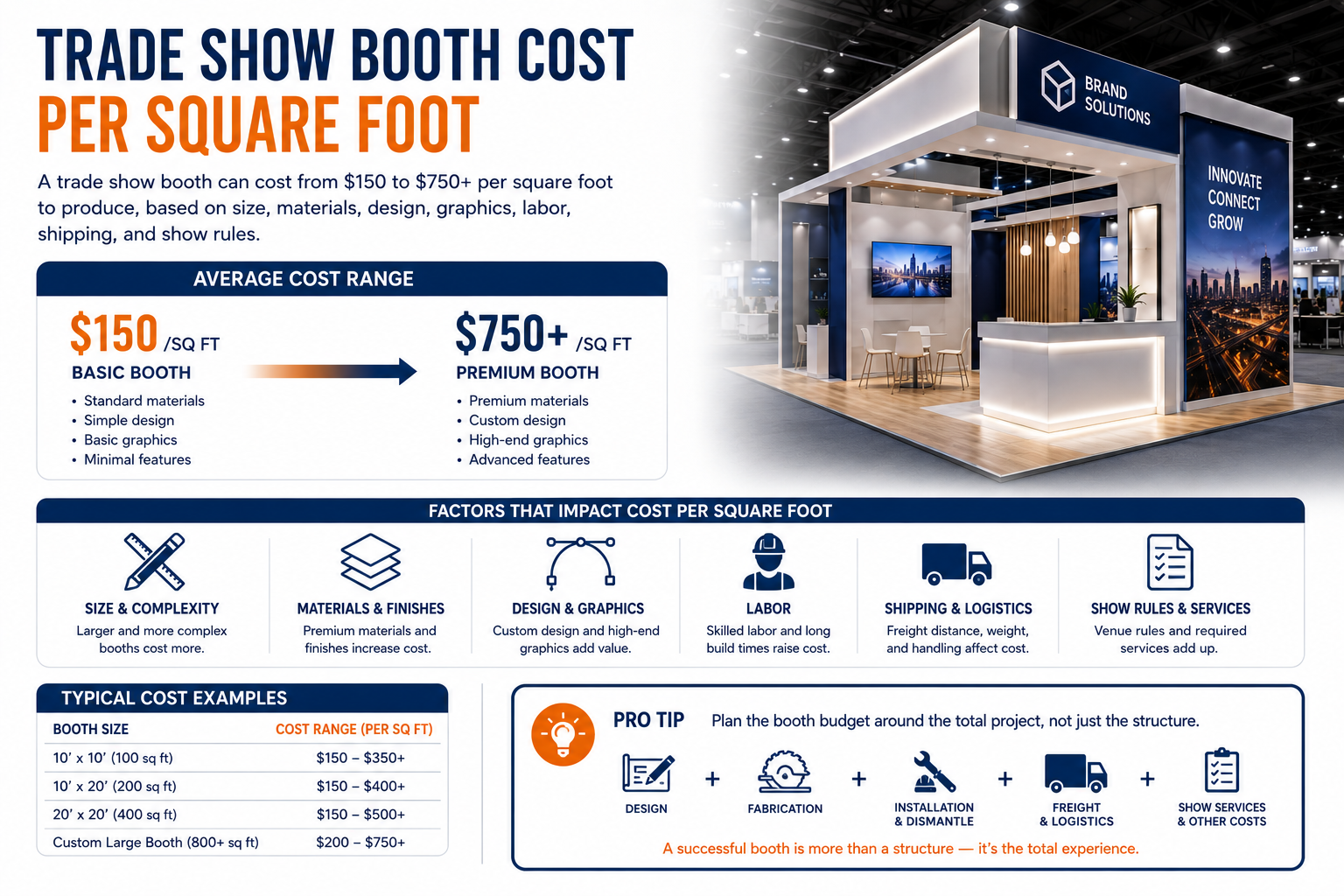
A trade show booth can cost from $150 to $750+ per square foot to produce1, based on size, materials, design, graphics, labor, shipping, and show rules. I usually tell exhibitors to plan the booth budget around design, fabrication, installation, freight, and services, not only the structure.

trade show booth production cost

I have worked with many exhibitors who first ask for “just a booth price.” I understand that question. I also know the real answer needs more detail. A 10x10 booth with printed walls is not priced like a custom 20x30 island booth with storage, lighting, flooring, and LED screens. A booth is not only a display. It is a small brand environment that must be designed, built, shipped, installed, used, and removed on a fixed schedule. If one part is missed, the full cost can change fast.

What Is the Average Cost Range for a Trade Show Booth?

I see many exhibitors feel stuck at the first step. They want a fast number, but booth prices change because every show and booth goal is different.

The average production cost for a trade show booth often starts around $5,000 to $15,000 for a simple 10x10 booth.2 A larger custom booth can cost $30,000 to $150,000 or more3, based on design, materials, labor, and show services.

average trade show booth cost

I usually start with booth size because size affects nearly every cost. A 10x10 inline booth needs fewer materials and less labor. A 20x20 island booth needs more structure, more lighting, more graphics, and more planning. A 30x50 booth can become a full project with meeting rooms, demo areas, hanging signs, storage, and AV. I also remind exhibitors that the booth space fee from the show organizer is not the same as booth production. The organizer sells the floor space. The exhibit builder produces the booth.4

Common booth production ranges

Booth Type Common Size Typical Production Range What I Usually Include
Basic inline booth 10x10 $5,000–$15,000 Backwall, graphics, small counter, basic lights
Larger inline booth 10x20 $10,000–$30,000 Wider wall, more graphics, product display, flooring
Small island booth 20x20 $30,000–$80,000 Custom structure, reception, storage, lighting
Mid-size island booth 20x30 or 30x30 $60,000–$150,000 Demo areas, meeting space, raised signs, AV
Large custom booth 30x50+ $150,000+ Multi-zone design, high-end build, heavy AV, complex labor

I use these numbers as planning ranges, not fixed promises. I have seen a small booth cost more when the design used premium materials and detailed lighting. I have also seen a large booth stay controlled when the exhibitor reused parts and kept the layout simple. The cost depends on the booth goal. If the goal is lead capture, I focus on flow and clear messaging. If the goal is brand launch, I may suggest stronger visuals and a more custom build.

What Are the Main Parts of a Booth Production Budget?

I often see exhibitors miss costs because they only think about walls and counters. That mistake can cause stress when service orders and labor invoices arrive.

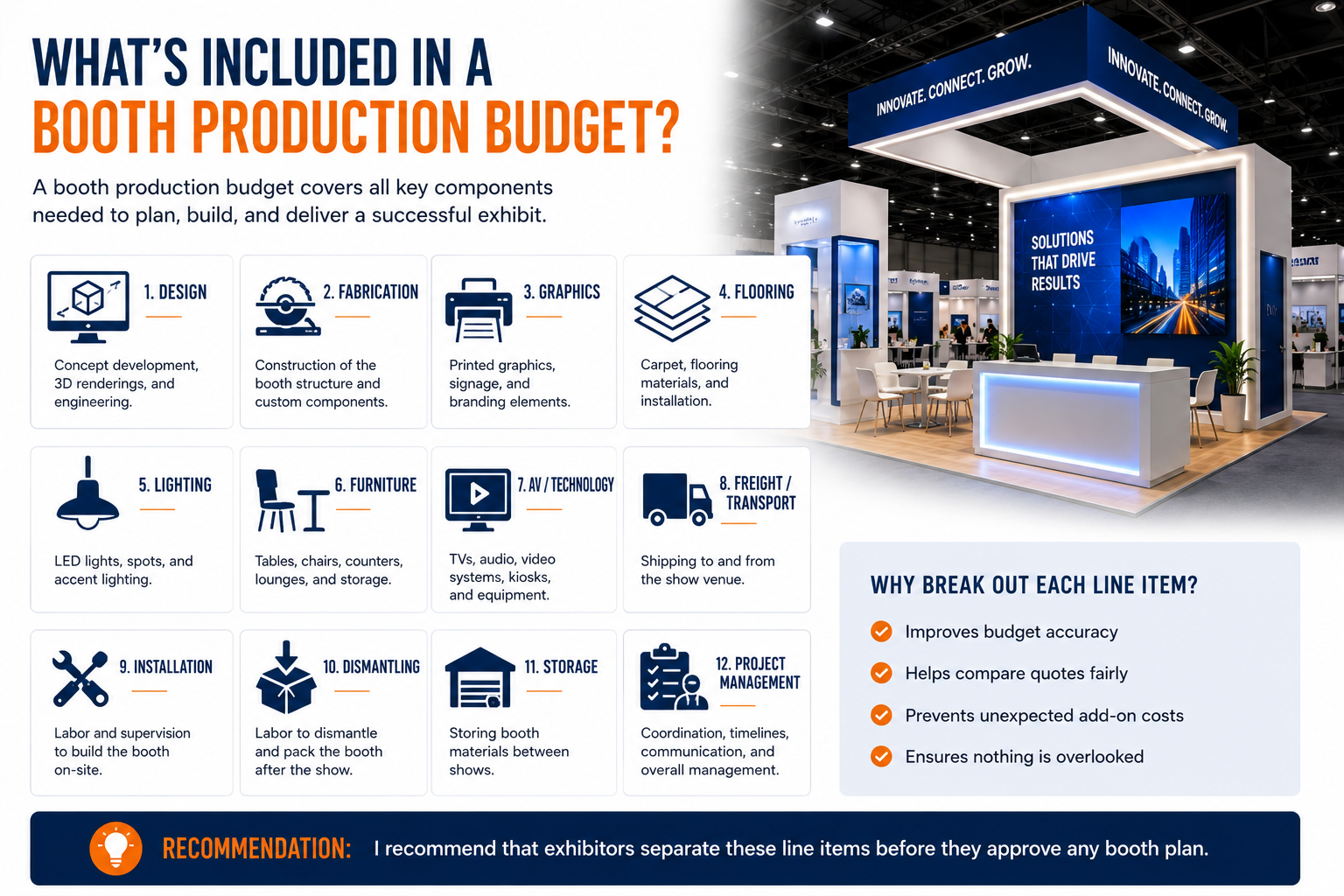
A booth production budget usually includes design, fabrication, graphics, flooring, lighting, furniture, AV, freight, installation, dismantling, storage, and project management.5 I recommend that exhibitors separate these line items before they approve any booth plan.

trade show booth budget breakdown

I break the booth budget into clear parts because this helps the exhibitor see where the money goes. Design is the planning stage. Fabrication is the physical build. Graphics make the message visible. Flooring affects comfort and appearance. Lighting changes how products and brand colors look. AV can increase attention, but it can also raise cost fast. Freight moves the booth to the venue. Installation and dismantling are required at most U.S. trade shows. Project management keeps the schedule and orders under control.

Typical budget categories

Budget Item What I Mean Why It Matters
Design Layout, 3D renderings, structure planning I need a clear plan before anything is built
Fabrication Wood, metal, laminate, acrylic, hardware I need the booth to look good and install safely
Graphics Printed fabric, SEG, vinyl, rigid panels I need the brand message to be visible
Flooring Carpet, vinyl, raised floor, padding I need the booth to feel finished
Lighting LED arms, spotlights, internal lights I need products and graphics to stand out
AV Screens, LED walls, media players, audio I need attention and product explanation
Freight Shipping to advance warehouse or show site I need booth parts to arrive on time
I&D labor Install and dismantle labor I need trained crews to build under show rules
Storage Post-show warehouse handling I need reuse plans to stay practical
Project management Orders, permits, schedules, vendor control I need fewer surprises before show opening

I like to tell exhibitors that booth cost is not only a product cost. It is also a time cost and a risk cost. A cheaper booth can become expensive if it is hard to install. A beautiful booth can fail if the graphics arrive late. A strong budget should include a small cushion. I often suggest a 10% to 15% buffer when the project has custom parts, tight timing, or many vendors.6 This buffer can protect the exhibitor from small changes that are common in U.S. trade shows.

How Does Booth Size Change the Final Cost?

I see size become the biggest cost driver because it changes materials, labor time, freight weight, and show service needs at the same time.

Booth size affects cost because larger booths need more structure, more graphics, more flooring, more freight, and more installation labor.7 I often see costs rise faster when a booth changes from inline space to island space.

booth size and trade show cost

I always ask for the booth size early because the size controls the design rules. A 10x10 inline booth usually has height limits and sidewall limits.8 A 20x20 island booth usually allows more open design, but it needs to look good from all four sides. That means I cannot treat the back of the booth as hidden. Every side may need finished surfaces, graphics, counters, or product displays. This increases the cost per project, even if the cost per square foot may not rise the same way.

How size changes the work

Size Factor Smaller Booth Larger Booth
Structure Simple backwall or modular wall Custom build, overhead elements, storage rooms
Graphics One or two main prints Many branded surfaces and large prints
Labor Shorter install time More crew hours and more show coordination
Freight Fewer crates or cases More crates, pallets, and handling
Utilities Basic power More power, internet, rigging, and AV needs
Visitor flow One entry point Multiple paths, demo zones, meeting areas

I also pay attention to the exhibitor’s business goal. A small booth can work well for meetings and lead scanning. A larger booth is useful when the exhibitor needs live demos, product samples, private talks, or a stronger brand image. I once worked on a project where the client wanted to move from a 10x20 booth to a 20x20 booth. The floor space doubled, but the planning work more than doubled because the booth needed open traffic flow, storage, and product stations on several sides. That is why I never price a booth by size alone. I use size as the starting point, then I look at the experience the exhibitor wants to create.

How Do Materials and Design Choices Affect Booth Price?

I often see exhibitors focus on looks first. That is normal, but every finish, curve, lightbox, and display choice has a cost behind it.

Materials and design choices affect booth price because custom shapes, premium finishes, backlit graphics, LED walls, and special product displays need more fabrication time and higher material costs. I recommend matching design choices to the show goal.

custom booth materials and design cost

I believe good booth design should support the business goal. It should not only look expensive. A clean booth with clear graphics can perform better than a complex booth with weak messaging. I still understand why exhibitors want strong design. In a crowded hall, the booth must stop people. The question is where to spend the money. I often suggest spending on the parts people see first. This can include the main header, the front counter, the product display zone, and the hero graphic.

Design choices that change cost

Design Choice Lower-Cost Option Higher-Cost Option
Walls Modular panels Custom wood walls or shaped structures
Graphics Standard printed panels SEG fabric, backlit graphics, large seamless prints
Counters Rental counters Custom reception counters with storage
Lighting Basic booth lights Integrated LED lighting and spotlights
Product display Shelves or tables Custom pedestals, locking cases, demo stations
Media Standard monitor LED video wall or large interactive screen
Finish Simple laminate High-end laminate, acrylic, metal, specialty paint

I usually guide exhibitors to think in levels. Level one is “clear and functional.” Level two is “branded and polished.” Level three is “custom and premium.” Not every exhibitor needs level three. A startup may need a smart rental booth with strong graphics. A global brand may need custom fabrication because the booth must match a full brand system. I also think about reuse. A custom counter may cost more now, but it can be used at several shows. A very show-specific structure may look great once, but it may be hard to reuse. I try to balance first-show impact with long-term value.

What Extra Costs Should I Expect at a U.S. Trade Show?

I see many international exhibitors get surprised by U.S. show costs. They know the booth price, but they do not expect drayage, union labor, and service deadlines.

Extra U.S. trade show costs can include material handling, electrical service, internet, rigging, cleaning, waste removal, labor overtime, forklift service, and late order fees.9 I recommend checking the exhibitor manual before the booth design is finalized.

hidden trade show costs in the United States

I spend a lot of time reading exhibitor manuals because U.S. shows have specific rules. Each venue and general contractor may handle services in a different way. Material handling, often called drayage, can be one of the biggest surprises.10 This is the fee for receiving freight, moving it to the booth, storing empty crates, and returning them after the show. It is not the same as shipping. A booth can be shipped to the venue, then still require material handling inside the venue.

Common extra show costs

Extra Cost What I Mean Why I Watch It
Material handling Moving freight inside the show system It can be charged by weight
Electrical Power drops, outlets, labor AV and lights need correct power
Internet Wired or wireless service Demos and lead systems may need it
Rigging Hanging signs or overhead items It needs approval and special crews
Cleaning Vacuuming, trash removal The booth must look clean each day
Labor overtime Work outside regular hours Tight schedules can trigger this cost
Forklift Heavy item movement Large crates and machines may need it
Late fees Orders after discount deadlines Missed dates raise the cost

I also tell exhibitors to plan around time. Late design approvals can create rush printing. Late freight can create show-site delivery fees. Late service orders can miss discount rates.11 I have seen a booth stay within fabrication budget but go over total budget because service orders were placed too late. This is why I keep a project calendar. I track artwork deadlines, production deadlines, shipping dates, service order dates, and installation dates. A good booth budget needs both money control and time control.

Is It Cheaper to Rent or Build a Custom Trade Show Booth?

I often hear this question when exhibitors want a strong booth but do not know how many U.S. shows they will attend each year.

Renting a booth is usually cheaper for one show or a short test.12 Building a custom booth can be better when I plan to reuse the same exhibit at several shows and need a very specific brand experience.

rent vs custom trade show booth cost

I see rental booths work well for international exhibitors entering the U.S. market. A rental booth reduces storage concerns and allows the exhibitor to test the market. It can still look custom when the design uses strong graphics, good lighting, and selected custom elements. A custom booth makes more sense when the exhibitor has a long show schedule, a stable brand direction, and a need for exact finishes or special product displays. The custom booth may cost more at the start, but the cost can spread across several shows.

Rental booth vs custom booth

Choice Best For Cost Pattern Main Benefit
Rental booth One show, market test, tight timeline Lower first cost Less storage and faster setup
Hybrid booth Several shows, flexible brand needs Medium cost Rental frame with custom graphics or parts
Custom booth Repeated shows, strong brand control Higher first cost Full control and better reuse potential

I often suggest a hybrid booth when the exhibitor wants value and brand impact. The main structure can be rented. The graphics, reception counter, product displays, or video wall can be customized. This gives the booth a unique look without requiring a full custom build. I also look at freight and storage. A custom booth can become costly if it needs large crates and long-term storage. A rental booth may avoid some of those costs, but the exhibitor does not own the structure. I usually ask one simple question: “How many shows will this booth serve?” If the answer is one, rental is often better. If the answer is five or more, custom may deserve a closer look.

How Can I Control Booth Costs Without Hurting the Brand?

I know exhibitors want to save money, but I also know a cheap-looking booth can hurt trust on a crowded show floor.

I control booth costs by setting priorities early, reusing components, simplifying custom shapes, choosing smart rental parts, approving artwork on time, and ordering show services before discount deadlines. Good planning saves more money than last-minute cutting.

control trade show booth cost

I try to protect the brand first, then I look for savings. I do not like removing the most visible parts of the booth just to reduce the number. I prefer to simplify hidden areas, reduce complex construction, or use rental systems where the visitor will not notice the difference. I also like to reuse counters, monitors, flooring, and graphic frames when possible. Reuse is one of the simplest ways to lower future show costs.

Practical ways I reduce cost

Cost Control Method How I Use It What It Protects
Set a target budget I design within the real number I avoid redesign and delay
Reuse booth parts I plan sizes and crates for future shows I lower long-term cost
Use rental structures I rent frames and walls when they fit I save on fabrication and storage
Keep shapes simple I avoid complex curves unless needed I reduce labor and material waste
Prioritize hero areas I spend on the most visible parts I protect brand impact
Approve early I lock artwork and production details I avoid rush fees
Order services early I meet discount deadlines I reduce show service costs

I also ask exhibitors to share the show plan for the full year. If I know the booth will travel to Las Vegas, Chicago, Orlando, and Anaheim, I can design with shipping and reuse in mind. If I only know about one show, the design may not fit the next venue. I have learned that cost control starts before the first rendering. It starts with clear goals, clear product needs, and clear dates. A booth does not become affordable by accident. It becomes affordable when each choice has a reason.

Conclusion

I price booth production by scope, not guesswork. I plan design, build, freight, labor, and services together so the full cost stays clear.


  1. "How Much Does It Cost to Produce a Trade Show Booth?", https://www.edecorp.com/blog/produce-trade-show-booth-cost/. Industry cost benchmarks for trade show exhibits support a broad per-square-foot production range, with substantial variation by size, fabrication complexity, graphics, labor, freight, and show services; such figures should be treated as planning estimates rather than fixed market prices. Evidence role: statistic; source type: institution. Supports: Independent exhibit-industry benchmarks place booth production costs in a broad per-square-foot range that varies by booth size, materials, and service requirements.. Scope note: Contextual support; exact prices vary by city, show rules, labor jurisdiction, and project scope.

  2. "Unveiling the Hidden Trade Show Costs You Need to Consider", https://www.moddisplays.com/post/unveiling-the-hidden-trade-show-costs-you-need-to-consider?srsltid=AfmBOoo2C4zjAiCDX4OxrURx_xp7AK9RMOdvGaQNDMYIBKaKjNQvefWt. Exhibit-industry cost benchmarks indicate that basic 10x10 inline exhibits commonly require several thousand dollars in production costs, with higher totals when graphics, lighting, flooring, freight, and labor are included; the benchmark is best read as a planning range rather than a universal average. Evidence role: statistic; source type: institution. Supports: Published exhibit-industry cost guides or benchmark surveys provide typical budget ranges for small inline booth production.. Scope note: Contextual support; the cited range may depend on whether rental components, labor, freight, or show services are included.

  3. "Trade Show Booth Cost - Exhibit Experience", https://exhibitexperience.com/cost-of-exhibiting/. Trade show exhibit cost benchmarks support that larger custom booths may require five- or six-figure production budgets, especially when custom fabrication, large-format graphics, lighting, audiovisual systems, and installation labor are included; the evidence establishes plausible ranges, not a guaranteed price for any single booth. Evidence role: statistic; source type: institution. Supports: Industry benchmark data show that larger custom exhibits can move into five- and six-figure production budgets depending on scope.. Scope note: Contextual support; project-specific design decisions and venue service rates can materially change the final cost.

  4. "Exhibitor Contract Terms and Conditions - ASHA Convention", https://convention.asha.org/exhibitors/exhibitor-contract-terms-and-conditions/. Exhibition-management guidance distinguishes the purchase of exhibit floor space from the separate procurement of exhibit design, construction, logistics, and on-site services; this supports the distinction in roles but does not determine the amount charged by any specific organizer or builder. Evidence role: definition; source type: institution. Supports: Trade show management resources distinguish exhibit-space rental from separate exhibit design, construction, and service costs.. Scope note: Contextual support; terminology and contracting practices can differ between shows.

  5. "[PDF] Helpful Resources", https://agr.mt.gov/_docs/marketing-docs/tradeshows/TradeShowTrainingGuide_Resources.pdf. Exhibitor planning materials commonly separate exhibit budgets into design, construction or rental, graphics, flooring, lighting, furniture, audiovisual equipment, freight, installation and dismantling, storage, and project-management or service-order costs; the source supports the budget framework rather than exact percentages for each line item. Evidence role: general_support; source type: education. Supports: Exhibitor planning guidance identifies the same categories as common components of an exhibit budget.. Scope note: Contextual support; not every booth uses every category.

  6. "Contingency - Are you Covered? - PMI", https://www.pmi.org/learning/library/contingency-are-covered-6099. Project-management and event-budgeting guidance supports the use of contingency reserves to manage uncertain costs, with percentage-based reserves commonly used for projects with schedule pressure, custom work, or multiple suppliers; this supports the practice of adding a buffer but does not prove that 10% to 15% is optimal for every exhibit. Evidence role: expert_consensus; source type: institution. Supports: Project-management and event-budgeting guidance commonly recommends contingency reserves for uncertain costs, often expressed as a percentage of the total budget.. Scope note: Contextual support; the proper contingency depends on risk level, contract terms, and cost certainty.

  7. "Cost of Building a Trade Show Booth in the USA in 2026 - Propshop", https://thepropshop.us/blog/cost-of-building-a-trade-show-booth-in-the-usa-in-2026. Exhibit-planning guidance supports the mechanism that larger booth footprints generally require more physical materials, graphics coverage, flooring, freight handling, and installation labor, all of which can increase total project cost; this is a general cost relationship rather than a precise pricing formula. Evidence role: mechanism; source type: institution. Supports: Exhibit-planning sources explain that booth size influences the quantity of materials, graphics, flooring, shipment weight or volume, and installation labor.. Scope note: Contextual support; modular reuse, lightweight materials, and simple designs can reduce the size-cost relationship.

  8. "[PDF] IAEE Guidelines for Display Rules and Regulations - NCSI", https://www.ncsi.com/wp-content/uploads/2019/04/iaee-guidelines-for-display.pdf. Standard display guidelines for exhibitions describe inline booths as spaces that are commonly subject to backwall height limits and sidewall or line-of-sight restrictions; this supports the design-rule claim while leaving final authority to each show’s exhibitor manual. Evidence role: definition; source type: institution. Supports: Standard exhibition display rules describe height and sidewall restrictions for inline booths.. Scope note: Contextual support; individual events may publish different or stricter rules.

  9. "Quick Guide: The International Exhibitor - Freeman", https://www.freeman.com/resources/quick-guide-the-international-exhibitor/. Exhibitor manuals and convention-center service documents commonly list material handling, electrical service, internet, rigging, cleaning, waste removal, overtime labor, forklift service, and late-order charges as separately billable services; the evidence supports the existence of these categories, not their cost at a particular event. Evidence role: general_support; source type: institution. Supports: Exhibitor manuals and convention-center service documents list these categories as common separately billed trade show services.. Scope note: Contextual support; fee availability and billing rules vary by venue, contractor, and show.

  10. "Trade Show Material Handling or Drayage Strategies", https://insights.ges.com/us-exhibitor-roadmap/trade-show-material-handling. Exhibitor-service definitions describe material handling, or drayage, as the receipt, movement, storage of empty containers, and return handling of exhibit freight within the show system, typically billed separately from transportation to the venue; this supports the distinction but not the relative size of the fee in every show. Evidence role: definition; source type: institution. Supports: Exhibitor-service materials define drayage or material handling as the on-site movement and handling of freight, often billed separately from shipping.. Scope note: Contextual support; whether it is one of the largest surprise costs depends on shipment weight, venue, and contractor rates.

  11. "[PDF] Book 1 - Agriculture", https://agr.mt.gov/_docs/marketing-docs/tradeshows/TradeShowTrainingGuide_Track1.pdf. Exhibitor service kits commonly use advance-order deadlines that offer discounted rates before a specified date and standard or higher rates afterward; this supports the timing-based cost claim, although the exact deadlines and fee increases are show-specific. Evidence role: case_reference; source type: institution. Supports: Exhibitor service kits often set advance-order deadlines with lower rates and higher standard or late rates after the deadline.. Scope note: Contextual support; some services or events may not offer advance discounts.

  12. "Exhibit Rental vs Purchase: How to Make the Best Budget Decision", https://skyline.com/blog/exhibit-rental-vs-purchase. Event-budgeting and exhibit-planning guidance supports the economic mechanism that rental exhibits can reduce upfront fabrication, ownership, and storage costs for one-time or short-term use, whereas custom ownership may become more favorable when capital costs are amortized across multiple shows; this supports the general comparison but not a universal financial outcome. Evidence role: mechanism; source type: education. Supports: Budgeting guidance supports that renting can reduce upfront capital, storage, and ownership costs for short-term use, while ownership becomes more relevant when costs are spread across repeated use.. Scope note: Contextual support; total cost depends on rental pricing, customization, freight, labor, storage, and number of future shows.