
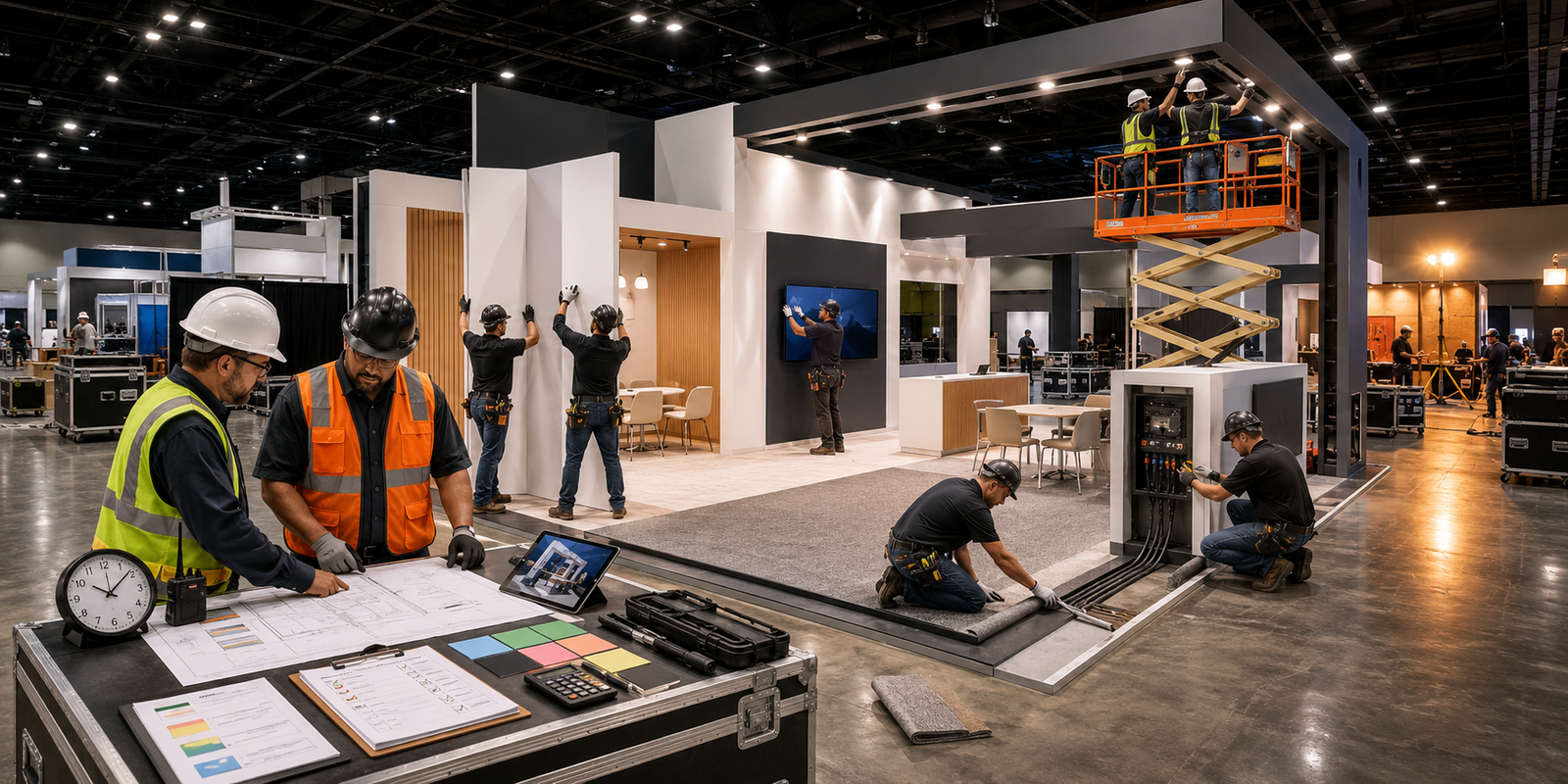
Union labor cost for booth installation in Las Vegas can feel opaque when you first plan a U.S. trade show. The rules are real, and the rates change by show, venue, and contractor. That can create budget shock. With the right planning, I can turn this “fixed” expense into a controllable line item without risking compliance.
In Las Vegas, union labor for booth installation typically ranges from $110–$160 per hour at straight-time, $165–$240 at overtime, and $220–$320 at double-time, with a four-hour minimum per person per call.1 Costs vary by venue, show contractor (e.g., Freeman, GES), trade (carpenters, riggers, electricians), shift, and show-specific rules. Always confirm in the show manual.
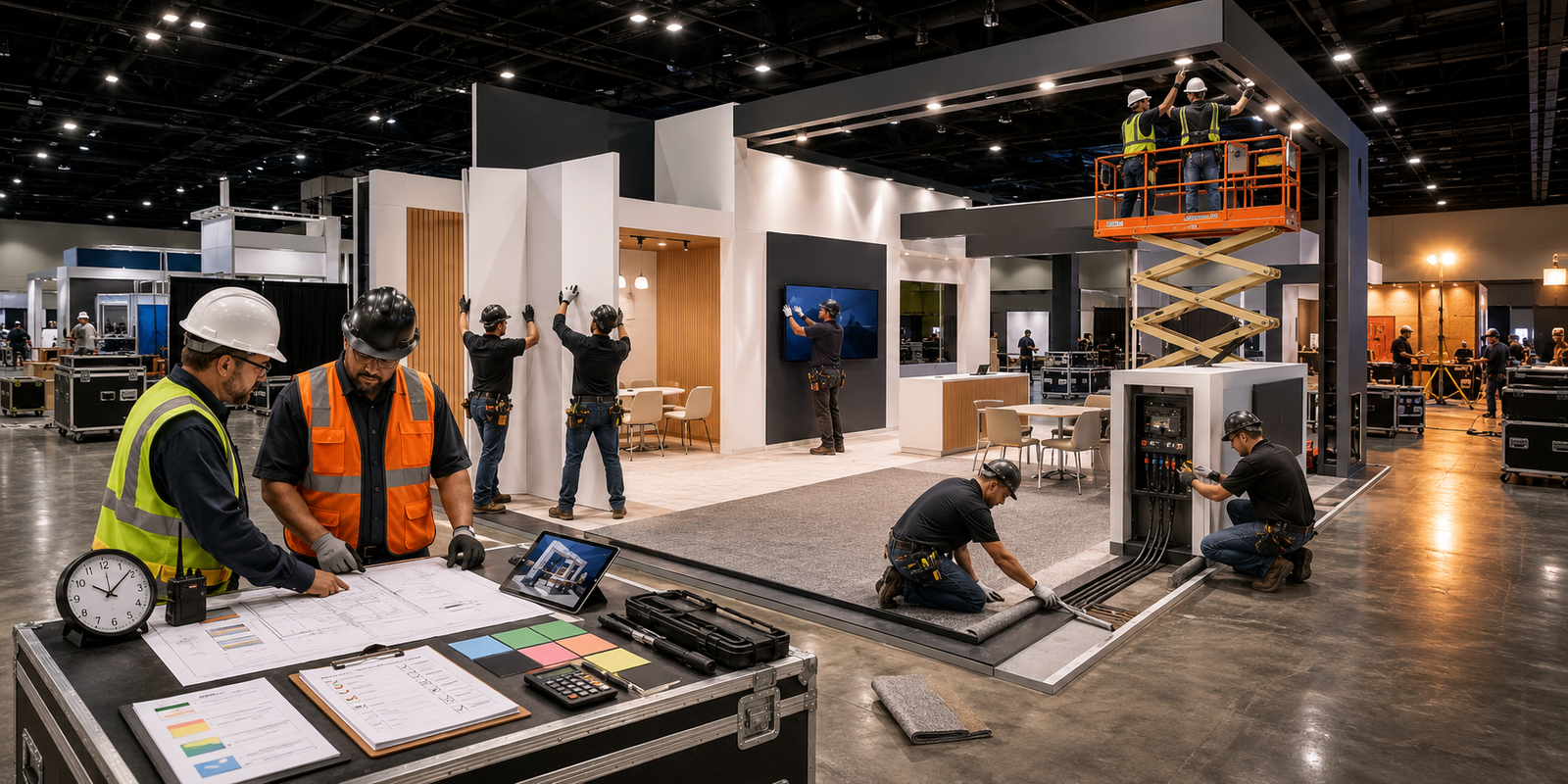
Union rules are not guesswork. They are published in each show’s exhibitor manual, and they vary by contractor and venue. Below I break down what drives cost, which tasks require union labor, and how I routinely optimize labor plans for international exhibitors without cutting corners.
What makes up union labor cost for booth installation in Las Vegas?
You need to know the parts before you can control the whole. Exhibitors often only look at the hourly rate. That misses the real drivers like minimums, premium time, crew mix, and supervision. I have seen well-intentioned teams pay 25–40% more than necessary because they ignored these hidden levers.
The short answer: Union labor cost for booth installation in Las Vegas is a combination of hourly rates by trade (straight-time, overtime, double-time), four-hour minimums per call, potential show-floor supervision fees, and surcharges tied to shift, holidays, or specialized work like rigging and electrical. General contractor and venue policies strongly influence totals.
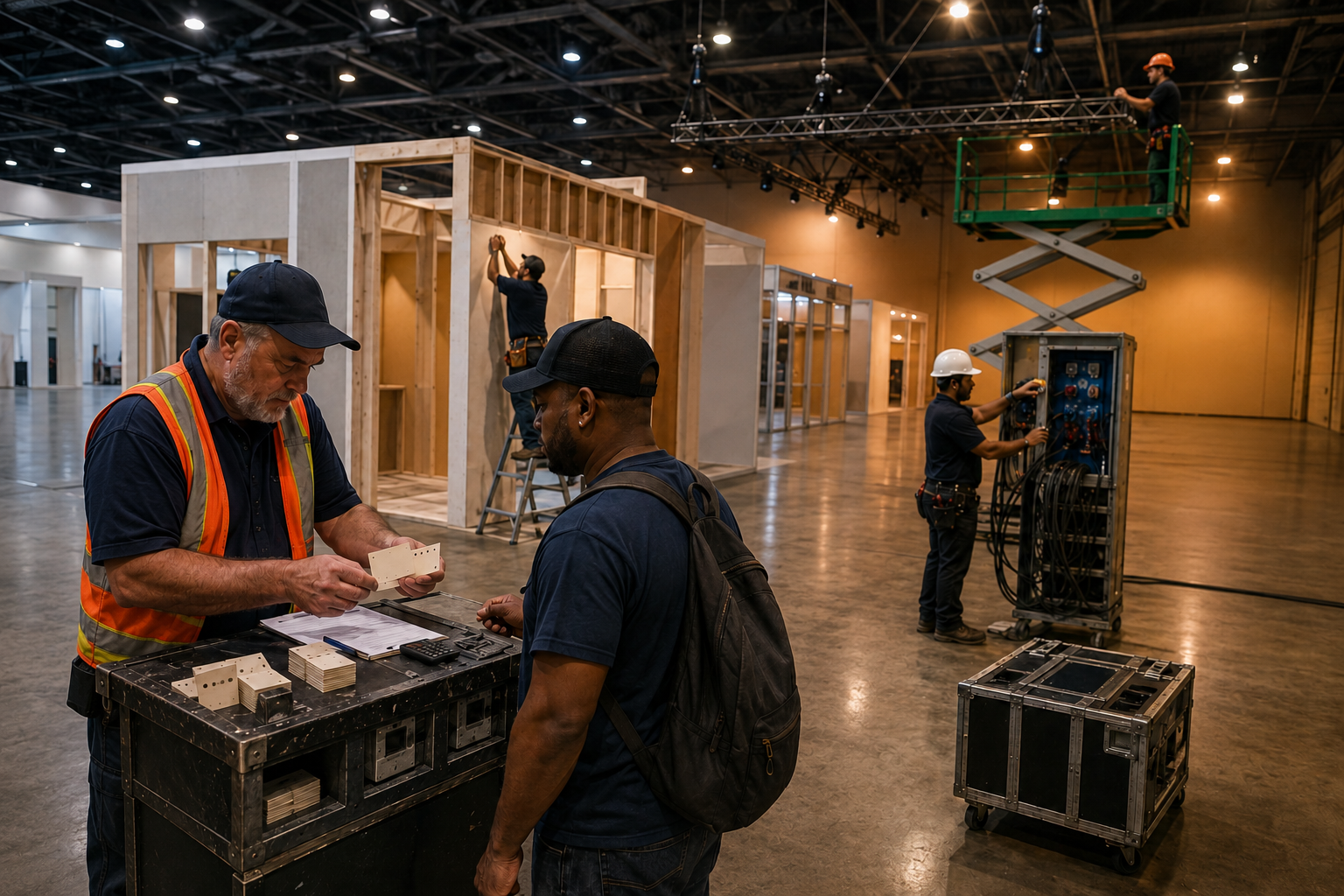
The core components I budget
- Hourly rates by trade:
- Carpenters/Installation & Dismantle (I&D): often $110–$160 ST, $165–$240 OT, $220–$320 DT
- Riggers (for hanging sign/overhead): often 10–20% above I&D2
- Electricians (exclusive provider like Edlen): similar to or slightly above I&D
- Teamsters/material handling: billed differently (see exclusives below)
- Time classifications:
- Straight-time (ST): typically weekday daytime hours
- Overtime (OT): evenings and Saturdays
- Double-time (DT): Sundays and holidays
- Minimums:
- Four-hour minimum per person per call is standard. A 90-minute task can cost four hours per worker if you call separately.
- Supervision:
- Option A: Exhibitor supervises (you must be present during install/dismantle).
- Option B: Show-site supervision by the contractor can add 25–35% to labor hours or a fixed fee.3 Useful for complex builds or late arrivals.
- Specialized surcharges:
- Rigging requires certified riggers and often special equipment.
- Electrical services are handled by exclusive providers; rates and minimums are separate from I&D.4
- Small tools or equipment fees may apply (cordless kits, lifts, etc.).
From our work with international exhibitors, I see two common missteps: 1) Calling partial crews multiple times and paying multiple four-hour minimums. 2) Accepting OT/DT due to late freight arrival that could have been avoided by meeting the target move-in.
A successful strategy I implemented for a 20×30 medical device booth was consolidating calls into one morning ST window and sequencing the carpenters and riggers. That alone cut 12 man-hours of OT and saved roughly 22% of labor spend.
Which tasks require union labor in Las Vegas?
The biggest budgeting risk is doing tasks that seem harmless but conflict with union rules. In Las Vegas, some services are exclusive, and others are union-only unless performed by your own full-time employees. I never promise workarounds. I help clients stay compliant and efficient.
The short answer: Material handling, rigging, and electrical are typically exclusive services in Las Vegas and must be performed by authorized crews. I&D carpentry must be performed by union labor unless done by your own full-time company employees. Hand-carry rules allow limited self-move-in with no equipment. Always verify specifics in your show manual.
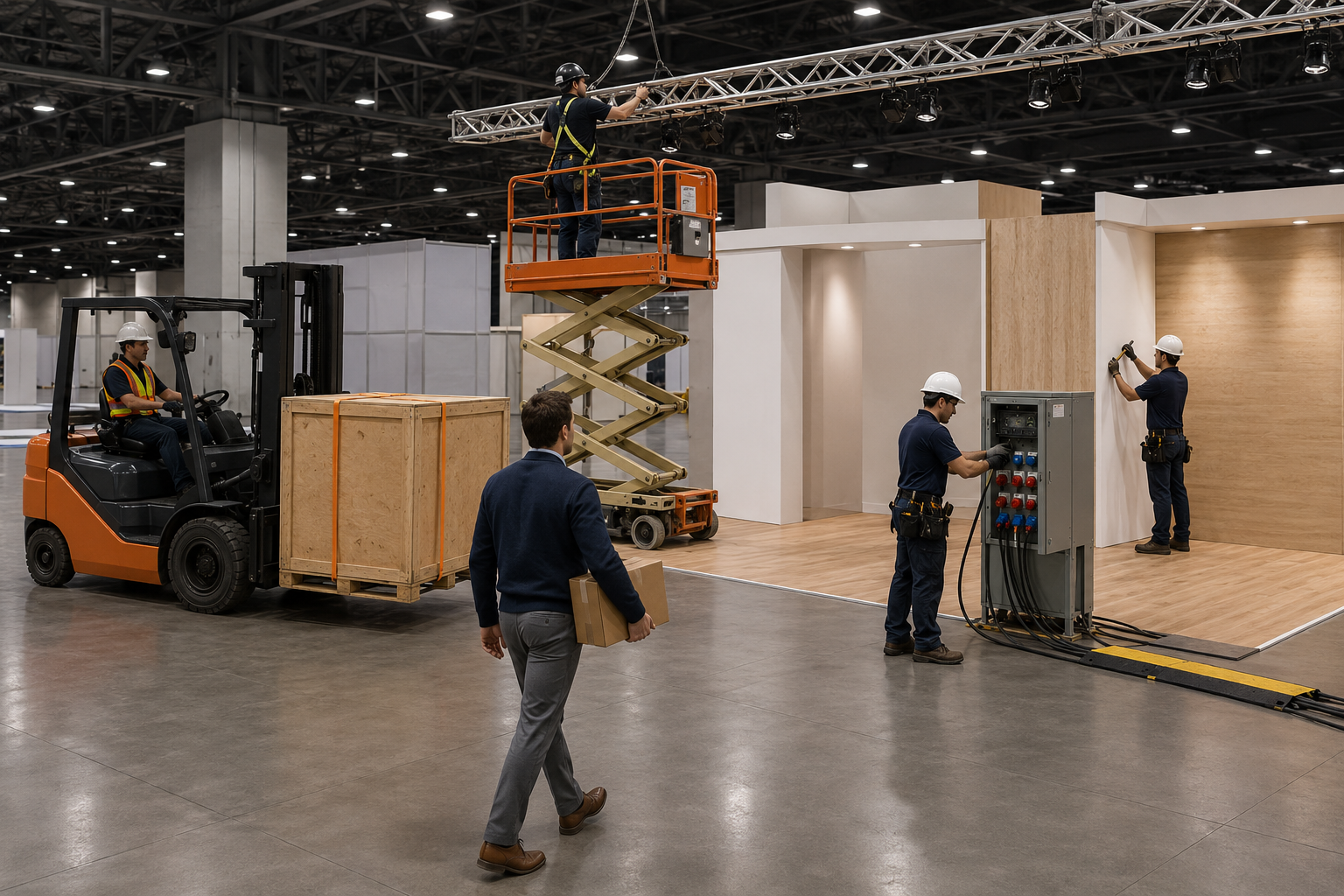
What the rules usually mean on site
- Material handling (a.k.a. drayage): Exclusive to the general contractor. Only they move freight from dock to booth and back. Teamsters operate forklifts and pallet jacks. Exhibitors cannot use their own or hired equipment.5
- Rigging: Exclusive to certified rigging teams. Hanging signs and overhead elements require union riggers and facility approval. Plan for lift rentals and a rigger crew.
- Electrical: Exclusive or venue-appointed (e.g., Edlen). Only licensed electricians can install floor power, run cables under carpet, and connect to mains. Exhibitors may connect simple devices after outlets are installed.
- I&D carpentry: Union carpenters perform installation and dismantle unless your own full-time employees do the work. They must carry company ID, be on your payroll, and follow safety rules. Temporary staff do not qualify.6
- Hand-carry: You may bring small items by hand or with a small personal cart from your vehicle, within strict limits. No forklifts, pallet jacks, or motorized equipment by exhibitors.7
We once supported a startup that tried to roll heavy crates from the parking lot on a rental pallet jack. The steward stopped them, and the general contractor charged standby plus material handling to correct the situation. The fix doubled what simple advance planning would have cost. The lesson: understand exclusives and plan within them.
How do venues and contractors affect union labor cost for booth installation in Las Vegas?
I see rates change not just by city but across Las Vegas venues and even by show. That confuses first-timers. The venue’s exclusive providers and the event’s general contractor set the framework that determines your labor cost profile and available scheduling windows.
The short answer: Contractor (e.g., Freeman, GES) and venue (LVCC, Mandalay Bay, The Venetian Expo) dictate rate cards, time windows, and exclusives.8 Their definitions of straight-time, overtime, and double-time differ by show schedule. Your union labor cost for booth installation in Las Vegas hinges on these published rules.
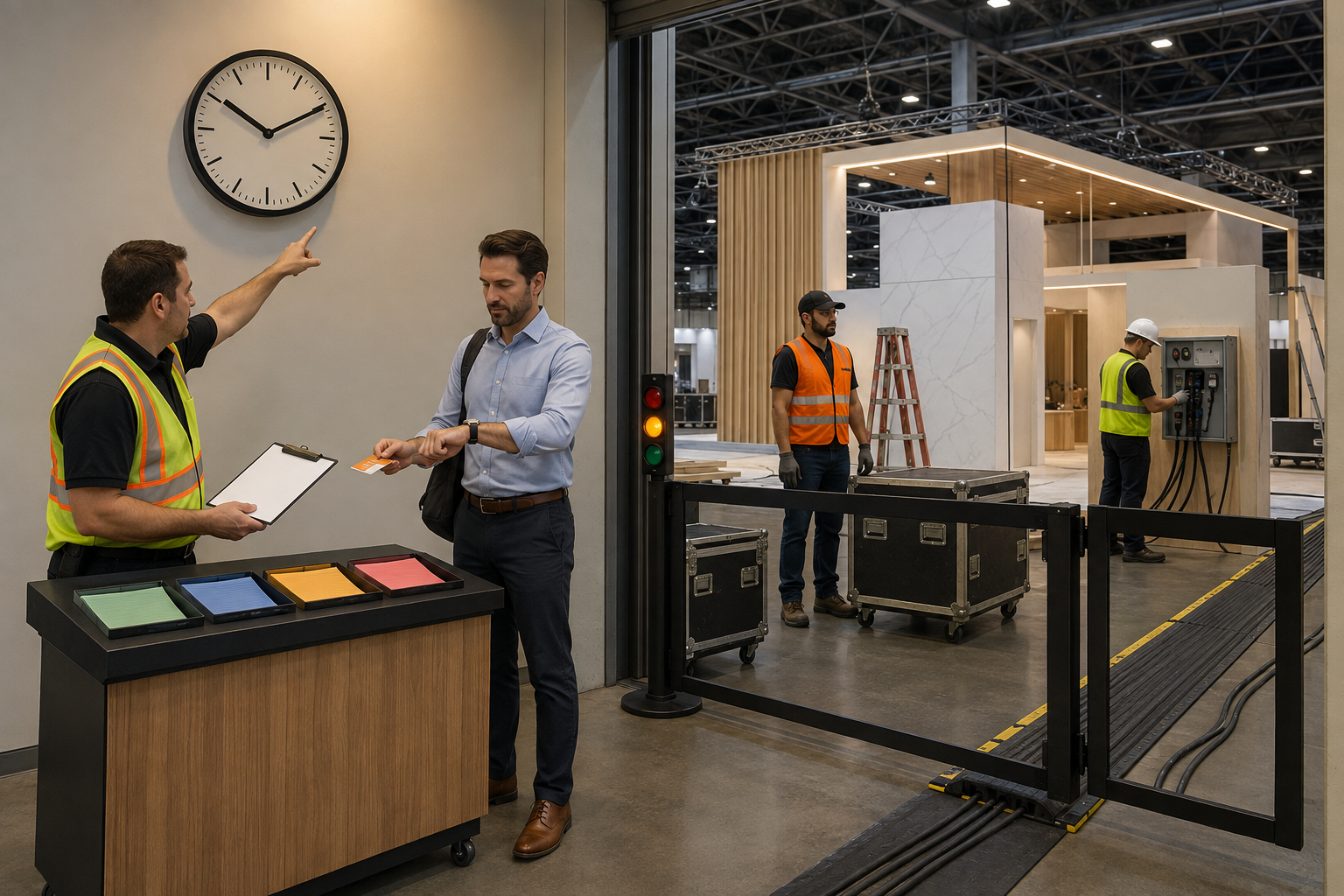
What varies by venue and contractor
- Work-hour definitions:
- Some shows define ST as 8:00–5:00 Mon–Fri. Others shift ST earlier/later. Sundays are often DT.
- Rate cards:
- The same contractor may post slightly different rates by show. Always check the current exhibitor kit.
- Exclusives:
- Electrical provider, internet, and rigging policies can differ by venue. Your build plan must respect each exclusive.
- Marshaling and target times:
- Targeted move-in/out windows can force OT if you miss your slot.9 Local traffic and event overlaps matter.
- Lift and equipment access:
- Shared equipment is scheduled tightly on big shows. Late requests often mean OT or delays.
I maintain a show-by-show playbook. For example, at the Las Vegas Convention Center during a large tech show, we planned a two-shift install because the last mile congestion would push late crates into OT. We shipped early to the advance warehouse, booked rigging first thing on ST, then scheduled carpenters to follow. That sequencing protected the budget when the dock backed up midafternoon.
Typical rate range reference (planning only; confirm your show’s kit)
| Trade/Service | Straight-Time (ST) | Overtime (OT) | Double-Time (DT) | Notes |
|---|---|---|---|---|
| I&D Carpenters | $110–$160/hr | $165–$240/hr | $220–$320/hr | 4-hr minimum per person per call |
| Certified Riggers | +10–20% over I&D | +10–20% | +10–20% | Lift fees extra |
| Electricians | $120–$170+/hr | $180–$255+ | $240–$340+ | Exclusive provider (e.g., Edlen) |
| Show-Site Supervision | 25–35% add-on | 25–35% | 25–35% | Or fixed fee per project |
These are planning ranges I see across major Las Vegas shows. Your exhibitor manual and order forms always take precedence.
What strategies reduce union labor cost for booth installation in Las Vegas without breaking rules?
You cannot “avoid” union labor in Las Vegas for exclusive tasks. You can, however, structure the work so you pay for fewer premium hours and zero duplicates. This is where I spend most of my time with clients: building a schedule that respects rules and avoids waste.
The short answer: To lower union labor cost for booth installation in Las Vegas, consolidate calls to avoid multiple four-hour minimums, schedule high-hour tasks in straight-time windows, pre-stage and pre-build components, sequence rigging before carpentry, and ship to the advance warehouse to avoid dock delays. Use show-site supervision only when it protects schedule risk.
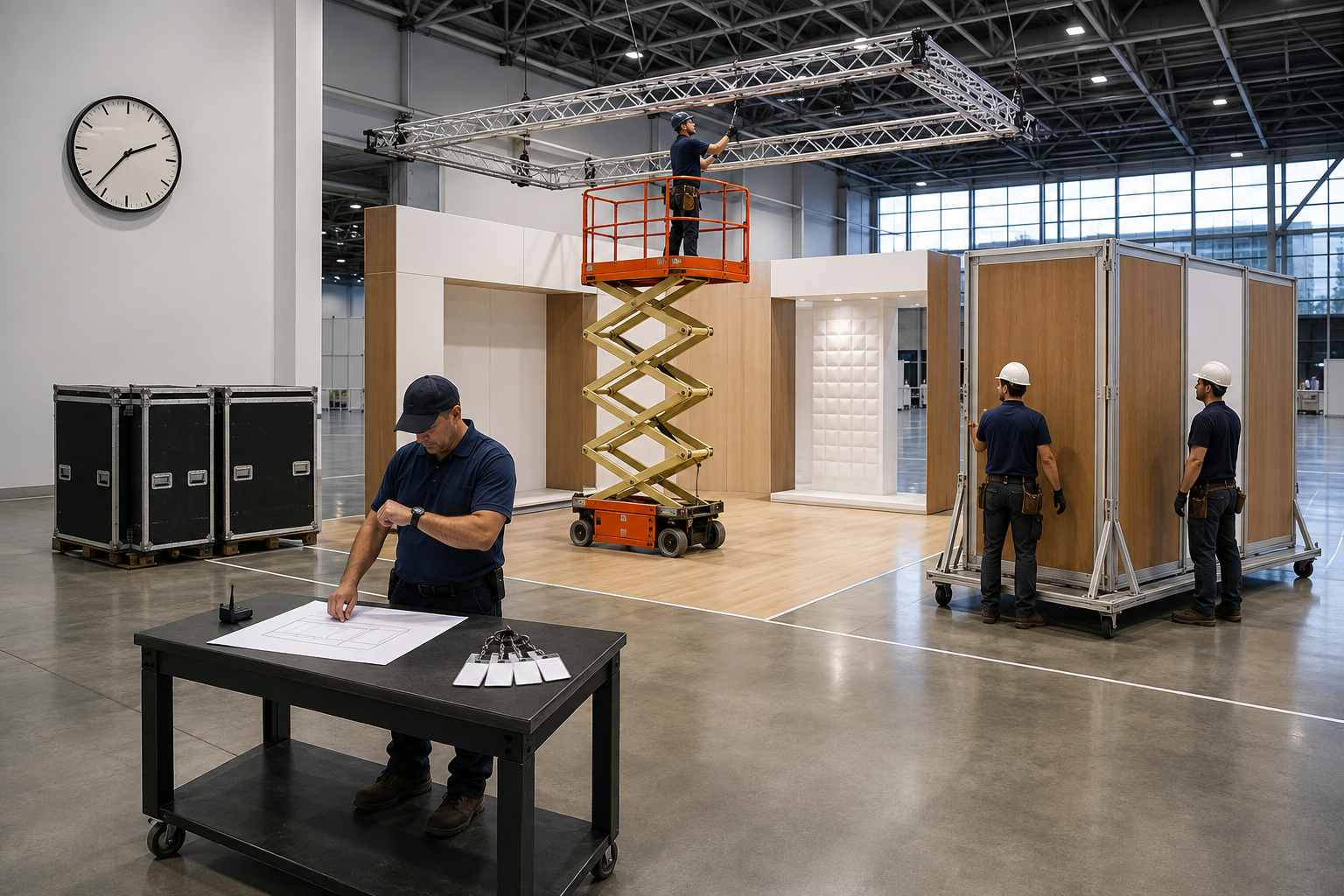
Practical tactics I use repeatedly
- Design for install speed:
- Modular frames with labeled parts, color-coded cables, and pre-wired headers cut on-site hours.
- Pre-build and QC:
- Factory pre-build with photos and a video guide reduces rework. We discovered two misdrilled panels in pre-build and avoided a two-hour on-site fix at OT rates.
- Crate and label intelligently:
- Pack by install sequence. Crate 1 contains flooring, then frame base, then verticals. Clear labels save 10–30 minutes per person quickly.
- Sequence union crews:
- Book rigging early on ST, then bring carpenters just-in-time. Avoid idle time billed at full rates.
- Hit ST windows:
- Push all heavy-hour work into weekday daytime. Move graphics touch-ups and light dressing to later if needed.
- Consolidate labor calls:
- Aim for one call per day per crew type. A second call of two hours still bills four hours.
- Ship to the advance warehouse:
- The small handling premium is often cheaper than missing the target and triggering OT or standby at the dock.
- Reserve equipment in advance:
- Pre-book lifts and power drops. On-site orders run into delays and OT creep.
- Right-size supervision:
- If your team cannot be present, show-site supervision can save you. If we are present, we often skip it.
- Use your full-time employees legally:
- For small booths (e.g., 10×10, 10×20), your employees can often install within rules. Bring ID and understand hand-carry limits.
From a 30×30 pavilion install, we shaved 28% off projected labor by repacking the crates, prescheduling rigging at 8:00 AM ST, and staggering our carpenter crew across two mornings. We also pushed AV testing to late afternoon to avoid equipment delays. The steward even complimented the sequencing because nobody stood idle.
How do I estimate hours and total union labor cost before I commit?
Most overruns begin with a thin estimate. I prefer a bottom-up build: hours by task, by crew, by shift. I use ranges when design details are still in flux, then refine after the pre-build and crate plan are set.
The short answer: Estimate union labor cost for booth installation in Las Vegas by task and shift: layout/flooring, structure, graphics, electrical, rigging, and AV. Assign realistic crew sizes and straight-time windows. Add four-hour minimums, 10–15% contingency for first-time builds, and confirm exclusives. Validate against your exhibitor kit.
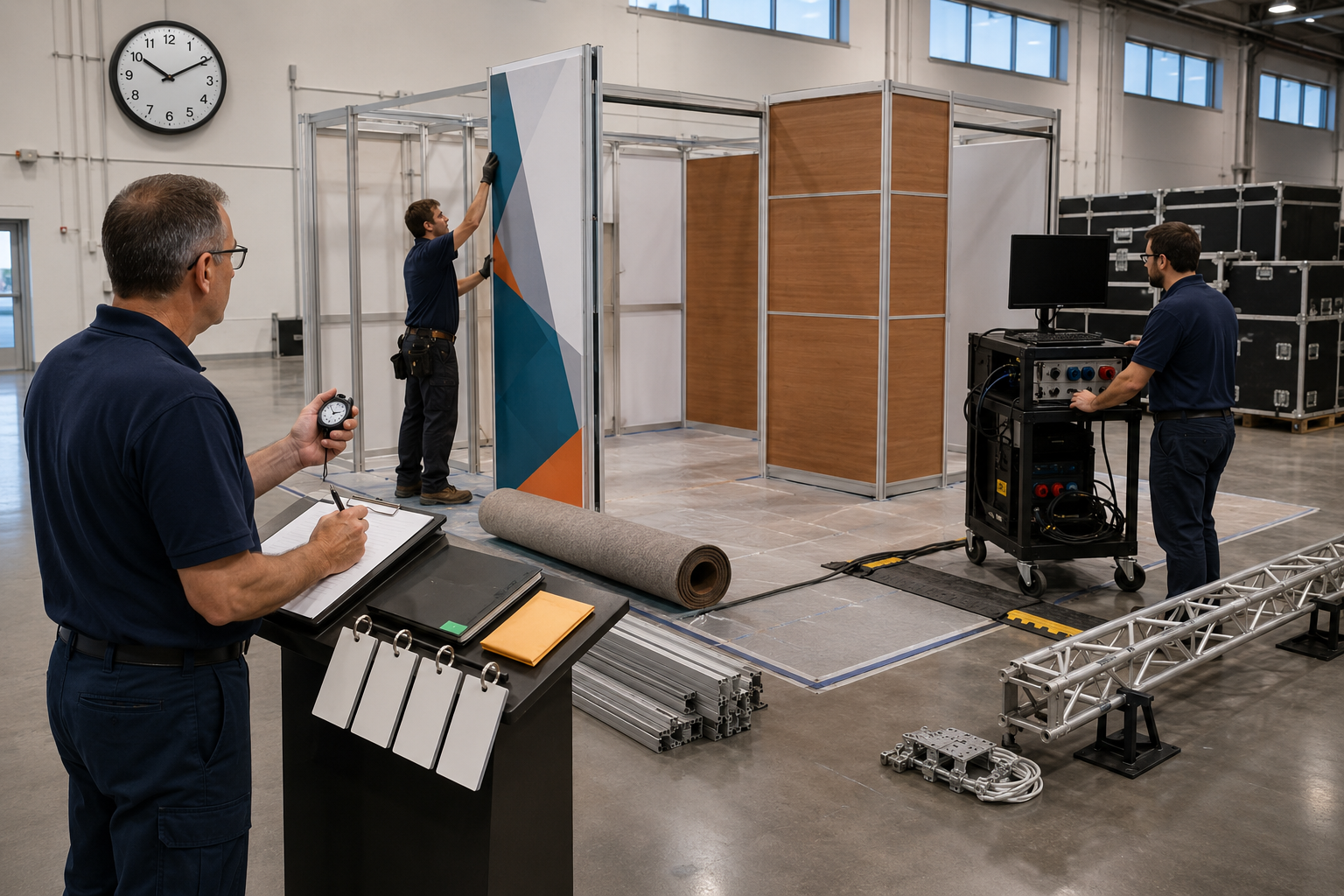
A planning framework you can adapt
1) Break the scope:
- Flooring/layout: 1–2 hours for 10×10, 3–4 hours for 20×20+
- Structure assembly: varies by system and complexity
- Graphics install: simple velcro vs. tension fabric vs. large SEG
- Electrical: drop placement, power distribution
- Rigging: hanging sign, truss, lighting
- AV/LED: mount, cable, test
2) Choose crew size and sequence:
- Keep crews lean early (two skilled carpenters start the base), then add hands for paneling and graphics.
- Start riggers first, then carpenters; bring electricians at scheduled drops.
3) Assign time windows:
- Map tasks into weekday daytime. Avoid Saturday/Sunday unless schedule requires.
4) Apply minimums and contingency:
- Multiply by four-hour minimums for each call.
- Add 10–15% contingency for first builds or imported systems.
Example planning grid (for budgeting, not a quote)
| Booth Size/Complexity | I&D Carpenter Hours | Rigger Hours | Electrician Hours | Est. Total Labor Cost (ST mix) |
|---|---|---|---|---|
| 10×10 simple | 4–8 (1–2 people) | 0 | 1–2 | $800–$1,600 |
| 10×20 moderate | 8–16 (2 people) | 0 | 2–4 | $1,600–$3,200 |
| 20×20 custom | 24–40 (3–4 people) | 4–8 | 4–8 | $6,000–$10,000 |
| 20×30 complex | 40–64 (4–6 people) | 8–12 | 6–10 | $10,000–$18,000 |
| 30×30 with hanging sign | 64–96 (6–8 people) | 12–20 | 8–14 | $18,000–$30,000+ |
Assumptions:
- Rates blended toward straight-time with minimal OT.
- No Sunday/holiday work.
- Electrical/rigging priced at typical Vegas ranges.
- Excludes material handling, rentals, graphics production, and LED walls.
I always validate this estimate against the show’s kit and our pre-build results. A complex double-deck or LED-heavy booth can double the hours if we do not pre-wire and segment LED tiles by row.
Is union labor worth the cost in Las Vegas?
Some exhibitors view union labor as a hurdle. I see it as paid risk reduction. You get trained crews, access to equipment, and a predictable process. The trick is aligning design, logistics, and schedule so you buy the hours you need at the right time of day.
The short answer: Yes—when planned well, union labor in Las Vegas delivers safety, speed, and reliability. You cannot avoid exclusives, so focus on design-for-install, straight-time scheduling, and sequencing. That approach turns union labor cost for booth installation in Las Vegas into a managed variable with fewer surprises.
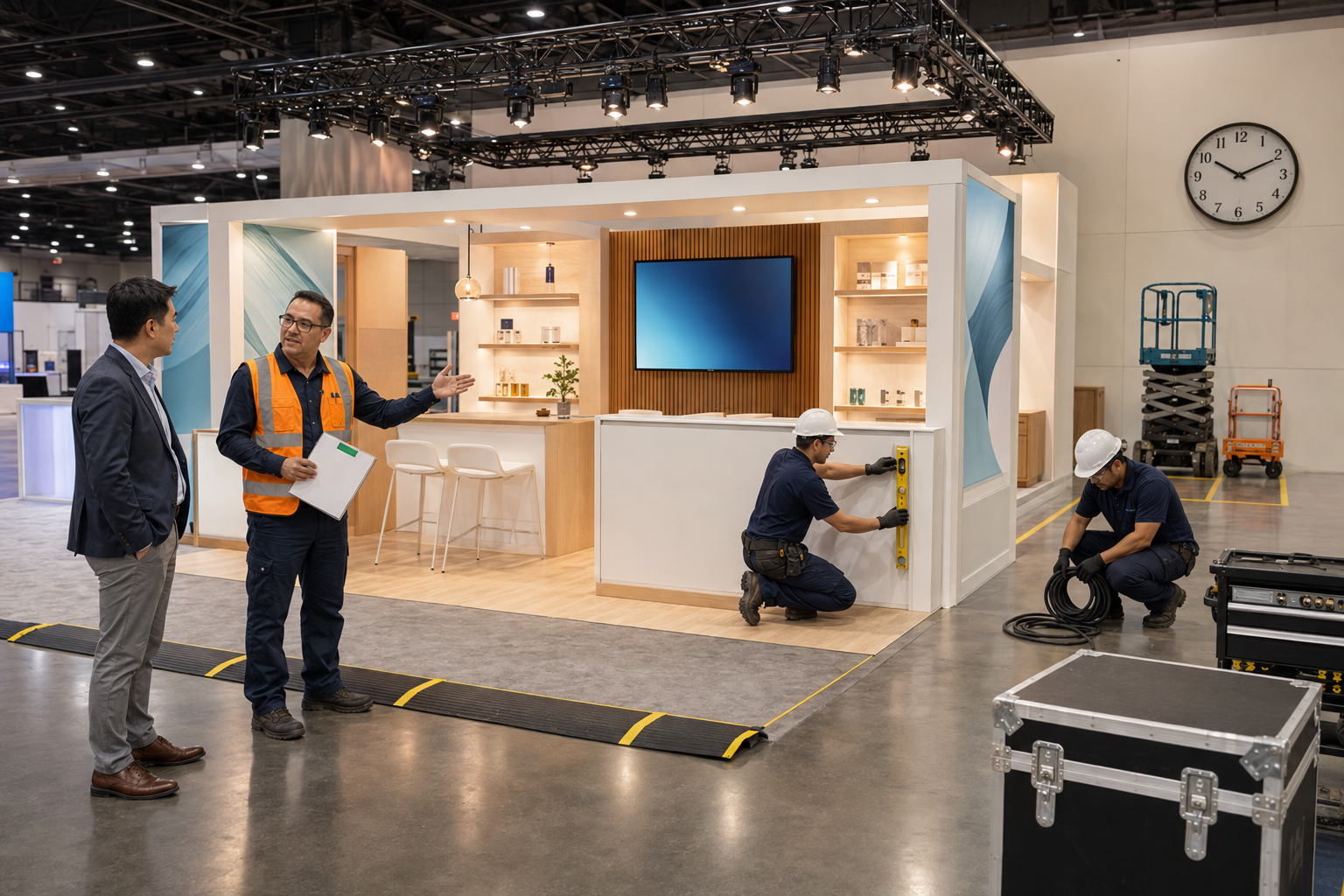
The value proposition, with real-world outcomes
- Safety and compliance:
- Certified riggers and electricians prevent accidents and costly delays.
- Equipment access:
- Lifts, hoists, and power distribution are coordinated and insured.
- Local know-how:
- Crews know the venue, docks, and rules. That saves time.
- Schedule reliability:
- If we miss an element, getting a union tech back is a known process.
We supported a brand owner launching in the U.S. who feared union costs would spiral. We redesigned their 20×20 for tool-less frames and pre-wired LED headers, documented a 14-step install sequence, and shipped to the advance warehouse. The show opened on time. We spent 91% of labor in straight-time and finished under budget by 19% compared to their previous DIY attempt.
Misconception alert: Union cost is not “fixed.” Your decisions—design, crating, shipping method, and call times—shape the final number far more than the posted rate card. That is why I invest the time up front.
Frequently Asked Questions
Can my team install our booth without union labor in Las Vegas?
Often yes, if they are your full-time employees and the task is non-exclusive. They must carry company ID and follow safety rules. You still cannot perform exclusive services like material handling, rigging, or electrical. Always confirm the show’s rules, as definitions and enforcement vary.
What triggers overtime and double-time in Las Vegas?
Overtime usually applies to evenings and Saturdays; double-time often applies to Sundays and holidays.10 Exact hours vary by show and contractor. The exhibitor kit defines straight-time windows. Plan high-hour tasks inside weekday daytime to avoid premiums.
What is the four-hour minimum, and how do I avoid paying extra?
Most unions require a four-hour minimum per worker per call. If you call a two-person crew for two hours, you still pay eight hours. Consolidate tasks into a single call, avoid split shifts, and sequence work so the crew remains productive throughout the minimum.
How do material handling charges relate to union labor?
Material handling (drayage) is separate from I&D labor. The general contractor has the exclusive to move freight from dock to booth and back, billed by weight with minimums.11 Missing target times or arriving late can add wait-time or OT. Ship to the advance warehouse when timing is tight.
Are show-site supervision fees required?
No. You can supervise your own labor if you or your appointed rep is present. Show-site supervision simplifies logistics when you cannot be on site, but it usually adds 25–35% to labor hours or a fixed fee. I recommend it only when it protects schedule risk.
Conclusion
Union labor cost for booth installation in Las Vegas is manageable when you understand the components, respect exclusive services, and schedule smartly. I focus on design-for-install, crate sequencing, and straight-time windows to control spend without risking compliance. If you want a precise plan for your next Las Vegas show, reach out to Exhibitsmax to review your drawings, schedule, and budget together.
"2022-2023 Prevailing Wage - Nevada Labor Commissioner", https://labor.nv.gov/uploadedFiles/labornvgov/content/PrevailingWage/Amendment%207%20-%20Plasterer%20Southern%20Nevada.pdf. Example Las Vegas exhibitor labor schedules from major general contractors list straight‑time, overtime, and double‑time hourly ranges and state a four‑hour minimum per worker per call, consistent with the figures noted; however, exact rates and minimums are set per event and contractor. Evidence role: statistic; source type: other. Supports: Published Las Vegas labor rate cards for major contractors show ST/OT/DT hourly ranges and specify a four-hour minimum per worker per call.. Scope note: Rates and minimums vary by show, venue, and contractor; one rate card illustrates typical ranges but does not establish universal pricing. ↩
"2026 PREVAILING WAGE RATES CLARK COUNTY REGION", https://labor.nv.gov/uploadedFiles/labornvgov/content/PrevailingWage/Clark%20County%20Region%202025-2026-Amendment%2003(2).pdf. Contractor rate cards for Las Vegas shows commonly price certified riggers above I&D carpenters, with differences on the order of tens of percent, consistent with the 10–20% premium noted; the exact spread depends on the event’s rate schedule. Evidence role: general_support; source type: other. Supports: Las Vegas exhibitor labor rate cards list certified riggers at a higher hourly rate than I&D carpenters, with a typical premium.. Scope note: Premiums vary by contractor and specific show. ↩
"[PDF] quick facts - NAMCP", https://www.namcp.org/conferences/fmcf/10/FALL%20MANAGED%20CARE_Exhibitor%20Service%20Manual.pdf. Exhibitor manuals from large contractors for Las Vegas shows specify optional show‑site labor supervision, commonly billed at approximately 30% of labor charges or as an alternative fixed supervision fee, supporting the stated range; the exact percentage and fee structures differ by event. Evidence role: general_support; source type: other. Supports: Contractor manuals for Las Vegas events describe optional show-site labor supervision billed as a percentage (around 30%) or as a fixed fee.. Scope note: Supervision percentages and fee options vary by contractor and show. ↩
"EDLEN Electrical Exhibition Services at Tampa Convention ...", https://www.tampa.gov/sites/default/files/document/2025/edlen-electrical-exhibition-at-tcc-show-organizers-2026_0.pdf. Las Vegas venue facility policies identify electrical distribution as an exclusive service provided by designated firms (e.g., Edlen) and require exhibitors to order and pay for electrical separately from installation/dismantle labor, corroborating the exclusivity and distinct billing. Evidence role: definition; source type: institution. Supports: Venue facility guidelines list exclusive services for electrical distribution and note that electrical must be ordered separately from booth labor.. Scope note: Exclusive providers and ordering procedures vary by venue and event. ↩
"[PDF] EXHIBITOR KIT - NACS Show", https://www.nacsshow.com/getContentAsset/3cb2730a-d9a6-4297-a71b-083e79eae540/54c9dc03-01d8-4d42-9976-9f8115f6bf26/LVCC-Exhibitor-Kit.pdf?language=en-US. Las Vegas facility guidelines specify that the official contractor handles material movement and explicitly prohibit exhibitors from operating forklifts or pallet jacks, substantiating the equipment restriction. Evidence role: definition; source type: institution. Supports: Facility rules state that material handling is performed exclusively by the official contractor and forbid exhibitor-operated forklifts or pallet jacks.. Scope note: Rules can vary by venue and event; some policies allow limited hand-carry exceptions. ↩
"Employer/Union Rights and Obligations", https://www.nlrb.gov/about-nlrb/rights-we-protect/your-rights/employer-union-rights-and-obligations. Contractor‑published union jurisdiction guidelines for Las Vegas clarify that exhibitors’ bona fide, full‑time employees may install and dismantle their own exhibits, whereas temporary personnel do not qualify for this exception; all other I&D work is assigned to union crews. Evidence role: definition; source type: other. Supports: Union jurisdiction documents for Las Vegas events state that bona fide full-time employees of the exhibitor may perform I&D, while temporary labor is not permitted for that exception.. Scope note: Proof requirements (company ID, payroll status) and enforcement are determined by the specific show and union local. ↩
"LVCC HAND CARRY POLICY", https://qtxasset.com/quartz/qcloud2/2025-04/Hand%20Carry%20Policy_2.pdf?VersionId. Official hand‑carry policies published by Las Vegas venues permit exhibitors to bring small items by hand or via non‑motorized personal carts and explicitly prohibit motorized equipment, confirming the stated limitations. Evidence role: definition; source type: institution. Supports: Venue hand-carry policies allow small items to be carried or moved via small non-motorized personal carts and forbid motorized equipment.. Scope note: Specific limits (e.g., cart size, hours, access points) are venue- and event-specific. ↩
"IAEE: Selecting Service Contractors Flashcards", https://quizlet.com/509964206/iaee-selecting-service-contractors-flash-cards/. Exhibitor manuals issued by general contractors and facility guidelines published by Las Vegas venues delineate labor rate schedules, straight‑time/overtime windows, and exclusive services, indicating that these entities define the operative rules for each event. Evidence role: general_support; source type: institution. Supports: Industry and venue documentation shows exhibitor manuals and facility guidelines specify labor rates, time classifications, and exclusive services.. Scope note: Specifics vary by event, and manuals are updated periodically. ↩
"Trade Show Move-In & Move-Out: What Exhibitors and Brand ...", https://www.steelcitydisplays.com/trade-show-move-in-move-out-guide. Exhibition industry guidance describes targeted move‑in schedules designed to manage freight flow; exhibitors who miss assigned windows often experience delays that can push installation into premium labor periods, increasing costs, which accords with the stated risk. Evidence role: mechanism; source type: institution. Supports: Industry guides explain targeted move-in schedules and how missing assigned times can cause delays that shift work into premium labor hours.. Scope note: Whether overtime is incurred depends on the show’s specific labor windows and rescheduling options. ↩
"300 Exhibit Services & Events, Inc.", https://www.nlrb.gov/case/28-CA-022347. Las Vegas labor order forms from major contractors enumerate straight‑time, overtime (commonly evenings and Saturdays), and double‑time (often Sundays and holidays) windows, supporting the general time classifications presented; exact hours are defined in each show’s exhibitor kit. Evidence role: general_support; source type: other. Supports: Contractor labor rate forms list straight-time, overtime, and double-time windows, often defining evenings/Saturdays as OT and Sundays/holidays as DT.. Scope note: Daypart definitions vary by event and contractor. ↩
"Materials Handling and Storage", https://www.osha.gov/sites/default/files/publications/osha2236.pdf. Exhibition industry literature describes material handling (drayage) as an exclusive service of the official contractor and notes that fees are commonly assessed by the hundredweight (CWT) with minimum charges per shipment, supporting the statement. Evidence role: definition; source type: institution. Supports: Industry references explain drayage as an exclusive contractor service charged by the hundredweight (CWT), typically with minimums.. Scope note: Exact pricing units and minimums vary by contractor and show. ↩