
Exhibitsmax Logo
VENUE GUIDE

Mandalay Bay Convention Center: Installation & Drayage Guide

Published on August 9, 2026
Mandalay Bay Convention Center: Installation & Drayage Guide

Mandalay Bay Convention Center can feel confusing when your booth freight, labor rules, electrical work, and move-in deadline all meet at the same time. That confusion can turn into overtime, surprise drayage invoices, or delayed setup. I use this guide to make installation and drayage planning clearer before your freight reaches Las Vegas.

The best way to manage installation and drayage at Mandalay Bay Convention Center is to plan around four items: the official show manual, material handling rules, labor jurisdiction, and a realistic installation schedule. International exhibitors should confirm deadlines early, label freight correctly, budget for drayage by weight and handling type, and assign an experienced on-site project manager.

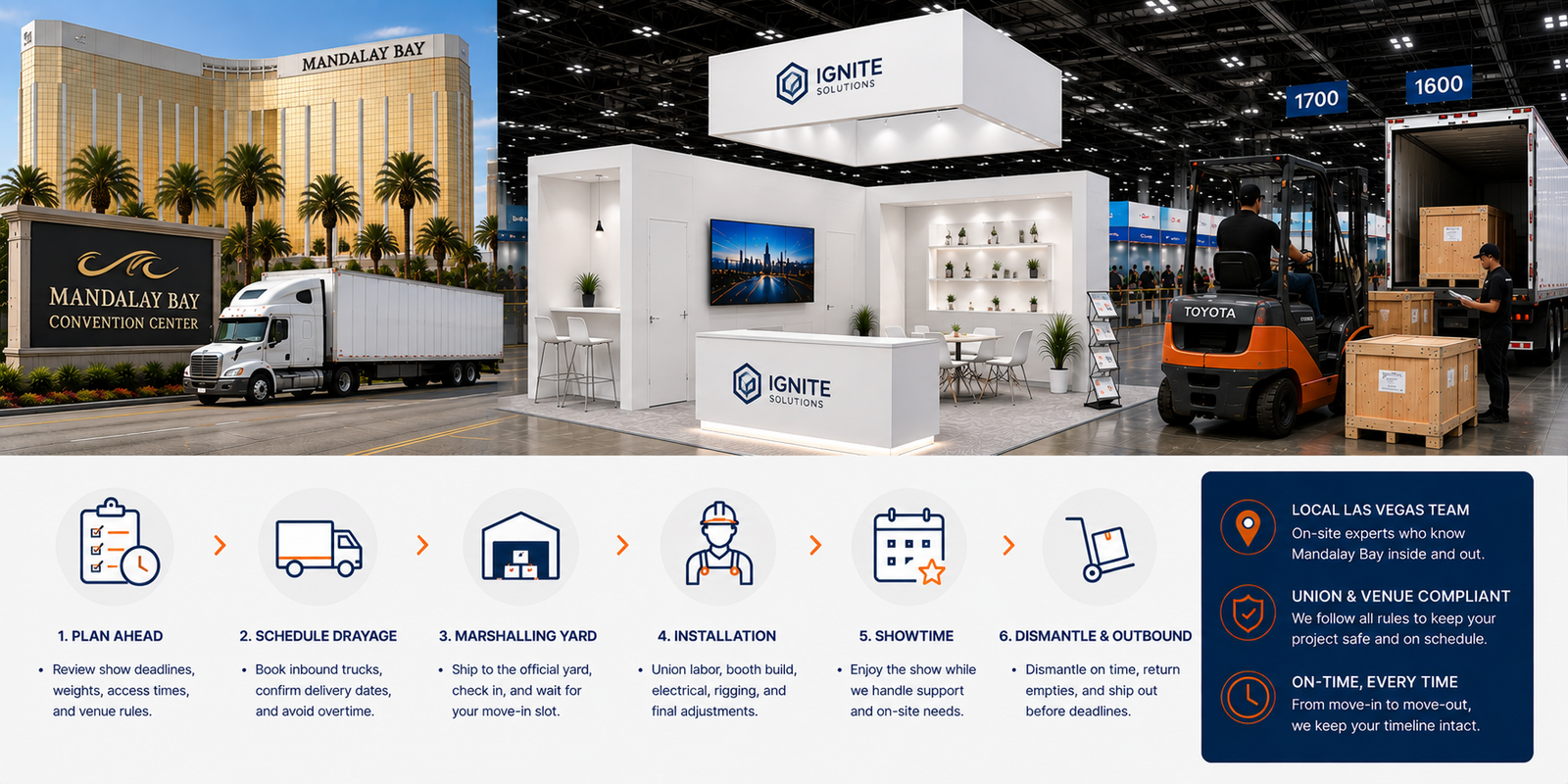
Mandalay Bay Convention Center installation and drayage guide for exhibitors

I have seen many booth problems start before the crates arrive. A missing label, late electrical order, or wrong labor assumption can create a chain reaction. The good news is that most of these issues are predictable if you know where to look and what to ask.

How does drayage work at Mandalay Bay Convention Center?

Drayage at Mandalay Bay Convention Center often surprises first-time international exhibitors because it is not the same as normal freight delivery. You may already have paid a carrier to reach Las Vegas, but material handling is a separate show-site service. If you miss that distinction, your budget can change quickly.

Drayage is the process of receiving, moving, storing, and returning your booth freight inside the trade show system.1 At Mandalay Bay, exhibitors usually pay based on shipment weight, delivery method, timing, and handling complexity.2 The official contractor’s service manual is the document you should use to confirm current rates and rules.

Mandalay Bay Convention Center drayage cost planning for trade show freight

What drayage usually includes

At Mandalay Bay, drayage is commonly called material handling. The exact contractor and rates depend on the show, so I always check the current exhibitor manual instead of relying on memory. However, the basic flow is usually similar:

  1. Freight arrives at the advance warehouse or directly at the show site.
  2. The official contractor receives and records the shipment.
  3. Forklifts or crews move crates to the booth space.
  4. Empty crates are removed and stored during the show.
  5. Empty crates return after the show closes.
  6. Freight is moved from the booth to the outbound carrier.

That full cycle is why drayage can cost more than exhibitors expect. It is not only “moving a box from the dock to the booth.” It includes receiving, documentation, equipment, labor, storage of empties, and outbound handling.

Common cost drivers

Most material handling charges are calculated by hundredweight, often written as CWT. One CWT equals 100 pounds.3 Many shows also apply a minimum charge per shipment.4 That means a small 80-pound shipment may be billed at the same minimum as a heavier shipment.

Drayage factor Practical meaning for exhibitors Cost risk
Shipment weight Heavier booths cost more to handle High
Minimum shipment charge Small shipments may still trigger a minimum Medium
Advance warehouse vs. direct to show Advance warehouse may be easier to schedule, but it has deadlines Medium
Special handling Mixed freight, loose items, uncrated pieces, or stacked shipments may cost more5 High
Overtime handling Deliveries or move-out during overtime windows can increase charges High
Split shipments Multiple deliveries may create multiple minimum charges Medium

My practical approach to reducing surprises

When I coordinate freight for Mandalay Bay shows, I try to reduce handling complexity before the shipment leaves the warehouse. I prefer fewer, better-organized crates over many loose cartons. Loose items often create more handling risk, more counting time, and more opportunities for missing pieces.

I also check three details early:

  • Target move-in date and time
  • Advance warehouse deadline
  • Direct-to-show receiving window

These dates matter because Mandalay Bay can be very busy during large Las Vegas shows. If freight arrives outside the approved window, the carrier may wait, return later, or trigger extra costs. If freight arrives late, your installation crew may stand by with nothing to build.

My rule is simple: I do not treat freight as “delivered” until I confirm it is received by the show contractor and released to the booth.

For international exhibitors, I also recommend building a buffer for customs clearance, inland transport, and documentation review. A booth that arrives in the United States on time can still be late to the booth if customs paperwork, carrier appointment scheduling, or show labels are not handled correctly.6

What Mandalay Bay Convention Center installation rules should exhibitors plan for?

Mandalay Bay Convention Center installation rules matter because booth setup is not only a design task. It is also a labor, safety, electrical, and schedule task. If your team assumes they can build everything themselves, you may face delays or be asked to use approved labor on site.

Exhibitors should plan installation around the show’s official labor rules, EAC requirements, electrical jurisdiction, move-in schedule, and booth safety standards. At Mandalay Bay, these rules are usually defined in the exhibitor service manual, not by informal advice. Always verify current requirements before shipping or assigning staff.

Mandalay Bay Convention Center booth installation labor and setup planning

Labor jurisdiction is practical, not theoretical

In the United States, trade show labor rules can feel unusual to international exhibitors. At Mandalay Bay, the show manual usually explains what exhibitors may do themselves and what requires approved labor.7 The exact rules can vary by show and contractor, so I do not guess.

The practical point is this: your booth design must match the labor environment.

For example, if your booth has heavy frames, overhead components, hard-wall rooms, complex wiring, or raised flooring, you need to plan installation labor in advance. You should not wait until the crates open on the show floor.

Common labor-related tasks may include:

  • Assembling exhibit structures
  • Installing graphics
  • Handling electrical connections
  • Rigging or hanging signs, if permitted by the show
  • Laying carpet or flooring
  • Using forklifts or other equipment
  • Dismantling and repacking crates

EAC paperwork matters

If you use your own exhibit builder, that company may be considered an Exhibitor Appointed Contractor, or EAC. In many shows, the EAC must submit forms, insurance certificates, and authorization before the deadline.8

I have seen teams lose valuable setup hours because EAC documents were incomplete. The crew may be ready. The booth may be at the venue. But if the paperwork is not approved, access can become difficult.

Here is a simple planning checklist:

Item Why it matters When to check
EAC authorization Allows your appointed team to work on site Before show deadline
Certificate of insurance Required by many organizers and contractors Before crew arrival
Labor order forms Reserves installation and dismantle labor Before discount deadline
Electrical order Defines power location and capacity Before floor plan finalization
Hanging sign approval Needed if using overhead elements Early design stage
Safety and fire rules Affects materials, fabric, and booth layout Before fabrication

Design choices that affect installation time

A booth may look simple in a rendering but still take many hours to install. The difference is usually in the hidden details.

I look closely at:

  • Number of crates
  • Number of wall panels
  • Tool requirements
  • Graphic alignment
  • Lighting and wiring
  • Flooring type
  • Ceiling or overhead elements
  • Product display weight
  • AV and LED screen integration

A modular booth with clear labeling may install quickly. A custom booth with mixed hardware, unlabeled parts, and last-minute graphics can take much longer.

For Mandalay Bay, I prefer a setup plan that includes:

  1. Booth layout drawing
  2. Crate inventory
  3. Installation sequence
  4. Electrical placement map
  5. Graphic placement map
  6. Tool list
  7. On-site contact list
  8. Dismantle and repack instructions

This plan reduces confusion when the hall is noisy, the clock is running, and multiple teams need answers at the same time.

How should international exhibitors plan load-in at Mandalay Bay Convention Center?

Load-in at Mandalay Bay Convention Center can become stressful because the timing is controlled by the show schedule, not only by your carrier. International exhibitors may be used to direct venue delivery, but U.S. trade shows often require advance warehouse receiving, target times, marshaling instructions, and strict labeling.9

International exhibitors should plan load-in by working backward from the official move-in schedule. Confirm whether freight should go to the advance warehouse or directly to the show site, apply official shipping labels, book labor for the correct window, and keep customs, carrier appointments, and drayage rules aligned.

Mandalay Bay Convention Center load-in planning for international exhibitors

Advance warehouse versus direct-to-show

One of the biggest early decisions is where your freight should arrive.

Option Best for Main advantage Main risk
Advance warehouse International freight, complex booths, early shipments More controlled receiving before move-in Deadline and storage rules
Direct-to-show Local shipments, simple booths, tight timelines Goes directly to venue during move-in Narrow receiving window
Van line or padded shipment Finished custom elements or sensitive displays Better protection for delicate pieces Special handling charges may apply
Small parcel Samples, brochures, small supplies Easy for light items Multiple minimums or lost carton risk

For international exhibitors, I often prefer advance warehouse delivery when the schedule allows it. It gives more time to confirm receipt before the show floor opens for installation. It also reduces the risk of a carrier arriving during the wrong direct-to-show window.

However, the advance warehouse is not a magic solution. It has receiving dates, labels, deadlines, and possible late fees. You still need to confirm the shipment was received under the correct exhibitor name, booth number, and show name.

Labels are not decoration

Shipping labels are one of the simplest ways to prevent expensive confusion. At a large venue like Mandalay Bay, many shows and shipments may be moving around Las Vegas at the same time. A vague label can slow everything down.

A correct label usually includes:

  • Exhibiting company name
  • Show name
  • Booth number
  • Contractor warehouse or show-site address
  • Delivery type
  • Number of pieces
  • Contact information

I also like to mark crates with large numbers such as Crate 1 of 5, Crate 2 of 5, and so on. This makes it easier to identify missing pieces during installation.

Build a load-in timeline

A realistic Mandalay Bay load-in plan should include more than the carrier delivery date. I usually build the timeline in layers:

  1. International pickup date
  2. Export documentation date
  3. Ocean or air freight schedule
  4. Customs clearance buffer
  5. U.S. domestic trucking
  6. Advance warehouse or direct-to-show receiving
  7. Freight release to booth
  8. Installation labor start
  9. Electrical and AV setup
  10. Final cleaning and inspection

This timeline helps prevent a common problem: labor arrives before freight is available. When that happens, exhibitors may pay for standby time. If the booth then arrives late, the team may need overtime to catch up.

Keep critical items separate

For important small items, I do not put everything into the main freight shipment. Product samples, laptops, media players, adapters, uniforms, and key graphics may need a separate backup plan.

A practical approach is:

  • Carry essential electronics with the team when allowed.
  • Ship duplicate printed materials when budget allows.
  • Keep digital artwork files accessible online.
  • Bring extra power adapters for U.S. outlets.
  • Pack basic booth tools only if show rules allow exhibitor use.

This does not replace proper freight planning. It only reduces the damage if one crate is delayed.

How can exhibitors control installation time and overtime at Mandalay Bay Convention Center?

Installation time at Mandalay Bay Convention Center can expand quickly when the booth design, labor plan, and freight schedule do not match. A beautiful booth can still become expensive if the crew needs late-night work, extra electricians, missing hardware runs, or emergency graphic reprints.

Exhibitors can control installation time by estimating labor before shipping, simplifying assembly points, ordering electrical services early, confirming freight availability, and assigning one decision-maker on site. The goal is not only a faster build. The goal is a predictable setup that avoids last-minute overtime.

Mandalay Bay Convention Center installation time and overtime control

Estimate by task, not by booth size only

Many exhibitors estimate installation time by square footage. That helps, but it is not enough. A 10x20 booth with simple fabric graphics may install faster than a 10x10 booth with custom millwork, monitors, locking storage, and product displays.

I prefer estimating by task:

Task Questions to ask Time risk
Flooring Is it carpet, vinyl, raised floor, or platform? Medium to high
Wall structure Are panels numbered and hardware packed by section? High
Graphics Are graphics fabric, SEG, rigid panels, or adhesive? Medium
Electrical Are outlet locations shown on a floor plan? High
Lighting Are fixtures pre-tested and labeled? Medium
AV Are screens, mounts, media players, and cables ready? High
Product display Are products heavy, fragile, or powered? Medium
Final detailing Is cleaning, touch-up, and inspection included? Medium

Electrical work needs early attention

Electrical planning is one of the most common sources of last-minute stress. At Mandalay Bay trade shows, electrical services are usually ordered through the official provider listed in the exhibitor manual.10 Rates, deadlines, and floor plans vary by show.

You should confirm:

  • Power requirements for each device
  • Outlet locations
  • 24-hour power needs
  • Cable routing
  • Labor requirements for connections
  • Internet or data needs
  • LED video wall power needs
  • Equipment voltage compatibility

International exhibitors should pay special attention to U.S. voltage and plug types.11 Many products and displays need adapters, transformers, or different power supplies. A booth team should not discover that problem during final setup.

Use a build sequence

A clear build sequence saves time because crews do not need to stop and ask what comes next. For many booths, the sequence looks like this:

  1. Confirm freight and crate count.
  2. Mark booth space and orientation.
  3. Install flooring or underfloor cabling if required.
  4. Build main structure.
  5. Install electrical rough-in.
  6. Mount graphics and signage.
  7. Install lighting and AV.
  8. Place furniture and product displays.
  9. Test power, screens, and demos.
  10. Clean, inspect, and photograph the booth.

This sequence should match the actual booth design. If a wall must be open for wiring, the team needs to know before the wall is closed. If flooring covers cables, electrical placement must happen before the final floor finish.

Why one on-site decision-maker matters

During installation, many people may have opinions. The brand manager may care about graphics. The sales team may care about product placement. The builder may care about structure. The electrician may need access. The show contractor may need compliance.

If no one has authority, small decisions become delays.

I recommend assigning one person to approve:

  • Booth orientation
  • Graphic placement
  • Product layout
  • Furniture changes
  • Labor extensions
  • Emergency purchases
  • Dismantle priorities

That person should have the budget authority to approve small changes. Waiting for overseas approval can cost more than the decision itself, especially when labor is billed by the hour.

What should exhibitors do during dismantle and outbound shipping at Mandalay Bay Convention Center?

Dismantle at Mandalay Bay Convention Center deserves the same planning as installation. Many exhibitors relax after the show closes, but move-out is where missing crates, forced freight, damaged materials, and outbound paperwork errors often happen. A rushed dismantle can create costs that appear after everyone has flown home.

Exhibitors should prepare outbound shipping before the show closes. Confirm carrier pickup times, complete the material handling agreement, label every crate, supervise repacking, photograph booth condition, and check that freight is tendered correctly. Dismantle planning protects your booth investment and reduces post-show disputes.

Mandalay Bay Convention Center dismantle and outbound shipping for trade show booths

Move-out starts before the show ends

I like to prepare move-out documents before the first show day if possible. That sounds early, but it prevents panic after closing. Once the aisle carpet comes up and empty crates return, the hall becomes busy and noisy very fast.

Before the show closes, I confirm:

  • Return shipping address
  • Carrier name and contact
  • Pickup deadline
  • Number of crates or pallets
  • Bill of lading or material handling agreement
  • Special instructions for fragile items
  • Storage destination, if applicable
  • Who will stay until freight is accepted

The official contractor may use a specific outbound form. Exhibitors should complete it carefully. If paperwork is missing, freight may be rerouted, delayed, or handled as forced freight according to the show’s rules.

Repacking needs supervision

Booth components often fit into crates in a specific way. If the people dismantling the booth did not pack it originally, they may not know the correct sequence. This can cause scratches, broken graphics, bent frames, or crates that will not close.

A good repack plan includes:

  • Photos of crate interiors before unpacking
  • Numbered packing diagrams
  • Hardware bags labeled by booth section
  • Protective blankets or foam
  • Separate cartons for electronics
  • “Do not stack” or fragile labels when needed
  • Inventory checklist

I have learned to take photos during both unpacking and repacking. Photos help the next installation team, and they can also support damage discussions if something goes wrong in transit.

Avoid forced freight

Forced freight is one of the most expensive move-out surprises.12 It can happen when an exhibitor’s carrier does not arrive by the deadline or when outbound paperwork is incomplete. In that situation, the show contractor may send the freight with a carrier selected under the show’s procedures.

The best prevention is simple:

  1. Book the carrier early.
  2. Confirm the carrier understands trade show pickup.
  3. Provide the correct venue and show details.
  4. Confirm the move-out deadline.
  5. Submit outbound paperwork.
  6. Keep proof of pickup or tender.

Not every regular trucking company understands convention center move-out. A trade show pickup can involve marshaling yards, waiting time, dock access rules, and strict deadlines. I prefer carriers that know the process.

Think about the next show

Many international exhibitors use Mandalay Bay as one stop in a larger U.S. trade show plan. If the booth will be reused, dismantle should protect the next installation.

After the show, I recommend reviewing:

  • What was damaged?
  • What took too long to build?
  • Which graphics need replacement?
  • Which crates need repair?
  • Which parts were missing?
  • Which electrical locations should change?
  • Which drayage charges were higher than expected?

This review turns one show into better planning for the next one. It also helps your exhibit partner redesign weak points before the next deadline.

Frequently Asked Questions

Is drayage the same as shipping to Mandalay Bay Convention Center?

No. Shipping moves your freight to Las Vegas or to the show’s receiving point. Drayage, or material handling, covers receiving, moving freight to your booth, storing empty crates, returning empties, and moving freight out after the show. These are usually separate charges.

Can international exhibitors install their own booth at Mandalay Bay?

Sometimes exhibitors can perform limited setup, but rules vary by show, booth type, and labor jurisdiction. You should review the exhibitor manual and confirm with the official contractor. Complex structures, electrical work, flooring, rigging, and heavy assembly often require approved labor.

Should I ship to the advance warehouse or directly to the show site?

Advance warehouse shipping is often safer for international exhibitors because it allows earlier receiving confirmation. Direct-to-show can work for simple booths with reliable local trucking. The best choice depends on deadlines, freight type, budget, and your installation schedule.

How can I estimate drayage costs before the show?

Start with your packed freight weight, number of shipments, delivery method, and handling type. Then apply the official material handling rates from the exhibitor manual. Watch for minimum charges, special handling, overtime windows, and separate shipments because these can change the final invoice.

What is the biggest installation mistake first-time exhibitors make?

The biggest mistake is treating installation as a one-day setup task instead of a coordinated logistics plan. Freight, labor, electrical, graphics, AV, paperwork, and approvals must line up. If one part is late or unclear, the entire booth setup can slow down.

Conclusion

Mandalay Bay Convention Center is a strong venue for major U.S. trade shows, but exhibitors need a clear plan for installation and drayage. You should verify the show manual, budget material handling carefully, respect labor procedures, schedule installation by task, and prepare dismantle before the show closes. If you are exhibiting in Las Vegas for the first time, Exhibitsmax can help you plan booth design, fabrication, logistics, installation, dismantle, storage, and on-site coordination with practical trade show experience.


  1. "Trade Show Material Handling Explained", https://www.dtsone.com/trade-show-material-handling-explained/. An exhibition-industry source defines trade-show drayage, often called material handling, as the on-site receipt, movement to the booth, storage or return of empty containers, and outbound handling of exhibit freight; this supports the general process rather than the fee rules for a specific Mandalay Bay event. Evidence role: definition; source type: institution. Supports: A neutral exhibition-industry source should define drayage or material handling as the on-site handling of exhibit freight, including receipt, delivery to the booth, storage of empty containers, and outbound movement.. Scope note: The source would support the general trade-show definition, not current rates or procedures for every Mandalay Bay show.

  2. "Mandalay Bay Convention Center 2026", https://exhibitorly.com/blog/mandalay-bay-convention-center-the-2026-exhibitors-strategic-guide. An official exhibitor service manual for a Mandalay Bay event lists material-handling charges by shipment weight and receiving category, with additional classifications such as special handling or overtime; this supports the pricing structure in context but not a universal rate for all events. Evidence role: general_support; source type: institution. Supports: An official exhibitor manual should show that material handling fees are structured around shipment weight, receiving method, deadlines or overtime, and special-handling classifications.. Scope note: The support is event-contextual because Mandalay Bay shows may use different contractors, deadlines, and rate schedules.

  3. "Hundredweight", https://en.wikipedia.org/wiki/Hundredweight. A measurement reference identifies the U.S. hundredweight, abbreviated cwt, as a unit equal to 100 pounds. Evidence role: definition; source type: government. Supports: A measurement reference should confirm that the U.S. hundredweight is 100 pounds..

  4. "Custom Trade Show Booth Builder in Las Vegas & USA | Exhibitsmax", https://exhibitsmax.com/trade-show-booth-builder-in-las-vegas/. Exhibitor service manuals commonly state material-handling minimums per shipment, often expressed in hundredweight units, supporting the article’s warning that small shipments may still incur a minimum charge. Evidence role: general_support; source type: institution. Supports: A trade-show exhibitor manual or industry guide should document minimum material handling charges per shipment.. Scope note: This supports a common billing structure, while the exact minimum depends on the individual show manual.

  5. "Exhibitor Service Manual Material Handling Information 34", https://www.jisshow.com/content/dam/sitebuilder/rna/jis/fall/2025/docs/exhibitor-manual/JIS-FALL-25-Material-Handling.pdf.coredownload.454061339.pdf. Exhibitor service manuals define special handling to include freight that is loose, mixed, uncrated, stacked, or otherwise difficult to process, and they commonly assign higher material-handling charges to those categories. Evidence role: general_support; source type: institution. Supports: An exhibitor manual should show that special-handling categories include mixed, loose, uncrated, or otherwise difficult-to-handle freight and may carry additional charges.. Scope note: The source would support the general billing category, not the exact surcharge for a specific Mandalay Bay event.

  6. "Importers - I ordered goods from abroad, but the seller said ...", https://www.help.cbp.gov/s/article/Article-1171. U.S. customs guidance explains that importers must provide required entry documentation and that incomplete or inaccurate information can delay clearance; this directly supports the customs-delay component and only contextually supports later show-site scheduling or labeling delays. Evidence role: mechanism; source type: government. Supports: A customs authority should support the point that incomplete or inaccurate import documentation can delay release of goods; exhibitor instructions can contextualize carrier appointments and show labels.. Scope note: A customs source does not by itself prove carrier-appointment or show-label delays, which would require separate exhibitor-logistics documentation.

  7. "Show Rules and Regulations", https://ordering.ges.com/011600522/download/show_rules_regs. Official exhibitor manuals for convention events set out labor-jurisdiction rules, including tasks exhibitors may perform themselves and tasks requiring approved labor; this supports the need to consult the show manual rather than assuming self-installation rights. Evidence role: general_support; source type: institution. Supports: An official show manual should describe exhibitor work rules and labor jurisdiction for installation and dismantle tasks.. Scope note: The support is procedural and event-dependent; it does not prove the same labor rules apply to every Mandalay Bay show.

  8. "Exhibitor Appointed Contractor Form", https://tps.tamu.edu/exhibition/exhibitor-toolkit/service-providers/exhibitor-appointed-contractor-form/. Exhibitor manuals commonly require Exhibitor Appointed Contractors to provide authorization forms and certificates of insurance by stated deadlines before they may work on site. Evidence role: general_support; source type: institution. Supports: A trade-show or venue manual should confirm that EACs are commonly required to submit authorization and insurance documentation before a stated deadline.. Scope note: The exact documents, insurance limits, and deadlines vary by show organizer and venue.

  9. "Shipping Overview - Sections — AHR Expo Exhibitor Manual", https://www.ahrexhibitormanual.com/shipping-overview. Exhibitor shipping instructions for U.S. convention events commonly distinguish advance-warehouse and direct-to-show receiving, specify target move-in or marshaling procedures, and require shipment labels with show and booth information. Evidence role: general_support; source type: institution. Supports: Institutional exhibitor instructions should show the use of advance receiving warehouses, targeted move-in schedules, marshaling procedures, and required freight labels.. Scope note: This supports common U.S. convention logistics practices, while individual procedures are set by each event.

  10. "Event Setup & Support Services - Mandalay Bay - MGM Resorts", https://mandalaybay.mgmresorts.com/en/meetings-groups/event-setup-and-support-services.html. An official exhibitor manual for a Mandalay Bay event identifies the designated electrical-service provider and ordering procedures, supporting the article’s statement that exhibitors should use the manual for electrical service requirements. Evidence role: general_support; source type: institution. Supports: An official exhibitor manual should identify the official electrical service provider and ordering process for a Mandalay Bay event.. Scope note: The evidence is event-specific because the official provider and order deadlines may differ by show.

  11. "Mains electricity by country", https://en.wikipedia.org/wiki/Mains_electricity_by_country. An international electrical reference lists the United States as using Type A and Type B plugs and a 120 V, 60 Hz supply, supporting the need for international exhibitors to verify equipment compatibility before installation. Evidence role: general_support; source type: institution. Supports: A standards or electrical reference should confirm that the United States uses specific voltage, frequency, and plug standards that may differ from those in other countries..

  12. "Understanding Trade Show Shipping Costs for Exhibitors", https://www.dcexport.com/breaking-down-trade-show-shipping-costs-a-guide-for-exhibitors/. Exhibitor move-out rules commonly provide that freight may be designated as forced freight when the exhibitor’s carrier fails to check in by the deadline or outbound paperwork is incomplete, and that resulting carrier or handling charges are billed to the exhibitor. Evidence role: general_support; source type: institution. Supports: An exhibitor manual should explain that freight may be rerouted through a designated carrier if the exhibitor’s carrier misses the deadline or paperwork is incomplete, potentially creating additional charges.. Scope note: The source would support the mechanism and potential cost exposure, while the actual amount depends on the event and carrier.

Related Exhibitor Services

Explore the services that move your booth from planning to successful on-site execution.

Browse all trade show services