Exhibitsmax Logo
INSTALLATION

What Is Included in Trade Show Booth Installation and Dismantling?

Published on July 20, 2026
What Is Included in Trade Show Booth Installation and Dismantling?

Trade show booth installation and dismantling is the on‑site process that gets your exhibit safely built, show‑ready, and then packed for its next destination. The problem: many exhibitors think it’s just “set up and take down.” That assumption leads to surprises. The solution is to see I&D as a workflow with defined responsibilities, not a single line item.

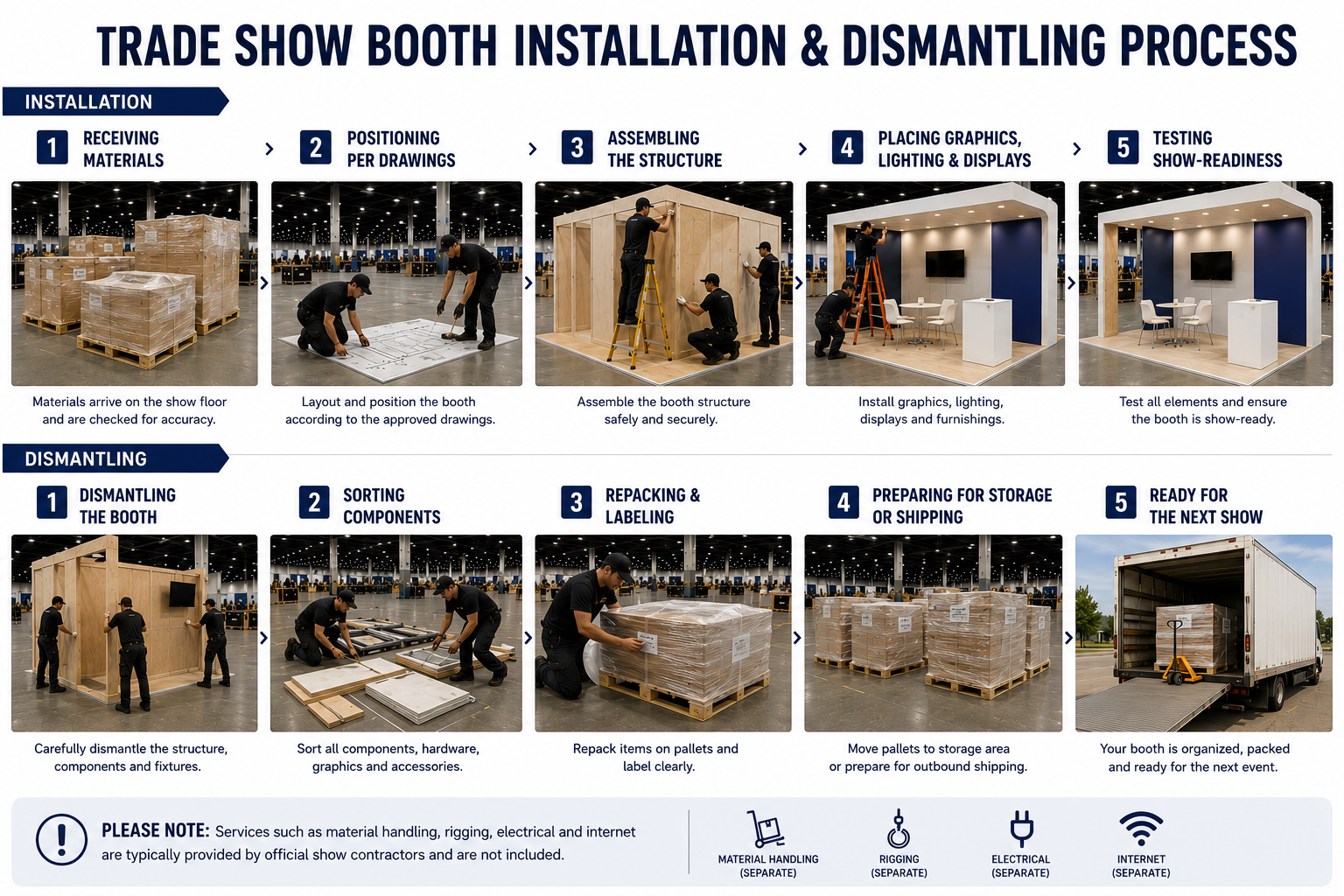
Trade show booth installation and dismantling typically includes receiving materials on the show floor; positioning per drawings; assembling the structure; placing graphics, lighting, and basic displays; testing show‑readiness; then dismantling, sorting, repacking, labeling, and preparing items for storage or outbound shipping. However, costs like material handling, rigging, and electrical are often separate.1

trade show booth installation and dismantling workflow diagram

Good news: once you understand what’s inside the scope—and what lives with the venue or official contractors—you can control the timeline and avoid surprise charges. I’ll break down how we run installation and dismantling as a coordinated workflow, how scope changes by city and booth type, and exactly what to confirm up front.

What does trade show booth installation and dismantling actually include on-site?

Many teams underestimate the number of handoffs during move‑in and move‑out. That creates stress and avoidable risk. When I treat trade show booth installation and dismantling as a step‑by‑step workflow, the exhibit goes up cleaner, faster, and with fewer costly fixes.

The short answer: it includes the labor and supervision to build your booth according to approved drawings, place and test visible elements, and then take everything down and pack it safely. It usually excludes services controlled by the venue or the show’s official contractors, like electrical distribution, internet, and material handling.2

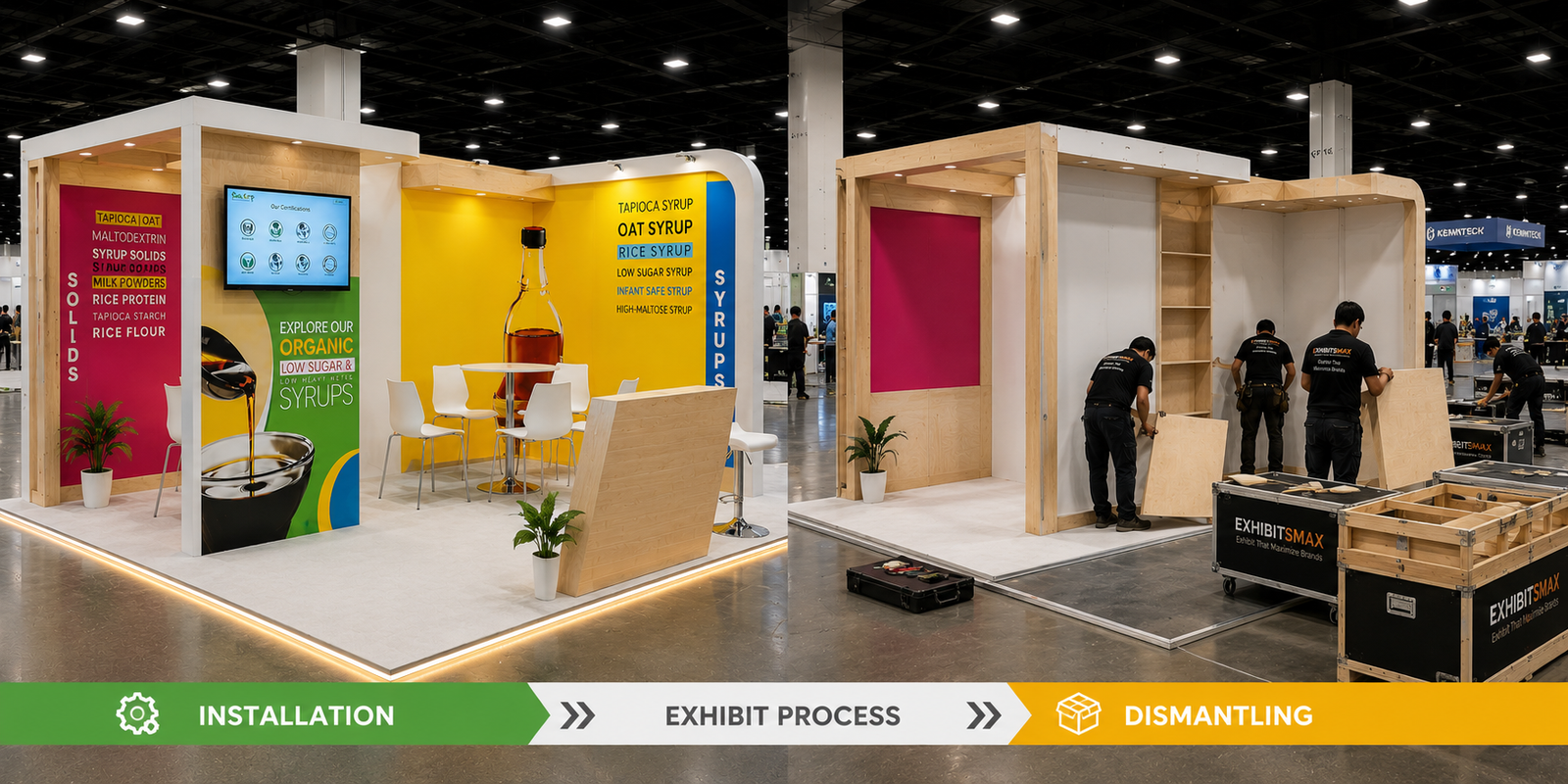
trade show booth installation and dismantling steps and tasks

The full workflow that actually gets you show‑ready

I manage this as a sequence with clear checkpoints. Here’s how a typical 20x20 to 30x30 booth flows on a U.S. show floor:

  • Inbound receiving and check‑in

    • Confirm crates arrived and were delivered from the warehouse to your space by the show’s material handling team.
    • Verify quantities against the packing list; report shortages immediately.
  • Space layout and mark‑out

    • Measure the booth footprint to the floor plan.
    • Establish anchor points for key structures, counters, and traffic paths.
  • Build the structure

    • Erect frames, walls, platforms, and towers per drawings.
    • Follow engineering notes; use appropriate anchors and safety practices.
  • Power and services coordination

    • Locate electrical drops and floor ports; call official electricians for tie‑ins.
    • Protect cable runs and keep aisles clear for safety inspections.
  • Graphics and finishes

    • Install SEG fabric, panels, and printed skins without creases or light leaks.
    • Touch up paint or edges as needed; clean visible surfaces.
  • Lighting and basic AV placement

    • Mount light fixtures and test output; aim to avoid glare.
    • Set hardware for LED tiles or monitors (final power and signal handled by AV team if separate).
  • Quality check and punch list

    • Walk the booth from the attendee’s viewpoint.
    • Fix gaps, level counters, and test doors, locks, and interactive elements.
  • Handover for show open

    • Remove tools and trash; tag empties for storage by material handling.
    • Brief your team on do’s and don’ts for daily operation.
  • Dismantle and outbound

    • Reverse the build carefully; protect fragile edges.
    • Sort, label, and pack components by crate; update inventory.
    • Prepare bills of lading for outbound trucking or storage.

A key point: our crew leads supervise the entire flow, but some steps depend on official providers. For example, only the show’s electricians can distribute power beyond the main drop.3 The same goes for internet, material handling (also called drayage), and rigging overhead.

How does the trade show booth installation and dismantling scope change by booth type, venue, and city?

Scope isn’t one‑size‑fits‑all. Different structures and cities create different dependencies, from union labor rules to ceiling rigging. The risk is assuming last show’s scope fits this show. We ask targeted questions before we lock in labor, timing, and cost.

Scope changes with booth design (inline vs. island), structure (modular vs. custom), ceiling height and rigging, and the show city’s labor rules. In union-heavy venues, some tasks require certified crews. Larger island booths often need forklifts or rigging, which are ordered through official contractors rather than included in I&D.

trade show booth installation and dismantling variables by city and booth type

Common patterns that affect scope and budget

Booth type and structure

  • Inline (e.g., 10x20) modular systems:

    • Usually ground‑supported and hand‑carried from the aisle.
    • Lower material handling weight; limited or no rigging.
    • Faster I&D with smaller crews.
  • Island (e.g., 20x20+), custom builds:

    • Heavier crates, more components, and frequent equipment needs.
    • May require forklifts for placement; longer build time.
    • Lighting grids or signage may require overhead rigging.

Venue and city rules

Time windows and overtime

  • Move‑in/move‑out windows:
    • Compressed windows mean larger crews or overtime rates.
    • Night or weekend work typically incurs premiums.
  • Marshaling yards:
    • Trucks must check in and sequence; missing the target causes delays and added fees.

Here’s a simplified comparison:

Factor Inline Modular Island Custom
Typical I&D Duration 3–6 hours 1–3 days
Equipment Needs Carts/dollies Forklift, possibly rigging
Union Sensitivity Lower Higher
Material Handling Weight Light Heavy
Risk of Overtime Low Medium–High

These variables are why we avoid blanket promises. Instead, we scope trade show booth installation and dismantling after confirming design, venue, and the show manual. When the plan fits reality, the floor goes smoother and cheaper.

What on-site costs are often not included in trade show booth installation and dismantling?

The biggest misunderstandings happen here. A single “I&D” line in a proposal rarely covers services controlled by show contractors or the venue. If you assume it does, surprise invoices land after the show. I have seen teams overspend by 30% simply because no one clarified the boundaries.

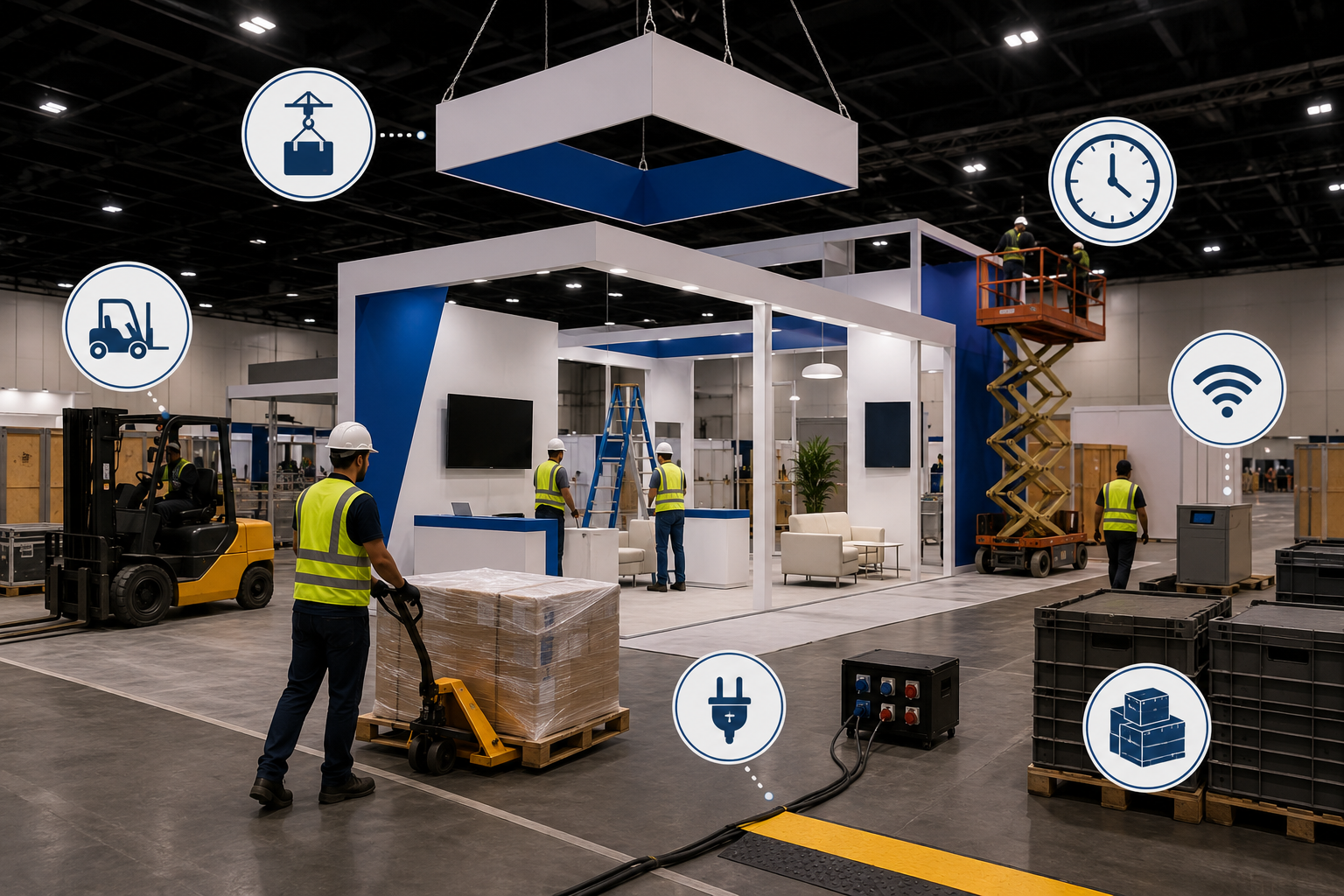
Typically excluded costs include material handling (drayage), rigging, electrical distribution, internet, equipment rentals like forklifts or scissor lifts, empty crate storage, and show‑ordered overtime. These are ordered and billed through the show’s official contractors, not through the trade show booth installation and dismantling crew.

trade show booth installation and dismantling cost exclusions and services

Plain‑language explanations of common add‑ons

  • Material handling (drayage):

  • Rigging:

  • Electrical:

    • Floor power drops, distribution to locations, and final connections are performed by the official electrical contractor.
    • You pay for power (amps/volts), labor, and sometimes a one‑hour minimum for any change.
  • Internet and lead systems:

    • Wired and wireless services come from the venue or show provider.
    • Pricing and performance vary widely; order early.
  • Equipment and storage:

    • Forklifts, pallet jacks, and scissor lifts are typically ordered through the show.
    • Empty crate storage is part of material handling; retrieval timing affects dismantle speed.
  • Overtime and waiting:

Knowing these realities up front lets you budget accurately and set internal expectations. We highlight them in our quotes so there are no gaps between what we do, what the show controls, and what you need to order.

How do we avoid surprise charges and opening-day delays?

Surprises usually come from compressed schedules, missing paperwork, and unclear responsibilities. The fix is simple to say but hard to execute: align design, logistics, and on‑site services well before move‑in. I set trigger points weeks ahead so we are never negotiating from the show floor.

You avoid surprises by locking the design and drawings early, ordering show services before advance deadlines, labeling and weighing crates precisely, scheduling crews against published move‑in windows, and assigning a single on‑site decision‑maker. Clear EAC paperwork and insurance, plus a tested inventory list, keep approvals smooth.

trade show booth installation and dismantling planning to avoid delays

A practical pre‑show roadmap I use

6–8 weeks out

3–4 weeks out

  • Confirm freight plan:
    • Decide advance warehouse vs. direct to show. Warehouse is safer for schedule; direct is cheaper but riskier.
    • Label every crate with booth number, company name, and piece count (e.g., 1 of 6).
  • Verify weights and dimensions; overweight surprises trigger extra CWT charges.

1–2 weeks out

  • Publish an on‑site schedule:
    • Labor start times by day.
    • Dependencies: power drop, rigging window, delivery of crates.
    • Responsibility matrix for who calls which contractor.
  • Prepare a punch‑list kit (touch‑up paint, cleaning wipes, spare SEG gaskets, zip ties, Velcro).

Move‑in days

  • Walk the space at delivery; validate power location and crate count.
  • Stage work to avoid rework:
    • Build structures away from unused power boxes.
    • Hang graphics after dust‑heavy work is complete.
  • Keep a change log:
    • Any field deviation gets logged and photographed for future cycles.

Show close and move‑out

  • Pre‑assign someone to call for empty crates as soon as the aisle carpet is pulled.
  • Pad and wrap fragile pieces first; confirm serial numbers of high‑value assets.
  • Close crates with inventory sheets inside and outside; take photos of each pallet.

I once watched a neighboring exhibitor miss their rigging window because the sign art changed at the last minute; the crane slot slipped by eight hours, then all their downstream work moved into overtime. A two‑day cost hit. That is why we lock artwork that impacts rigging 30 days out.

What should be in a complete I&D scope of work and responsibility matrix?

Ambiguity kills budgets. A complete trade show booth installation and dismantling scope defines who does what, with what approval, and by when. The matrix needs to reflect what the booth builder handles, what the exhibitor provides, and what only official contractors can perform.

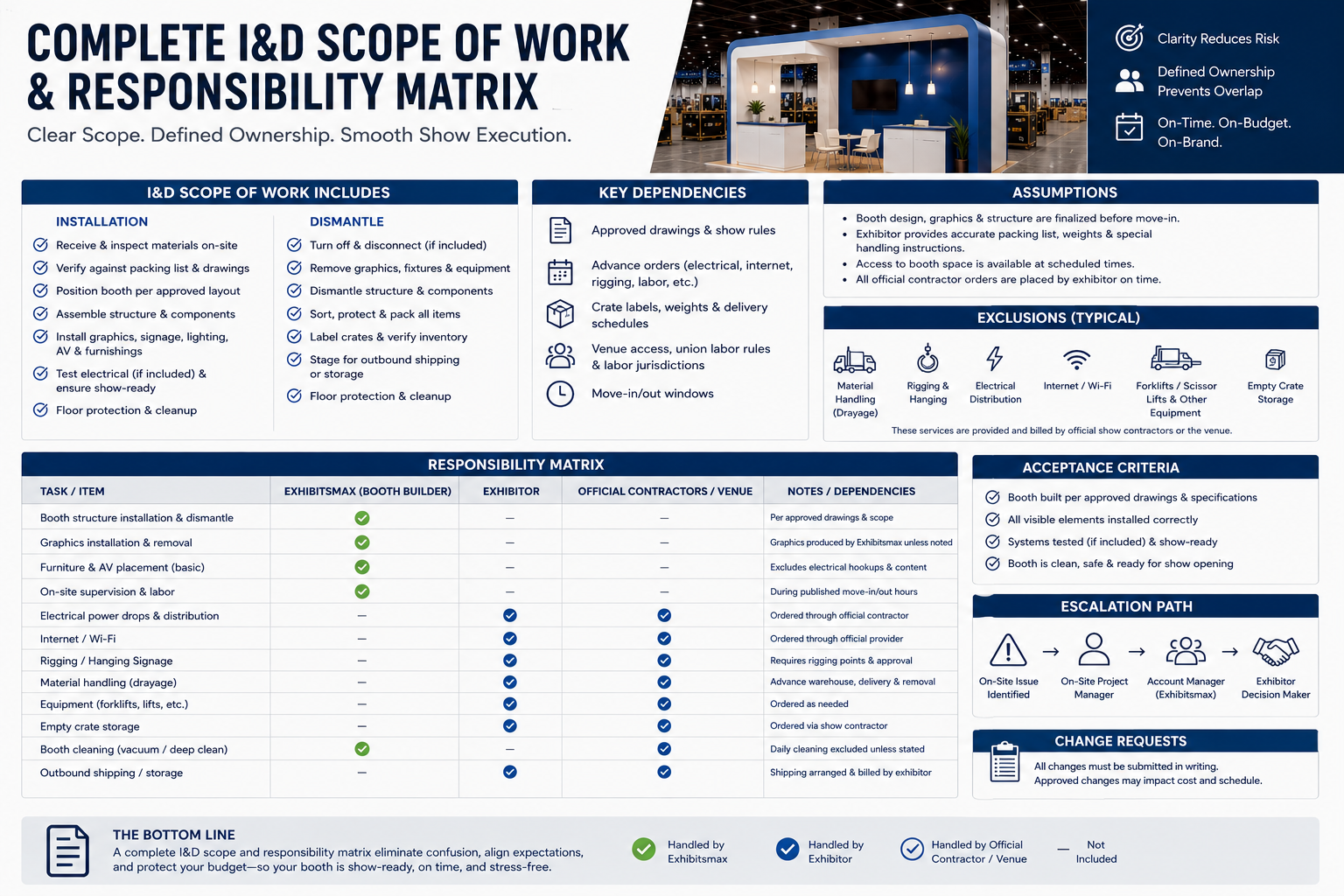
A strong scope specifies tasks, dependencies, materials, and acceptance criteria for install and dismantle, plus a responsibility matrix that assigns Exhibitsmax, the exhibitor, or official contractors to each line item. It should include assumptions, exclusions, and escalation paths for schedule slips, damages, or change requests.

trade show booth installation and dismantling scope and responsibility matrix

What the scope should actually say

Below is a simplified responsibility matrix we use as a starting point. Actual assignments vary by show and client preference.

Task/Service Exhibitsmax Exhibitor Official Contractor
EAC forms & COI submission ✓ (prepare) ✓ (sign/submit)
Freight booking
Material handling (drayage)
Receiving & inventory on floor
Booth structure assembly
Electrical order & floor plan ✓ (execution)
Power tie‑ins
Overhead rigging
AV equipment supply ✓ or third‑party ✓ (specs/approval)
Graphic installation
Cleaning before show open ✓ (booth wipe‑down) ✓ (if nightly service) ✓ (if ordered)
Supervision & punch list
Dismantle and packing
Outbound bills of lading ✓ (prepare) ✓ (sign)
Storage or return shipping ✓ (arrange) ✓ (approve)

Key elements to include in the written scope:

  • Assumptions:
    • Move‑in/move‑out windows and standard hours.
    • Equipment availability and floor conditions.
  • Inclusions:
    • Labor hours and crew size by day.
    • Basic tools and consumables.
    • Protection materials (moving blankets, edge guards).
  • Exclusions (to be ordered via show):
    • Material handling, electrical, internet, rigging, equipment rentals, carpet.
  • Deliverables:
    • As‑built photos, packing list updates, damage report if applicable.
  • Escalation:
    • Who can approve overtime or scope changes.
    • How we handle late freight or delayed services.

When these points are explicit, procurement teams can compare quotes apples‑to‑apples, and on‑site teams waste less time debating “who owns what.”

What questions should you answer before we confirm trade show booth installation and dismantling?

The smartest way to control cost and risk is to answer a standard set of questions before we price or schedule. When we skip these, hidden complexity shows up on the floor and budgets expand. I run this checklist on every new build or new venue.

You should confirm booth size, structure type, reusability, graphics plan, weight and crate count, show city and venue rules, move‑in/out windows, service orders, and what happens to the booth after the show. Your answers directly impact labor, equipment needs, and the trade show booth installation and dismantling plan.

trade show booth installation and dismantling pre-scope questions

The pre‑scope checklist that prevents surprises

Booth and design

  • What is the footprint (e.g., 10x20 inline, 20x20 island)?
  • Is the structure modular, custom wood, or hybrid?
  • Are there any overhead signs or hanging light grids?
  • What graphics are new versus reused? SEG fabrics, hard panels, or vinyl?

Logistics and assets

  • How many crates or pallets? What are weights and dimensions?
  • Are fragile items (e.g., LED tiles, glass shelving) crated separately?
  • Are spares included for hardware, gaskets, and connectors?
  • Will the booth be stored, shipped to another show, or discarded?

City, venue, and rules

  • Which city and venue? Any known union jurisdictions?
  • What are the published move‑in and move‑out windows?
  • Have EAC forms and insurance been prepared?
  • Are there height restrictions or engineering requirements?

Services and vendors

  • Has electrical been ordered with a marked floor plan?
  • Will there be internet, plumbing, or compressed air?
  • Are AV and LED video walls supplied by us or by your vendor?
  • Are there special certifications required (e.g., safety cables, flame certificates)?

Supervision and approvals

  • Who is the on‑site decision‑maker for changes?
  • What is the approval process for overtime or equipment?
  • Who signs the outbound bill of lading and receives the inventory photos?

Each answer shapes the labor plan. For instance, a 20x20 island with a 16‑foot tower and a hanging sign usually needs a forklift and riggers; we cannot lawfully substitute our crew for those tasks. Conversely, a 10x20 modular inline can be installed by a two‑person team in a single shift without equipment.

Frequently Asked Questions

What is the difference between installation/dismantling and material handling?

Installation and dismantling covers building, finishing, and packing your booth. Material handling (also called drayage) is the show contractor’s service that moves your freight from the receiving area to your booth, stores empty crates during the show, and returns them at move‑out. They are separate costs and vendors.

Does I&D include electrical and internet?

No. Electrical power drops, distribution, and internet are ordered from the official show or venue providers. Our team coordinates locations and timing and connects your equipment once power is live, but the fees for those services are billed by the official contractors and are not part of I&D labor.

Can our team help with installation to reduce costs?

In some venues, small booths allow exhibitor staff to assist with limited hand tools and within time caps. In union‑regulated cities, rules can be strict. We will advise what is allowed after reviewing the show manual. Safety, tool types, and booth size often determine whether exhibitor‑assisted labor is permitted.

How long does trade show booth installation and dismantling take?

It depends on booth size, complexity, and service dependencies. A 10x20 modular inline might install in 3–6 hours and dismantle in 2–4 hours. A 20x20 island with rigging and AV can require one to three days to install and a full day to dismantle, plus waiting time for services.

What happens if our freight arrives late?

We escalate immediately, adjust the build sequence, and add labor if needed with your approval. However, late freight can trigger overtime, equipment charges, and rush fees from official contractors. The best protection is shipping to the advance warehouse with accurate labels and confirming target move‑in dates.

Conclusion

Trade show booth installation and dismantling is a coordinated, on‑site execution service—not just “build it and take it down.” When the scope, responsibilities, and venue rules are clear, you avoid surprise charges and opening‑day delays. If you’re planning a U.S. show, let Exhibitsmax map your I&D workflow and responsibility matrix before you ship. Contact us to schedule a planning call.


  1. "15 Costly Mistakes Exhibitors Make at Javits Center (and How to ...", https://www.purexhibits.com/javits-center-exhibitor-mistakes/. The Javits Center’s exhibitor policies specify that electrical service, rigging/hanging signs, internet, and freight handling are performed by designated contractors and must be ordered separately from exhibit installation labor. Evidence role: general_support; source type: government. Supports: That exhibitor I&D labor does not include electrical, rigging, or drayage, which must be ordered from designated providers separately.. Scope note: Policies can vary by venue and event; the principle is broadly applicable but not universal.

  2. "[PDF] LAS VEGAS CONVENTION CENTER", https://qtxasset.com/quartz/qcloud1/2023-09/LVCC%20Exhibitor%20Resource%20Guide_0.pdf?VersionId=krLAvbTzW_GIKtUqAaHa.BLwibPJVuQ8. The Las Vegas Convention Center’s exhibitor service information outlines that electrical, internet/telecom, and material handling are provided through official contractors and are separate from exhibitor labor to install booths. Evidence role: general_support; source type: government. Supports: That electrical distribution, internet, and drayage are venue-controlled services ordered separately from exhibit installation.. Scope note: Specific contractors and procedures differ by show; the separation of responsibilities is the consistent element.

  3. "[PDF] EXHIBITOR BILL OF RIGHTS | McCormick Place", https://www.mccormickplace.com/wp-content/uploads/2024/05/The-Exhibitor-Bill-of-Rights.pdf. McCormick Place’s exhibitor labor rules state that only official electricians may perform electrical work, including distribution and connections, beyond service drops. Evidence role: general_support; source type: government. Supports: That electrical connections and distribution on the show floor are performed exclusively by official electricians.. Scope note: Details such as allowable minor tasks can vary by facility; exhibitors should consult the specific venue’s manual.

  4. "SB3215ham002 96TH GENERAL ASSEMBLY", https://ilga.gov/ftp/legislation/96/SB/09600SB3215ham002.htm. Official exhibitor guidelines for McCormick Place (Chicago) and the Javits Center (New York) outline union jurisdictions and specify tasks that must be performed by union personnel. Evidence role: general_support; source type: government. Supports: That exhibition work at major venues in Chicago and New York is subject to union labor rules for defined tasks.. Scope note: Exact task assignments and exceptions differ by venue and event contracts.

  5. "Exhibitor Service & Guidelines - McCormick Place", https://www.mccormickplace.com/exhibitors/service-guidelines/. Venue work rules (e.g., McCormick Place and the Javits Center) state that exhibitors may perform limited work with specific hand tools under defined conditions, with larger or specialized tasks assigned to union labor. Evidence role: general_support; source type: government. Supports: That venues restrict exhibitor self‑installation to defined conditions such as use of hand tools and size limits.. Scope note: Allowances vary by facility and event; exhibitors must review the specific show manual.

  6. "Exhibitor Appointed Contractors (EAC) Terms and Conditions", https://www.electricalwireshow.com/exhibitor-appointed-contractors-eac-terms-and-conditions. Industry guidelines from exhibition associations indicate that Exhibitor Appointed Contractors are typically required to submit EAC registration and proof of insurance to the show organizer before access is granted. Evidence role: general_support; source type: institution. Supports: That EACs must provide documentation, including forms and insurance certificates, to the show organizer.. Scope note: Organizer‑specific forms and insurance limits can differ; exhibitors should confirm event requirements.

  7. "Material Handling FAQs - Exhibitor Magazine", https://www.exhibitoronline.com/topics/article.asp?ID=2808. Exhibition industry guidance notes that material handling is frequently charged per hundredweight (CWT) and that rates may differ for freight received at the advance warehouse versus direct-to-show deliveries. Evidence role: general_support; source type: institution. Supports: That drayage is often priced per hundredweight and distinguishes rates for advance warehouse and direct shipments.. Scope note: Rate structures are set by individual contractors and shows and may not be uniform.

  8. "Rigging & Engineering Stamp Guidelines - ECI", https://exhibitconcepts.exhibit-design-search.com/trade-show-tips/rigging-and-engineering-stamp-guidelines-121/. The Javits Center’s rigging policies require advance submission of drawings and compliance with structural and safety standards, and some hanging elements must be reviewed or certified before installation. Evidence role: general_support; source type: government. Supports: That rigging and hanging signs must follow venue procedures including advance orders, drawings, and in some cases engineer certification.. Scope note: Approval thresholds and documentation requirements vary by venue and the weight/complexity of the hang.

  9. "Overtime - California Department of Industrial Relations", https://www.dir.ca.gov/dlse/faq_overtime.htm. Published labor policies for major convention centers outline straight‑time, overtime, and double‑time billing for show labor based on work hours and weekends. Evidence role: general_support; source type: government. Supports: That venue labor schedules specify straight time versus overtime/double‑time rates depending on hours and days worked.. Scope note: Specific time bands and rates vary by union contract and venue.

  10. "[PDF] CERTIFICATE OF INSURANCE & EAC POLICY", https://cdn.asp.events/CLIENT_CL_US_323E7AA7_5056_B733_8303D39C538813E0/sites/DI-2025/media/Insurance-Requirements-2025-1.pdf. Exhibition association guidance indicates that EAC registration and certificates of insurance are required prior to move‑in for outside contractors to access the show floor. Evidence role: general_support; source type: institution. Supports: That EAC registration and insurance documentation are required in advance for third‑party crews.. Scope note: Exact deadlines and forms are set by each organizer; exhibitors must follow event‑specific instructions.