Exhibitsmax Logo
VENUE GUIDE

Las Vegas Convention Center Booth Planning Guide

Published on July 15, 2026
Las Vegas Convention Center Booth Planning Guide

Las Vegas Convention Center Booth Planning Guide: What Should You Decide First?

Las Vegas Convention Center booth planning can feel simple until deadlines, freight rules, booth size, graphics, labor, and product displays start competing for the same budget. That pressure gets worse when your team is exhibiting in the U.S. for the first time. The solution is not a bigger checklist. It is a better decision framework.

A smart Las Vegas Convention Center booth planning guide starts with your exhibit goal, booth size, product requirements, schedule, and risk level. Exhibitors should choose between rental, custom, hybrid, or modular booths based on budget, shipping needs, installation complexity, brand expectations, and how often they plan to exhibit in the United States.

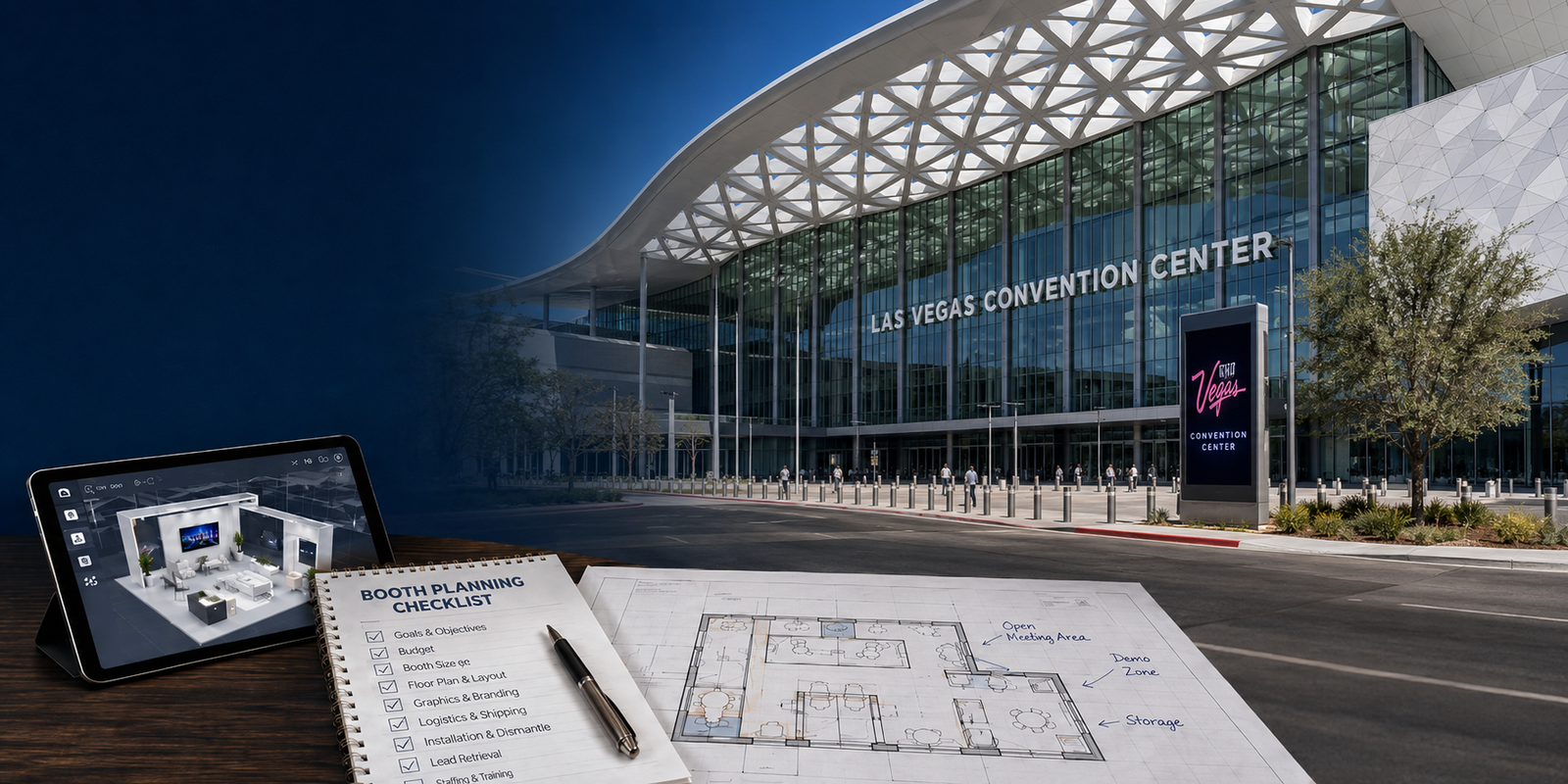
Las Vegas Convention Center booth planning guide for exhibitors

I have seen many exhibitors ask for “just a booth quote” before they know what the booth must achieve. That is where planning usually goes wrong. The better question is not “What does a booth cost?” The better question is “Which choices reduce risk and support the show goal?”

Why Does Las Vegas Convention Center Booth Planning Need More Than a Checklist?

Many exhibitors start with a checklist because it feels safe. They want booth size, graphics, furniture, lighting, freight, and installation marked as complete. The problem is that a checklist does not tell you which decision matters most, which item creates hidden cost, or which assumption could delay the booth.

A Las Vegas Convention Center booth planning process needs more than a checklist because every booth decision affects another decision. Booth type affects freight. Freight affects labor. Product display affects structure. Graphics affect production time. Schedule affects cost.1 A planning framework helps exhibitors compare trade-offs before money is committed.

Las Vegas Convention Center booth planning framework for trade show exhibitors

A checklist confirms tasks. A framework improves judgment.

I like checklists. I use them. However, I do not rely on them as the main planning tool. A checklist can tell you whether the flooring was ordered, but it cannot tell you whether the flooring choice fits your booth traffic, product weight, or cleaning needs during a three-day show.

A better Las Vegas Convention Center booth planning guide should help you answer questions like:

  • What is the purpose of this booth? Lead generation, distributor meetings, product launch, retail buyer meetings, or brand awareness?
  • How many staff members will work inside the booth?
  • Will visitors need to touch, test, compare, or photograph the product?
  • Will the booth be reused at other U.S. trade shows?
  • Does the design need to impress buyers, investors, dealers, or government partners?
  • What risks are unacceptable? Late graphics, damaged freight, unclear installation, or weak storage planning?

The “simple booth” is often not simple

In customer conversations, I often hear a version of this sentence:

“We only need a simple booth.”

That can be true. But “simple” means different things to different exhibitors.

A 10x20 booth with printed back walls, carpet, a reception counter, and LED monitor may be simple for a local exhibitor with small products. The same booth can become complex for an international manufacturer shipping heavy samples, needing secure storage, and coordinating staff from three countries.

Here is how the same booth size can create very different planning needs:

Exhibitor Situation What Looks Simple Hidden Planning Issue
Startup launching a small product 10x10 rental booth Needs strong graphics and fast lead capture
Manufacturer showing machinery parts 10x20 booth Product weight, crate handling, and flooring protection
International brand entering U.S. market 20x20 island booth Customs timing, brand standards, and installation control
Distributor meeting buyers 10x20 inline booth Private conversation space and sample storage
National pavilion exhibitor Shared exhibit area Consistent design, multiple stakeholders, and logistics alignment

Planning should start with constraints

A booth plan becomes more realistic when you identify the constraints early. I usually group them into five areas:

  1. Show rules and booth regulations
  2. Product size, weight, and handling
  3. Budget range and payment timing
  4. Production and shipping schedule
  5. Decision-making structure inside the exhibitor’s company

These constraints are not obstacles. They are decision filters. They help you avoid designing a booth that looks good on a screen but fails during move-in.

What Booth Type Should You Choose for a Las Vegas Convention Center Exhibit?

Choosing a booth type can feel confusing because many options look similar in renderings. A custom booth, rental booth, modular exhibit, and hybrid display may all appear polished. The real differences show up in cost structure, reuse value, freight volume, installation time, and how much control you need.2

For a Las Vegas Convention Center exhibit, choose a rental booth for short-term flexibility, a custom booth for strong brand control, a modular booth for reuse across multiple shows, and a hybrid booth when you need a balance of cost control and custom appearance. The best option depends on goals, timeline, and logistics.

Las Vegas Convention Center booth planning for rental custom and modular exhibits

Booth type is a business decision, not only a design choice

I have learned that many exhibitors compare booth types by appearance first. That is understandable. Trade shows are visual. But the more important comparison is operational.

A booth that looks affordable in a rendering can become expensive if it requires large crates, long installation hours, special rigging, or rushed graphic production. A booth that looks expensive can sometimes save money over several shows if it is built for reuse and stored properly.

Here is a practical comparison:

Booth Type Best For Main Advantage Main Risk
Rental booth One-time or first-time U.S. exhibitors Lower upfront cost and faster setup Less design ownership
Custom booth Brands needing a premium presence Full control over look and function Higher fabrication and storage cost
Modular booth Exhibitors attending multiple shows Reuse and flexibility Design may feel less unique
Hybrid booth Growing brands balancing image and budget Custom look with rental efficiency Requires careful planning to avoid compromise

When rental makes sense

A rental booth often works well when the exhibitor is testing a U.S. market, attending one show, or working with limited internal time. Many international exhibitors prefer rental because they do not want to import, store, or manage exhibit assets after the event.

Rental can be a strong choice when:

  • The booth size is 10x10, 10x20, 20x20, or another common footprint.
  • The show is not part of a long U.S. exhibition calendar.
  • The brand can accept standard structures with custom graphics.
  • The exhibitor wants predictable installation and dismantling.
  • The team wants fewer post-show storage decisions.

When custom makes sense

A custom booth can be the better option when brand experience matters more than short-term savings. This is common for product launches, dealer meetings, investor-facing events, or high-value B2B sales environments.

Custom makes sense when the booth must support:

  • Product demonstrations
  • Private meeting rooms
  • Heavy or unusual product displays
  • Strong lighting design
  • Large-format graphics
  • High-traffic visitor flow
  • Long-term reuse across several shows

Do not ignore the product

Your product should influence the booth more than most exhibitors expect. A booth for cosmetics, industrial components, food equipment, medical devices, and consumer electronics should not be planned the same way.

Important product questions include:

  1. How heavy is the product?
  2. Does it need power, water, air, or internet?
  3. Will people touch it or watch a demo?
  4. Does it need locked storage after show hours?
  5. Can it be shipped early, or will it arrive close to move-in?

These questions often reveal whether the booth needs reinforced counters, special shelving, secure cabinets, wider aisles, or controlled access.3 Good Las Vegas Convention Center booth planning connects the product to the exhibit structure before design approval.

How Should Las Vegas Convention Center Booth Planning Account for Logistics and Show Rules?

Logistics are where many booth plans become real. A rendering may look finished, but the booth still has to be built, packed, shipped, received, moved to the booth space, installed, inspected, dismantled, repacked, and either stored or shipped out.4 Each step has cost and timing implications.

Las Vegas Convention Center booth planning should account for logistics by confirming show deadlines, freight method, material handling rules, installation labor, electrical needs, hanging sign requirements, and outbound shipping before production begins. Early logistics planning reduces rush fees, missed deliveries, booth damage, and move-in confusion.5

Las Vegas Convention Center booth planning logistics and show rules

Logistics decisions start earlier than most exhibitors think

Many exhibitors treat logistics as the final step. I see why. Design feels more exciting than freight. But in practice, freight and labor can shape the design from the beginning.

For example, a tall back wall may improve visibility, but it may also increase crate size. A heavy reception counter may look premium, but it may increase material handling and require more labor. A hanging sign may help branding, but it requires approval, rigging, and a separate schedule.

Key logistics checkpoints

A strong Las Vegas Convention Center booth planning process should include these checkpoints:

  • Show manual review: Every major event has specific rules, deadlines, forms, and vendor requirements.
  • Advance warehouse vs. direct-to-show shipping: Advance warehouse shipping offers more control but may add handling costs. Direct shipping can work, but timing risk is higher.6
  • Crate labeling: Poor labeling can delay freight identification during move-in.
  • Electrical layout: Power locations should match monitor, lighting, demo, and charging needs.
  • Installation and dismantling schedule: Labor availability and show move-in hours can affect what is realistic.
  • Outbound freight planning: Dismantling is not finished until the booth leaves correctly.

The show manual is not optional

The show manual is one of the most important planning documents. It often includes:

Planning Area Why It Matters
Move-in and move-out dates Determines production and freight deadlines
Booth height limits Affects wall design, signage, and visibility
Electrical ordering Prevents last-minute power issues
Material handling Impacts total cost and freight strategy
Fire and safety rules Affects materials, coverings, and approvals
Hanging sign rules Impacts rigging, labor, and inspection timing

I have seen exhibitors underestimate show manuals because the booth design seems straightforward. But even a small booth can run into problems if electrical is ordered late, graphics arrive separately, or the crate is not labeled according to show requirements.

International exhibitors need extra timing buffer

International exhibitors often face additional layers:7

  • Customs documentation
  • Ocean or air freight timing
  • Product samples arriving separately from booth materials
  • U.S. address coordination
  • Communication across time zones
  • Payment approval delays
  • Last-minute staff travel changes

These issues do not mean international exhibiting is risky by default. They mean the plan must include buffer time. In my experience, a few extra planning days can prevent many expensive emergencies.

Post-show planning matters too

Many exhibitors focus heavily on move-in and forget move-out. This creates problems when no one knows where the booth goes after the show.

Ask these questions before the show opens:

  1. Will the booth be stored in the U.S.?
  2. Will it be reused at another show?
  3. Will graphics be replaced or saved?
  4. Will damaged parts be repaired after dismantling?
  5. Who is responsible for outbound freight paperwork?

A booth plan is not complete until the post-show path is clear.

How Do Budget Choices Affect Your Las Vegas Convention Center Booth Planning?

Budget questions often start with the booth structure, but the structure is only one part of the total cost. Exhibitors also need to consider design, graphics, freight, material handling, installation, dismantling, electrical, flooring, furniture, AV, storage, and project management.8

Las Vegas Convention Center booth planning should treat budget as a total project cost, not only a booth price. The right budget decision balances booth impact, operational risk, reuse potential, show deadlines, product needs, and service requirements. A cheaper booth can become expensive if it causes delays or hidden labor costs.9

Las Vegas Convention Center booth planning budget and cost decisions

“How much does a booth cost?” needs context

This is one of the most common questions I hear. It is also one of the hardest to answer responsibly without more details.

A useful budget conversation usually starts with:

  • Booth size
  • Show name and date
  • Booth type
  • Product display requirements
  • Graphic quantity and quality
  • Installation complexity
  • Freight origin
  • Reuse plan
  • Electrical and AV needs
  • Storage expectations

Without those details, any number can be misleading.

Budget categories exhibitors should compare

Here is a simplified budget framework:

Budget Category What It Includes Planning Implication
Design and rendering Concept, layout, revisions More complexity requires more design time
Fabrication or rental Walls, counters, structures Determines ownership, reuse, and storage
Graphics Printing, finishing, installation Late artwork can cause rush costs
Freight Shipping booth and products Size and weight affect cost heavily
Material handling Moving freight at the venue Often separate from shipping cost
Labor Installation and dismantling More complex booths require more hours
Electrical and AV Power, monitors, lighting, LED walls Needs early layout coordination
Furniture and flooring Seating, tables, carpet, padding Affects comfort and visitor experience
Project management Coordination and deadlines Reduces miscommunication and risk
Storage Post-show warehouse handling Important for reusable booths

Cheap can be expensive when risk increases

A lower booth price is not automatically bad. I support cost control. However, cost control should reduce waste, not increase risk.

A cheaper option may become expensive when:

  • The booth takes longer to install.
  • Graphics do not fit correctly.
  • Product displays are not stable.
  • Freight arrives late because shipping was rushed.
  • The structure cannot be reused.
  • Staff cannot work comfortably inside the booth.
  • Visitors cannot understand the product quickly.

Budget should match show value

Not every exhibitor needs a large custom booth. A company attending a small industry show for lead testing may be better served by a clean rental exhibit with strong graphics and a good staff plan. A manufacturer launching a major product line at a national trade show may need a more developed experience.

A practical way to decide is to rank your booth priorities:

  1. Brand impact
  2. Lead generation
  3. Product demonstration
  4. Private meetings
  5. Speed of setup
  6. Reuse across shows
  7. Cost control
  8. Low operational risk

If cost control ranks first, you can still build a professional booth. But you should avoid design features that create high labor, freight, or rush production costs. If brand impact ranks first, you may need to invest more in custom fabrication, lighting, graphics, and AV.

LED video walls and AV need early planning

Many exhibitors ask about LED video wall rental after the booth design is already approved. That timing can create layout problems. Video walls affect power, structure, sightlines, content, labor, and visitor flow.10

Before adding a video wall, ask:

  • Will the content be visible from the aisle?
  • Is the booth structure designed to support the display plan?
  • Does the show schedule allow proper installation?
  • Does the booth need extra electrical service?
  • Who will manage content playback during the show?

AV can improve a booth, but it should support the message. It should not be added only because it looks impressive.

What Risks Should You Review Before Approving Booth Design, Graphics, and Installation?

Approving a booth design feels like the finish line, but it is actually a decision checkpoint. Once design moves into production, changes can affect cost, timing, materials, labor, and graphics. The best time to reduce risk is before final approval, not during move-in.

Before approving Las Vegas Convention Center booth planning decisions, exhibitors should review design fit, product dimensions, graphic deadlines, electrical locations, installation complexity, freight timing, storage needs, and post-show responsibilities. Approval should confirm that the booth can be built, shipped, installed, used, dismantled, and reused as planned.

Las Vegas Convention Center booth planning risk review before booth approval

Risk review protects the booth and the team

Most booth problems do not come from one major mistake. They come from small assumptions that were never checked.

For example:

  • Someone assumes the product fits on the counter.
  • Someone assumes the monitor can be mounted anywhere.
  • Someone assumes graphics can be changed the week before the show.
  • Someone assumes storage is included.
  • Someone assumes the booth will install in a few hours.

Each assumption can create real cost.

Pre-approval questions I recommend

Before approving the booth, I like to walk through these questions:

1. Does the design match the booth space?

Confirm the booth footprint, orientation, aisle exposure, height limits, neighboring booths, and open sides. A 20x20 island booth has different traffic behavior than a 10x20 inline booth.

2. Does the design match the product?

Check actual product dimensions, weight, demo needs, packaging, and display height. Product information should not be estimated if the display is critical.

3. Are graphics production-ready?

Graphics should be reviewed for size, resolution, bleed, color expectations, and file format. Late artwork is one of the most common causes of stress.

4. Is power planned correctly?

Power should connect to monitors, lighting, demo units, chargers, refrigerators, machinery, or interactive displays. Electrical locations should be marked on the floor plan.

5. Is installation realistic?

A booth can look simple in a rendering but require careful assembly onsite. The installation plan should match the move-in window and labor availability.

6. Is the post-show plan clear?

The booth may be discarded, returned, stored, repaired, or reused. Each option requires a different plan.

A practical risk matrix

A risk matrix helps decision-makers see where attention is needed.

Risk Area Low Risk Signal High Risk Signal Best Action
Graphics Final artwork ready early Artwork still changing near deadline Set a hard approval date
Freight Crates scheduled with buffer Shipping close to move-in Use earlier shipping or advance warehouse
Product display Dimensions confirmed Product still in development Build adjustable display areas
Installation Standard rental components Complex custom build Confirm labor plan early
Electrical Floor plan marked Power needs unclear Map every device
Storage Reuse plan confirmed No post-show decision Choose storage or disposal path

Feedback after delivery should improve the next booth

Booth planning does not end when the show closes. I pay close attention to post-delivery feedback because it reveals what worked in the real environment.

Useful feedback includes:

  • Did visitors understand the message quickly?
  • Did staff have enough storage?
  • Did the booth feel crowded?
  • Did product displays hold up well?
  • Did graphics attract the right people?
  • Did installation take longer than expected?
  • Did the booth ship back without damage?
  • Should the booth be reused, modified, or replaced?

This feedback turns one booth project into better future planning. It also helps exhibitors avoid repeating small problems across multiple shows.

Frequently Asked Questions

How early should I start Las Vegas Convention Center booth planning?

I recommend starting at least 8–12 weeks before the show for standard booths and earlier for custom builds, international freight, large graphics, hanging signs, or LED video walls.11 More time gives your team better pricing options, fewer rush fees, and more room to solve logistics issues.

Is a rental booth a good option for first-time exhibitors?

Yes, a rental booth is often a good option for first-time exhibitors at the Las Vegas Convention Center. It reduces ownership, storage, and fabrication commitments. It also helps your team test the market before investing in a fully custom exhibit for future U.S. trade shows.

What is the biggest mistake exhibitors make when planning a booth?

The biggest mistake is approving a design before confirming product needs, show rules, freight timing, electrical requirements, and installation complexity. A booth can look excellent in a rendering but still create problems if operational details are not checked before production.

Do international exhibitors need a U.S.-based exhibit partner?

International exhibitors often benefit from a U.S.-based exhibit partner because local support can simplify logistics, installation, dismantling, storage, and show coordination. This is especially helpful when the exhibitor is managing time zones, customs, product samples, and unfamiliar convention center procedures.

Should I choose a custom booth or modular booth?

Choose a custom booth when brand control, product experience, and premium presentation are top priorities. Choose a modular booth when your team plans to reuse the exhibit across several shows and needs flexibility. Many exhibitors also choose hybrid solutions to balance design impact and budget control.

Conclusion

Las Vegas Convention Center booth planning works best when you treat it as a decision-making process, not a checklist. Your booth type, product needs, logistics, budget, graphics, installation, and post-show plan all affect the final outcome. The right choices reduce risk and help your team exhibit with confidence. If you are preparing for a Las Vegas trade show, Exhibitsmax can help you review your goals, compare booth options, and build a practical plan for design, fabrication, rental, logistics, installation, dismantling, storage, and LED video wall support.


  1. "Book 1", https://agr.mt.gov/_docs/marketing-docs/tradeshows/TradeShowTrainingGuide_Track1.pdf. An exhibition-industry planning guideline or project-management standard explains that scope, schedule, cost, labor, and logistics are interdependent variables in event execution; this supports the article’s use of a decision framework for booth planning, although it does not quantify the effect of each booth choice. Evidence role: mechanism; source type: institution. Supports: An exhibition-industry or project-management source should explain how design scope, logistics, labor, and scheduling decisions affect one another.. Scope note: Contextual support; the source may describe planning interdependencies generally rather than Las Vegas Convention Center booths specifically.

  2. "Exhibitsmax: Custom Trade Show Booth Builder in USA", https://exhibitsmax.com/. Exhibition-management guidance distinguishes rental, custom, and modular exhibit systems by ownership, reusability, logistics burden, installation requirements, and design flexibility; this supports the article’s comparison of booth types, although terminology such as “hybrid” may vary by source. Evidence role: general_support; source type: institution. Supports: A neutral exhibition-management source should document that exhibit-system selection affects ownership, reuse, shipping, installation, and customization.. Scope note: Contextual support; the source may not use the exact four-category taxonomy used in the article.

  3. "Merchandising & Shelving Solutions for Trade Show Booths", https://tradeshowbooth.com/collections/merchandising-trade-show-displays-shelving-solutions?srsltid=AfmBOorsoDu4nP8Zk4x8k3Fcr3gGcrGfitGgnBd2b3YKIHWWcD9b3xV7. Exhibition display and safety guidance indicates that product demonstrations and displayed items must be accommodated through appropriate structural support, access, storage, and traffic-flow planning; this supports the article’s claim that product requirements should shape booth design, although the specific need for reinforced counters or cabinets depends on the product. Evidence role: mechanism; source type: institution. Supports: A display-rules or exhibit-safety source should support the link between product characteristics and structural, storage, aisle, and access requirements.. Scope note: Contextual support; source guidance is likely principle-based rather than a direct checklist for each listed feature.

  4. "Exhibitor Services Manual Table of Contents", https://web.cof.org/2012Annual/docs/Annual%20Service%20Kit.pdf. Official exhibitor-services materials describe booth execution as a sequence involving inbound freight, material handling, installation, utility or rule compliance, dismantling, and outbound shipment; this supports the article’s distinction between a design rendering and the operational work required to exhibit. Evidence role: general_support; source type: institution. Supports: An official exhibitor-services manual should show that booth execution includes freight, material handling, installation, inspection or compliance, dismantling, outbound shipping, and storage decisions.. Scope note: Contextual support; individual shows may use different terminology or omit some steps from a single document.

  5. "Shipping Overview - Sections — AHR Expo Exhibitor Manual", https://www.ahrexhibitormanual.com/shipping-overview. Exhibitor-service manuals commonly set advance-order deadlines, late-order pricing, freight receiving windows, and move-in procedures; this supports the article’s claim that early logistics planning can reduce late fees and operational confusion, though it does not directly measure booth-damage reduction. Evidence role: mechanism; source type: institution. Supports: An official show or venue manual should support that advance ordering, freight deadlines, and move-in procedures affect pricing and operational risk.. Scope note: Partly contextual; deadline fees and move-in procedures are directly supported, while damage reduction is an inferred operational benefit.

  6. "Helpful Resources", https://agr.mt.gov/_docs/marketing-docs/tradeshows/TradeShowTrainingGuide_Resources.pdf. Official exhibitor-service freight instructions distinguish advance-warehouse receiving from direct-to-show delivery and describe separate receiving windows and material-handling charges; this supports the article’s comparison of control, cost, and timing considerations, although the relative risk depends on the specific event schedule. Evidence role: general_support; source type: institution. Supports: An exhibitor-services manual should explain the difference between advance warehouse and direct-to-show freight, including receiving windows and handling charges.. Scope note: Contextual support; the source may document procedures and fees without explicitly ranking one method as riskier.

  7. "Trade Shows - Exhibiting a Product - help.CBP.gov", https://www.help.cbp.gov/s/article/Article1286?language=en_US. U.S. customs guidance on temporary imports and trade-show materials documents that goods entering the United States for exhibition may require customs documentation and specific import procedures; this supports the article’s point that international exhibitors face additional planning layers, though it does not address every operational issue listed. Evidence role: general_support; source type: government. Supports: A government customs source should support that international exhibitors may need import documentation or temporary-admission procedures for samples and exhibit materials.. Scope note: Direct for customs documentation; contextual for time-zone coordination, payment approvals, and staff travel changes.

  8. "An Exhibitor's Guide to Creating a Trade Show Budget - GES", https://insights.ges.com/exhibitor-resources/an-exhibitors-guide-to-creating-a-trade-show-budget?hs_amp=true. Exhibitor-service manuals and exhibit-management guidance itemize separate charges for freight, material handling, installation and dismantling labor, electrical service, furnishings, flooring, graphics, audiovisual services, and storage; this supports the article’s treatment of booth cost as a total project cost rather than a structure-only price. Evidence role: general_support; source type: institution. Supports: An exhibitor-services or exhibit-management source should list common cost categories beyond the booth structure..

  9. "What Is Total Cost of Ownership (TCO)?", https://www.ibm.com/think/topics/total-cost-of-ownership. Total-cost-of-ownership research shows that purchase price is only one component of cost and that operating, transaction, delay, and labor costs can make a lower initial price more expensive over the project life cycle; this supports the article’s warning about cheap booth options, although the evidence is a general procurement principle rather than booth-specific proof. Evidence role: mechanism; source type: paper. Supports: A total-cost-of-ownership or project-cost paper should support that low acquisition cost may be offset by operating, labor, delay, or transaction costs.. Scope note: Contextual support; the source may address procurement generally rather than trade-show booths specifically.

  10. "Video Wall Solutions: What to Know Before Installation", https://www.avixa.org/explore/articles/video-walls-101-what-to-know-before-installation. Audiovisual design guidance for video walls addresses electrical load, mounting or structural support, viewing distance and sightlines, content format, and installation coordination; this supports the article’s claim that LED video walls affect booth planning beyond visual appearance. Evidence role: mechanism; source type: institution. Supports: An AV standards or professional audiovisual source should support that video walls require planning for power, mounting structure, viewing geometry, content, and installation labor..

  11. "Trade Show Booth Timeline: When Should You Start Planning?", https://therogersco.com/blog/trade-show-booth-timeline-when-should-you-start-planning/. Exhibition planning guides and exhibitor manuals commonly set advance deadlines for graphics, freight, electrical service, rigging, hanging signs, and installation orders, supporting the article’s recommendation to begin standard booth planning weeks before the event; the exact 8–12 week window should be treated as a practical planning benchmark rather than a universal rule. Evidence role: expert_consensus; source type: institution. Supports: An industry planning guide or exhibitor manual should support advance planning windows and earlier deadlines for custom builds, freight, graphics, hanging signs, and AV.. Scope note: Contextual support; actual deadlines vary by show, booth complexity, shipping origin, and service provider.