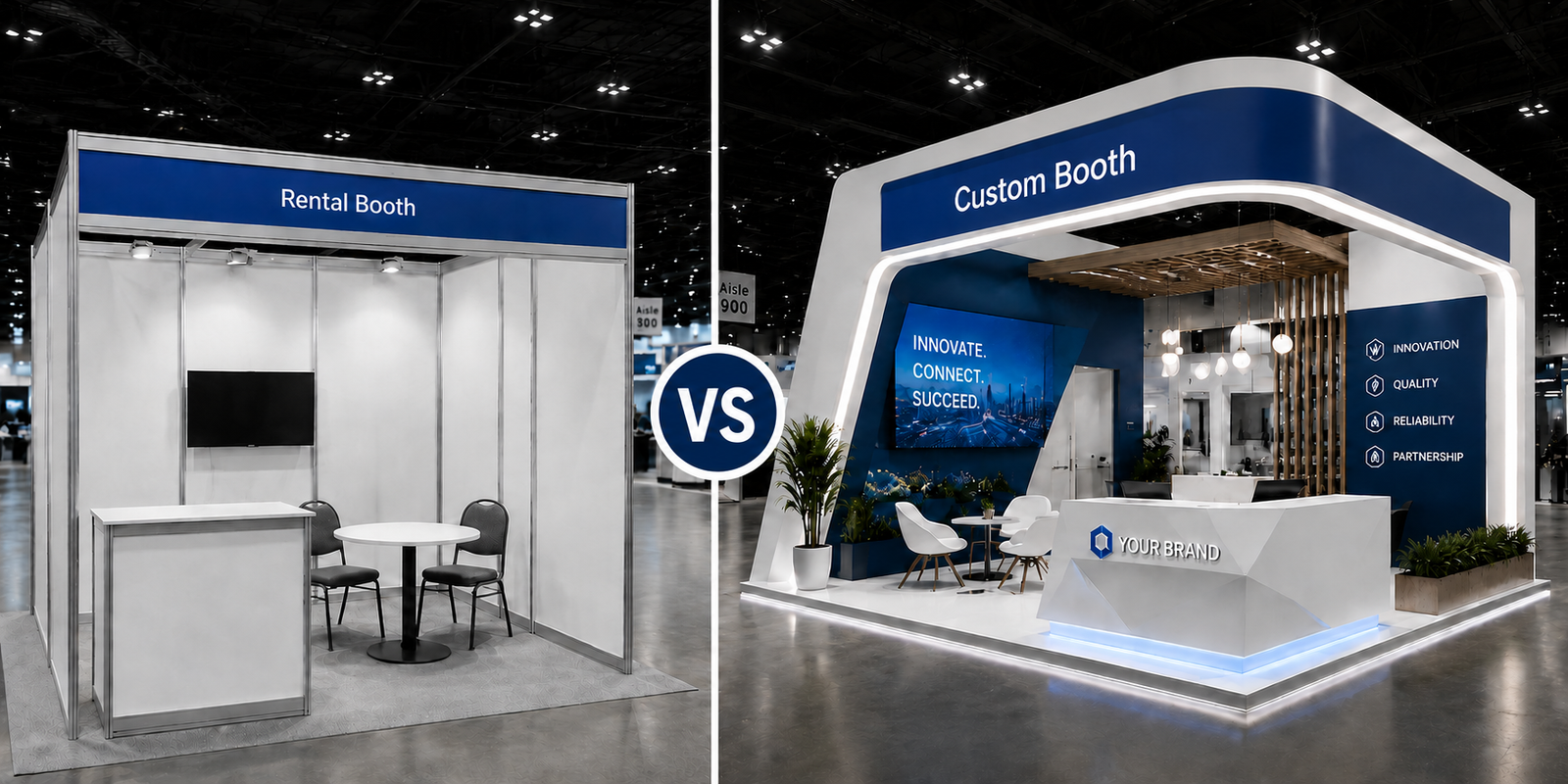
There is no universal winner. A trade show booth rental is usually the better choice when flexibility, shorter lead times, changing booth sizes, or a limited U.S. show schedule matter most. A custom booth makes more sense when your show calendar, footprint, brand message, and product experience are stable enough to support repeat use.
The decision is about the working model that best supports your goals: visitor experience, brand control, flexibility, timeline, ownership responsibility, and the practical work required between events.
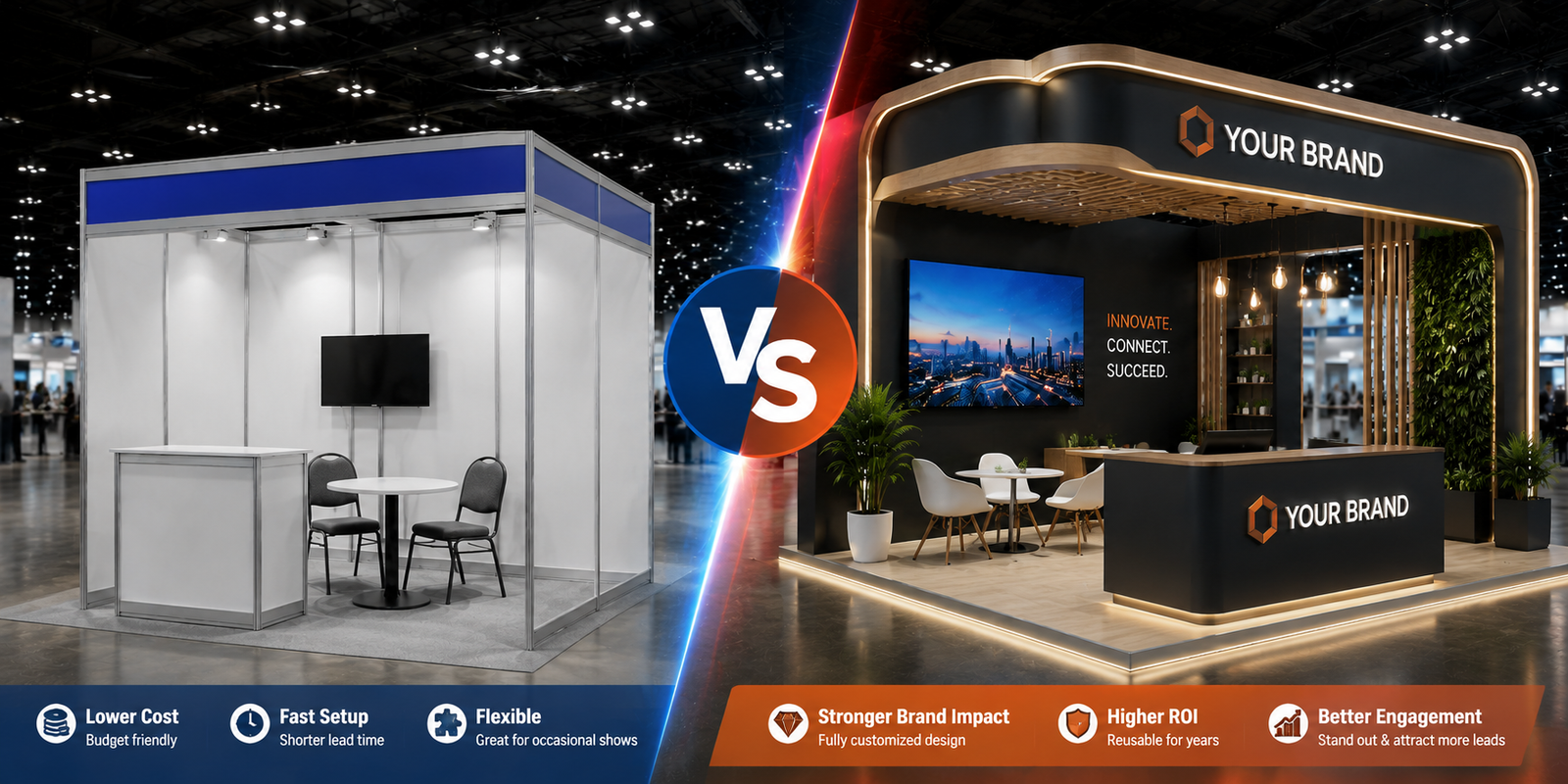
Rental vs Custom Booth: Quick Comparison
| Decision factor | Booth rental | Custom booth |
|---|---|---|
| Best fit | One or a few shows, changing needs, new-market testing | A stable multi-show program with a clear brand environment |
| Initial commitment | Lower asset commitment; costs are concentrated per show | Higher initial investment in design and fabrication |
| Footprint flexibility | Usually easier to scale or reconfigure | Strong when designed as a modular system; lower for a one-piece build |
| Brand control | High with tailored graphics, lighting, furniture, and AV | Highest control over architecture, materials, product displays, and visitor flow |
| Lead time | Often shorter when using available systems | Requires design, engineering, fabrication, graphics, and logistics planning |
| Storage and maintenance | Typically handled as part of the rental program | The owner needs a storage, maintenance, and refurbishment plan |
| Logistics profile | Can reduce long-term asset handling | Requires crating, freight, storage, condition checks, and reuse planning |
| Practical middle ground | Rent the core booth and add brand-specific elements | Own a modular core and rent city- or show-specific add-ons |
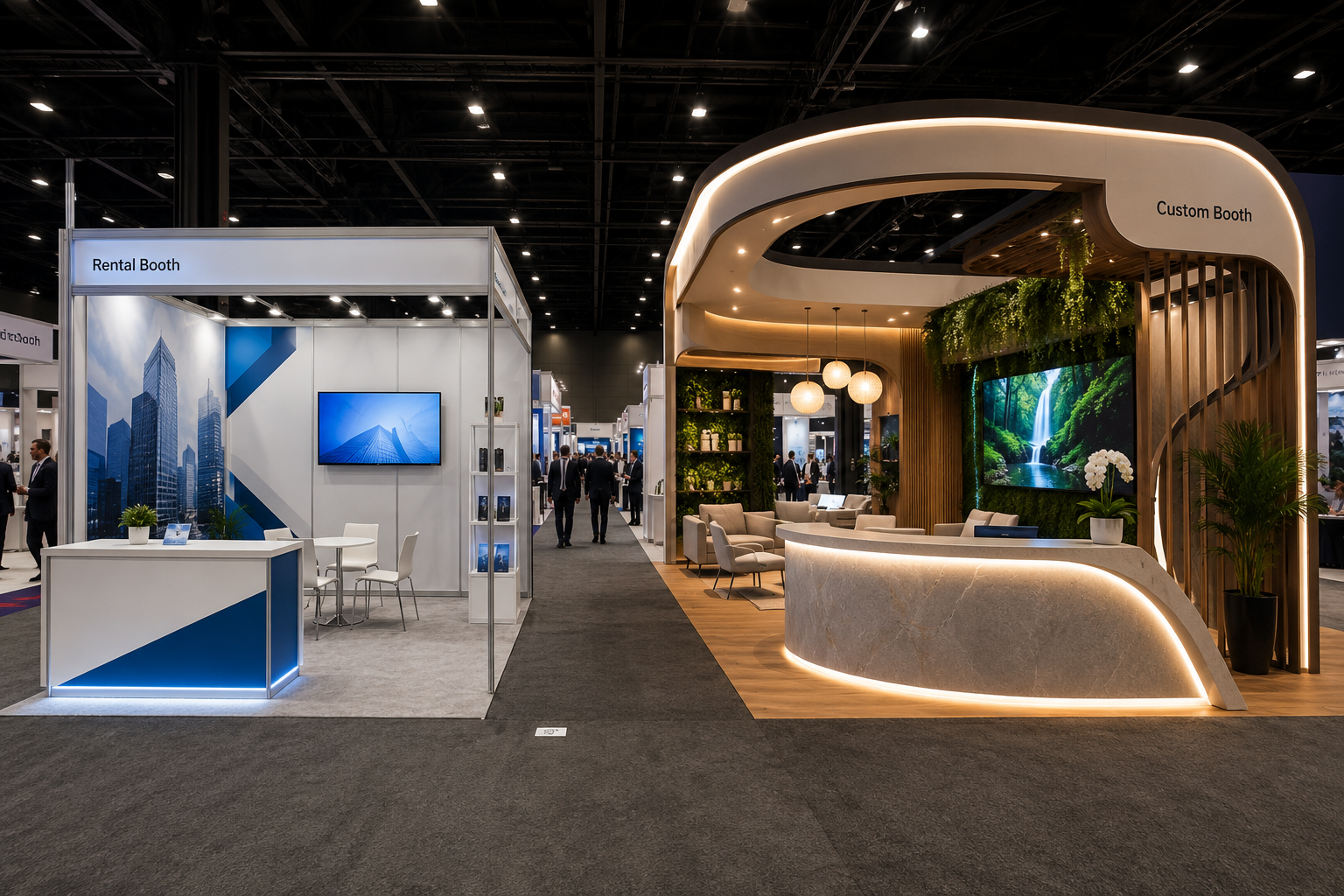
For many exhibitors, the answer is a hybrid program. A rental structure can deliver flexibility while custom graphics, a product display, a reception counter, or an LED feature create a stronger branded environment.
What Does a Rental Booth Include vs a Custom Booth?
A trade show booth rental is a temporary exhibit package designed for a specific event or series of events. Depending on the scope, it can include a structure, branded graphics, flooring, lighting, furniture, counters, monitors, and support for logistics and installation. The important question is not whether a booth is labeled “turnkey”; it is exactly which services, show orders, and on-site responsibilities are included.
Rental does not mean off-the-shelf. A rental booth can be highly customized through layout, graphic architecture, lighting, flooring, furniture, product displays, meeting zones, counters, LED or monitor integration, and show-specific brand elements. The right rental program starts with the visitor experience and functions you need, then selects the structure and services that support that plan.
A custom booth is designed and fabricated around the brand, products, visitor journey, and technical requirements of the program. It can include distinctive architecture, integrated demo areas, secure storage, meeting rooms, specialty materials, and repeatable components. The booth may be a one-off asset, or it may be engineered as a modular kit for several booth sizes.
At Exhibitsmax, we define the scope before comparing options. That means confirming the booth size, show calendar, products and demos, graphics needs, show services, freight plan, installation requirements, and what happens to the booth after the event.
How Should Cost Influence the Decision?
Cost is one decision factor, not the decision itself. Rental usually shifts more cost into each scheduled show, while custom ownership places more investment up front and adds ongoing storage, refurbishment, and reuse responsibilities. The right comparison is total cost of ownership across your actual show calendar.
For the full cost model—including per-show operating costs, freight, material handling, installation, storage, graphic refreshes, and break-even conditions—read Custom Booth vs. Rental Booth Cost: How to Compare Total Cost of Ownership.
When Does Rental Make More Sense?
A rental booth is usually the practical choice when flexibility is more valuable than owning an exhibit asset.
- One or a few U.S. shows. You can focus the budget on the specific event without committing to storage and reuse before the program is proven.
- A new U.S. market. A rental makes it easier to test audience response, product positioning, booth traffic patterns, and meeting needs before building a long-term exhibit system.
- Changing footprints. If one event is a 10×20, the next is a 20×20, and the next has an uncertain layout, a rental structure can usually adapt more easily.
- Shorter timelines. An available system may reduce the amount of engineering and fabrication required, although graphics, service orders, and move-in planning still need time.
- Avoiding storage responsibility. You are not committing to long-term crating, warehouse coordination, maintenance, and the risk of owning an asset that no longer fits your program.
- Testing messaging. When products, brand positioning, or demo content are changing, rental graphics and layout adjustments allow a faster learning cycle.
Rental does not have to look generic. A strong layout, clear graphics, targeted lighting, furniture, product displays, and locally rented AV can create a professional, distinctive space without building the entire structure from scratch.
When Does Custom Make More Sense?
A custom booth is most valuable when it becomes a repeatable business asset rather than a one-show expense.
- A stable show calendar. You know which U.S. events you will attend and can plan how the booth will be reused.
- Stable footprints. Similar booth sizes or a modular layout make it easier to protect the value of a custom build across multiple events.
- A distinctive brand environment. Custom architecture, finishes, lighting, and circulation can express the brand in ways a standard system may not.
- Integrated products and demos. Technical products, secure samples, interactive demos, hospitality, storage, and staff workflows often benefit from purpose-built elements.
- Multi-year reuse. The program has enough continuity for storage, refurbishment, and repeat logistics to be planned as part of the investment.
- A modular custom design. A custom booth does not need to be rigid. Well-planned wall systems, counters, meeting areas, graphics fields, and AV zones can be reused in more than one size.
At Exhibitsmax, we recommend designing for the whole program when custom is selected: how the booth is assembled, packed, moved, stored, refreshed, and scaled down or up. Those decisions have as much impact on long-term value as the first rendering.
See Related Booth Projects
The project examples below show how booth size, product presentation, and brand requirements affect the final environment. They are custom booth examples, not fixed templates; rental programs can apply many of the same principles through a tailored layout, graphics, lighting, furniture, and AV.
Compact Product-Focused Environment
ASCRS 2025 10×10 Booth for VIA in Los Angeles shows how a compact custom footprint can be organized around a focused product presentation and a professional visitor experience.
Larger Technology-Focused Environment
CES 2024 20×30 Booth for MAY in Las Vegas shows a larger custom environment planned for technology displays, customer interaction, and a strong trade-show presence.
For a Nashville event, compare Nashville booth rental and custom exhibit options against the venue, show schedule, and installation scope. The city guide includes our CMS project at Music City Center as a local custom-booth reference.
How Do Lead Time, Logistics and I&D Change the Decision?
Timeline, freight, material handling, installation and dismantling, storage, and execution risk should be assessed together. They are not separate afterthoughts: each changes the total workload and can change which solution is practical.
A rental can shorten the design and fabrication portion of the project when suitable systems are available. A custom booth requires enough time for design approval, technical coordination, fabrication, graphics, packing, and quality checks. Both paths still require the current exhibitor manual, show-service ordering, clear artwork approvals, and a plan for the available move-in window.
Logistics also change the picture. A rental may reduce the need to ship an owned exhibit across the country or internationally, while a custom booth needs a defined crate plan, freight route, storage location, and condition process between shows. Material handling charges and access procedures remain specific to each venue and show contractor, so the current manual should always be reviewed before freight is released.
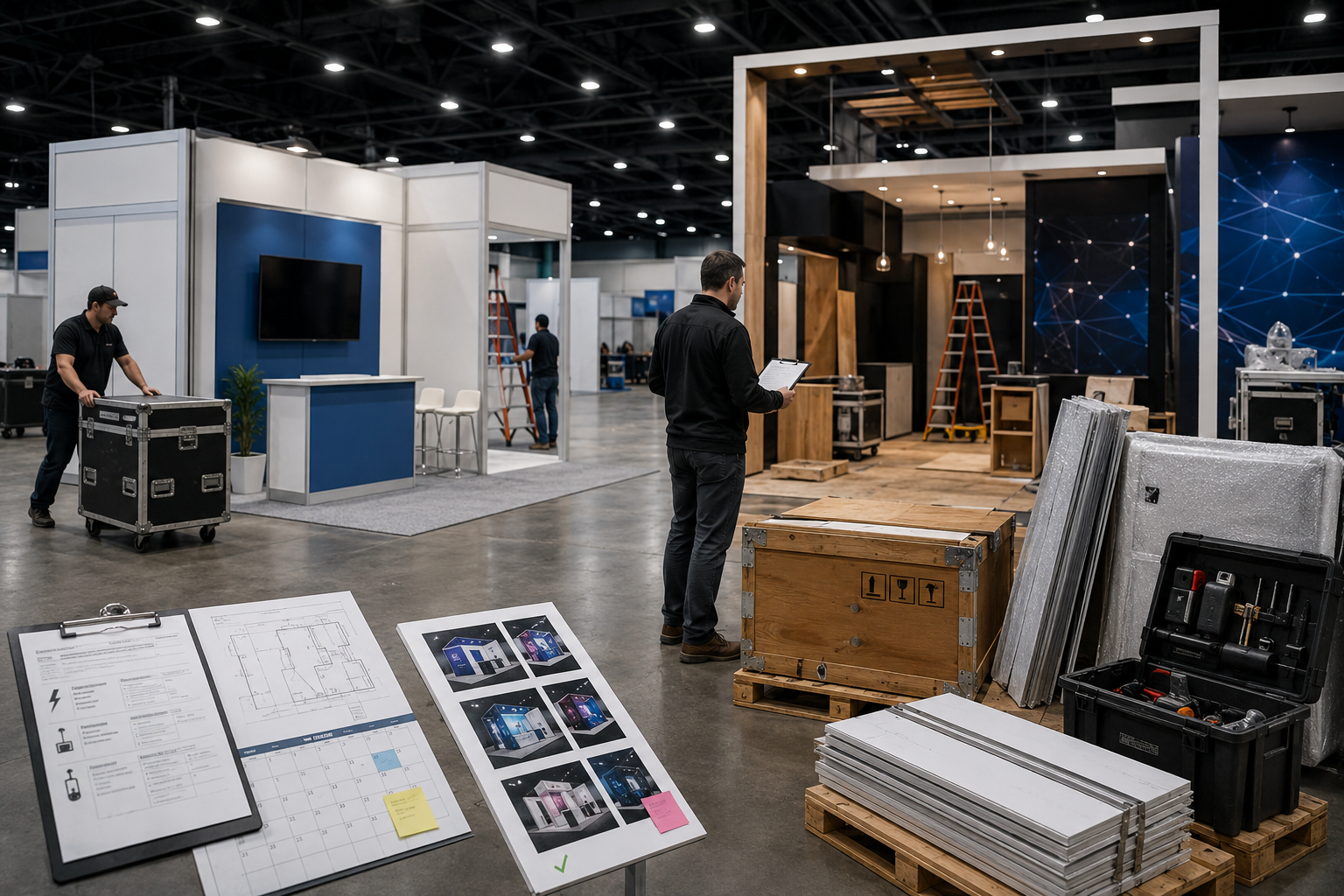
The Installation & Dismantling service scope should be reviewed before the booth is built or shipped. At Exhibitsmax, we look at the actual floor plan, booth drawing, packing list, freight method, show schedule, graphics, AV, and current exhibitor documentation to align the execution plan. This helps identify service interfaces and open risks before the on-site window begins.
For an owned booth, exhibit storage and reconditioning are part of the decision. For a rental, the asset responsibility is usually lighter, but you still need a clear plan for graphics, product samples, lead-retrieval equipment, and outbound freight.
What Should International Exhibitors Choose?
For a first U.S. show cycle, a rental or hybrid approach is often a practical starting point. It can reduce the complexity of international booth freight, customs documentation, long-term storage, and a booth asset that may need major changes after the first market test.
The decision should still be based on the whole program. International exhibitors should share the show calendar, booth sizes, target audience, product and demo needs, brand requirements, shipping plan, and decision timeline. That information makes it possible to compare a U.S.-based rental, a U.S.-built custom booth, and a hybrid program on equal terms.
At Exhibitsmax, we help international teams translate those requirements into a U.S. execution plan, including design, fabrication or rental, graphics, logistics, and I&D coordination. A U.S.-built custom booth may become the more efficient option after the program is stable; a flexible rental can be the stronger first step while the market, booth size, and message are still being tested.
Rental vs Custom Decision Checklist
Before deciding, answer these six questions:
- How many U.S. shows will you attend in the next 12–24 months?
- Will your booth sizes and footprints remain stable?
- Is your product story and brand messaging stable enough for a long-term asset?
- How distinctive does the architecture need to be for visitors to understand and remember the brand?
- Who will manage storage, freight, maintenance, and I&D between shows?
- Does the total cost of ownership across your actual calendar fit the program?
Mostly flexibility → Rental.
Mostly stability and control → Custom.
Mixed answers → Hybrid.
The checklist is a starting point, not a substitute for the event documents. For cost-only planning, use the Custom Booth vs. Rental Booth Cost guide rather than relying on a generic break-even figure.
FAQ
Is a trade show booth rental always cheaper than a custom booth?
Not necessarily. Rental can reduce the initial asset commitment, while custom may create more value when it is reused consistently and the program supports storage, maintenance, and repeat logistics. Compare the actual cost model in Custom Booth vs. Rental Booth Cost.
Can a rental booth still look distinctive?
Yes. Custom graphics, a tailored layout, product displays, lighting, furniture, and AV can create a strong brand environment. The key is to define the visitor experience and the components needed to support it, rather than selecting a structure in isolation.
Should international exhibitors ship an owned booth to the United States?
It depends on the program, existing asset, shipping timing, customs requirements, future reuse, and the ability to manage storage and servicing. For a new U.S. program, compare the complete logistics plan with a U.S.-based rental or custom build before committing.
Can a custom booth be flexible across different sizes?
Yes, if modularity is planned during design. Reconfigurable walls, graphics fields, counters, meeting areas, and AV zones can support more than one footprint. This needs to be designed intentionally; a one-piece structure has less flexibility.
Not Sure Whether to Rent or Build Custom?
Send Exhibitsmax your show calendar, booth sizes, target budget, and brand requirements. We can compare rental, custom, and hybrid approaches for your U.S. program, including the practical implications for design, logistics, storage, and I&D.
To make the comparison useful, include your show city, booth dimensions, product or demo needs, key brand requirements, and whether your footprint is likely to change.