
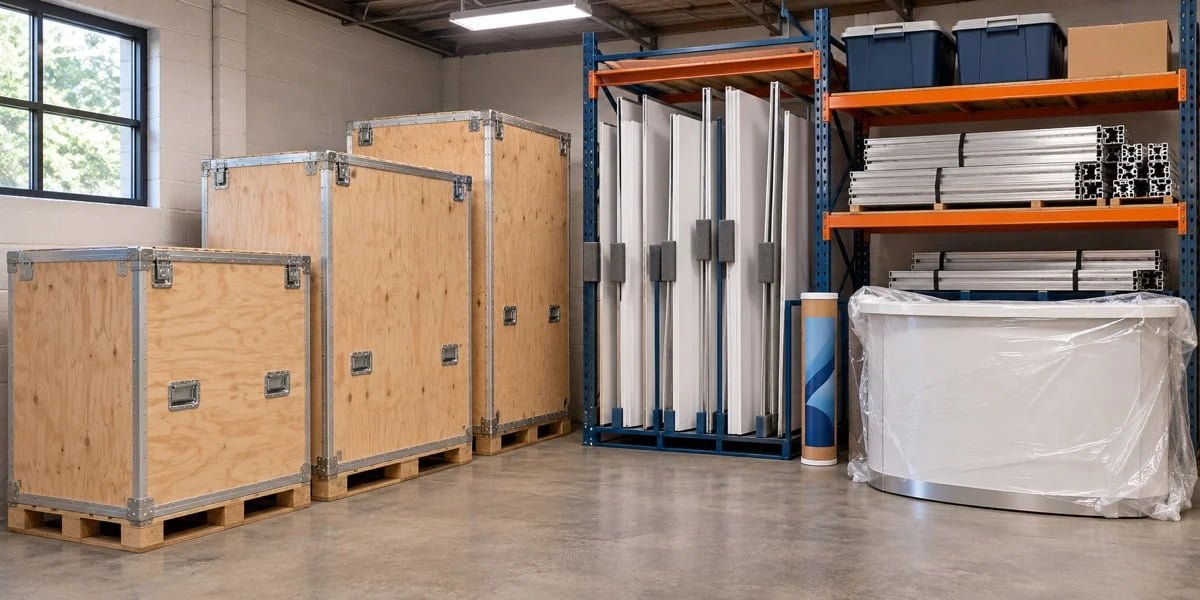
Trade show booth storage makes sense when keeping an exhibit ready for its next use costs less than a suitable replacement. Compare storage, packing, freight, repairs and reinstallation together—and confirm that the retained components fit your next show.
What Is Trade Show Booth Storage?
Trade show booth storage is the retention and protection of exhibit components between events. A storage agreement may also cover receiving, inventory records, condition reviews, retrieval and preparation for the next shipment. Confirm each service in writing; renting warehouse space does not automatically include these tasks.
It is different from an event’s advance warehouse, which receives freight for a particular show during its designated receiving window. Empty-container storage during an event is another separate arrangement. Neither automatically provides long-term storage for a dismantled exhibit.
Exhibitsmax’s Exhibit Storage Services connect Las Vegas storage with inventory, condition reviews and next-show preparation under an agreed scope. This guide focuses on deciding what to retain and how to compare the cost.
When Is Booth Storage Worth It?
Storage is a stronger option when the next event is identified, the retained components are in usable condition and the next design can accommodate them without extensive modification.
On smaller screens, swipe horizontally to view all columns.
| Decision Factor | Supports Storage | Reason to Reconsider |
|---|---|---|
| Next event | Known location, footprint and receiving schedule | No realistic next use or a substantially different layout |
| Condition | Complete components with manageable repairs | Damage, missing parts or unresolved support requirements |
| Branding | Structure remains useful with selected graphic updates | Campaign-specific shapes or finishes dominate the build |
| Transport | Packing and freight fit the next show’s budget | Large or awkward components are expensive to move |
| Ownership | Owned assets or explicitly agreed retention rights | Rental items must be returned after the show |
Selective storage can be more practical than keeping the entire booth. Retain useful counters, compatible framing or display fixtures while replacing outdated graphics. A modular label alone does not guarantee that components will fit a different footprint or configuration.
Exhibit Storage Options: Short-Term vs. Long-Term
Define the period by your show calendar and provider’s terms. There is no universal cutoff that makes an exhibit a short-term or long-term storage project.
On smaller screens, swipe horizontally to view all columns.
| Storage Plan | Main Planning Priority | Terms to Confirm |
|---|---|---|
| Between confirmed shows | Keep the next pull list, repairs and shipping deadline aligned | Billing periods, receiving fees, release notice and access charges |
| Seasonal or annual reuse | Review graphics, condition and layout before each event | Renewal terms, inspection scope and maintenance authorization |
| Future use uncertain | Limit ongoing expense to assets with a credible reuse purpose | Minimum commitment, review date and exit arrangements |
Set a decision date before the next billing commitment. If the show is canceled, reassess the inventory rather than allowing the original plan to continue indefinitely.
What Affects Trade Show Booth Storage Costs?
Booth floor area is not enough to price storage. A 20×20 exhibit might pack into compact cases or several large, non-stackable crates. Request a quote based on the actual packed inventory.
- Space and billing basis: Crate count, packed dimensions, stacking limitations, minimum charges and billing frequency.
- Handling: Unloading, receiving, internal moves, retrieval, staging and loading for release.
- Access: Visits, partial shipments, inspections and any required notice.
- Condition: Damaged crates, missing hardware, finish repairs and graphic replacement.
- Transportation: Origin, warehouse location, next destination, shipment characteristics and timing.
- Special requirements: Agreed environmental conditions, restricted items, equipment care and protective packaging.
Include exhibit transportation planning in your storage comparison. Moving an exhibit to a less expensive warehouse can add freight and handling that outweigh the rent difference. Confirm applicable taxes and insurance arrangements separately instead of assuming the storage charge covers them.
How to Calculate Storage vs. Rebuild Costs
Start at the same decision date and compare the same next-show requirements. The amount already paid to build the existing booth is a past cost; it is not a new expense of choosing storage.
Storage-and-reuse cost = retention packing + inbound freight + receiving + storage charges + access/retrieval + repairs and updates + outbound freight + next-show installation and applicable show services.
Replacement cost = design and new fabrication or rental + packing + freight + installation and applicable show services + any relevant old-asset removal costs.
If a charge is identical for both options, it can be excluded from both calculations. If shipment size, weight, installation labor or service needs differ, include those differences. Do not compare a storage-only subtotal with a fully installed replacement quote.
Illustrative Example: Six Months of Storage Before Reuse
The following USD figures demonstrate the calculation only. They are not an Exhibitsmax quote, an actual project settlement or a market-price benchmark.
On smaller screens, swipe horizontally to view all columns.
| Cost Item | Illustrative Calculation | Subtotal |
|---|---|---|
| Storage | $250 per month × 6 months | $1,500 |
| Post-dismantling packing and transport to storage | Example allowance | $800 |
| Warehouse receiving and inspection | Example allowance | $300 |
| Outbound retrieval and transportation | Example allowance | $900 |
| Repairs and graphic updates | Example allowance | $500 |
| Illustrative storage-and-preparation subtotal | $4,000 | |
This subtotal excludes dismantling labor, next-show installation, official show-service charges, taxes, insurance and any charges not listed. Add applicable items to complete the comparison. Confirm packing or transport is not already included elsewhere in your proposal.
Here, non-storage items total $2,500. If all other assumptions stayed unchanged, the illustration would be $2,500 + ($250 × months stored). Every additional month adds $250 in this example—not a universal storage rate. Actual quotes may have minimums, changing rates or additional access fees.
The $4,000 subtotal does not prove reuse is cheaper. Obtain a replacement or rental proposal for the same layout and finish expectations, then compare the remaining installation and event costs. Include the expected service life and usefulness of each option when the decision covers several shows.
How to Pack, Label & Inventory a Booth
Make the stored booth understandable to a crew that did not dismantle it. Agree on retained items and packing responsibilities with the Installation & Dismantling team before move-out.
On smaller screens, swipe horizontally to view all columns.
| Record or Task | What to Include |
|---|---|
| Asset inventory | Component ID, quantity, ownership, crate location and condition |
| Crate labels | Project, crate number, contents, handling notes and inventory reference |
| Hardware | Labeled kits linked to specific components and assembly drawings |
| Graphics | Artwork version, dimensions, intended location and suitable protective packing |
| Photo record | Installed views, visible damage, packed contents and closed-crate labels |
| Installation files | Current drawings, connection details, assembly notes and missing-item list |
For example: Crate 2 of 5 — Project EX-104 — Backwall panels W01–W04 — Hardware kit H02 — Packing photo set P02. Keep a shared copy of the inventory outside the crates.
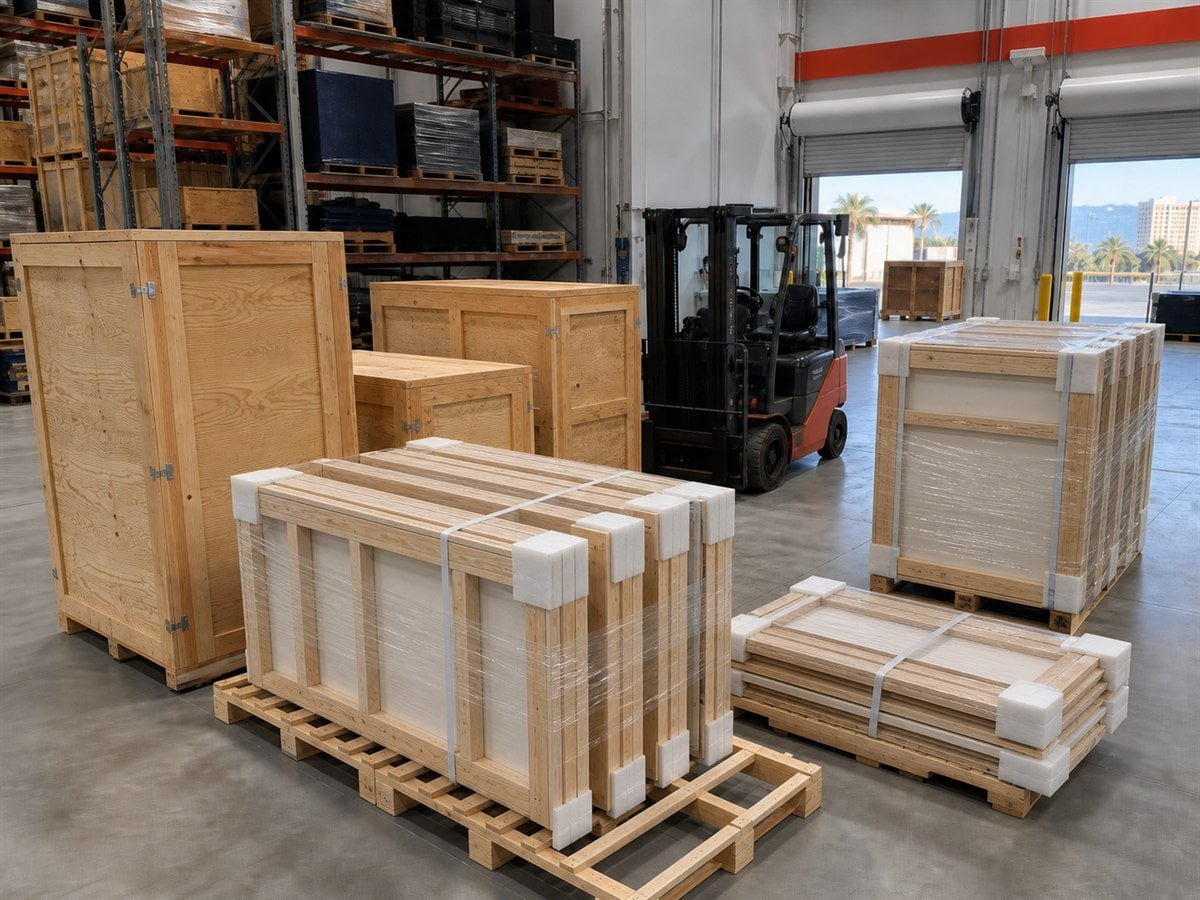
Use packing methods suited to the actual graphics, finishes and equipment. Confirm supplier instructions before folding or rolling graphics, stacking components or selecting protective wrap. Obtain approval before disposing of customer-owned parts or branding.
Repairs, Refurbishment & Reuse Planning
Review stored assets against the next layout before releasing them for shipment. Separate components into three groups: ready to reuse, requiring approved work, and unsuitable for the planned exhibit.
Check connections, finish damage, missing hardware, graphic relevance and equipment access. A different screen, heavier product or revised shelf arrangement may require technical review. Storage condition alone does not establish that a component remains suitable for its new function.
Use the Trade Show Booth Materials guide to compare material choices, repairability and transport considerations. Where new elements are needed, Custom Booth Fabrication can be scoped around the retained components. Confirm dimensions and interfaces before ordering replacements.
Approve repairs, graphic changes and any test assembly with an owner and completion date. Work backward from the carrier pickup and current event’s receiving schedule; do not wait until installation to discover whether the stored configuration still fits.
When Should You Avoid Storage?
Reconsider storage when there is no credible reuse plan, repairs are extensive, components cannot adapt to the next layout, or ongoing charges and freight approach the cost of a suitable replacement.
A selective plan may retain useful fixtures while returning rental items and removing obsolete branding. If the next show changes city or footprint, compare the actual freight route and modification scope. Neither a nearby warehouse nor a lower monthly fee automatically produces the lower project cost.
Before ending storage, agree on release, return or disposal instructions, asset ownership and final charges. Keeping an inventory also helps prevent reusable items from being removed with unwanted materials.
Real Exhibitsmax Projects With Storage in Scope
The linked Exhibitsmax portfolio pages list Exhibit Storage in their published service scope. These public descriptions do not include warehouse receiving records, inventory logs, storage duration or later reuse dates. Completed-booth photos show exhibit components, not proof of warehouse intake. The takeaways below are planning considerations for similar exhibits, not claims of verified storage cycles or savings.
Klacci — ISC West 2024 — 20×30 — Las Vegas
The Klacci project combined door-hardware demonstration frames, product pedestals, reception and meeting functions. Its documented scope includes storage, transportation, dismantling and pre-show assembly alongside custom and rental elements.

Storage takeaway: For a similar exhibit, distinguish rented items from retained assets and keep demonstration fixtures, their hardware and the corresponding drawings identifiable together.
ZIG·ZAG — NACS 2021 — 20×20 — Chicago
The ZIG·ZAG project organized several brands through separate display zones, shelving and counters. The published scope includes storage within a custom-and-rental project.
Reuse takeaway: A similar multi-brand exhibit benefits from inventory grouped by brand zone and component. Review which graphics still match the next campaign separately from whether the fixtures remain useful. Wood-look surfaces do not establish the underlying construction material.
Frequently Asked Questions
How much does trade show booth storage cost per month?
A meaningful quote requires packed dimensions, crate count, storage duration and access needs. Confirm the provider’s billing basis and minimum charges, then add receiving, retrieval, repairs and freight. The $250 monthly figure above is a calculation input only.
Can I store only part of my booth?
Yes, subject to ownership and the storage agreement. Identify retained structures, fixtures and accessories, return rental items as required, and keep a record of anything removed. Compare the reduced packed volume with the cost of preparing a partial shipment.
Does storing a booth mean it is ready for the next show?
No. Match the inventory to the next footprint and display requirements, review condition and approve necessary work before release. Confirm the current event’s requirements and identify what needs to be tested or assembled.
Can a stored booth be shipped to another U.S. city?
Yes, with a confirmed release and transportation plan. Compare the next destination, packed shipment, carrier schedule and event receiving window. A warehouse close to the previous show may not be the most practical starting point for the next one.
Is insurance included in a storage quote?
Do not assume it is. Ask what coverage, if any, is included and review the storage terms with your insurer. Confirm how declared values, damage reporting and transit are handled before sending the exhibit.
What if the next show is canceled?
Review the next billing commitment and compare continued storage with partial retention, return shipping or authorized disposal. Update the expected release date and inventory instructions with the provider.
Get a Trade Show Booth Storage Quote
Share your crate count, packed dimensions, current location, condition photos, expected storage period and next-show details. Exhibitsmax can review the storage, repair and release scope for your exhibit.