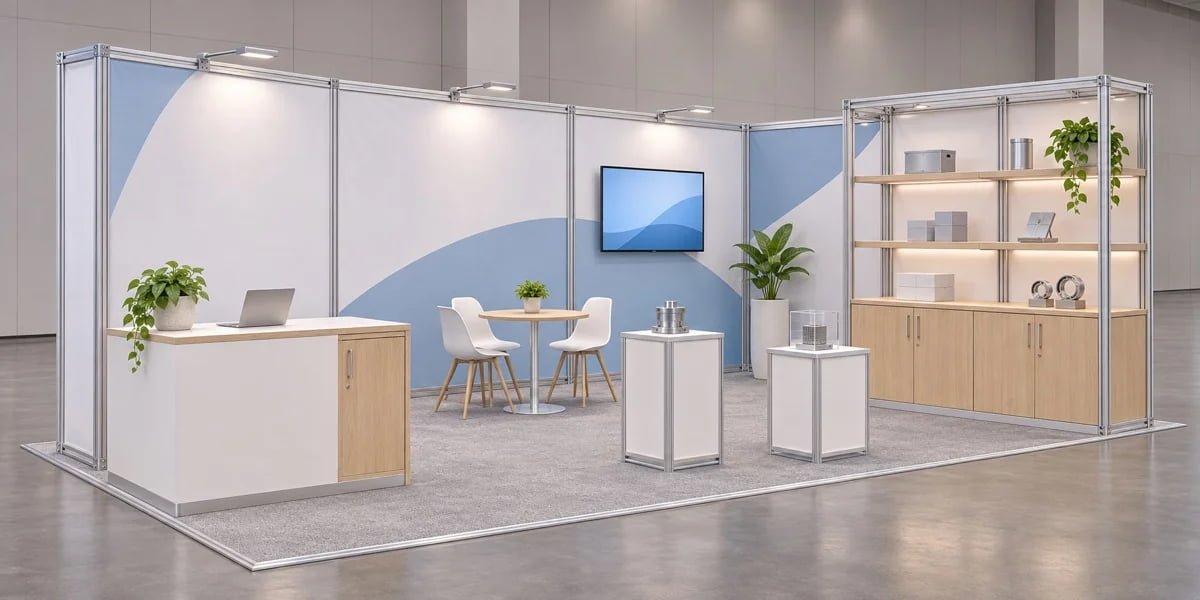
Trade show booth materials should fit the display, shipping plan, and intended reuse. Wood-based construction offers custom shapes and finishes; aluminum systems provide repeatable components; hybrid construction combines both. Compare the complete assembly—not just the visible surface or raw material price—before approving a design.
What Materials Are Used in Trade Show Booths?
A booth usually combines several materials. Its frame, display surfaces, graphics, flooring, hardware, and finishes perform different jobs. A wood-grain wall may be a finish over a panel; a fabric graphic may conceal a metal frame. Neither appearance identifies the underlying specification.
In this comparison, wood means wood-based panels and millwork, potentially including plywood, MDF, and timber components. Aluminum refers to specified extrusions or frame systems combined with graphics or infill panels. Hybrid describes an assembly using both custom wood-based components and aluminum systems. It is a construction approach, not a third raw material.
Keep that distinction separate from ownership: rental, purchased, and mixed-ownership exhibits can use different material combinations. A project described as “custom and rental” is not automatically a verified wood-and-aluminum build.
Wood vs. Aluminum vs. Hybrid: Comparison Table
Use this table to shortlist an approach, then compare actual drawings, component schedules, and packing plans.
| Decision factor | Wood-based fabrication | Aluminum systems | Hybrid construction |
|---|---|---|---|
| Design flexibility | Custom counters, cabinetry, shapes, and surface treatments | Layouts built around available profiles, frames, connectors, and accessories | Custom focal elements coordinated with system dimensions |
| Visible finish | Paint, laminate, veneer, or applied graphics | Exposed or concealed frames with fabric, rigid panels, or other specified infills | Requires consistent colors, edges, and junctions across components |
| Installation | Depends on preassembly, module size, joints, and finish protection | Repeatable connections can simplify assembly; complexity and accessories still matter | Depends on how clearly custom and modular connections are resolved |
| Freight and storage | Large finished pieces may need bulky protective crates | Breakdown components may pack compactly; total shipment still includes panels and accessories | Compare the complete crate list, not the frame alone |
| Reuse | Possible with durable finishes, serviceable joints, and protected storage | Depends on compatible parts, condition, inventory, and future layouts | Works best when custom pieces do not prevent reconfiguration |
| Main question | Which custom details justify fabrication and handling? | Does the selected system fit the displays and future footprints? | Is the added interface work worth the flexibility? |
Wood Booth Construction: Benefits & Limitations
Wood-based fabrication is useful for reception counters, fitted cabinets, product niches, enclosed storage, and architectural features that need specific dimensions. It gives the production team control over panel shapes, edge details, hardware, and visible finishes.
The specification should identify the substrate, thickness, finish, mounting method, and intended use. “Wood counter” is too broad to explain how a cabinet is assembled, how its doors operate, or how a displayed product is supported. Different panels and joint details are not interchangeable.
Custom pieces also need a practical handling plan. A large finished counter can be awkward to crate and move even if its shop price is modest. Splitting it into modules may improve handling, but introduces joints and assembly work. Decide which tradeoff is acceptable before fabrication.
Ask for finish samples, edge protection, access to hardware, and a repair approach. Do not rely on unplanned cutting or repainting during move-in. Reusable wood components are possible when disassembly, packing, and future graphic changes are designed into them.
Aluminum Booth Systems: Benefits & Limitations
Aluminum systems suit projects that can use repeatable frame dimensions and connections. Depending on the selected system, frames can accept fabric graphics, rigid infill panels, doors, lighting, and approved display accessories. The visible result can be understated or highly branded; exposed metal is not required everywhere.
For a manufacturer reference, OCTANORM’s exhibition systems illustrate how extrusions and modular frames work with different claddings, including fabric and panels. This explains system options; it does not identify the manufacturer or specification used in any Exhibitsmax project below.
SEG means silicone edge graphics: the graphic edge fits into a compatible frame channel. The graphic and the frame are separate parts of the specification. A seamless graphic appearance alone does not confirm the frame material, profile, or load capacity.
The limitations are usually in the details: available module sizes, connector compatibility, accessory mounting, replacement parts, and the amount of custom cladding. A frame that works for graphics is not automatically suitable for a heavy monitor or product shelf. Confirm each proposed attachment with the system supplier and project team.
Ask for an assembly drawing and packed inventory before assuming aluminum means faster installation or cheaper shipping. Tall frames, large panels, extensive AV, and many accessories can offset the handling advantages of a compact system.
Hybrid Booth Construction: When It Works Best
A material hybrid works when each component has a clear purpose. A reusable aluminum graphic wall might provide the background, while a custom wood-based demonstration counter accommodates product mounting, storage, and concealed cables. Neither component needs to imitate the construction of the other.
For example, a proposed 20×30 exhibit could combine modular graphic walls with two fitted demo counters and a freestanding meeting table. This is an illustrative specification, not a documented client project. Start with the activities and circulation described in our 20×30 Custom Island Booth Design guide, then assign materials to the components.
Resolve the interfaces early: how panels meet, which item supports the monitor, where power enters, which connections can be accessed, and what must be installed first. Independent components can be easier to reuse than a custom feature permanently integrated with one exact frame arrangement.
Hybrid is less compelling when it adds special brackets, adapters, finish matching, and packing work without a useful benefit. A simple modular exhibit or a well-planned custom build may serve the brief more efficiently.
How Materials Affect Cost, Freight & Reusability
Compare a complete show program using the same display functions and finish expectations. A bare frame price and a finished custom wall price are different scopes.
| Cost area | What to request | Why it changes the decision |
|---|---|---|
| Production | Materials, finishing, graphics, hardware, technical work, and preassembly scope | Surface details and custom connections can matter more than raw material cost |
| Packing and freight | Crate count, packed dimensions, shipment weight, and delivery route | Compare the protected shipment, including graphics and accessories |
| Show services and I&D | Installation sequence, crew estimate, equipment needs, and separate provider orders | Assembly details and receiving arrangements influence labor and handling |
| Between shows | Return freight, storage, inspection, repairs, and graphic replacement | “Reusable” only helps when the components can return to service |
| Future changes | Required parts and work for the next footprint or product range | Changing from one booth size to another is not automatically cost-free |
Material handling depends on the current event’s rate basis, shipment classification, minimums, and handling requirements. Do not assume a particular frame material guarantees a lower invoice. Separate that estimate from carrier freight and the builder’s work.
Our Custom Booth Quote Guide explains how to compare inclusions and exclusions. For material selection, focus on which components remain useful across your actual show calendar and what each reuse will require.
Reuse also needs an operational plan. Identify the storage location, component owner, replacement-part source, and inspection responsibility. Avoid blanket environmental claims based only on “wood,” “aluminum,” or “recyclable”; actual reuse and end-of-life arrangements need supporting information.
Real Exhibitsmax Booth Material Examples
The following workshop and project references show machining, finishing, and completed display applications. The project photographs establish visible design features; they do not reveal every substrate or concealed frame specification.
Workshop Reference: Custom Panels and Finishes
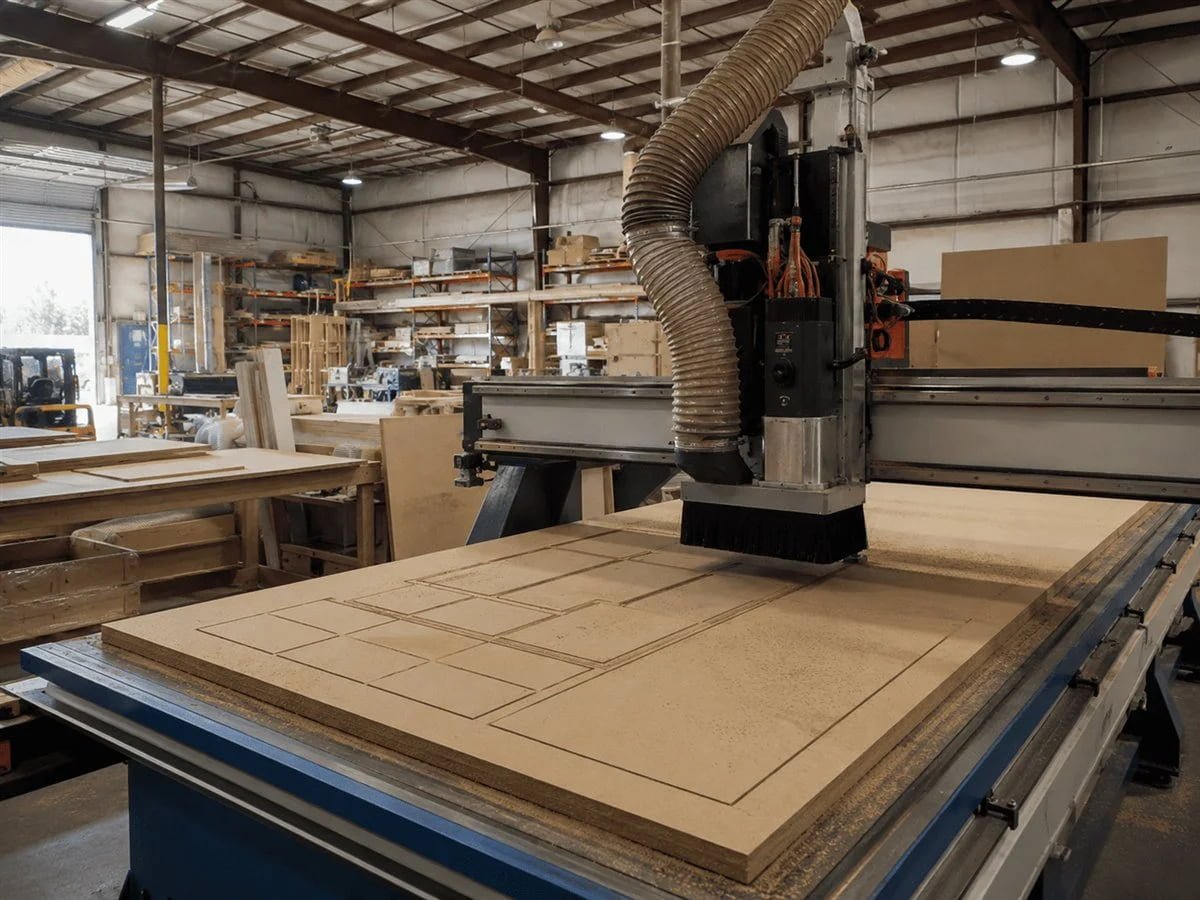
Exhibitsmax’s Las Vegas production capabilities include woodworking, CNC machining, metal fabrication, finishing, graphics, and pre-show assembly. The machining photo above and finishing photo below show different production activities, not a documented before-and-after sequence for the same component.
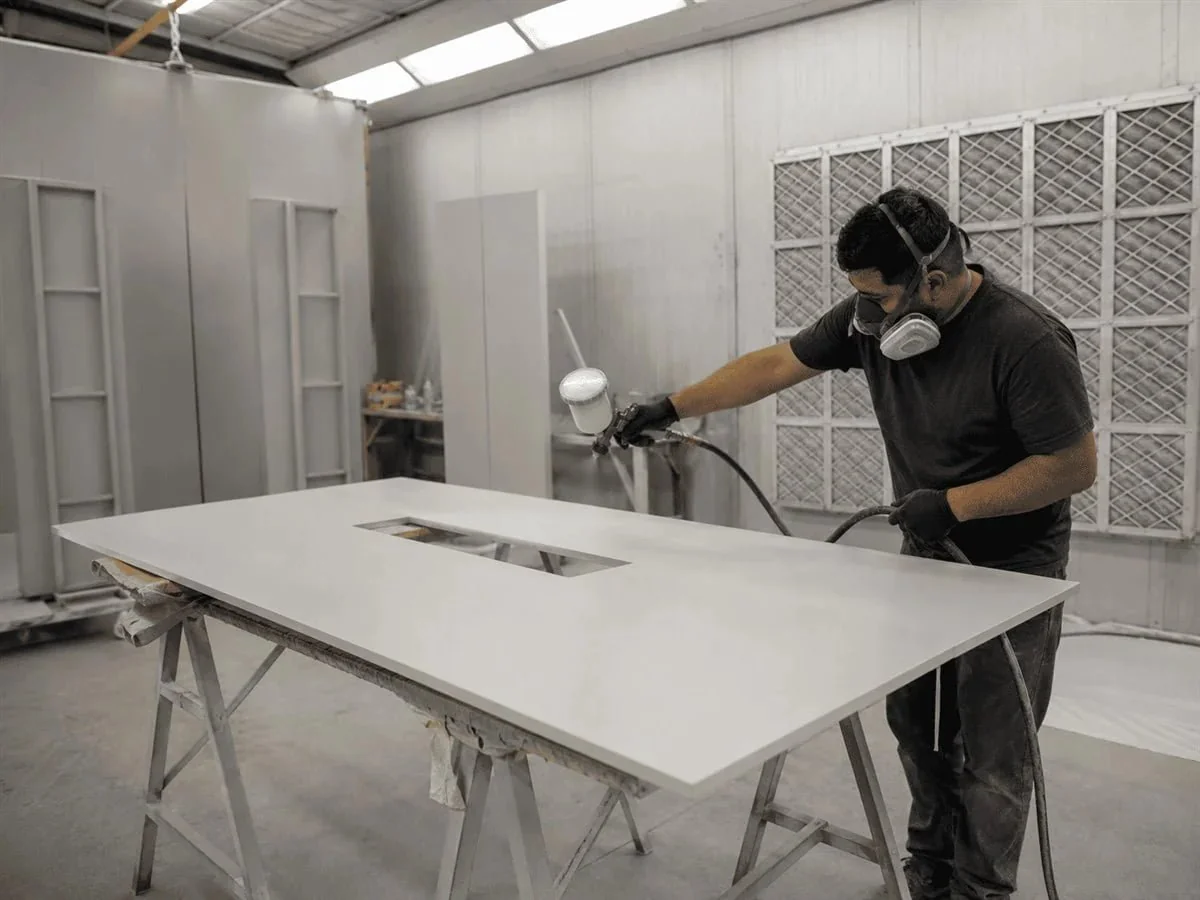
Design takeaway: Approve the substrate and finish together. The visible coating, edges, joints, and protection during handling all affect the finished component. Our Custom Booth Fabrication service covers the specified production scope; the Custom Booth Fabrication Process guide explains the stages from technical review to installation.
ZIG·ZAG — NACS 2021 — 20×20, Chicago
The completed exhibit used wood-look display surfaces, shelving, branded counters, and distinct retail presentation areas. The project record confirms fabrication, graphic production, pre-show assembly, rental elements, and installation support. It does not identify every underlying panel or frame material.
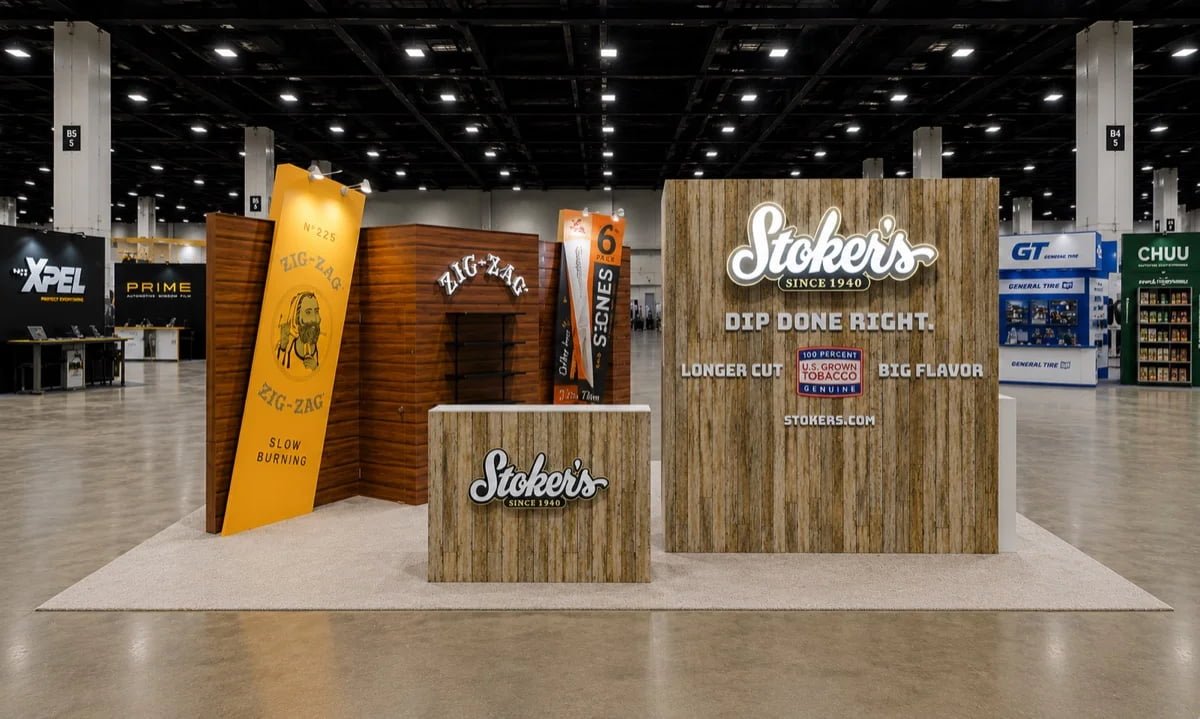
Design takeaway: Coordinate finish direction, counter surfaces, shelving, and graphic edges to create a consistent display. Ask for the material schedule separately from the rendering. View the ZIG·ZAG project.
Klacci — ISC West 2024 — 20×30, Las Vegas
Door demonstration frames, white display pedestals, seating, and red overhead branding served different functions within this exhibit. The recorded scope combined custom fabrication and rental services. That mixed service scope does not, by itself, confirm a wood-and-aluminum structural hybrid.

Design takeaway: Specify each component around its job. A working door display, a product pedestal, and an overhead sign need separate connection and handling decisions. View the Klacci project.
How to Choose Materials for Your Next Trade Show
Give the design team a component brief instead of asking for an entirely “wood” or “aluminum” booth. Use these five checks to reach a useful specification:
- Define the function. List products, operating space, storage, screens, seating, and visitor activities.
- Set the finish priorities. Identify the surfaces visitors see closely or touch, and request representative samples.
- Map the show program. Include assigned footprints, freight origins, storage locations, and likely changes.
- Review execution. Compare packed dimensions, assembly connections, installation access, and the actual move-in window.
- Approve the specification. Record material grades, finishes, attachments, ownership, and required documentation before production.
Bring these decisions into Trade Show Booth Design while the layout is still adjustable. A material change can affect wall thickness, usable storage, graphic dimensions, and how components connect.
Confirm applicable structural, fire-related, and installation requirements with the current event and responsible providers. Neither a material label nor a previous approved project establishes approval for a new design. Submit the required information before committing to affected production work.
Frequently Asked Questions
Are wood booths always cheaper than aluminum booths?
No. Compare equivalent finished components, including technical work, graphics, packing, freight, installation, and future changes. A low-cost panel does not necessarily produce a lower total project cost.
Can aluminum booths look custom?
Yes. Graphics, cladding, proportions, lighting, and custom fixtures can create a distinct appearance around a system frame. Check how the selected system accommodates those features before approving the concept.
Can a wood-based booth be reused?
Yes, when joints, finishes, packing, and storage support repeated handling. Ask which pieces are intended for reuse, which are replaceable, and how they fit the next event.
Does an SEG graphic mean the booth uses aluminum?
No. SEG describes the graphic-edge attachment method. Confirm the frame and support structure separately, including compatible graphics, connectors, and display attachments.
Which construction approach suits international exhibitors?
Start with where the booth will be produced, stored, and shipped. A locally supplied rental, custom, or hybrid exhibit may reduce the need to transport a complete booth internationally. Compare the agreed delivery and reuse plan rather than selecting a material by nationality.
What documents should support a material decision?
Request a component schedule, relevant drawings, finish samples, assembly and packing information, and the documentation required for proposed loads or event approvals. The level of detail should match the design’s complexity.
Get a Free Custom Booth Design & Quote
Share your show, booth size, product requirements, finish preferences, budget, and reuse plans. Exhibitsmax’s Las Vegas team can review the material options and develop a design and quote with a defined production scope.