

Quick answer: Trade show electrical costs vary by show. Exhibitors may be charged separately for power service, outlet placement or distribution, electrical labor, and optional services such as 24-hour power. Use the current event’s electrical order form to confirm pricing and what each service includes.
How Much Does Trade Show Electrical Service Cost?
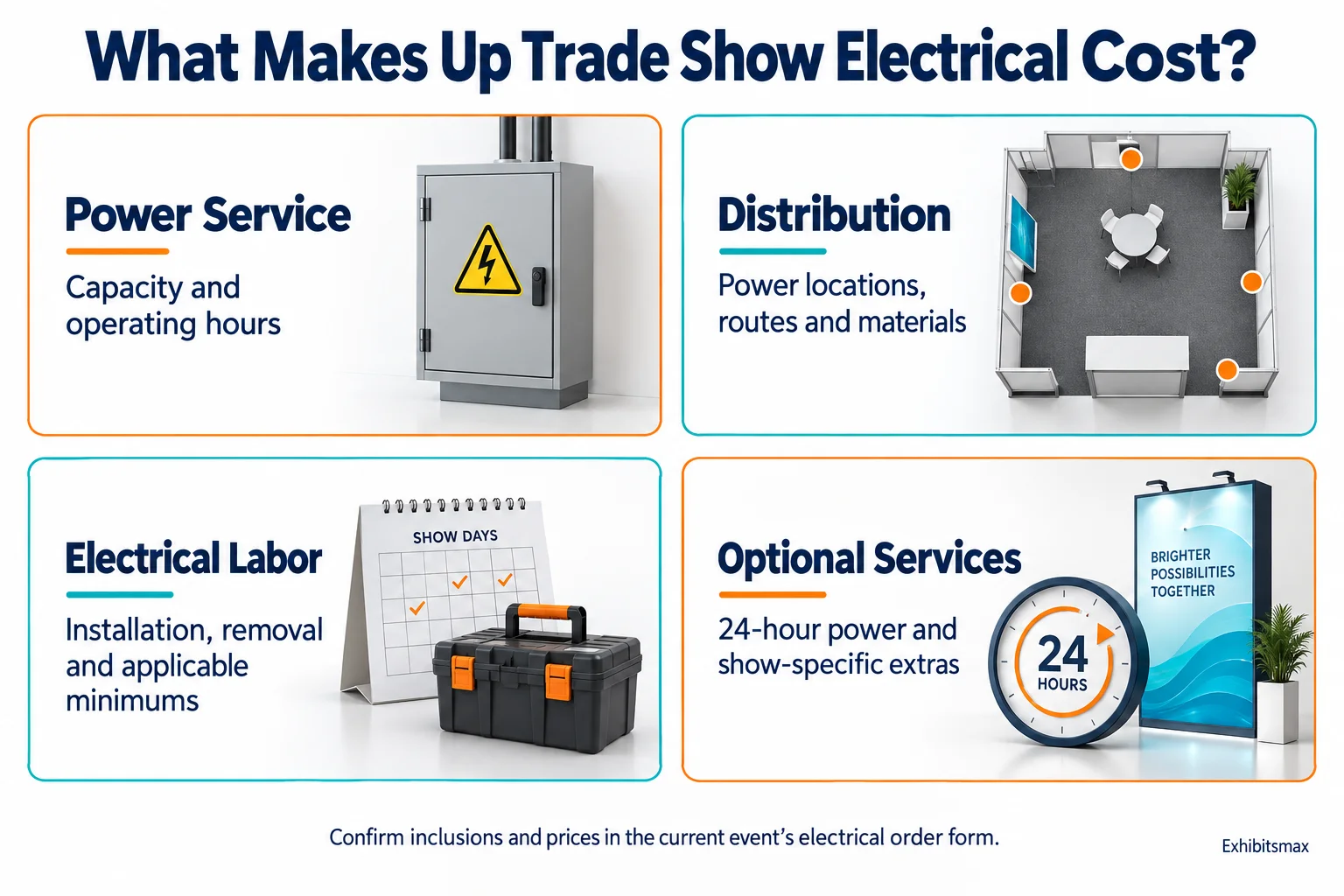
Electrical pricing varies by show, venue, contractor, service capacity, installation requirements, and order date. A basic outlet price is a starting point—not the total electrical budget for a furnished, illuminated booth.
| Electrical service | How it may be priced | What to verify |
|---|---|---|
| 5-amp / low-power service | Per ordered outlet or service tier | Published wattage limit and included placement |
| 10-amp service | Per ordered outlet or service tier | Actual equipment load and dedicated-service requirements |
| 20-amp service | Per ordered outlet or service tier | Published capacity; do not substitute a calculated wattage allowance |
| 208V service | By amperage and phase | Equipment voltage, connector, and phase compatibility |
| Outlet placement / distribution | Labor, materials, or a defined package | Main drop, internal locations, and cable routes |
| Electrical labor | Hourly, with applicable minimums | Installation, removal, crew size, and work periods |
| 24-hour power | Supplement or separate service option | Energized hours and charges |
| Late or on-site orders | Regular, late, or on-site pricing | Actual deadline, availability, and any additional fees |
Official Price Example: CES 2027 at LVCC
The following figures appear in the CES 2027 LVCC topline budgeting rates, checked on 10/01/2026. They are event-specific published figures, not national averages or an Exhibitsmax quote.
| Service label in the published summary | Advance | Regular |
|---|---|---|
| 500-watt outlet | $115.35 | $173.05 |
| 2000-watt/20-amp service | $243.10 | $364.60 |
Source: CES official exhibitor resources — LVCC topline rates.
Use these figures for orientation. Confirm the current order form for inclusions, taxes, distribution, labor, and overnight service. The summary labels these columns Advance and Regular; it does not establish a separate on-site price for these rows. Its topline figures should be reconciled with the final ordering documents.
For arithmetic only, two of the listed 2000-watt/20-amp services would have a service subtotal of $486.20 advance or $729.20 regular, before any additional charges. This does not establish that two services suit your equipment or cover a complete booth installation.
Is Electrical Service Included in Your Booth Build Quote?
It may be excluded, included as an allowance, or coordinated by your builder and billed separately. Ask for a written breakdown instead of assuming either that everything is included or that your builder cannot arrange the order.
| Scope | What the quote should clarify |
|---|---|
| Lighting fixtures, lightboxes, and AV equipment | What equipment is supplied and who installs it |
| Booth electrical layout | Who prepares power locations and equipment information |
| Official power service | Who orders, pays, and confirms acceptance |
| Distribution and connections | Which work requires the authorized electrical provider |
| Electrical labor and removal | What is included, estimated, or charged after the work |
Electrical work at many major U.S. trade shows is performed by the show’s authorized electrical contractor. Labor rules, minimum charges, overtime periods, and jurisdiction requirements vary by venue and show. Prewired components do not automatically exempt a booth from those requirements.
Edlen’s exhibitor resources distinguish power ordering, floor plans, and electrical labor, including work under carpet. Apply the rules for your specific event rather than assuming general booth installation labor covers electrical work.
For the larger budget, keep electrical services visible alongside builder scope in your trade show booth cost plan.
How Do You Calculate the Power Your Booth Needs?
List each device’s actual model, quantity, input voltage, frequency, phase where applicable, and rated electrical requirements. Record maximum or startup demand when specified. Do not rely only on a screen’s size or a product’s marketing description.
Example Equipment List
The numbers below are illustrative assumptions, not verified specifications for particular products.
| Equipment | Quantity | Assumed watts each | Assumed total |
|---|---|---|---|
| Monitor | 2 | 150W | 300W |
| LED lighting assembly | 3 | 60W | 180W |
| Laptop power supply | 2 | 65W | 130W |
| Demo kiosk | 1 | 200W | 200W |
| Phone charging station | 1 | 100W | 100W |
| Espresso machine | 1 | 1,200W | 1,200W |
| Total | 2,110W |
At 120V, 2,110W ÷ 120V ≈ 17.6A as a simplified calculation assuming a power factor of 1. Actual AC input current can differ; use manufacturer ratings and the electrical provider’s assessment.
Do not size a circuit from this calculation alone. Startup loads, continuous-use requirements, circuit-loading rules, and the show’s service limits may change the required supply. A service sold as “2000W/20A” must not be treated as a 2400W allowance simply because 120 × 20 equals 2400. Confirm the final service selection and load allocation with the official electrical provider.
U.S. Electrical Standards Differ From International Norms
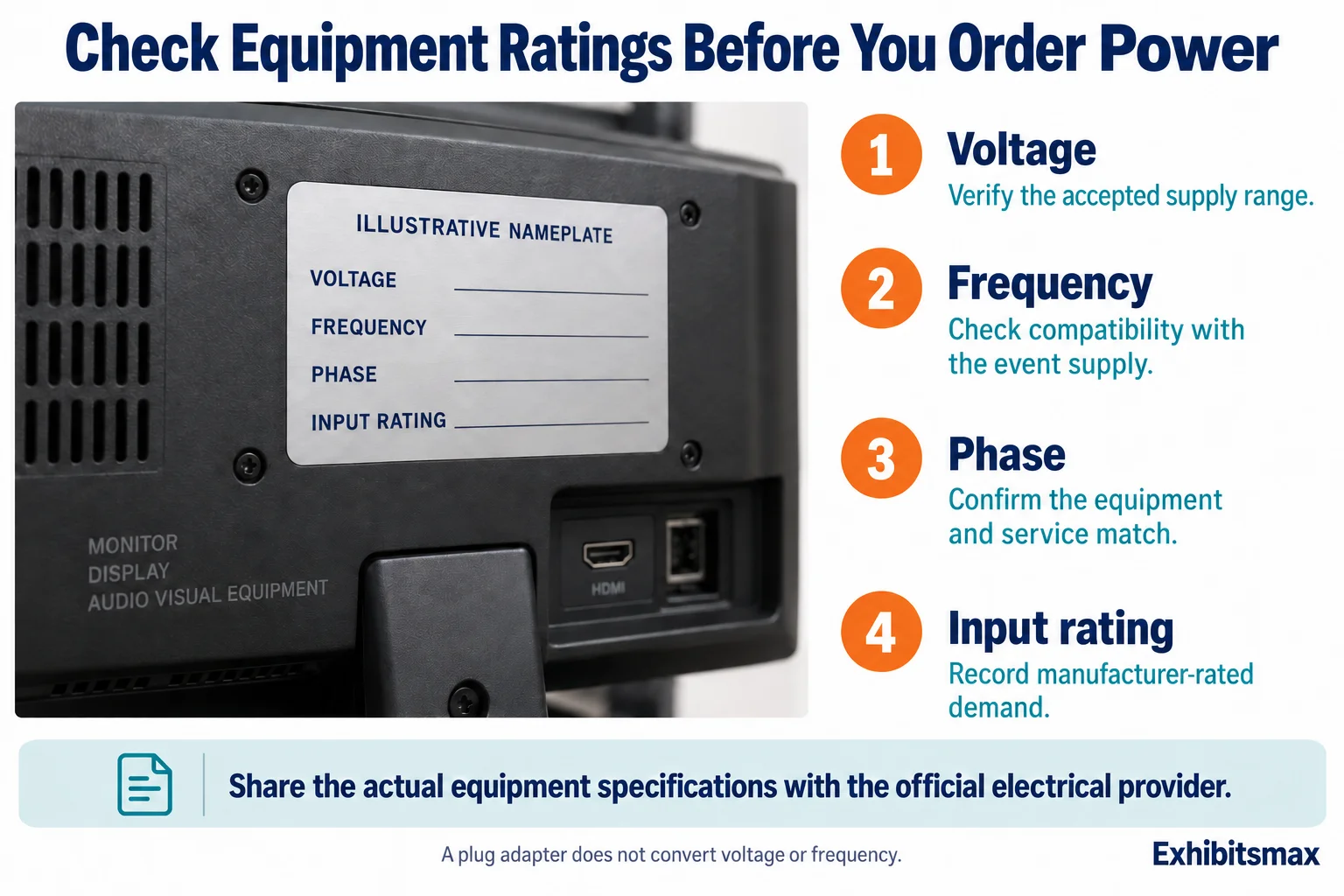
Standard U.S. convenience power is commonly nominal 120V, 60Hz, but exhibit equipment may require a different supply. Check the nameplate or power supply before shipping equipment from overseas.
- Confirm both voltage and frequency compatibility. A label such as 100–240V, 50/60Hz is different from a device rated only for 230V, 50Hz.
- A plug adapter changes the connection shape; it does not convert voltage or frequency.
- A transformer may address voltage compatibility but does not change the supply frequency. Its suitability and capacity need qualified review.
- Do not assume 208V and 240V are interchangeable. Verify the equipment’s accepted voltage range, phase, grounding, and connector.
Send equipment specifications to the authorized provider before ordering. Avoid buying a transformer or an unfamiliar service tier as a guess.
Example: Building an Electrical Budget for a 20×20 Booth
Consider a booth with LED lighting, two monitors, reception-counter charging, and an LED video wall. This is a planning scenario, not an actual Exhibitsmax project invoice.
20×20 Trade Show Booth Electrical Plan
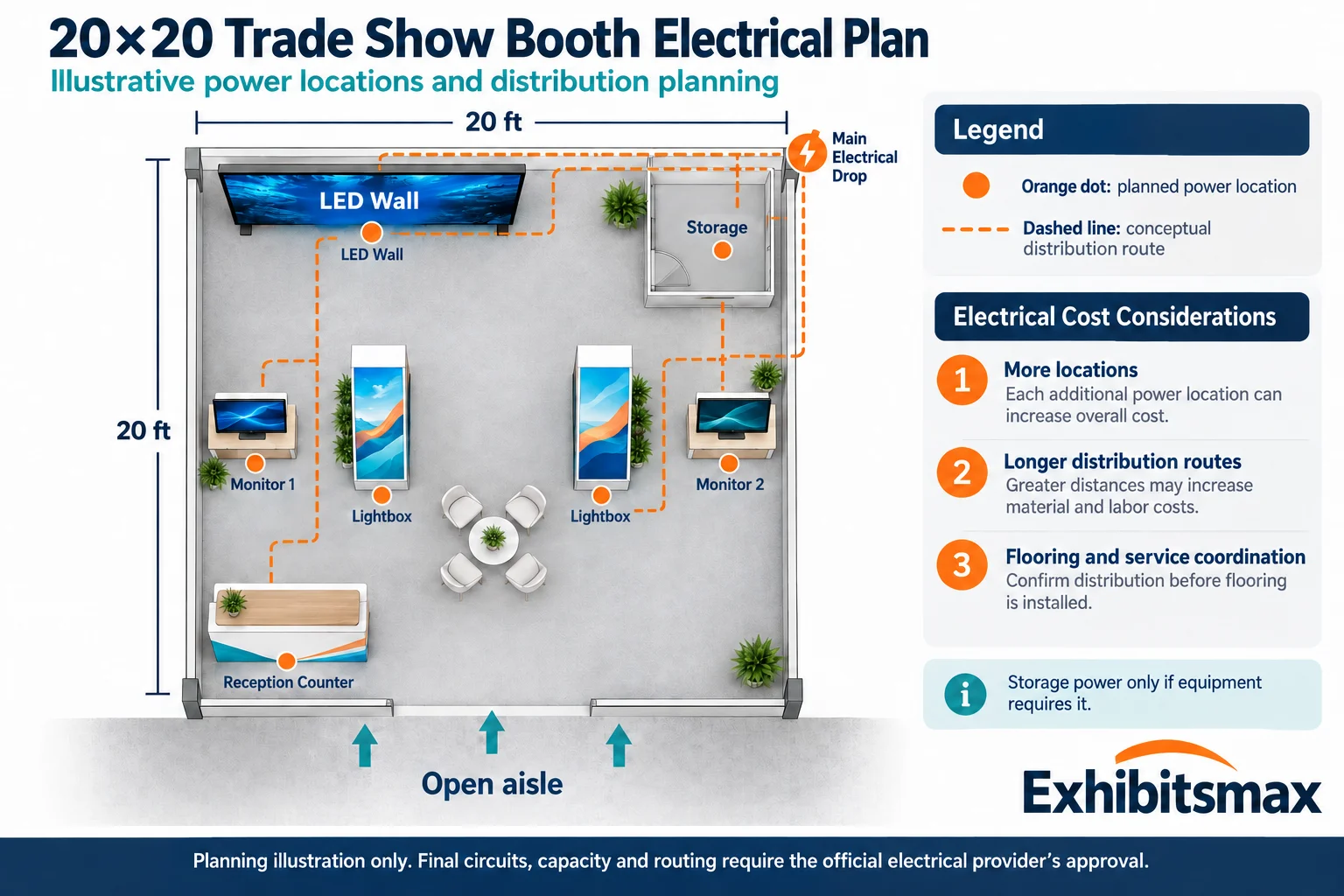
Planning illustration only—not a wiring diagram, a service order, or a completed client project. Final circuits, capacity, drop location, and routing require the official electrical provider’s approval.
The orange points identify proposed power locations for the LED wall, two monitors, lightboxes, and reception counter. Storage needs power only when equipment there requires it. A point does not automatically represent a separate circuit or a separately purchased service.
The dashed routes illustrate distribution planning. Even with the same equipment load, moving a powered display farther from the main drop may change the materials and labor required. Confirm the layout before flooring is installed, and ask the provider which distribution work is included in the service price. Actual routes must follow the approved plan and event requirements.
| Step | What to document | How it affects the budget |
|---|---|---|
| Required power | Model-specific ratings for lights, monitors, charging, LED panels, and control equipment | Establishes service requirements |
| Number of services | Provider-approved circuit allocation and any dedicated supply | Determines service quantities |
| Outlet locations | Reception, displays, video wall, and main distribution point on a scaled plan | Defines distribution work |
| Labor | Floor distribution, connections, equipment-related work, and removal | Adds labor, materials, and equipment where charged |
| Operating hours | Show-hours-only versus overnight needs | Identifies any continuous-service option |
| Estimated budget | Approved service quantities × event rates, plus other applicable charges | Produces a scoped estimate rather than a square-footage guess |
Budget formula: ordered services + chargeable distribution/materials + electrical labor and removal + any 24-hour or late-order charges + applicable taxes and fees.
Do not assign the LED video wall a generic wattage. Ask the AV provider for maximum input demand, supply requirements, and distribution details for the actual panel count and control equipment. Average display consumption alone is not a reliable basis for selecting service. Our LED video wall rental service can be considered alongside the booth’s power and layout planning.
What Can Increase the Electrical Bill?
More Capacity or More Complex Distribution
More powered equipment can require additional services. A spread-out layout may add distribution work even when the total load stays the same. A physical socket, an outlet location, and a dedicated circuit are not necessarily equivalent billable items; ask the provider to clarify the order.
Orders or Floor Plans Received After the Deadline
Advance rates are generally lower than regular or on-site rates, but the difference depends on the event. A complete order may require payment and a matching electrical plan—not just submission of a request.
For example, the Edlen CONEXPO-CON/AGG 2026 guidance tied advance eligibility to a complete order, payment, and scaled plan. That is a historical event example, not a deadline for your next show.
Labor, Removal, and Changes During Move-In
Confirm minimum calls, chargeable work periods, and removal charges in the current electrical labor form. Relocating power after flooring is installed can create extra work. Coordinate this sequence with your installation and dismantling team.
Overnight Power and Specialty Equipment
Refrigeration, equipment that must retain settings, or other overnight loads may require 24-hour service. Check which hours standard service covers and whether specialty equipment requires additional connections or supervision. Track these items in your hidden booth costs checklist.
When Should You Plan and Order Electrical Service?
Use the actual show deadlines rather than treating “four to six weeks before opening” as a universal ordering rule.
| Planning stage | Action |
|---|---|
| Initial booth design | List powered equipment and identify its location |
| Current exhibitor manual available | Confirm provider, service options, labor rules, and deadlines |
| Design confirmed | Finalize the equipment schedule and scaled power plan |
| Before the advance deadline | Submit the complete order, required plan, and payment documentation |
| Before shipping | Check the confirmation against the final layout and equipment specifications |
| Move-in | Keep printed and digital order confirmations and the latest electrical plan at the booth |
If equipment changes after ordering, contact the provider before arrival. An installation team should not discover a new high-load appliance or relocated demo station after the floor is finished.
Frequently Asked Questions
Does my booth builder arrange the official electrical service?
Some builders coordinate it; others leave ordering to the exhibitor. Confirm who submits the order, who pays, and whether charges are included or passed through. Coordination by a builder does not replace the official provider’s approval or labor requirements.
What happens if I order too little power?
The equipment may not operate reliably, and an overload can trip protection or create a safety concern. Contact the authorized provider instead of adding unapproved connections. On-site upgrades depend on availability and may involve extra charges or delays.
Are electrical costs the same at every U.S. trade show venue?
No. Compare the current event’s service tiers, inclusions, labor terms, and deadlines. Even two shows at the same venue can have different arrangements. For a local project, pair your event manual with our LVCC booth planning guide.
Can I bring my own power strips or extension cords?
Check the event’s approved equipment and distribution rules. Bringing a cord does not authorize you to perform floor distribution or hardwiring. Confirm product ratings, permitted connections, and who may install them with the electrical provider.
Do I need 24-hour power?
You may need it if equipment must remain energized outside standard service hours. State the operating requirement explicitly and confirm coverage during move-in, show days, overnight periods, and move-out. Do not assume ordinary service stays on whenever the building is accessible.
How much electrical power does a 10×20 trade show booth need?
The footprint does not determine the load. Lighting, screens, charging, refrigeration, and demonstrations can create very different requirements within the same size booth. Provide a device list and layout so the official provider can confirm suitable services.
How much power does an LED video wall require at a trade show?
It depends on the panel model, panel count, power supplies, and associated equipment. Obtain the AV supplier’s maximum-demand and distribution specifications, including voltage and phase requirements. Have the official electrical provider confirm the service order rather than sizing it from screen dimensions or average consumption alone.
Planning a Trade Show Booth in Las Vegas?
Send us your booth size, show name, booth design, and equipment list. Our team can help review the layout, power locations, and electrical requirements before you submit the official show service order. Final service selection and electrical work remain subject to the authorized provider’s requirements.