
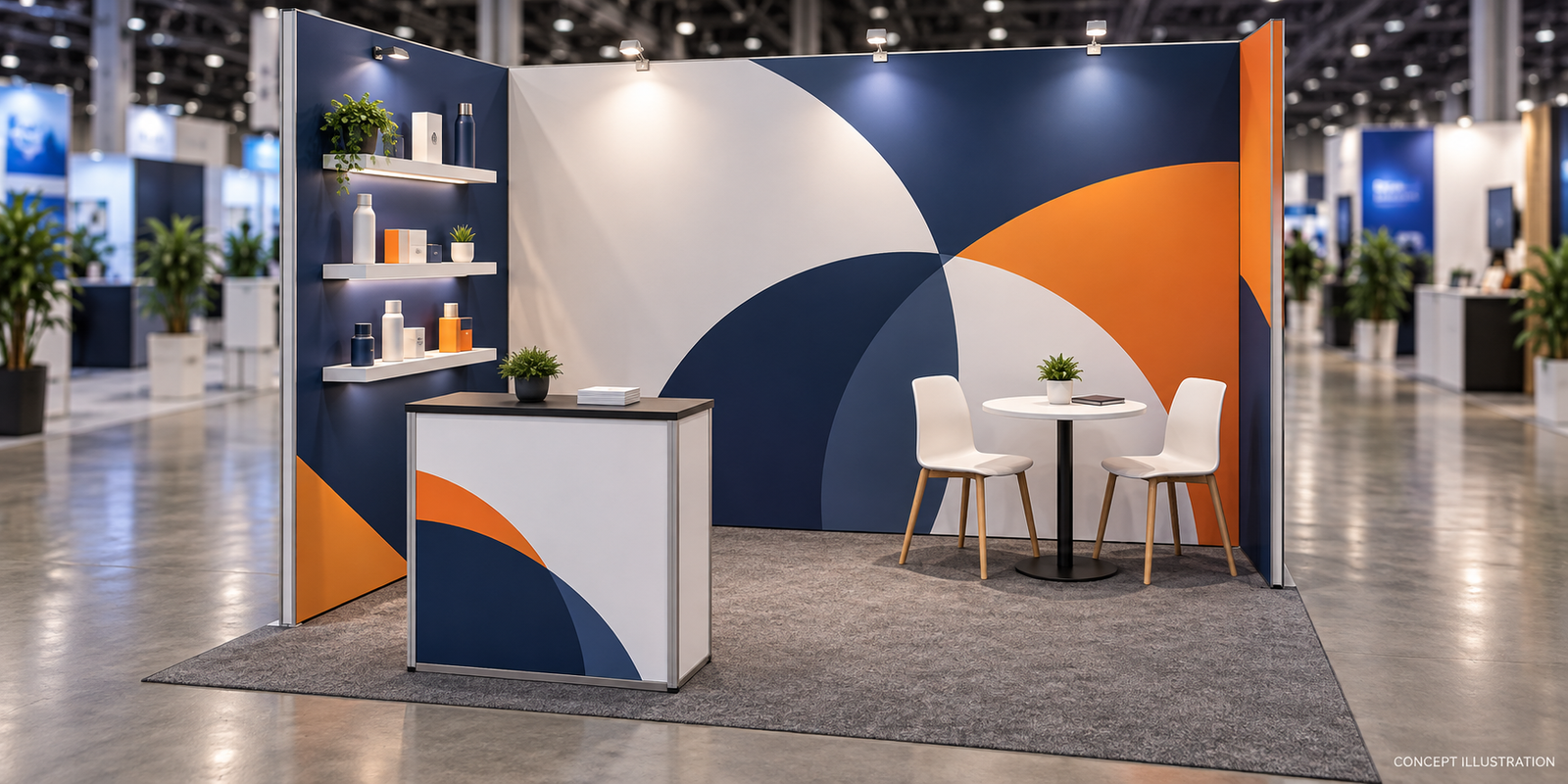
The most useful trade show booth display ideas for small budgets protect what visitors need: clear branding, readable graphics, useful lighting, and a place to engage. Compare each idea by its delivered-and-installed cost, then simplify elements that do not support your main booth goal.
Small-Budget Booth Display Ideas at a Glance
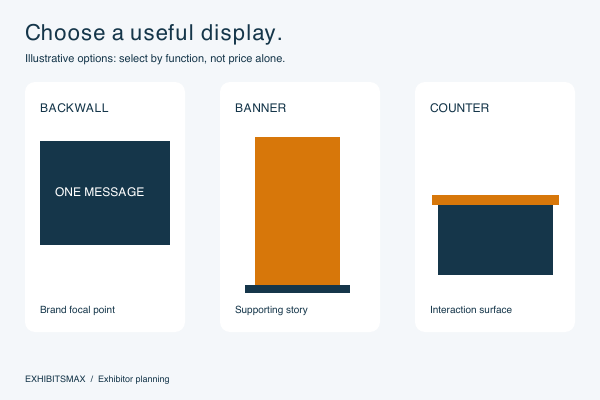
Start with the function you need, then choose the simplest display that can deliver it reliably.
| Display idea | Best use | Check before committing |
|---|---|---|
| One fabric backwall | A clear brand message behind a compact exhibit | Print quality, frame stability, packing, and setup requirements |
| One or two retractable banners | A portable brand message or supporting product story | Readability, base stability, replacement graphics, and baggage limits |
| A portable counter or included table | Samples, a short demonstration, or lead capture | Existing package inclusions, load capacity, storage, and visitor access |
| Reconfigurable modular components | Repeated use across compatible booth sizes | Reconfiguration costs, replacement parts, storage, and transport |
| Selected rental elements | Access to furniture, displays, or structures without owning everything | Availability, customization, delivery, I&D, and excluded show services |
Rental is a sourcing option, not a separate construction type: backwalls, counters, and modular components may be rented or purchased.
Why Can a Cheap Display Become an Expensive Booth?
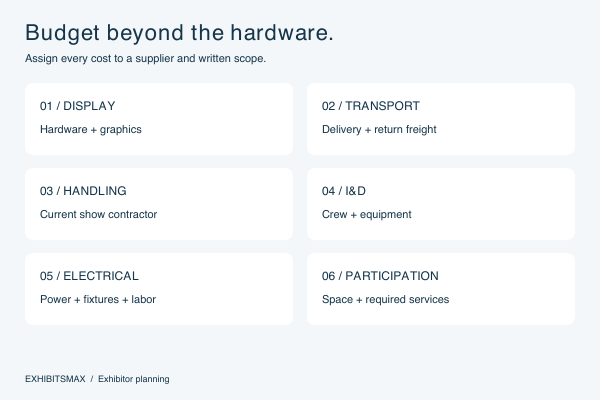
A low purchase price tells you little about the cost of exhibiting with that display. Hardware is only part of the budget; graphics, freight, handling, labor, and services can change the comparison substantially.
For illustration, a hypothetical $300 pop-up display still needs a delivery and setup plan. That figure is a made-up purchase price, not a supplier quote or a U.S. show-cost benchmark.
| Cost layer | What to include in your comparison |
|---|---|
| Display hardware | Purchase or rental, accessories, cases, and replacement components |
| Graphics | Artwork preparation, printing, proofing, and future replacements |
| Transportation | Inbound freight, local delivery, return freight, and packing |
| Material handling / drayage | The current contractor’s handling scope, pricing basis, minimums, and applicable conditions |
| Installation and dismantling | Assembly, teardown, supervision, equipment, and permitted work hours |
| Electrical and lighting | Fixtures, power service, distribution, and any required installation labor |
| Other participation costs | Space rental, required flooring, internet, cleaning, staff travel, and other applicable items |
Budget backward from total show cost, not forward from a product catalog. Reserve the amounts needed for participation, execution, and return logistics before deciding how much remains for display features. Separate included services from allowances and exclusions so you do not count the same item twice.
Freeman’s exhibitor guide distinguishes shipping, material handling, labor, and electrical services. Check the current event’s order forms for the actual scope and charges; a contractor’s general guide is not a venue-wide price list.
Use the Trade Show Booth Cost Guide for the broader budget. If freight and handling are unfamiliar, review what drayage includes before comparing delivery quotes.
Planning a Small-Budget Booth?
Download our Trade Show Booth Planning Checklist to organize your project information before comparing display options and requesting quotes. Use it alongside your current exhibitor manual and supplier proposals.
Download the Free Trade Show Booth Planning Checklist (PDF) →
What Should You Protect When the Budget Is Tight?
Protect the message, the product presentation, and the visitor interaction. Simplify duplicate signs, decorative structures, and furniture that do not serve those functions.
Use a “First Three Seconds” Clarity Test
Treat this as a practical design exercise, not a research-backed attention-span rule: show someone your booth graphic briefly, then ask whether they can identify the company, its offering, and a reason to stop.
- One primary message: Give the backwall a clear headline rather than a full product catalog.
- Readable graphics: Test the layout at the expected aisle viewing distance. Contrast, typeface, letter size, and surrounding displays all affect readability.
- Useful lighting: Illuminate important graphics or samples where needed, without glare on screens or reflective products.
- One clear action: Make room to handle a sample, watch a demonstration, ask a question, or have a conversation.
Keep required flooring, safe installation, and accessibility in the plan. An aesthetic upgrade can be optional; a show requirement is not. A focused trade show booth design brief helps separate the two.
Which Display Formats Are Worth Considering?
Fabric Backwalls
When they work: You need one coherent graphic behind a compact exhibit. A lightweight frame-and-fabric system can be practical to pack and reuse when it suits the required dimensions.
When they waste money: Poor graphic preparation, unstable hardware, or a difficult replacement process can undermine the initial saving. Do not assume every fabric system is wrinkle-resistant or tool-free.
Before ordering: Ask for packed dimensions and weight, assembly instructions, material documentation required by the show, and the cost of a replacement graphic. Spend on a readable design before adding extra panels.
Retractable Banner Stands
When they work: A banner supports a focused message, marks a demonstration area, or gives a simple booth portable branding.
When they waste money: Several competing banners can consume floor space without creating a stronger message. A weak base or damaged retraction mechanism can also make a low purchase price a poor bargain.
Compare base stability, graphic tension, replaceable parts, case protection, and warranty terms. Price labels such as “economy” and “premium” do not establish how many shows a stand will survive. Confirm packed size and airline allowances before planning to fly with it.
Portable Counters and Tables
When they work: One surface supports sample handling, a tablet, a short demonstration, or a welcoming conversation point.
When they waste money: A second counter duplicates a table already included in the exhibitor package or blocks the entrance. Check package inclusions first.
Choose height, load capacity, storage, and position around the activity. A lightweight promotional counter may be unsuitable for a heavy product. Standing conversations and seated discussions can both work; plan for the visitors you need to accommodate.
Modular Display Systems
When they work: Compatible components can serve a recurring show program and adapt to the footprints you actually book.
When they waste money: Buying expansion capability you will not use adds upfront cost, packing volume, and storage responsibility.
Request layouts for the intended booth sizes before purchasing. Include reconfiguration labor, new graphics, repairs, and transport in the reuse comparison. A modular system can be either owned or rented.
Rental Displays and Selected Rental Elements
When they work: Renting can give you access to structures, furniture, monitors, and other components without purchasing and storing the entire exhibit. Rental booths can also incorporate highly customized graphics and branded elements.
When they waste money: An attractive base price becomes less useful if delivery, graphics, installation, or required services are excluded and never budgeted.
Rental does not automatically remove freight, material handling, electrical, or labor charges. Compare the written scope of trade show booth rental services with the complete cost of using an owned display.
How Can a 10×10 Booth Look Professional Without Overspending?
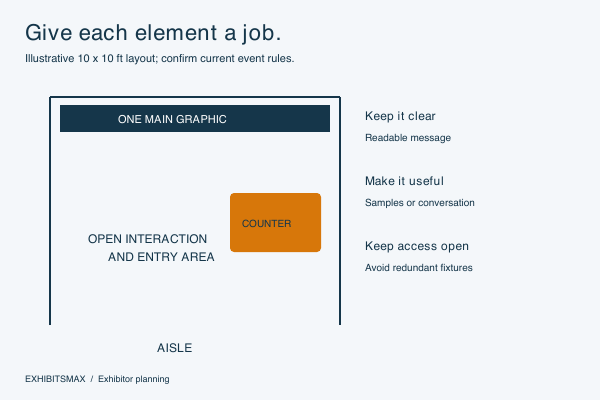
A 10×10-foot booth provides 100 square feet. Start with one principal graphic, one useful interaction point, appropriate lighting, and an unobstructed route into the space. Add equipment and furniture only when they support a defined activity.
Give Each Item a Job
Place the main message where visitors can see it without staff or products blocking it. Position the counter or demonstration surface to allow both engagement and entry. Keep stock and personal items in planned storage instead of using circulation space.
A meeting table may be appropriate for longer discussions; a standing counter may suit brief demonstrations. Neither belongs in every small booth. Check the layout against the current show’s booth configuration and access requirements.
Browse 10×10 booth projects and design ideas for spatial references. A compact project is not proof of a low budget: published photographs do not establish its price, rental status, or included services.
Make the Graphic Do More Work
Use a clear headline, a recognizable logo, and imagery that supports the product story. Leave enough space around these elements to preserve hierarchy.
Supply vector logos where available and follow the printer’s artwork specifications for the actual output size. There is no single image-resolution requirement that fits every large-format print and viewing distance. Review the proof before approving production.
Budget for Lighting as a Complete Service
Use lighting where it improves graphic or product visibility. Check mounting compatibility, screen reflections, cabling, and the electrical load before buying fixtures.
Fixture cost is only part of the equation. Confirm electrical service, permitted connections, and installation requirements with the show. Do not assume a plug-in light comes with free power or permission to install it yourself. Freeman’s international exhibitor guide explains why the event’s service manual matters for labor rules and designated providers.
A Real 10×10 Booth Example
VIA — ASCRS 2025 — Los Angeles Convention Center
The Exhibitsmax VIA 10×10 project provides a useful reference for organizing a compact footprint. The project photograph shows a large medical video display, a mint-colored branded counter, two stools, and an open approach from the aisle.
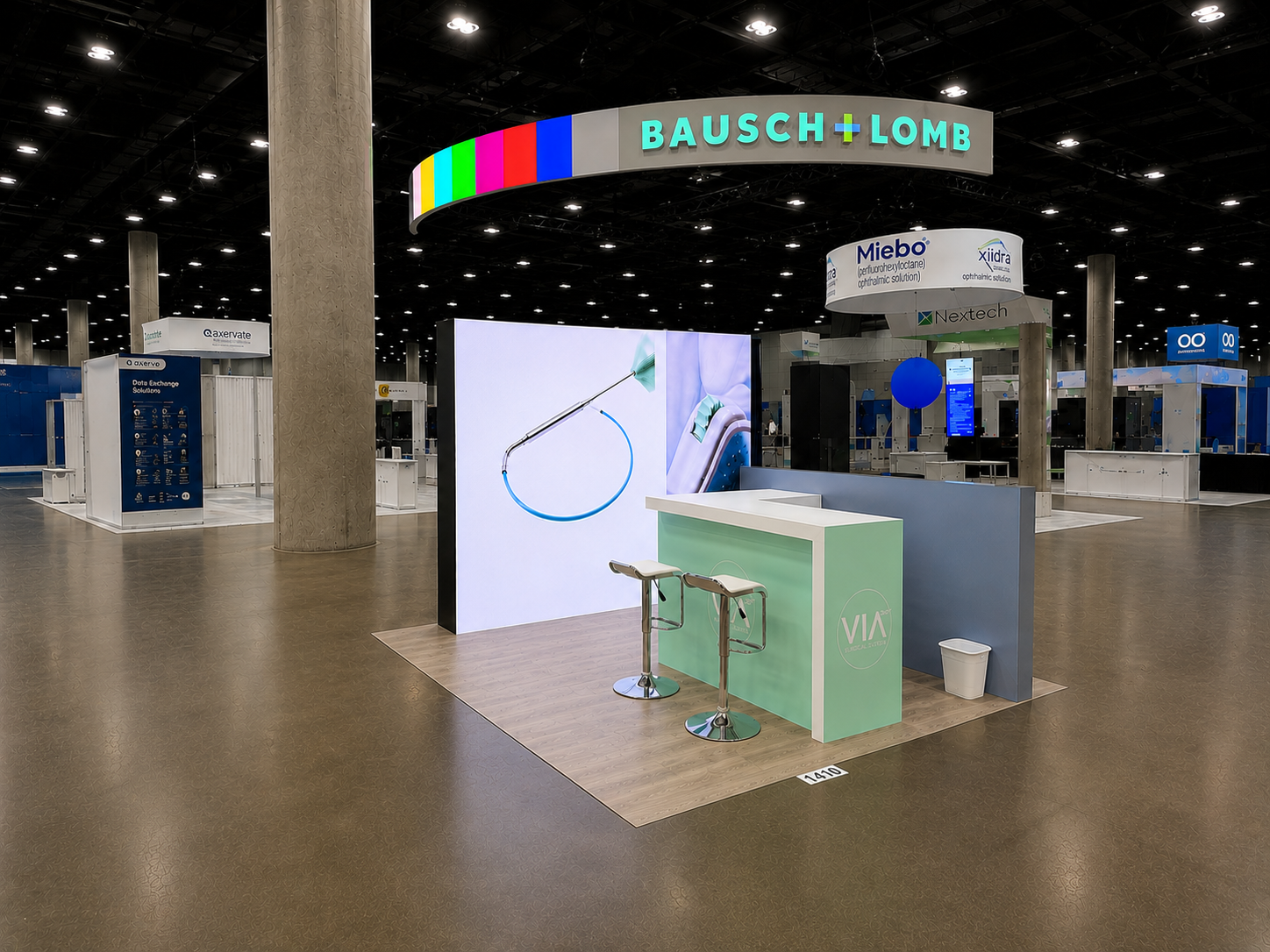
VIA at ASCRS 2025 in Los Angeles. Background exhibits belong to other exhibitors.
The layout concentrates attention on one main presentation surface and keeps the conversation area together. The useful lesson is to give the display and the interaction point clear roles without filling the footprint with competing elements.
For a smaller budget, apply that layout principle before selecting the hardware. A printed graphic may serve as the focal point when moving content is unnecessary. The photograph alone does not establish this project’s cost; it is a compact-layout reference, not a claimed low-budget or rental example.
View the VIA 10×10 Booth Project →
Should You Buy, Rent, or Combine Both?
Compare your actual show calendar and logistics arrangements. There is no universal rule that buying becomes cheaper at the third show.
| Consideration | Ownership may be practical when… | Rental may be practical when… |
|---|---|---|
| Reuse | The same components suit several planned events | Future participation or footprints remain uncertain |
| Storage | You have a suitable storage and maintenance arrangement | You want to avoid managing owned exhibit inventory |
| Transport | Packing and shipping are manageable across the planned route | Sourcing components nearer the event reduces a costly shipment |
| Branding | Graphics and configurations will remain useful | You expect substantial changes between events |
| Cash commitment | Upfront purchase fits the complete program budget | You prefer to commit to an agreed event scope |
For the broader operational decision, see Trade Show Booth Rental vs Custom Booth: Which Is Better?. Use it to weigh flexibility, design control, and ownership responsibilities alongside your display budget.
What About International Exhibitors?
Renting U.S.-based display components can reduce the need to ship bulky booth structures internationally. Your products, samples, and other owned materials may still need transportation and customs planning. Local delivery, handling, installation, and return arrangements for rented items also need to be included or assigned.
A hybrid approach is worth comparing: own portable branded items and rent selected bulky components. Ask who handles packing, delivery, collection, and any damage charges. Coordinate the remaining exhibit transportation rather than assuming it disappears.
Which Budget Mistakes Should You Avoid?
- Buying before checking the exhibitor package: Confirm what space rental actually includes.
- Assuming portable means exempt: Read the show’s rules for hand-carry access, self-installation, and electrical work.
- Missing advance-order deadlines: Put the actual dates from the current service manual in your project plan.
- Ordering lighting without power planning: List fixtures, monitors, and product loads before ordering services.
- Forgetting move-out: Assign dismantling, packing, collection, and return or storage responsibilities.
- Removing useful functions to fund decoration: Preserve the display, conversation, or demonstration that justified exhibiting.
Clarify the scope of installation and dismantling before approving the display. A simpler structure helps only if the resulting execution plan is workable.
Frequently Asked Questions
Can banner stands replace a full backwall?
They can work for a simple presentation when the message, stability, and layout are suitable. Compare the complete visual arrangement and floor space rather than adding banners until they imitate a wall.
Should I skip a monitor to save money?
Skip it if a static graphic or physical sample explains the product adequately. Keep it when a demonstration is central to the conversation, and budget for content, mounting, power, and setup.
Is DIY installation always cheaper?
No. First confirm what your staff may do under the current show rules. Then compare staff time, tools, assembly complexity, and the risk of missing components with a quoted installation scope.
Should I reuse last year’s graphics?
Reuse them if the messaging remains accurate, the dimensions fit, and the material is presentable. Outdated claims or damaged graphics are poor savings. Check compatibility before ordering a new frame.
How do I compare two budget booth quotes fairly?
Give both suppliers the same footprint, display needs, event details, and service scope. Separate fixed inclusions, allowances, and exclusions, including delivery, handling, power, I&D, and return arrangements.
Need a Budget-Friendly Trade Show Booth?
Exhibitsmax can help compare rental, modular, and custom options by booth size, show location, logistics, and total installed cost. Share your show name, city, booth size, floor plan, and target budget to start with a workable scope.