
Exhibitsmax Logo
BOOTH PLANNING

Choosing the Right LED Lighting for Trade Show Booths?

Published on July 29, 2026
Choosing the Right LED Lighting for Trade Show Booths?

LED lighting for trade show booths can make or break how visitors see your brand. A booth may have strong graphics, good products, and a smart layout, but poor lighting can make everything look flat or confusing. The right approach helps you attract attention, guide visitors, and present products clearly.

The right LED lighting for trade show booths should match your exhibit goals, product type, booth structure, and show-site conditions. Buyers should evaluate color temperature, CRI, beam angle, glare control, power needs, installation speed, and maintenance—not just brightness. Good lighting supports brand image, product visibility, attendee comfort, and operational efficiency.

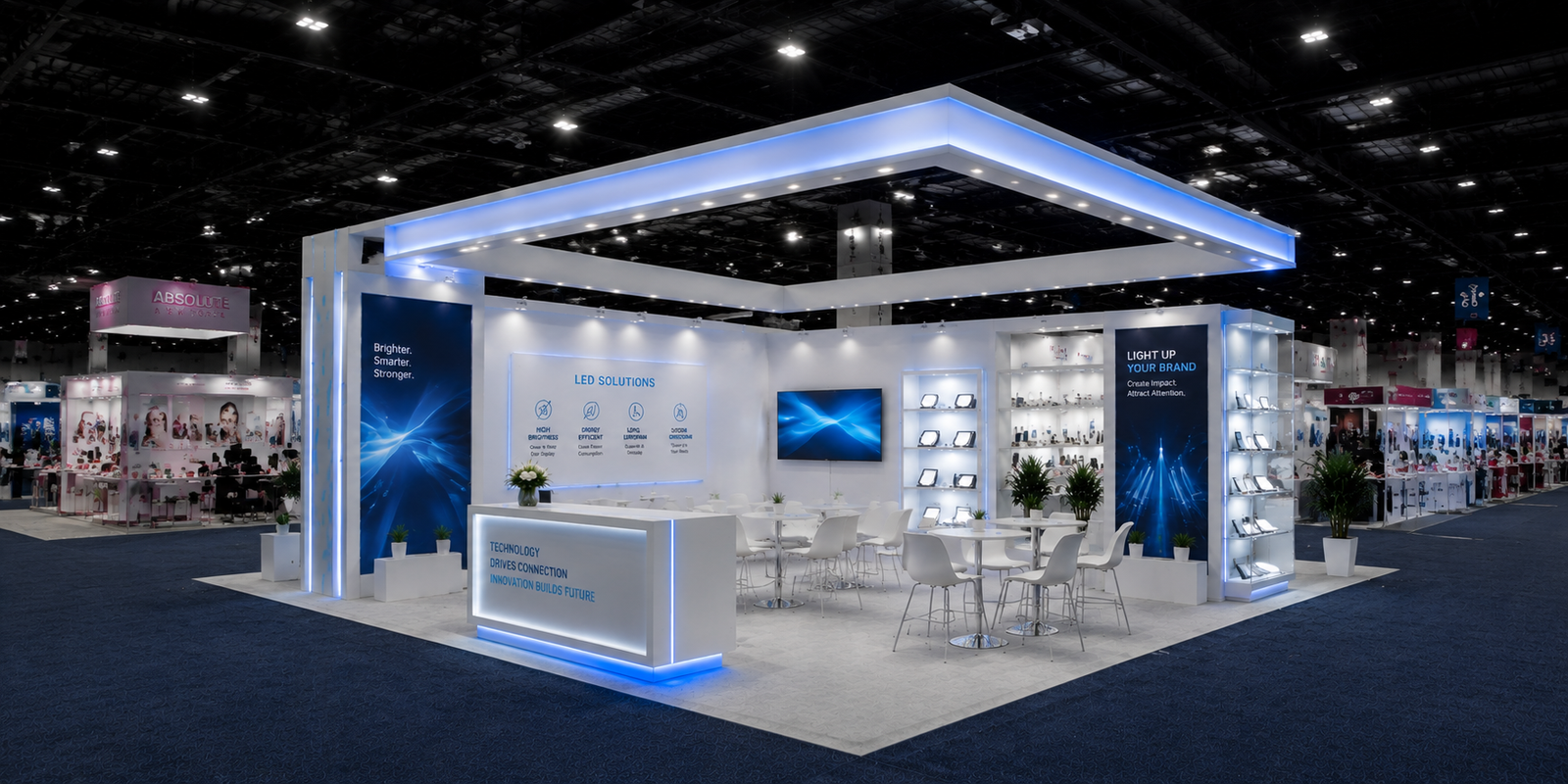
LED lighting for trade show booths with product display and branded exhibit design

I have seen many exhibitors treat lighting as an afterthought. That usually creates last-minute problems on the show floor. When lighting is planned with the booth design from the beginning, the whole exhibit feels more intentional, professional, and easier to operate.


Why does LED lighting for trade show booths matter so much?

Poor lighting creates a silent problem. Visitors may not know why a booth feels dull, harsh, or hard to read, but they will feel it. That discomfort can reduce dwell time, weaken product impact, and make the exhibit look less polished than nearby competitors.1

LED lighting for trade show booths matters because it affects visibility, mood, product presentation, brand perception, and staff performance. It helps direct attention, reduce shadows, support photography, and create a professional environment that encourages visitors to stop, look, and engage with your team.

LED lighting for trade show booths improving attendee attention and product visibility

Lighting is part of booth strategy, not only booth hardware

In my experience at Exhibitsmax, lighting is most effective when we connect it to the exhibitor’s main goal. A manufacturer showing precision parts needs different lighting than a beauty brand launching a new skincare line. A national pavilion needs a different lighting plan than a small startup booth.

Trade show lighting usually supports one or more of these goals:

  • Attracting attention from the aisle
  • Highlighting product details
  • Creating a premium brand atmosphere
  • Helping staff read, scan, and demonstrate
  • Improving photo and video quality
  • Making graphics and signage easier to understand
  • Controlling visitor movement inside the booth

The mistake I see most often is using brightness as the only decision factor. Brightness matters, but it is not the whole story. A booth can be bright and still look unpleasant. Glare can push people away. Uneven lighting can make expensive graphics look cheap. The wrong color temperature can change how product colors appear.2

What lighting changes in the visitor experience?

Trade show halls are visually crowded. Overhead hall lighting is often general, flat, and inconsistent. Your booth lighting needs to create a more controlled visual environment.

Good LED lighting can help with:

  1. First impression
    Visitors usually decide within seconds whether a booth feels relevant or professional.3

  2. Visual hierarchy
    Lighting can show visitors where to look first, second, and third.4

  3. Product confidence
    Clear lighting helps buyers inspect texture, finish, scale, and detail.

  4. Brand mood
    Warm, cool, soft, or dramatic lighting changes how people interpret your brand.

  5. Operational comfort
    Staff need usable light for conversations, badge scanning, literature, and product demos.

Here is a simple way I explain it to clients:

Booth Goal Lighting Priority Common LED Choice
Product inspection High CRI, controlled beam Track lights or spotlights
Brand atmosphere Color temperature and layering Backlit graphics, LED strips
High visibility Bright but controlled accents Overhead LED fixtures
Staff tasks Even, comfortable light Downlights or task lights
Fast setup Simple wiring and modular fixtures Pre-integrated LED systems

I once worked on a booth where the product was technically impressive, but the first lighting plan made the surfaces look dull. We adjusted beam angles and used higher color rendering fixtures. The product did not change, but the perceived quality improved immediately. That is why I always treat lighting as part of the sales environment.


How should you choose LED lighting for trade show booths based on exhibit goals?

Many exhibitors start with a fixture catalog. That creates confusion because every product claims to be bright, efficient, and professional. The better starting point is the purpose of the exhibit. Without clear goals, lighting choices become random and harder to justify.

You should choose LED lighting for trade show booths by defining what the booth must accomplish first. Decide whether you need to highlight products, create mood, attract traffic, support demonstrations, or improve staff workflow. Then select fixture types, brightness, color temperature, beam angle, and controls around those goals.

Choosing LED lighting for trade show booths based on product display goals

Start with the main visitor action

A booth is not just a display space. It is a decision environment. You want visitors to do something. They may need to stop, enter, scan a QR code, touch a product, watch a demo, or speak with a salesperson.

Before selecting fixtures, I recommend asking:

  • What should visitors notice first?
  • Which products need close inspection?
  • Will staff perform live demonstrations?
  • Will visitors take photos or videos?
  • Does the brand need to feel warm, premium, technical, playful, or bold?
  • Does the booth need to stand out from a long aisle?
  • Will the exhibit be reused at multiple shows?

These questions make the lighting plan more practical.

Match lighting type to display purpose

Different booth areas usually need different lighting. A single type of light rarely solves everything.

Lighting Type Best Use Watch Out For
Spotlights Featured products, hero displays Glare and harsh shadows
Floodlights Larger wall graphics or broad areas Flat appearance if overused
Track lighting Flexible product displays Mounting and aiming time
LED strip lighting Shelves, counters, edges, accents Visible dots or uneven diffusion
Backlit graphics Brand walls and high-impact visuals Graphic material and power planning
Downlights Meeting spaces and reception counters Ceiling structure requirements
LED video walls Motion content and attention Budget, rigging, power, content quality

At Exhibitsmax, we often combine several types of lighting. For example, a 20x20 booth may use backlit graphics for brand recognition, spotlights for products, soft downlights for a meeting area, and LED strips inside display shelves. This layered approach usually looks more professional than relying on one high-output fixture.

Think about product category

Product type changes everything.

Industrial products often need clean, neutral lighting so buyers can inspect materials and details. A manufacturer showing machined components may benefit from higher CRI lighting and careful beam control.

Beauty, wellness, and fashion brands often need flattering color temperature and soft diffusion. Skin tones and packaging colors need to look accurate.

Technology companies may want cooler tones, edge lighting, and LED video walls to create a modern atmosphere.

Food and beverage brands need color accuracy and warmth. Poor lighting can make food look less appealing.

I usually tell exhibitors this: lighting should make the product easier to believe in.

Balance attraction and comfort

A booth needs to stand out, but it should not punish the visitor’s eyes. Some exhibitors ask for “the brightest possible” setup. I understand the instinct, especially in a crowded hall. But excessive brightness can create glare, reflections, and eye fatigue.

A better plan is to create contrast. Make key areas brighter than the background. Use darker or softer zones to frame important products. This approach guides attention without overwhelming visitors.

Good booth lighting should answer three questions:

  1. Can visitors see the brand from the aisle?
  2. Can visitors understand the product up close?
  3. Can staff work comfortably for several days?

When the answer to all three is yes, the lighting plan is usually on the right path.


Which technical specifications matter for LED lighting for trade show booths?

Technical terms can feel overwhelming. Lumens, watts, CRI, Kelvin, beam angle, dimming, and voltage all appear in lighting discussions. The problem is not the terms themselves. The problem is choosing numbers without understanding how they affect the booth experience.

The most important specifications for LED lighting for trade show booths are color temperature, CRI, beam angle, lumen output, glare control, power consumption, dimming compatibility, fixture durability, and heat management. These specifications should be reviewed together because each one affects visual quality and show-site performance.

Technical specifications for LED lighting for trade show booths including CRI and color temperature

Color temperature affects mood

Color temperature is measured in Kelvin, often written as K. It describes whether light appears warm, neutral, or cool.5

Color Temperature Appearance Common Booth Use
2700K–3000K Warm, soft, hospitality-like Luxury, food, lifestyle, lounges
3500K–4000K Neutral, balanced General product displays
4000K–5000K Cool, crisp, technical Industrial, medical, technology
5000K+ Very cool, daylight-like Select inspection or high-energy effects

There is no universal “best” color temperature. The right choice depends on your brand and product. A warm 3000K light may make a lounge feel inviting. The same light may make a precision technology display feel less sharp. A cool 5000K light may make a technical product look clean, but it may feel too harsh for a premium lifestyle brand.

CRI affects color accuracy

CRI stands for Color Rendering Index. It measures how accurately a light source shows colors compared with a reference light source.6 Many trade show applications benefit from LED lighting with a CRI of 80+, while product categories where color matters may require 90+.7

Higher CRI is especially useful for:

  • Cosmetics
  • Textiles
  • Food packaging
  • Printed materials
  • Automotive finishes
  • Consumer goods
  • Medical or precision products

If your product color is important, I recommend reviewing sample lighting before final production when possible. A product that looks perfect in an office may look different under booth lighting.

Beam angle controls focus

Beam angle determines how wide or narrow the light spreads.

  • Narrow beam angles create focused highlights.
  • Medium beam angles work well for product displays.
  • Wide beam angles cover large graphics or general areas.

A narrow beam can make one product look dramatic, but it may leave nearby areas dark. A wide beam can cover more space, but it may reduce contrast. The right answer depends on what the visitor needs to see.

Lumens matter, but they are not everything

Lumens measure visible light output. They are useful, but they do not tell the full story. Two fixtures with similar lumen ratings can perform very differently depending on optics, mounting height, beam angle, diffusion, and fixture quality.8

Here is a practical comparison:

Spec What It Tells You What It Does Not Tell You
Lumens Total light output Whether light is comfortable or well aimed
Watts Energy use Brightness quality or color accuracy
CRI Color accuracy Mood or beam shape
Kelvin Warm/cool appearance Brightness or glare
Beam angle Spread of light Color quality or efficiency

Power and heat need planning

LEDs are more efficient than many older lighting types, but power still matters.9 Trade show booths often have limited electrical service. Every fixture, monitor, charger, video wall, refrigerator, and demo machine may draw from the same electrical plan.

Buyers should confirm:

  • Total wattage
  • Voltage requirements
  • Plug types
  • Dimming compatibility
  • Driver locations
  • Cable routing
  • Heat dissipation
  • Electrical rules from the show organizer

In the United States, electrical installation at trade shows often involves venue rules and official contractor requirements.10 I always recommend checking the exhibitor manual early. Late electrical changes can be expensive and stressful.

Durability matters in reusable exhibits

Trade show lighting gets packed, shipped, unpacked, installed, dismantled, and stored. A fragile fixture may work in a showroom but fail in an exhibit program. For reusable booths, fixture durability and easy replacement become part of total cost of ownership.

Look for practical features such as:

  • Secure mounting hardware
  • Replaceable drivers or modules
  • Clean cable management
  • Protective cases or packing
  • Reliable connectors
  • Consistent color across fixtures
  • Easy aiming and adjustment

The best specification sheet is not always the best booth solution. The best solution performs well visually and survives the realities of trade show logistics.


How can you avoid common mistakes with LED lighting for trade show booths?

Lighting mistakes often appear late. The booth is installed, the hall lights come on, and suddenly the graphics glare, the product shelves look dark, or the staff counter has shadows. At that point, fixes are possible, but they are usually less efficient.

You can avoid common mistakes with LED lighting for trade show booths by planning lighting during booth design, testing key effects, controlling glare, confirming power needs, simplifying wiring, and choosing fixtures that match the booth’s reuse plan. Early coordination prevents hidden costs and last-minute compromises.

Avoiding mistakes with LED lighting for trade show booths during installation

Mistake 1: Choosing brightness without direction

Bright light pointed in the wrong direction creates glare. It may also wash out graphics or reflect off glossy products. I have seen booths where staff avoided standing under certain fixtures because the light was uncomfortable.

A better approach is to define the target:

  • Product face
  • Graphic wall
  • Reception counter
  • Demo table
  • Aisle-facing brand sign
  • Meeting area

Then aim the light to support that target.

Mistake 2: Forgetting the hall environment

Trade show halls are not controlled like photography studios. Ceiling height, ambient lighting, neighboring booths, aisle traffic, and rigging rules all affect how your lighting appears.

A booth may look perfect in a rendering but feel different on site. That does not mean renderings are useless. It means renderings should be supported by practical knowledge of show conditions.

Important show-site questions include:

  1. What is the booth size and height limit?
  2. Is hanging signage allowed?
  3. Are there restrictions on lighting effects?
  4. Where is electrical service located?
  5. Who is allowed to connect power?
  6. How long is the installation window?
  7. Will the booth ship to multiple cities?

Mistake 3: Ignoring wiring and installation time

A beautiful lighting plan can become a problem if it takes too long to install. Every cable, transformer, driver, and connector needs a place. Installers need access. Dismantle crews need to pack items safely.

For multi-show programs, simplicity has real value. A slightly less complex lighting system that installs reliably can be better than an elaborate system that causes repeated labor issues.

Here is how I usually compare lighting plans with clients:

Plan Type Visual Impact Setup Complexity Best For
Basic clip-on lights Moderate Low Small booths, limited budgets
Integrated LED strips High Medium Shelving, counters, custom details
Track lighting High Medium Flexible product displays
Backlit fabric graphics Very high Medium Strong branding and reuse
LED video wall Very high High Launches, demos, major campaigns

Mistake 4: Not controlling reflections

Glossy products, glass cases, acrylic panels, polished metal, and screens all reflect light.11 Reflections can make it harder to see details and harder to photograph the booth.

To reduce reflection problems:

  • Use angled lighting instead of direct front lighting.
  • Test glossy surfaces under similar light.
  • Use diffusion where needed.
  • Avoid placing spotlights directly opposite reflective materials.
  • Coordinate lighting with product display heights.

Mistake 5: Treating budget as only fixture cost

The fixture price is only one part of the real cost. Exhibitors should also consider:

  • Electrical service
  • Labor for installation
  • Spare parts
  • Packing materials
  • Storage
  • Shipping weight
  • Replacement time
  • Reusability across future booth layouts

A more expensive fixture may be worth it if it reduces labor and lasts for several shows. A lower-cost fixture may be the better choice for a one-time booth. The right decision depends on the exhibit program, not on price alone.

I like to think in terms of total cost of ownership. A lighting plan should support the current show while also making sense for future events.


How should LED lighting work with booth design, graphics, and product displays?

A booth can have good fixtures and still look disconnected. This usually happens when lighting is selected after the design is already complete. The result feels patched together. Products, graphics, and structures need lighting that supports the full visual story.

LED lighting should work with booth design by reinforcing hierarchy, matching brand colors, improving graphic readability, supporting product displays, and making spaces feel intentional. The best lighting plans are integrated into the exhibit architecture, not added as decoration at the end.

LED lighting integrated with trade show booth graphics and product displays

Design hierarchy comes first

Every booth needs visual hierarchy. Visitors should understand what matters most without reading every word. Lighting helps create that hierarchy.

For example:

  • A backlit logo wall can establish brand identity.
  • Spotlights can create focus on hero products.
  • Shelf lighting can make smaller products easier to browse.
  • Soft lighting can make meeting spaces more comfortable.
  • Accent lighting can define architectural edges.

If every element is equally bright, nothing feels important. Good lighting creates contrast and order.

Graphics need even illumination

Large-format graphics are common in trade show booths. They carry brand messages, product benefits, and visual identity. Uneven lighting can make them look wrinkled, dull, or low quality.

Backlit fabric graphics can work very well when planned correctly. They offer a clean, modern appearance and strong visibility from the aisle. However, the result depends on the frame, fabric, LED placement, and graphic production quality.

For front-lit graphics, fixture placement matters. Lights that are too close may create hot spots. Lights that are too far may create dim zones. The goal is even readability without glare.

Product displays need depth

Product lighting should reveal shape, texture, and material. Flat lighting often makes products look less valuable. Some shadow is useful because it gives the eye depth cues.12 The goal is controlled shadow, not random darkness.

For product displays, I often consider:

  • Product size
  • Surface finish
  • Color accuracy needs
  • Viewing distance
  • Display height
  • Visitor flow
  • Photography needs
  • Staff demo requirements

A small product inside a case may need internal LED strips. A large machine may need overhead or angled lights. A premium item may need a focused spotlight and darker surroundings.

Brand color and light color must work together

Lighting can change how brand colors appear. A cool light may shift warm colors. A warm light may soften blues and whites. For brands with strict color standards, lighting should be reviewed with printed graphics and materials.

This matters especially for international exhibitors entering the U.S. market. Your booth may be the first physical brand experience many buyers have with your company. If colors look inconsistent, the brand can feel less controlled.

Lighting should help people move

Lighting can also guide movement. A brighter reception counter can signal where to start. A lit product wall can pull visitors deeper into the booth. A softly lit meeting area can feel more private.

In a busy show, attendees make fast decisions. Lighting can reduce confusion and help the booth feel easier to enter.


Frequently Asked Questions

What is the best color temperature for trade show booth lighting?

The best color temperature depends on your brand and product. Many booths use 3500K to 4000K for a balanced, neutral look. Warm brands may prefer 3000K, while technology or industrial exhibitors may use 4000K to 5000K for a cleaner, sharper appearance.

How bright should LED lighting for trade show booths be?

Brightness depends on booth size, mounting height, ambient hall light, and display goals. Do not choose lights by lumens alone. A better approach is to balance lumen output with beam angle, glare control, CRI, color temperature, and fixture placement.

Is CRI important for trade show booth lighting?

Yes. CRI is important when product color, material, or finish matters. A CRI of 80+ may work for general lighting, while 90+ is often better for cosmetics, textiles, food packaging, premium goods, and detailed product inspection.

Are backlit graphics worth it for trade show booths?

Backlit graphics can be worth it when brand visibility is a priority. They create strong aisle impact and a clean modern look. Buyers should confirm frame quality, fabric type, LED layout, power needs, and reuse plans before choosing this option.

Should I rent or buy LED lighting for my exhibit?

Rental may work well for one-time events or changing booth designs. Purchase may make sense for repeat exhibitors with reusable structures. The best choice depends on show frequency, booth design, storage, shipping, maintenance, and total cost over multiple events.

Conclusion

Choosing the right LED lighting for trade show booths is a strategic design decision, not just a fixture purchase. The best lighting plan supports your exhibit goals, product presentation, brand mood, power plan, installation schedule, and long-term budget. I recommend planning lighting early, reviewing technical details carefully, and thinking beyond brightness. If you want help creating a booth lighting plan that works on the real show floor, Exhibitsmax can support your design, fabrication, logistics, installation, and LED display needs across the United States.


  1. "Less Light, Better Bite: How Ambient Lighting Influences Taste Perceptions", https://digitalcommons.murraystate.edu/cgi/viewcontent.cgi?article=1169&context=faculty. Research on retail and environmental lighting indicates that lighting quality can affect user comfort, attention, time spent in a space, and perceptions of products; this evidence is contextual because it is usually based on retail or built-environment settings rather than trade show booths specifically. Evidence role: general_support; source type: paper. Supports: Lighting conditions can influence comfort, attention, time spent in a space, and perceptions of displayed products or retail environments.. Scope note: Contextual support; most studies address retail or interior environments, not trade show exhibits directly.

  2. "A Standard for Lighting Color Preference? | NIST", https://www.nist.gov/news-events/news/2017/03/standard-lighting-color-preference. Color science references from standards bodies such as CIE explain that illumination spectrum and correlated color temperature influence perceived object color; this supports the claim that product colors may shift under different booth lighting. Evidence role: mechanism; source type: institution. Supports: The spectral characteristics and correlated color temperature of illumination affect how object colors are perceived..

  3. "Very first impressions", https://pubmed.ncbi.nlm.nih.gov/16768559/. Psychological research on rapid impression formation shows that people can make evaluative judgments after very brief visual exposure; this supports the general premise of fast booth judgments, although the evidence is not specific to exhibition environments. Evidence role: expert_consensus; source type: paper. Supports: People can form rapid first impressions from brief visual exposure.. Scope note: Contextual support; rapid-impression studies generally examine faces, interfaces, or scenes rather than trade show booths.

  4. "Does luminance-contrast contribute to a saliency map for ...", https://pubmed.ncbi.nlm.nih.gov/12653985/. Studies of visual attention and salience show that luminance contrast and other visual features can influence fixation and attentional priority; this supports the use of lighting to structure visual hierarchy in a booth. Evidence role: mechanism; source type: paper. Supports: Differences in luminance, contrast, and visual salience can guide where people look.. Scope note: Contextual support; the mechanism is general visual perception rather than trade-show-specific testing.

  5. "Color temperature", https://en.wikipedia.org/wiki/Color_temperature. Reference works on color temperature define it in Kelvin and describe its use in characterizing the apparent warmth or coolness of light sources. Evidence role: definition; source type: encyclopedia. Supports: Color temperature and correlated color temperature are expressed in Kelvin and commonly describe the apparent warmth or coolness of light..

  6. "Color Rendering Index and LEDs", https://www.energystar.gov/ia/partners/prod_development/new_specs/downloads/integral_leds/Nexxus_Commercial_Lighting_2_IntegralLEDLampCommentsDraft2.pdf?0b55-1475. Lighting standards and technical references define the Color Rendering Index as a measure of how a light source renders object colors relative to a reference illuminant of comparable color temperature. Evidence role: definition; source type: institution. Supports: CRI is a metric for comparing how a light source renders colors relative to a reference illuminant..

  7. "Lighting Research Center", https://www.lrc.rpi.edu/. Lighting research and technical guidance commonly describe CRI values near 80 as acceptable for many general applications and higher values, such as 90 or above, as preferable where accurate color discrimination is important. Evidence role: general_support; source type: research. Supports: CRI values around 80 are commonly treated as acceptable for general applications, while higher values are used where color discrimination is important.. Scope note: Contextual support; CRI thresholds vary by application, lighting standard, and color-quality metric.

  8. "Luminaires V2 0 Final.pdf", https://www.energystar.gov/sites/default/files/asset/document/Luminaires%20V2%200%20Final.pdf. Lighting engineering references distinguish total luminous flux from delivered illuminance and show that optical distribution, mounting distance, beam spread, and diffusion affect the usable light reaching a target surface. Evidence role: mechanism; source type: education. Supports: Delivered illuminance and visual performance depend on fixture optics, distribution, distance, and installation conditions, not only total lumen output..

  9. "Learn About LED Lighting", https://www.energystar.gov/products/learn-about-led-lighting. U.S. government energy-efficiency resources report that LED lighting typically uses substantially less electricity than many legacy lighting technologies, supporting the statement that LEDs are efficient even though their cumulative electrical load must still be planned. Evidence role: statistic; source type: government. Supports: LED lighting generally uses less energy than many legacy lighting technologies while still requiring electrical load planning..

  10. "Trade Show Booth Builder in Las Vegas - Exhibitsmax", https://exhibitsmax.com/trade-show-booth-builder-in-las-vegas/. Exhibitor manuals from U.S. convention venues and show organizers commonly specify that electrical service, connections, or floor work must be handled through official contractors or approved venue personnel; this supports the operational caution, though requirements vary by show and venue. Evidence role: historical_context; source type: institution. Supports: Exhibitor manuals and venue rules commonly assign electrical service installation and connection to official contractors or approved personnel.. Scope note: Contextual support; rules differ by event, venue, union jurisdiction, and service provider.

  11. "Specular reflection", https://en.wikipedia.org/wiki/Specular_reflection. Optics and lighting references describe specular reflection from smooth surfaces such as glass, polished metal, acrylic, and glossy finishes, explaining why poorly placed light sources can create glare and reduce visual clarity. Evidence role: mechanism; source type: education. Supports: Smooth, glossy, metallic, and glass surfaces produce specular reflection that can create glare or obscure details..

  12. "The perception and recognition of natural object shape from deforming ...", https://www.wku.edu/psychological-sciences/labs/vision_and_haptics/downloads/p2994.pdf. Visual perception research on shape from shading shows that shadows and luminance gradients provide depth and form cues, supporting the claim that controlled shadow can improve the perception of product shape and material. Evidence role: mechanism; source type: paper. Supports: Shading and shadows contribute to human perception of depth, shape, and surface form..