Exhibitsmax Logo
BOOTH RENTAL

Las Vegas Trade Show Booth Rentals: What Should You Really Expect?

Published on July 29, 2026
Las Vegas Trade Show Booth Rentals: What Should You Really Expect?

Las Vegas trade show booth rentals can feel simple on the surface but tricky in practice. The problem is that “rental” often sounds turnkey, yet many quotes exclude critical items. That gap creates stress, surprise invoices, and brand risk. The solution is clarity: define scope, plan for local nuances, and choose a partner who manages the moving parts end to end.

Las Vegas trade show booth rentals typically include the structure, basic furniture, standard lighting, and graphics, while most costs for electrical, internet, material handling (drayage), onsite labor, and rigging are billed separately through the show’s general contractor.1 Verify inclusions against the exhibitor manual, ask for itemized estimates, and confirm onsite support and installation.

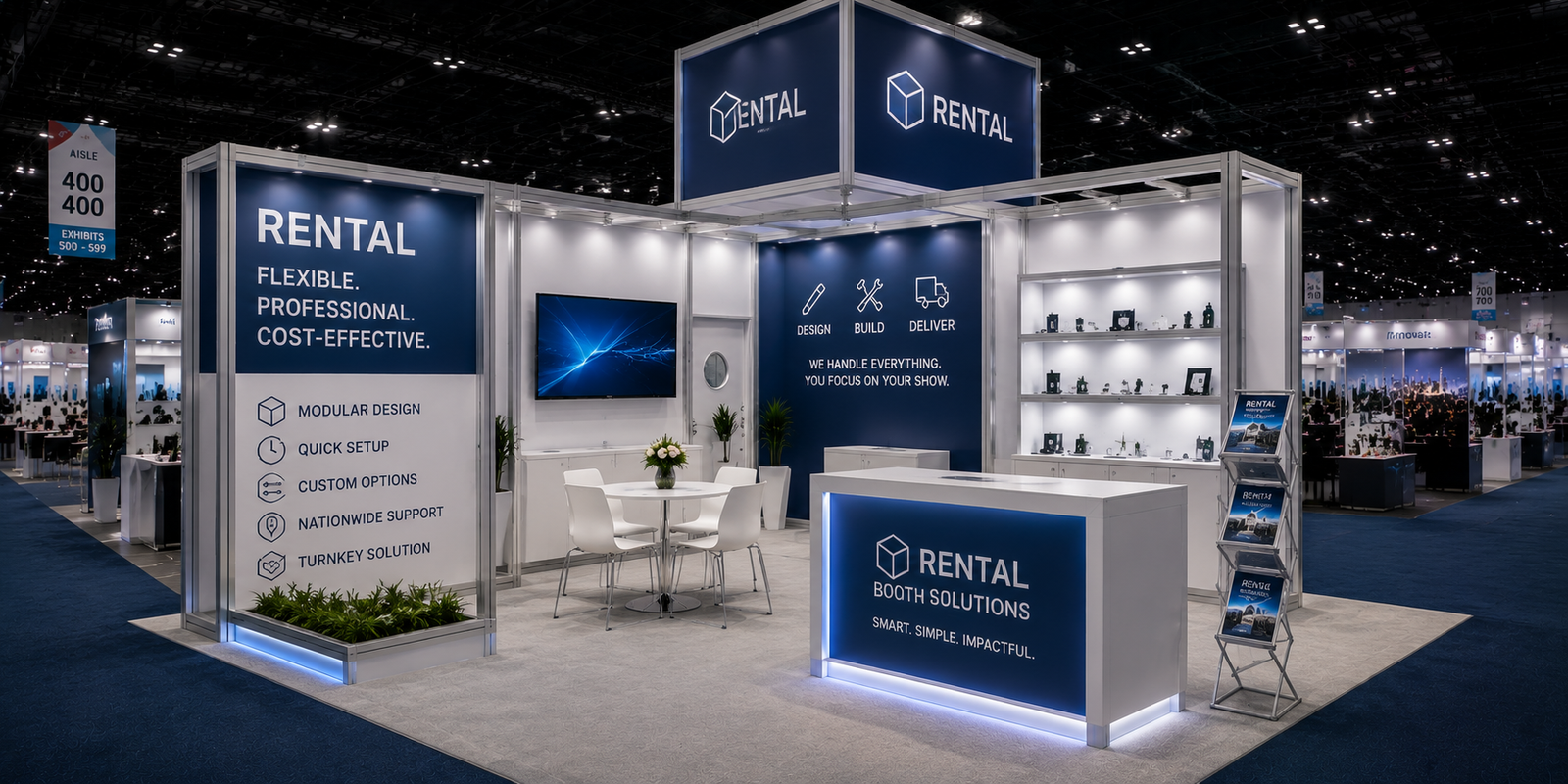
Las Vegas trade show booth rentals custom island booth at LVCC

You now have the short answer. The rest of this guide breaks down the real scope of a rental, the local fees that trip up budgets in Las Vegas, and how a single point of project management smooths the entire process. I’ll also share the checklists I use with international clients to eliminate surprises.

What do Las Vegas trade show booth rentals actually include?

A “rental” sounds all‑inclusive until you’re ordering power drops and union labor. That gap between expectation and reality causes friction. The fix is to unpack the scope line by line, so you see which pieces live with the rental supplier and which live with the show contractor. Then you can budget and plan accurately.

Most Las Vegas trade show booth rentals include the exhibit structure, standard lighting, basic furniture, and printed graphics. However, services like electrical, internet, drayage, rigging, and union labor are usually billed by the show contractor (e.g., Freeman or GES). Always request a written inclusion/exclusion list and an itemized estimate that maps to the exhibitor manual.

Las Vegas trade show booth rentals scope diagram showing inclusions and exclusions

Dive deeper

In our experience with exhibitors, the misunderstanding almost always centers on who controls which line item. A rental provider, like Exhibitsmax, supplies the physical booth and can package in services, but many fees are governed by the venue and general contractor.

Here is a practical way to read a quote:

  • Structure: wall systems, counters, storage closet, shelving.
  • Finishes: laminate, tension fabric, graphics.
  • Lighting: arm lights, LED strips included; specialty lighting quoted.
  • Furniture: stools, tables, reception desks; premium furniture costs more.
  • AV and LED: rental line items; installation may involve union labor.
  • Flooring: carpet and pad or raised floor; often optional.
  • Logistics: delivery to advance warehouse or direct to show; return shipping.
  • Labor: installation & dismantle (I&D) may be included by your rental partner or handled via the general contractor depending on show rules and your EAC (Exhibitor Appointed Contractor) status.
  • Onsite supervision: project manager onsite during move‑in/out.
  • Storage: pre/post show storage when needed.

Use this quick comparison to clarify scope with any vendor:

Category Typically Included by Rental Often Included (Confirm) Not Included (Order via GC)
Structure & Graphics Yes
Standard Lighting Yes
Furniture Yes (basic) Premium options
Flooring Sometimes Yes if turnkey
Shipping to Venue Sometimes Yes if turnkey
I&D Labor Sometimes Yes if turnkey w/ EAC
Electrical Service Cable management Yes
Internet Yes
Drayage (Material Handling) Yes
Rigging/Hanging Signs Yes
Lead Retrieval Yes

Notes:

  • GC = General Contractor (commonly Freeman or GES in Las Vegas).
  • EAC = Exhibitor Appointed Contractor. You’ll need a Certificate of Insurance (COI), usually $1M General Liability2, naming required parties.

Clients often ask us to “make it turnkey.” We can bundle many services and manage all orders so you write one check. But we still flag which fees are set by the GC and must be accepted as-is. This transparency keeps approvals swift and avoids friction with finance.

Which hidden costs affect Las Vegas trade show booth rentals?

Budgets get blindsided by fees that aren’t on the booth quote. The pain usually comes from material handling, overtime labor, and late surcharges. The fix is to pre-read the exhibitor manual, map every service to the right provider, and lock in early-order rates wherever possible.

The biggest hidden costs for Las Vegas trade show booth rentals are material handling (drayage), electrical power and labor, overtime/holiday rates for I&D, rigging for hanging signs, internet, and late order surcharges.3 Request current rate sheets, plan to ship to the advance warehouse, and schedule move‑in to avoid overtime windows.

Cost drivers for Las Vegas trade show booth rentals including drayage and labor

Dive deeper

We’ve found that many international brands overlook venue-specific cost drivers. Las Vegas venues like LVCC, The Venetian Expo, and Mandalay Bay follow strict target move-in schedules and union jurisdictions.4 A small misstep can cascade into hundreds or thousands in add-ons.

Key cost drivers and typical ranges to verify in your show kit:

  • Material Handling (Drayage): charged per 100 lb (CWT).5 Recent Las Vegas shows ranged roughly $1.90–$3.05/lb6 effective cost when you include minimums, special handling, and round-trip considerations. Always check CWT rates and surcharges such as off-target or special handling.
  • Electrical: outlets, labor to run power to locations, and floor work. Higher rates apply for orders placed after deadlines or onsite.
  • Internet: basic wireless may be insufficient; hardlines are premium-priced.7
  • Overtime/Holiday Labor: I&D and electrical rates increase after certain hours, on weekends, or holidays.8 Plan offloading and build within straight-time windows.
  • Rigging: any hanging sign needs advance approval, engineered drawings9, and rigging labor from the GC. Add point charges and lift fees.
  • Late Order Surcharges: many services add 20–40%10 after the advance deadline.

Practical tips that save money:

  • Ship to the advance warehouse. It simplifies target time compliance and reduces special handling. Use sturdy, uniform crates to avoid “loose” or “mixed” handling surcharges.
  • Mark freight with booth number, company name, and show contact. Include packing lists with weight breakouts.
  • Book electrical early and submit a scaled floor plan with outlet locations labeled. This prevents onsite changes billed at premium rates.
  • If your move-in target falls on a weekend, ask the GC to adjust if possible or budget overtime.
  • For hanging signs, submit drawings to the GC’s rigging department 3–4 weeks out and pre-pay to avoid holds.

We maintain a cost-tracking worksheet for each show. When clients see the end-to-end picture before they fly, it changes decisions: fewer last-minute orders, fewer surprises, and stronger ROI.

How should you budget and schedule for Las Vegas trade show booth rentals?

Time is money in Las Vegas. Missed deadlines create rush fees and force overtime. The fix is to work backward from show open, lock design decisions early, hit discount deadlines, and hold weekly check-ins with your rental partner to keep the plan on rails.

Build your budget around three buckets: booth rental and graphics, show services (electrical, drayage, internet, rigging), and labor/logistics. Start design 10–12 weeks out, submit orders 30–45 days before the show for discount rates, and finalize shipping 2–3 weeks out. Hold weekly status calls to track dependencies.

Timeline planning for Las Vegas trade show booth rentals

Dive deeper

Here’s a planning framework I use with first-time U.S. exhibitors. Adjust to your show’s calendar:

Week -12 to -10:

  • Discovery: goals, products, demos, and lead targets.
  • Space review: booth size, ceiling height, rigging rules, and egress.
  • Concept design: mood boards, brand guidelines, and modular options.

Week -10 to -8:

  • Layout and elevations: finalize structure, storage, and demo points.
  • Preliminary budget: rental, graphics, furnishings, AV/LED, services.
  • Approvals: internal brand/legal checks for messaging and imagery.

Week -8 to -6:

  • Graphic production: lock dimensions and resolution. Plan for dye-sub fabric or direct print. Allow 7–10 business days for production plus QA.
  • Services ordering: electrical, internet, lead retrieval, cleaning, rigging.
  • EAC paperwork: COIs, EAC forms, and onsite contact details.

Week -6 to -4:

  • Shipping plan: choose advance warehouse to avoid target conflicts.
  • Crating and labeling: detail inventory and weight. Confirm marshaling yard requirements.
  • Labor scheduling: I&D crew, supervision, expected hours by day.

Week -3 to -2:

  • Pre-flight: confirm tracking numbers, warehouse receipt, outbound BOLs.
  • Onsite binder: floor plan, power plan, permits, COIs, emergency contacts.
  • Rehearsal: if using complex AV or LED video walls, run a content check.

Budget model starters (verify current rates):

  • 10x20 inline: $12k–$25k rental package range plus $8k–$20k services.
  • 20x20 island: $30k–$60k rental package range plus $25k–$60k services.
  • LED video wall rental add: $6k–$25k depending on size/pixel pitch and show duration.

I always present budgets with a 10–15% contingency. It gives breathing room for legitimate last-minute needs without derailing ROI targets.

Can rental booths be customized without blowing the budget?

Brand teams fear that rentals look generic or lock them into cookie-cutter layouts. The fix is to use modular systems with custom graphics, branded finishes, and targeted hero elements like LED walls, without reinventing the whole structure.

Yes. You can customize rental booths cost-effectively by combining modular architecture with custom graphics, branded/lighted features, and selectively upgraded furniture or AV. Focus spend on high-impact zones: the front elevation, reception, key product demo areas, and a signature element such as a hanging sign or LED wall.

Custom look achieved with Las Vegas trade show booth rentals

Dive deeper

Clients often ask us, “Will a rental look like ours?” It can—and should. The secret is prioritization and modularity:

High-impact upgrades that travel well across shows:

  • Oversized tension-fabric graphics with dramatic photography.
  • Branded reception with integrated lighting and storage.
  • Product towers with halo lighting and replaceable graphic panels.
  • Feature demo counters with cable management and lockable storage.
  • LED video wall or large-format displays for motion content.

Cost-smart design principles:

  • Modular frames: reconfigure from 10x20 to 20x20 with shared parts.
  • Graphic zoning: design reusable backgrounds and show-specific overlays.
  • Lighting layers: combine general arm lights with accent LED strips.
  • Texture and finish: add laminate, wood tones, or metallic accents where the eye lands first.

When to consider custom fabrication within a rental program:

  • Unique product display needs (weight-bearing shelves, security cases).
  • Specialty materials for hero areas (backlit SEG, edge-lit acrylics).
  • Integrated tech (touchscreens, sensors, or live demo plumbing).

Risk and quality considerations:

  • Load-bearing and safety: verify any custom elements meet venue codes and fire regulations. Ask for drawings and weight specs.
  • Electrical and ventilation: AV and lighting can require extra power and heat management. Coordinate with electrical orders early.
  • Swap-and-store strategy: if you exhibit multiple times in the U.S., build a kit of branded parts and store them locally to reduce recurring costs.

I once worked with an international brand that feared a “rental look.” We invested in a single, iconic backlit wall and a signature reception finish. They carried those pieces to four shows and received consistent compliments—without paying custom prices twice.

How do you evaluate suppliers for Las Vegas trade show booth rentals?

Choosing a vendor only on price invites risk. The pain shows up onsite when parts don’t fit, crews arrive late, or paperwork is missing. The fix is a procurement checklist that scores partners on scope clarity, local experience, supervision model, and proof of execution.

Evaluate suppliers for Las Vegas trade show booth rentals on five pillars: clarity of inclusions, track record at Las Vegas venues, onsite project management, ability to manage show services, and quality of graphics/finishes. Request references, sample schedules, itemized quotes, and an onsite escalation plan with named contacts.

Supplier evaluation matrix for Las Vegas trade show booth rentals

Dive deeper

When we help clients run vendor evaluations, we use a simple scorecard:

1) Scope and documentation

  • Does the quote map to the exhibitor manual line by line?
  • Are exclusions explicit (e.g., electrical, drayage, internet)?
  • Is there a Gantt-style schedule from design to dismantle?

2) Las Vegas experience

  • Familiarity with LVCC, The Venetian Expo, and Mandalay Bay?
  • Understanding of union jurisdictions and target move-in?
  • Examples of past builds at the same venue?

3) Onsite project management

  • Named supervisor on the floor with phone and radio?
  • Plan for check-in at marshaling yard and dock?
  • Daily install milestones and sign-off points?

4) Service integration

  • Can the team act as your EAC, file COIs, and coordinate with the GC?
  • Will they prepare electrical and rigging diagrams?
  • Do they manage freight tracking and warehouse delivery confirmation?

5) Quality and risk control

  • In-house graphics QC with color-managed workflows?
  • Pre-build or fit-check photos before shipping?
  • Spare parts plan and overnight contingency?

Ask for these deliverables before you award:

  • Floor plan with power/rigging layers.
  • Itemized budget with assumptions and valid-through dates.
  • Proof of insurance and sample EAC paperwork.
  • Two Las Vegas references from the past 12 months.

We often win projects not by being the lowest price, but by preventing the preventable. Buyers who ask the right questions sleep better the week of the show.

What project management approach reduces risk in Las Vegas trade show booth rentals?

Multiple vendors mean multiple handoffs, and that is where delays and costs creep in. The fix is a single accountable team that drives design, logistics, orders, and onsite execution, with one weekly drumbeat and a clear escalation path.

Adopt a one-stop, accountable project management model. Assign a single lead who owns design, service orders, freight, I&D, and onsite supervision. Run weekly status calls, maintain a living checklist matched to the exhibitor manual, and require photo documentation at each milestone from pre-build to final walkthrough.

Project management workflow for Las Vegas trade show booth rentals

Dive deeper

Here is the workflow my team uses with international exhibitors who cannot be onsite until the last minute:

Core principles

  • One owner: your project manager is the “single throat to choke.”
  • One plan: a master checklist that mirrors the exhibitor manual tab by tab.
  • One cadence: weekly calls until show week, then daily updates during install.

Milestone checkpoints

  • Design lock: signed drawings and a dimensioned power plan.
  • Graphics proof: color proofs and pre-press checklist verification.
  • Pre-build: physical mock-up or fit-check with photos.
  • Freight: BOLs, tracking, and warehouse delivery confirmation with photos.
  • I&D Day 1: frame up; Day 2: graphics and lighting; Day 3: final dress and QA.
  • Final walkthrough: punch list with timestamps and owner for each item.

Risk controls

  • Contingency kit: spare graphics, connectors, hardware, touch-up materials.
  • Vendor matrix: named contacts for GC services (electrical, internet, rigging).
  • Overtime guardrails: define cut-off times to avoid unnecessary premium labor.
  • Incident playbook: escalation tree and decision thresholds for change orders.

Communications

  • Photo and video updates from the floor.
  • A live annotated floor plan that shows actual power drops and cable routes.
  • An onsite log of inspected items, with sign-offs by the client or delegate.

Exhibitsmax often serves as the EAC and orchestrates all moving parts. That does not mean we replace the show contractor. It means we anticipate and coordinate with them so your brand shows up on time, on budget, and on message.

Frequently Asked Questions

Are Las Vegas trade show booth rentals cheaper than buying?

Often, yes—especially for first-time or infrequent U.S. exhibitors. Rentals avoid capital expense, storage, refurbishment, and shipping between shows. If you exhibit multiple times per year with the same footprint, a purchase may pencil out. Run a two-year total cost of ownership comparison to decide.

Can I use my own labor crew for installation and dismantle?

Usually, you can appoint an EAC with proper insurance and approvals. However, union jurisdictions apply. Certain tasks (e.g., rigging, electrical) must be performed by the GC’s crews.11 Submit EAC forms and COIs by the deadline and confirm rules per venue and show.

How early should I book Las Vegas trade show booth rentals?

Book 10–12 weeks before the show.12 This timeline protects graphic production, early-order discounts on services, and pre-build checks. Large elements like LED walls, custom counters, or hanging signs benefit from even earlier confirmation to avoid stock constraints.

What is drayage and why is it so expensive?

Drayage, or material handling, is the fee the GC charges to move your freight from dock or warehouse to your booth, store empties, and return them post-show. It is labor- and equipment-heavy. Rates depend on weight, handling type, and timing. Pack dense, uniform crates and ship to the advance warehouse to reduce costs.

Can a rental booth include an LED video wall?

Yes. LED video wall rentals are common in Las Vegas. Plan for power draw, content resolution, and signal routing. Coordinate with the GC for rigging if the wall is flown, or ensure proper support if ground-stacked. Schedule a content rehearsal and bring spares like processors and cables.

Conclusion

Las Vegas trade show booth rentals work best when you treat them as a strategic program, not a one-off transaction. Define what the rental truly includes, plan for Las Vegas–specific fees, and choose a partner who manages design, logistics, and onsite execution under one roof. If you want a turnkey path with clear documentation and fewer surprises, contact Exhibitsmax to review your floor plan and build a right-sized rental plan for your next Las Vegas show.


  1. "Las Vegas Trade Show Venue Rules Before Move-In", https://www.circleexhibit.com/article/las-vegas-trade-show-venue-rules. Exhibitor manuals for major Las Vegas venues (e.g., LVCC and The Venetian Expo) specify that services such as electrical, internet/telecom, rigging, and material handling are provided by the event’s official contractors and are ordered and billed separately from exhibit structures or furnishings. Evidence role: general_support; source type: institution. Supports: That electrical, internet/telecom, rigging, and material handling are ordered from official venue/service contractors and billed separately from exhibit rentals.. Scope note: Details vary by event; some services are exclusive to venue providers rather than the general service contractor.

  2. "Are there different types of automatic contribution arrangements for ...", https://www.irs.gov/retirement-plans/faqs-auto-enrollment-are-there-different-types-of-automatic-contribution-arrangements-for-retirement-plans. Industry association guidance and exhibitor manuals commonly require EACs to submit certificates of insurance with general liability limits of approximately US$1 million, naming required parties for the event. Evidence role: expert_consensus; source type: institution. Supports: That EACs are commonly required to furnish COIs with at least $1,000,000 in general liability coverage naming specified parties.. Scope note: Exact limits and named insureds vary by show and venue policy.

  3. "New research provides benchmarks for trade show labor and materials ...", https://www.thetradeshownetwork.com/trade-show-blog/new-research-provides-benchmarks-for-trade-show-labor-and-materials-handling-cost-in-16-cities?hs_amp=true. Exhibitor cost analyses and published venue/provider rate schedules consistently identify material handling, electrical and rigging labor, internet/telecom, and deadline surcharges as significant contributors to total exhibiting costs. Evidence role: general_support; source type: research. Supports: That exhibitor spending commonly clusters in material handling, electrical/rigging labor, internet/telecom, and deadline-related surcharges.. Scope note: The relative weight of each cost driver varies by booth size, show services mix, and ordering behavior.

  4. "IATSE, Local 720, AFL-CIO (Encore Event Technologies, LLC)", https://www.nlrb.gov/case/28-CB-249564. Las Vegas venue exhibitor guides outline targeted freight move‑in schedules, and local union documentation (e.g., IATSE Local 720) describes jurisdictional rules for work performed on the show floor. Evidence role: general_support; source type: institution. Supports: That move‑in/out at Las Vegas venues is controlled by targeted freight schedules and that union jurisdictions govern who may perform specific tasks.. Scope note: Target dates and specific jurisdictional boundaries are set per event and venue agreements.

  5. "Material Handling FAQs", https://www.exhibitoronline.com/topics/article.asp?ID=2808. Industry glossaries describe trade show material handling (“drayage”) as a service typically billed by hundredweight (CWT), meaning charges are assessed per 100 pounds of freight. Evidence role: definition; source type: institution. Supports: That drayage at trade shows is commonly billed by CWT (per 100 pounds)..

  6. "Exhibitor Manuals", https://www.ces.tech/exhibitor-guides/exhibitor-manuals/. Material handling rate sheets for large Las Vegas events (e.g., at LVCC and The Venetian Expo) list base CWT prices and special‑handling surcharges that, when applied to typical shipments, produce effective costs consistent with approximately US$1.90–$3.05 per pound. Evidence role: statistic; source type: institution. Supports: That example CWT rates and common surcharges at major Las Vegas shows can yield effective per‑pound drayage costs within the stated range.. Scope note: Rates are show‑specific; cited figures illustrate possible ranges rather than a universal price.

  7. "internet service contract - tampa convention center", https://www.tampa.gov/sites/default/files/document/2026/smart-city-internet-order-form-2026_0.pdf. Las Vegas venue telecommunications rate sheets (e.g., Smart City Networks) show dedicated wired connections priced at a premium relative to basic wireless access tiers offered to exhibitors. Evidence role: general_support; source type: institution. Supports: That venue telecom providers price dedicated wired drops substantially higher than basic shared Wi‑Fi services.. Scope note: Bandwidth tiers and service inclusions differ by venue and event, affecting the price differential.

  8. "Holidays - California Department of Industrial Relations", https://www.dir.ca.gov/dlse/faq_holidays.htm. Service contractor rate sheets for Las Vegas events list separate straight‑time and overtime/holiday labor rates, with higher charges for work performed after designated hours, on weekends, or on holidays. Evidence role: mechanism; source type: institution. Supports: That exhibitor labor rate sheets distinguish straight‑time and overtime/holiday billing with higher charges outside standard hours.. Scope note: Specific time windows and multipliers vary by contractor and event.

  9. "HANGING SIGNS 101", https://aimexpousa.com/wp-content/uploads/2023/08/Shepard_Sign_Rigging_2024.pdf. Rigging guidelines published by Las Vegas venues state that hanging signs require advance approval, submittal of drawings (with engineering stamps when applicable), and installation by the event’s authorized rigging provider. Evidence role: mechanism; source type: institution. Supports: That suspended signage must be reviewed in advance, often with engineered drawings, and installed by the official rigging contractor.. Scope note: Engineering documentation requirements depend on size, weight, and the venue’s policies.

  10. "internet service contract - george r. brown convention center", https://tps.tamu.edu/wp-content/uploads/2023/02/Smart-City-Internet-Order-Form-2023.pdf. Provider rate schedules for Las Vegas venues specify late‑order price increases for services such as internet and electrical, with typical surcharges on the order of 20–40% when orders miss the advance deadline. Evidence role: mechanism; source type: institution. Supports: That late orders frequently incur percentage markups on published rates, often in the 20–40% range.. Scope note: Percentages and cutoff dates differ by provider and event.

  11. "EDLEN Electrical Exhibition Services at Tampa Convention Center", https://www.tampa.gov/sites/default/files/document/2025/edlen-electrical-exhibition-at-tcc-show-organizers-2026_0.pdf. Venue policies for Las Vegas convention centers list exclusive services—commonly electrical and rigging—that must be ordered from and performed by the authorized contractors rather than Exhibitor Appointed Contractors. Evidence role: mechanism; source type: institution. Supports: That services like electrical and rigging are designated as exclusive to official providers at major Las Vegas venues and are not performed by EACs.. Scope note: Exclusivity varies by venue and event contract; internet/telecom is similarly often exclusive to a venue provider.

  12. "President Trump Celebrates Small Business Revival ...", https://www.whitehouse.gov/releases/2026/05/president-trump-celebrates-small-business-revival-during-national-small-business-week/. Government and industry guides advise starting exhibit planning and placing service orders well in advance of show dates to secure production capacity and advance‑order discounts, making a 10–12 week window a practical benchmark. Evidence role: general_support; source type: government. Supports: That exhibitors are advised to begin planning and placing orders several months in advance to meet production and discount pricing deadlines.. Scope note: Actual lead times depend on booth complexity and event‑specific order deadlines.