
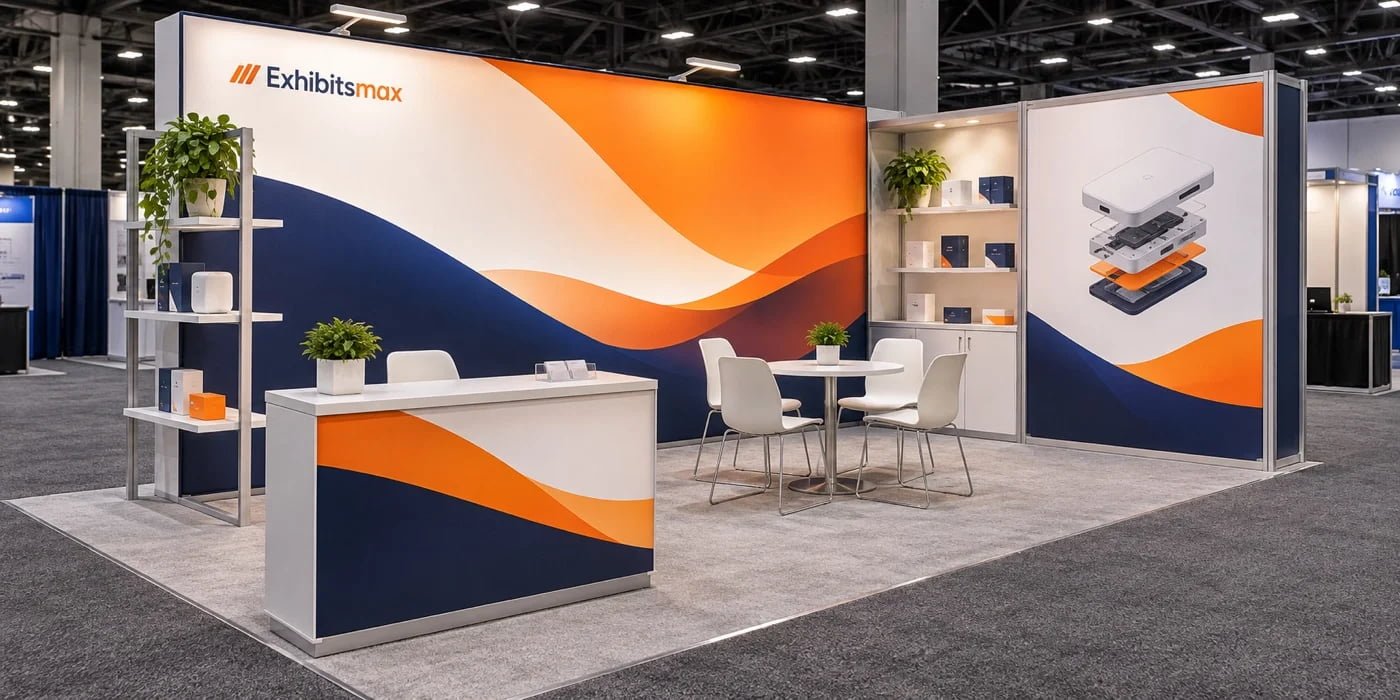
Choose trade show booth graphics around the display system, viewing distance, lighting and reuse plan. SEG fabric suits compatible tension frames; adhesive vinyl brands suitable surfaces; rigid panels provide mounted display faces. Compare the complete installed solution—not just the print price.
What Are Trade Show Booth Graphics?
Booth graphics include wall imagery, counter branding, product information, signs and other printed surfaces that help visitors understand your exhibit. Their placement should distinguish the main brand message from details intended for close viewing.
This guide compares three common options, not every available graphic system. SEG describes an edge-and-frame mounting method, vinyl describes a family of flexible media, and rigid panels describe a display format. They can overlap: adhesive vinyl, for example, may be applied to a rigid board.
Exhibitsmax’s trade show graphic printing services connect artwork review, material selection, production and finishing with the intended installation. Final specifications and services are confirmed in the project scope.
SEG Fabric vs. Vinyl vs. Rigid Panels: Comparison
| Option | Useful applications | What to confirm | Reuse and handling |
|---|---|---|---|
| SEG fabric | Tensioned graphic walls and compatible lightboxes | Frame channel, bead dimensions, template, fabric and lighting | Replacement graphics can retain the frame; follow the specified packing and care method |
| Adhesive vinyl | Counter wraps, approved wall surfaces and selected floor applications | Surface condition, adhesive compatibility, finish and removal requirements | Do not assume a removed graphic can be reapplied |
| Banner vinyl | Supported banners, signs and temporary branding | Attachment points, hems, tension and permitted placement | Reuse depends on condition, finishing and storage; protect against creasing |
| Rigid panels | Product information, mounted graphic faces and shaped signage | Substrate, thickness, joints, edge treatment and support | Protect faces and corners; allow for packing volume and replacement sections |
None of these options guarantees the lowest cost, fastest installation or sharpest image. Compare samples and the mounting plan for the actual application. For the underlying exhibit structure, see our trade show booth materials guide.
SEG Fabric Graphics: Benefits & Limitations
Silicone edge graphics use fabric finished with a perimeter bead that fits a compatible frame channel. Aluminum frames are common, but compatibility depends on the specified system. SEG does not require one particular printing process; the fabric and production method must suit the display.
A tensioned graphic can create a clean wall face and allow messaging to change while the frame remains in use. Confirm achievable panel size and seam placement rather than assuming every wall can be printed in one seamless piece.
- Fit: identify the frame model, measured opening, bead profile and printer’s template before artwork approval.
- Appearance: review fabric texture, opacity and printed detail at the intended viewing distance.
- Lighting: specify media intended for the actual illuminated or non-illuminated system.
- Care: keep the supplier’s cleaning, folding or rolling instructions with the graphic.
Orbus’s SEG requirements illustrate why frame measurements and bead specifications matter. Its fabric-care guidance also distinguishes washable and non-washable materials. Do not assume any SEG graphic can be machine-washed, steamed or tightly folded.
Vinyl Graphics: Adhesive vs. Banner
Adhesive vinyl
Adhesive vinyl is useful when the graphic needs to follow a compatible wall, counter or display face. Check the surface coating, texture, cleanliness and condition, along with the selected film’s application and removal requirements. Permission to cover rental components should be part of that review.
A removable adhesive label does not guarantee damage-free removal from every finish. Use the product instructions and a suitability test where needed. 3M’s substrate preparation bulletin explains the importance of matching graphic film to the receiving surface.
Banner vinyl
Banner vinyl needs a suitable support and finishing method, such as approved attachment points, pockets or hems. Plan tension, edge details and packing together. It may be reusable, but creasing, damaged edges or changes to the display can limit its useful life.
For either type, assess reflections under the planned lighting. A matte finish may help control glare, but proof the result. Floor applications require a purpose-specified graphic system and confirmation of the event’s surface, slip-resistance and removal requirements. Production availability must be checked before relying on an urgent replacement.
Rigid Panel Graphics: Materials & Applications
Rigid graphics can be printed directly on a board or produced by mounting a printed layer to it. Options include foam board, expanded PVC, aluminum composite and acrylic, with different grades, thicknesses and finishes.
They are useful for product information, display faces, dimensional branding and mounted wall graphics. Review the whole assembly: panel size, unsupported span, attachment method, edge finish and transport protection. A printed panel is not automatically a load-bearing wall or a suitable support for shelves, monitors or products.
Do not treat rigidity as a guarantee of perfect flatness or superior print detail. Large panels may need additional support, and image quality also depends on the artwork, surface, printing process and viewing conditions. Manufacturer information such as the SINTRA product specifications applies to defined products and gauges, not every board in a broad material category.
Coordinate panel divisions and attachments with custom booth fabrication before printing. A joint placed through a logo or a fastening point left out of the artwork can create avoidable rework.
How to Prepare Artwork for Trade Show Printing
Start with the printer-approved template for each graphic, rather than estimating print dimensions from the booth footprint. Connect the panel map to your trade show booth design so screens, shelves and counters do not hide essential messages.
| Check | What to approve before printing |
|---|---|
| Dimensions and scale | Finished size, visible area, units, file scale and panel orientation |
| Finishing allowances | Bleed, safe areas, seams, hems, SEG edges, cutouts and panel joints |
| Raster images | Effective resolution at final output size, judged against content and viewing distance |
| Logos and type | Vector assets where suitable; fonts outlined or supplied as requested |
| Color | Brand references, requested color workflow and proofing method for each medium |
| Files and version | Accepted format, linked assets, final copy, approval contact and version identifier |
| Readability and interaction | Text size, contrast, graphic obstructions and QR-code scanning at intended use distance |
There is no universal 100–150 DPI requirement for all large-format graphics. Raster-image resolution is normally discussed as pixels per inch at final size; printer output DPI is a different specification. Follow the actual production requirements, such as the system-specific instructions illustrated in Orbus’s artwork guidelines. Increasing a file’s resolution setting does not restore missing image detail.
A digital proof helps verify content and layout. For critical brand colors or backlit imagery, agree whether a physical sample is needed and how it will be evaluated under the intended lighting.
Backlit Graphics, Installation & Replacement
Backlighting is a separate design decision. SEG textiles, translucent films and selected rigid media can be used in appropriately specified illuminated systems. Match the graphic to the lightbox construction, light distribution and intended color appearance; a front-lit sample alone cannot establish the illuminated result.
Before packing, confirm panel identifiers, orientation, attachment details and any agreed fit check. Keep approved files and measurements available for replacements. The broader custom booth fabrication process explains where graphic integration and pre-show assembly connect with production.
Confirm material acceptance for the event
Fire-performance and documentation requirements depend on the venue, event and material use. Ask which certificates or test documentation apply to the specified material and installation. Do not treat “fire-rated” as a blanket approval for a finished display.
For a venue-specific example, the LVCC Facility Guide addresses flame-retardant certification or samples for testing in its Fire and Safety Exhibit Guidelines. Use that guidance for LVCC planning alongside the current event manual; confirm the applicable requirements separately for other venues.
What Affects Trade Show Graphics Costs?
Request a quote for the finished, installed scope. Printed area alone does not capture templates, proofs, sewing, lamination, mounting, protective packing or replacement work.
| Cost component | Why proposals can differ |
|---|---|
| Artwork and proofs | File corrections, design work, color samples and approval rounds |
| Media and print | Material specification, quantity, output size, ink process and illuminated use |
| Finishing and support | SEG sewing, hems, laminates, trimming, mounting, frames and attachments |
| Delivery and installation | Packing dimensions, freight, surface preparation, access and labor |
| Future shows | Storage, condition checks, replacement sections and updated artwork |
For reuse, compare initial graphics and hardware costs plus each show’s handling, fitting and refresh requirements. A replacement fabric face may reuse its frame; a branded counter may retain its structure but need a new wrap. Neither approach guarantees savings without the actual show calendar and scope.
Real Exhibitsmax Graphic Production Examples
The following project records include graphic production. Their photos demonstrate graphic placement and visual organization; they do not establish a specific substrate, ink process or SEG system.
Ultimate — PRINTING United 2023 — 20×40 — Atlanta
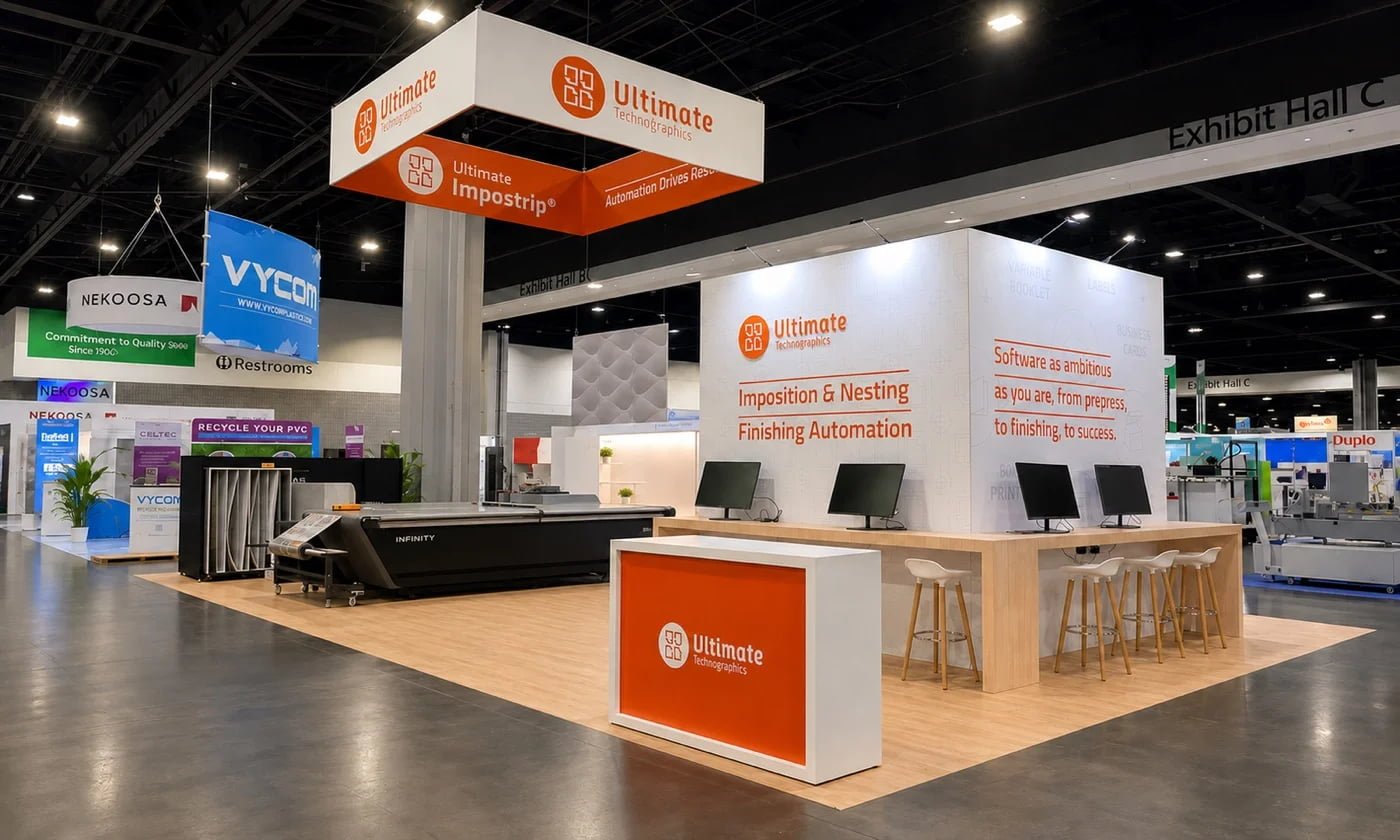
Ultimate combined overhead branding, a presentation wall, equipment displays and software demonstration areas. Graphics connected the larger brand identity with more detailed product information.
Design takeaway: assign a different job to each graphic level: recognition from the aisle, product context inside the booth and details near the demonstration. View the Ultimate project.
Klacci — ISC West 2024 — 20×30 — Las Vegas
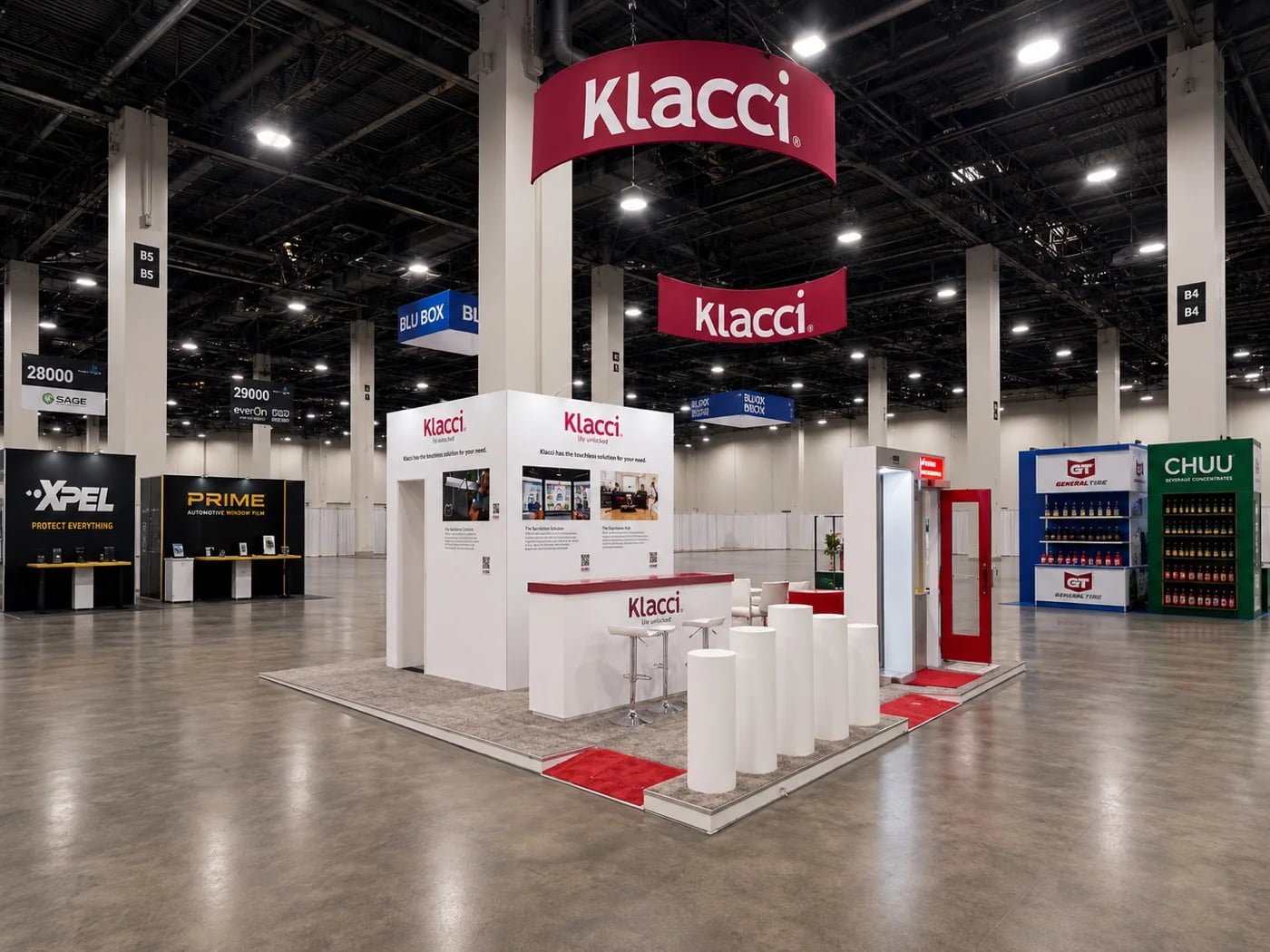
Klacci used red branding and white structures around door demonstrations, product pedestals, reception and meetings. The project record confirms graphic production as part of the exhibit scope.
Design takeaway: place the main brand message above the product interaction, then coordinate nearby information with the demonstration clearances. View the Klacci project.
ZIG·ZAG — NACS Show 2021 — 20×20 — Chicago
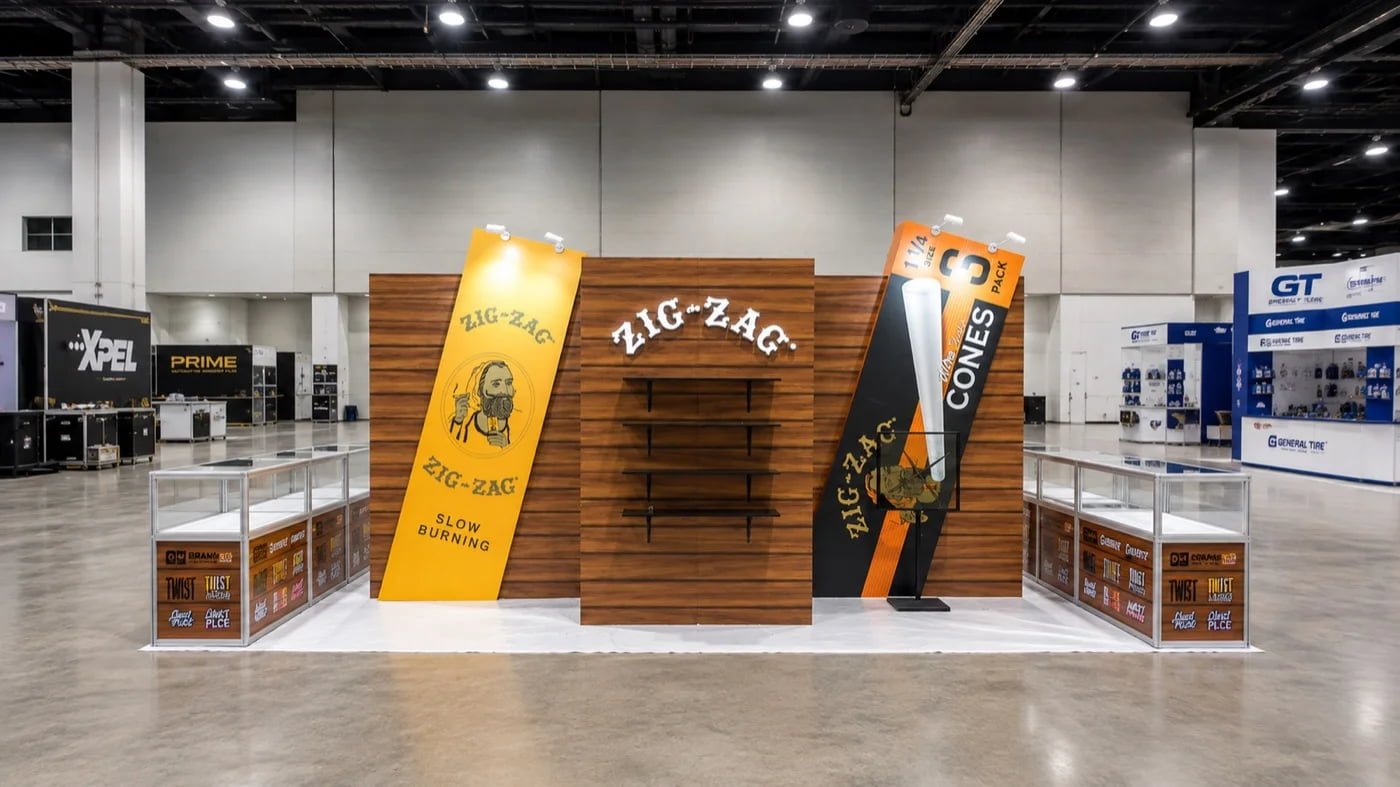
ZIG·ZAG’s booth gave several retail brands distinct visual areas through yellow ZIG·ZAG graphics, the Stoker’s presentation and a red FRĒ panel, connected by shelving and counters.
Design takeaway: agree on the graphic boundaries between brands before production, then check how shelves and products affect the visible message. View the ZIG·ZAG project.
Frequently Asked Questions
Can one booth combine SEG fabric, vinyl and rigid panels?
Yes. Specify each graphic around its function and support system. Review adjoining colors, finishes and image scale together so different media form a consistent exhibit.
Can I print replacement SEG graphics for an existing frame?
Often, provided the printer has the correct frame identification, measurements and edge specifications. Confirm the production template and whether a sample or fit check is needed; the booth’s advertised dimensions alone are insufficient.
Can SEG fabric graphics be washed?
Only when the supplier’s instructions permit it for that particular fabric and print. Cleaning and storage methods differ; for example, 40 VISUALS’ care instructions distinguish UV SEG care from other fabric care. Keep those instructions with the stored graphic.
How early should graphics be ordered?
Work backward from the required delivery and installation dates. Allow for template confirmation, artwork corrections, proof approval, printing, finishing, fit checks and transport. Confirm the schedule with the printer rather than relying on a general overnight or multi-week promise.
Should international exhibitors print locally or ship graphics to the U.S.?
Compare total delivered cost, frame compatibility, proofing access and shipping risk. Local production can simplify coordination with a U.S. booth builder; overseas production can also work when specifications and delivery are confirmed. In either case, keep approved files accessible and confirm replacement options before shipping.
Get a Free Booth Design & Graphics Quote
Send Exhibitsmax your show name, booth design, graphic dimensions, display-system details, artwork status and required delivery date. Our Las Vegas team can review the graphics and booth production scope together.