How to Choose a Trade Show Booth Builder: A Practical Evaluation Guide
Choosing a trade show booth builder is not simply a design decision or a price comparison. The right choice depends on whether the builder can deliver the agreed scope for your specific show, booth footprint, venue, timeline, and budget.
Start by comparing every shortlisted builder against the same project brief. A lower proposal total is only useful when the structure, graphics, freight, labor, show services, and project-management responsibilities are equally clear.
Booth Builder Evaluation at a Glance
| What to evaluate | What to verify | Why it matters |
|---|---|---|
| Similar finished projects | Comparable booth size, industry, venue, and complexity | A rendering alone does not prove build and installation capability. |
| Scope transparency | Inclusions, exclusions, allowances, and client responsibilities | Prevents two proposals with different scopes from appearing comparable. |
| Design-to-build process | Drawings, engineering needs, material choices, and approvals | Helps connect the concept to a buildable exhibit. |
| Project management | Named owner, timeline, approvals, and change control | Creates accountability before, during, and after the show. |
| Venue and show readiness | Current exhibitor manual, booth type, hall, and official providers | Requirements vary by show and cannot be copied from another event. |
| Logistics and I&D | Freight plan, receiving, labor, move-in, and move-out | These details can affect schedule, risk, and total cost. |
| Documentation | Insurance, safety documents, and required submissions | Keeps administrative requirements visible before deadlines. |
Start with One Comparable Project Brief
Before asking for proposals, give every builder the same baseline information. This is the simplest way to make an apples-to-apples comparison.
- Show name, venue, city, dates, assigned hall, and booth number if available
- Booth size, booth type, floor plan, and height limits
- Target budget and decision deadline
- Brand guidelines, product dimensions, meetings, demos, storage, hospitality, and lead-capture needs
- Graphics, furniture, lighting, AV, LED, electrical, or rigging requirements
- Shipping origin, reusable components, and post-show storage plans
- Whether installation and dismantling, freight, and show services are needed
If the booth number or current floor plan is not yet available, state that clearly. A qualified builder should identify which decisions can proceed and which details must be confirmed once the show documents are issued.
How Should You Compare Booth Builder Proposals?
Do not compare proposal totals alone. First compare the scope line by line.
| Scope item | Questions to ask every builder |
|---|---|
| Design | How many concepts and revisions are included? Is a 3D rendering included? |
| Structure and fabrication | What is being built, rented, reused, or outsourced? |
| Graphics | Which panels, sizes, finishes, artwork deadlines, and installation steps are included? |
| Furniture and AV | Are models, quantities, power, setup, and removal responsibilities specified? |
| Freight and material handling | Who packs, ships, receives, and coordinates freight with the show? |
| I&D labor | Is installation and dismantling included? What work is handled by the builder, venue, or official contractor? |
| Show services | Which electrical, internet, rigging, cleaning, or other orders remain separate? |
| Project management | Who owns the schedule, approvals, onsite handoff, and change orders? |
For a fuller budget framework, see How Much Does It Cost to Produce a Trade Show Booth? and Hidden Trade Show Booth Costs Exhibitors Should Know.
A useful proposal should name both inclusions and exclusions. It should also distinguish a builder's scope from venue or show services that must be ordered separately. This is especially important when comparing rental, custom, and hybrid options.
What Proof Should a Booth Builder Be Able to Show?
Ask for evidence that is specific to the project you are considering. The most useful proof is usually a finished project of a similar size or complexity, supported by a clear description of the delivered scope.
Look for:
- Finished project photos, not only 3D renderings
- Comparable booth footprints and booth types
- Examples of graphics, product displays, meeting spaces, AV, or hanging signs when relevant
- A clear explanation of who handled design, fabrication, logistics, and I&D
- Current examples of venue or show experience where it is relevant to your project
- A documented process for artwork, approvals, pre-build review, packing, and move-out
Published Exhibitsmax Project Examples
The following published projects are provided as transparent examples of the type of evidence a builder should be able to show. They are not a substitute for matching a proposed scope to your own project.
- CES 2024 20×30 Booth for MAY in Las Vegas — a published Las Vegas Convention Center project describing turnkey design, custom fabrication, and project management for a 20×30 custom booth.
- SEMA 2024 20×50 Booth for GTECHNIQ in Las Vegas — a published 20×50 custom-booth project with a large branded exhibit environment.
- MINExpo 2024 10×30 Booth for RTDrill in Las Vegas — a published 10×30 custom-booth project for an industrial product presentation.
When reviewing any portfolio, ask which images show the finished booth, whether the project is comparable to your footprint, and what parts of the scope the builder actually delivered.
Is the Builder a Fabricator, a Broker, or a Hybrid Provider?
There is no universal answer. A specialist design firm, a local fabricator, a rental supplier, or a hybrid provider can all be appropriate when the scope and responsibilities are clear.
Ask direct questions:
- Who will produce the structural components and graphics?
- Is fabrication performed in-house, through a partner, or both?
- Who will be the day-to-day project owner?
- Who is responsible for packing, freight coordination, and onsite labor?
- Which items are subcontracted, and how is quality checked before move-in?
- Can the builder show finished work that reflects the proposed approach?
The goal is not to require one business model. The goal is to understand accountability before the project starts.
How Do Venue, Show, and Labor Requirements Affect the Decision?
A booth builder should not apply rules from one event to another. Labor jurisdiction, exhibitor self-work allowances, electrical, rigging, material handling, fire-safety requirements, and I&D procedures can vary by city, venue, show, assigned contractor, booth type, and current exhibitor manual.
For every project, confirm the current show documents and the assigned hall before finalizing design, production, freight, or labor plans. Ask the builder how they will verify:
- Booth configuration, height, and signage requirements
- Applicable flame-resistance, fire-safety, structural, and documentation requirements for the materials and booth configuration
- Electrical, internet, rigging, and AV responsibilities
- Freight receiving, material handling, and move-in procedures
- Installation, dismantling, move-out, and outbound-carrier instructions
Venue familiarity can be useful, but current documentation matters more than a generic claim of venue experience. For Las Vegas projects, see the Las Vegas Convention Center Booth Planning Guide and the Mandalay Bay Trade Show Booth Setup Guide.
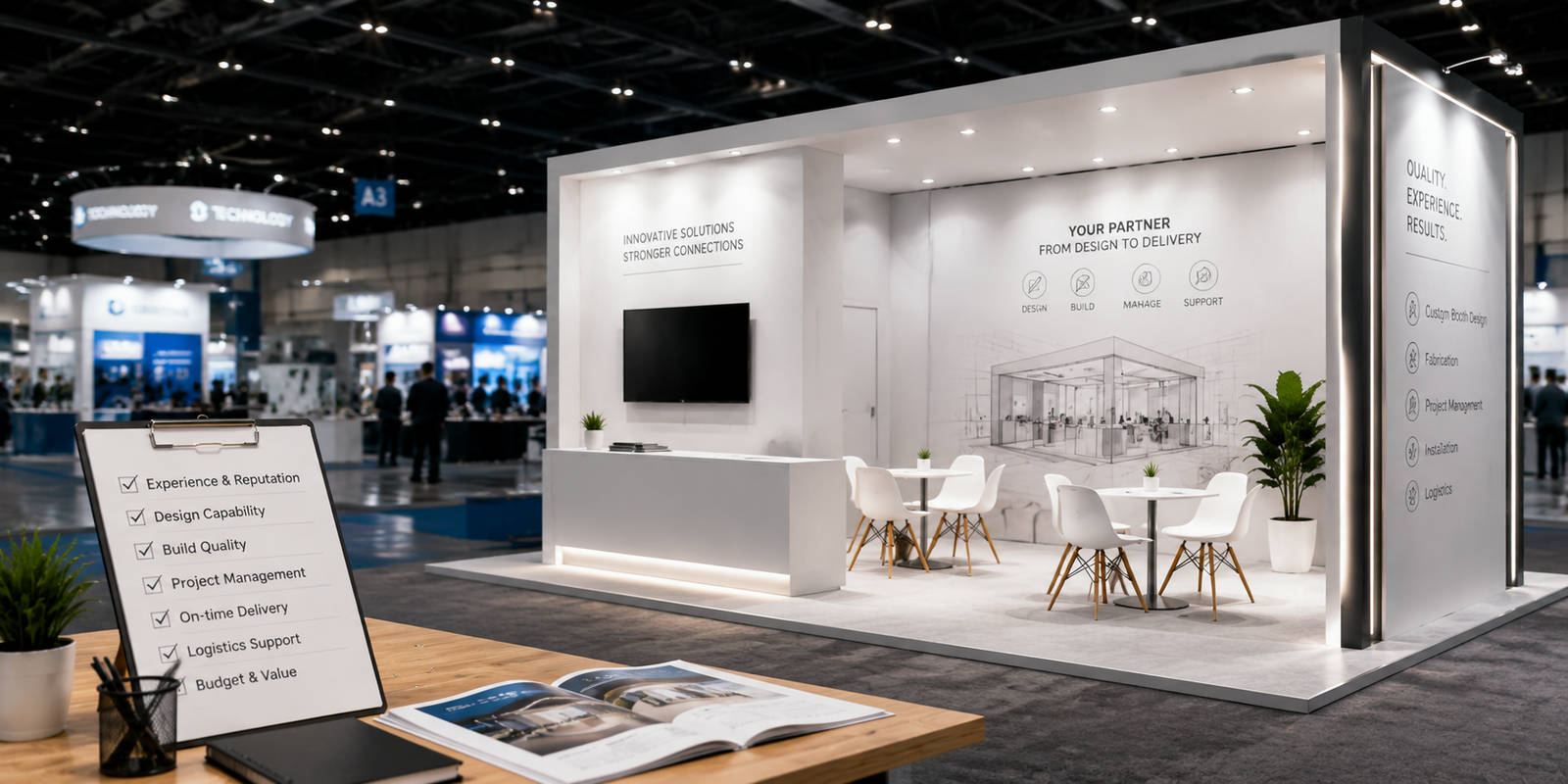
Booth Builder Evaluation Scorecard
Use the same scorecard for each shortlisted builder. Score the evidence you can verify, then discuss any major gaps before comparing the proposal total.
| Evaluation area | Points | What a strong answer looks like |
|---|---|---|
| Similar finished projects | 20 | Relevant completed work with clear scope and finished photos |
| Scope transparency | 20 | Specific inclusions, exclusions, assumptions, and responsibilities |
| Design-to-build capability | 15 | A process that connects design, engineering needs, materials, and production |
| Project management | 15 | Named owner, timeline, approvals, change control, and onsite handoff |
| Venue and show readiness | 10 | Uses the current exhibitor manual and verifies event-specific requirements |
| Logistics and I&D coordination | 10 | Clear freight, receiving, labor, move-in, and move-out approach |
| Communication | 5 | Timely, precise responses and a practical next-step list |
| Insurance and documentation | 5 | Will provide required documents and explain submission responsibilities |
| Total | 100 | Compare the same criteria for every builder |
A high score does not replace a commercial review. It does give procurement, marketing, and operations teams a shared way to compare risk, scope, and delivery readiness.
What Capabilities Should You Compare?
Comprehensive service can reduce handoffs, but it is not automatically the best choice for every exhibitor. Compare the capabilities that matter for your program and identify where the responsibilities sit.
| Capability | Why it matters | Related Exhibitsmax service |
|---|---|---|
| Booth design and 3D visualization | Aligns the concept with the footprint, brand, and visitor journey | Trade Show Booth Design and 3D Visualization & Concept Design |
| Custom fabrication or rental | Determines ownership, reuse, flexibility, and architectural options | Custom Booth Fabrication and Trade Show Booth Rental |
| Graphics | Connects approved artwork to production and installation | Graphic Printing |
| Freight and storage | Supports timing, packing, reuse, and post-show decisions | Exhibit Transportation and Exhibit Storage |
| Installation and dismantling | Connects labor planning to the freight and venue schedule | Installation & Dismantling |
| Project management | Keeps design, production, approvals, logistics, and onsite execution connected | Trade Show Project Management |
How Do You Evaluate Project Management and Communication?
A proposal should make the working process understandable before you sign. Ask each builder to explain the milestones, decision owners, and dependencies from brief to move-out.
A practical project-management plan normally identifies:
- The primary project contact and escalation path
- Design, artwork, and quote approval deadlines
- Current exhibitor-manual and show-service review
- Fabrication, graphics, pre-build, packing, and freight checkpoints
- Who places or coordinates show-service orders
- Move-in labor timing, onsite handoff, and issue resolution
- Change-order approval process and post-show storage or return plan
The quality of a builder's early questions is often useful evidence. A builder who asks about the floor plan, product requirements, show dates, budget, and logistics is working to define a deliverable scope rather than pricing a generic rendering.
Red Flags When Choosing a Booth Builder
A red flag is not necessarily an automatic rejection, but it should lead to a specific follow-up question.
- A proposal total with no itemized scope, assumptions, or exclusions
- Only renderings, with no relevant finished-project evidence
- A promise that venue or labor rules are already known without reviewing the current manual
- Vague answers about who fabricates, manages, ships, or installs the booth
- No named project owner or unclear communication path
- Unexplained changes to materials, lead time, or pricing after approval
- No plan for graphics proofing, freight receiving, move-out, or storage
- Pressure to approve before the scope, responsibilities, and timeline are understood
How Early Should You Start?
The right timeline depends on the show, booth type, venue, and scope. A simple rental booth may be workable within a shorter window when requirements are clear. Custom booths, island exhibits, international freight, hanging signs, major product displays, and AV-heavy programs should begin substantially earlier, often several months before the show.
Use How Early Should You Start Planning a Trade Show Booth? to match the planning window to your project rather than applying one schedule to every booth.
Frequently Asked Questions
How should I compare two booth builder proposals with different scopes?
Create one comparison sheet and list design, structure, graphics, furniture, AV, freight, material handling, I&D, show services, project management, storage, and exclusions. Ask both builders to identify what is included, optional, client-supplied, or ordered through the show before comparing totals.
How can I tell whether a booth builder can actually deliver the design?
Ask for finished photos and comparable completed projects, then confirm the builder's role in design, fabrication, graphics, logistics, and installation. A builder should be able to explain how the proposed structure will be produced and checked before move-in.
What should I budget for an exhibition booth?
Budgets vary by size, build type, materials, graphics, AV, freight, I&D, and show services. Compare proposals using the same scope instead of relying on a single per-square-foot figure. See How Much Does It Cost to Produce a Trade Show Booth? for a broader cost framework.
Can a booth builder help with international shipping?
Many can coordinate elements of international and domestic freight, but responsibilities, deadlines, customs documentation, delivery location, and material handling should be defined in writing. Confirm which party owns each step before freight is booked.
What are common red flags when selecting a booth builder?
Watch for incomplete scope, unverified portfolio claims, generic rule statements, unclear subcontractor responsibilities, missing project ownership, and a lack of a documented timeline. Ask for clarification before approving a deposit or production start.
Comparing Booth Builders for an Upcoming Show?
Send Exhibitsmax your show name, booth size, floor plan, target budget, design requirements, and any current proposal scope. Our team can review the project requirements and help identify the design, fabrication, logistics, and I&D details that should be confirmed before you choose a builder.