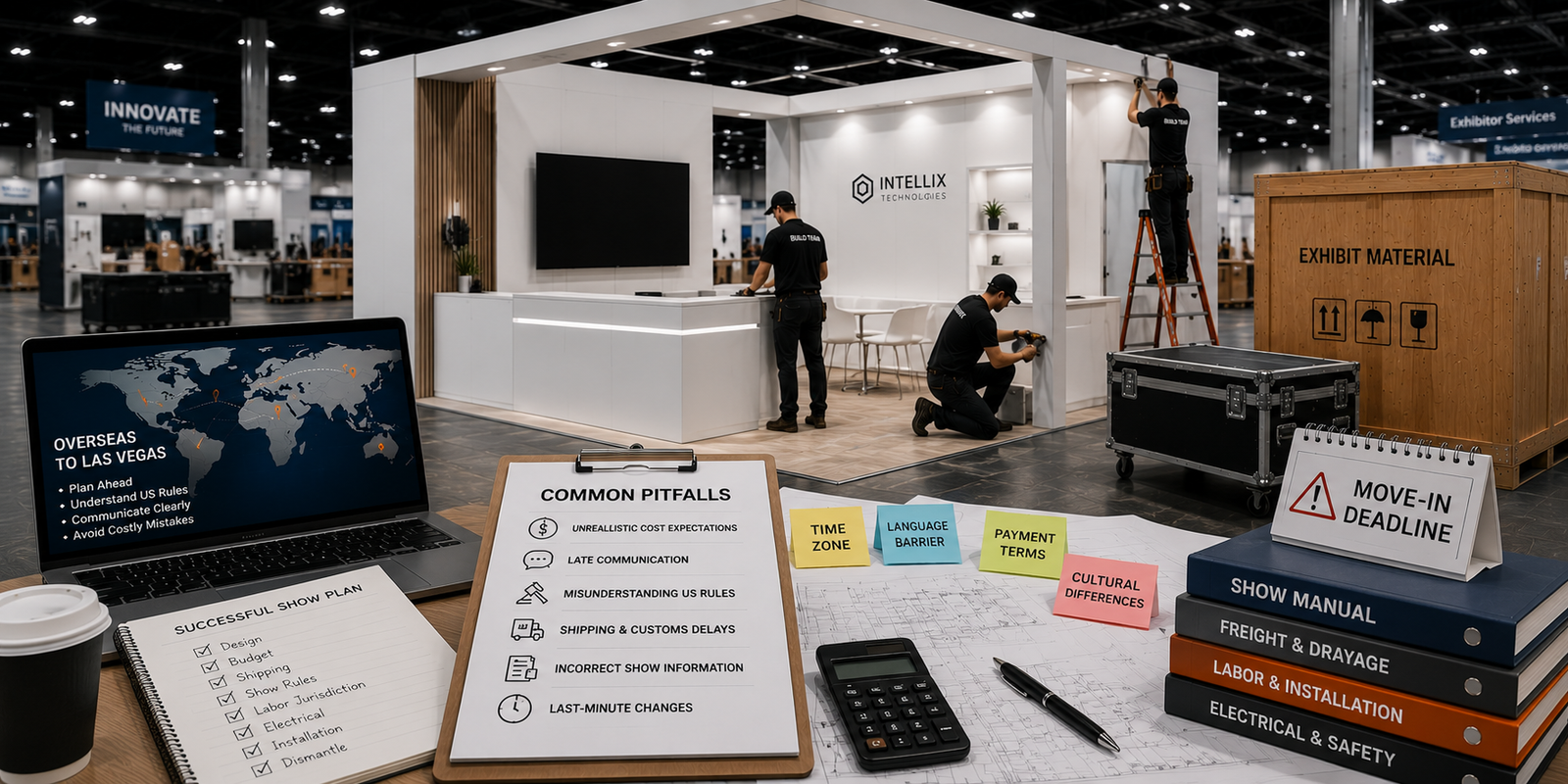
When overseas exhibitors work with US booth builders for the first time, they often expect the same process they know from shows in Europe or Asia. That assumption leads to sticker shock, delayed installations, and contractual friction. I have managed dozens of these projects directly, and the pattern repeats every single year. The good news is that every pitfall is avoidable with the right preparation.
The most common pitfalls for overseas exhibitors working with US booth builders are underestimated union labor costs, unfamiliar payment schedules, and contract terms that differ from international norms. Budget for US-specific fees, read every clause carefully, clarify intellectual property ownership, and choose a builder with proven experience guiding international clients. Preparation eliminates most costly surprises.
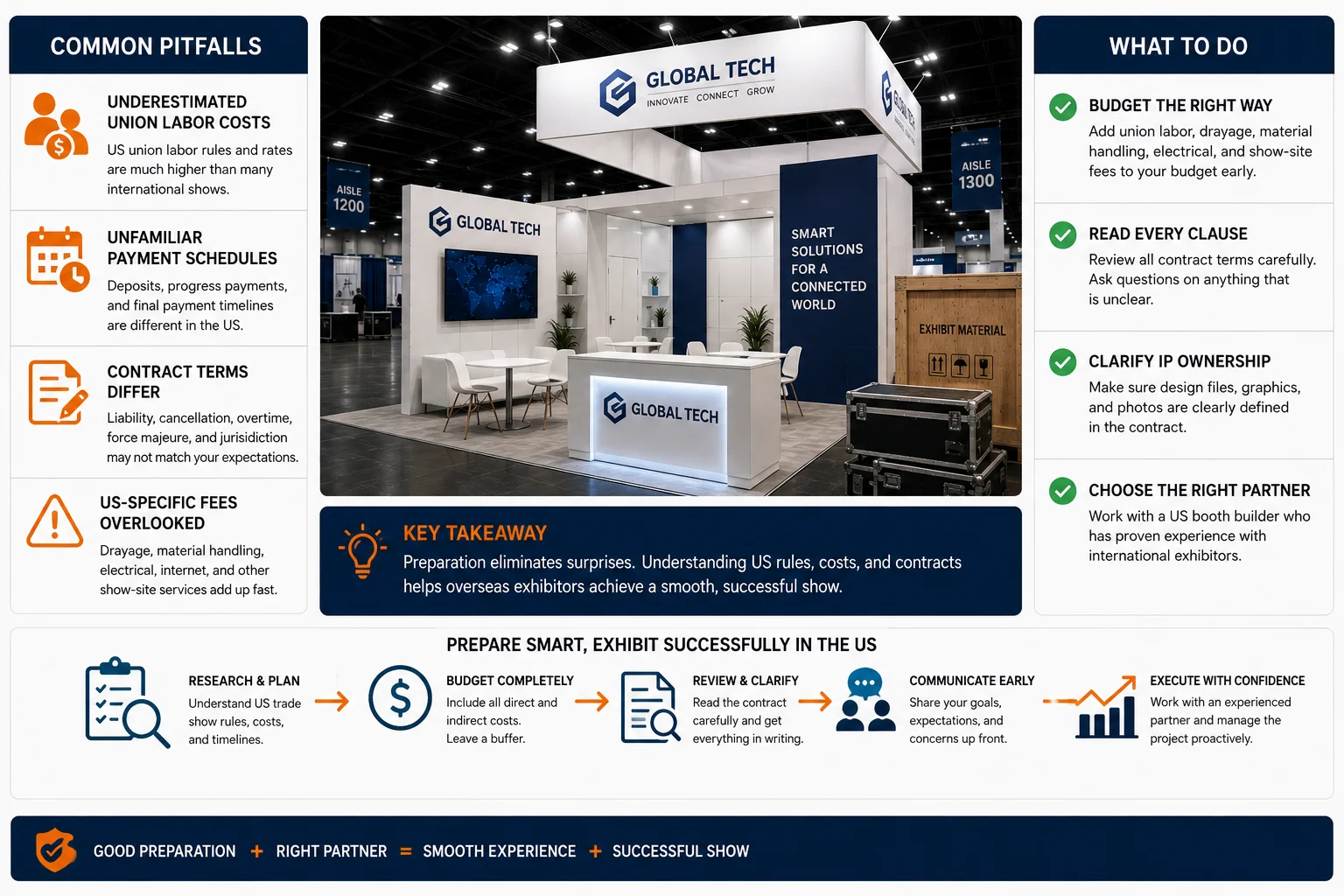
The learning curve is real, but it is manageable. Below, I break down the specific pitfalls I have witnessed in my own practice, and I explain exactly how to sidestep them. Each section tackles one problem area, so you can use this article as a reference throughout your entire planning cycle.
Why do US booth builders cost more than overseas exhibitors expect?
Almost every first-time client I have guided prepares a budget based on their home market. Within two weeks, that budget is obsolete. The US exhibition industry operates under its own cost structure, and the gap surprises even experienced exhibitors from Germany, China, or the United Arab Emirates.
US booth builders appear more expensive because their quoted price rarely covers the full installed cost. Union labor, venue service fees, and drayage are billed separately by the hall or by specialized contractors. A complete budget must include these line items, or your final invoice will land 30–50% above the quote.
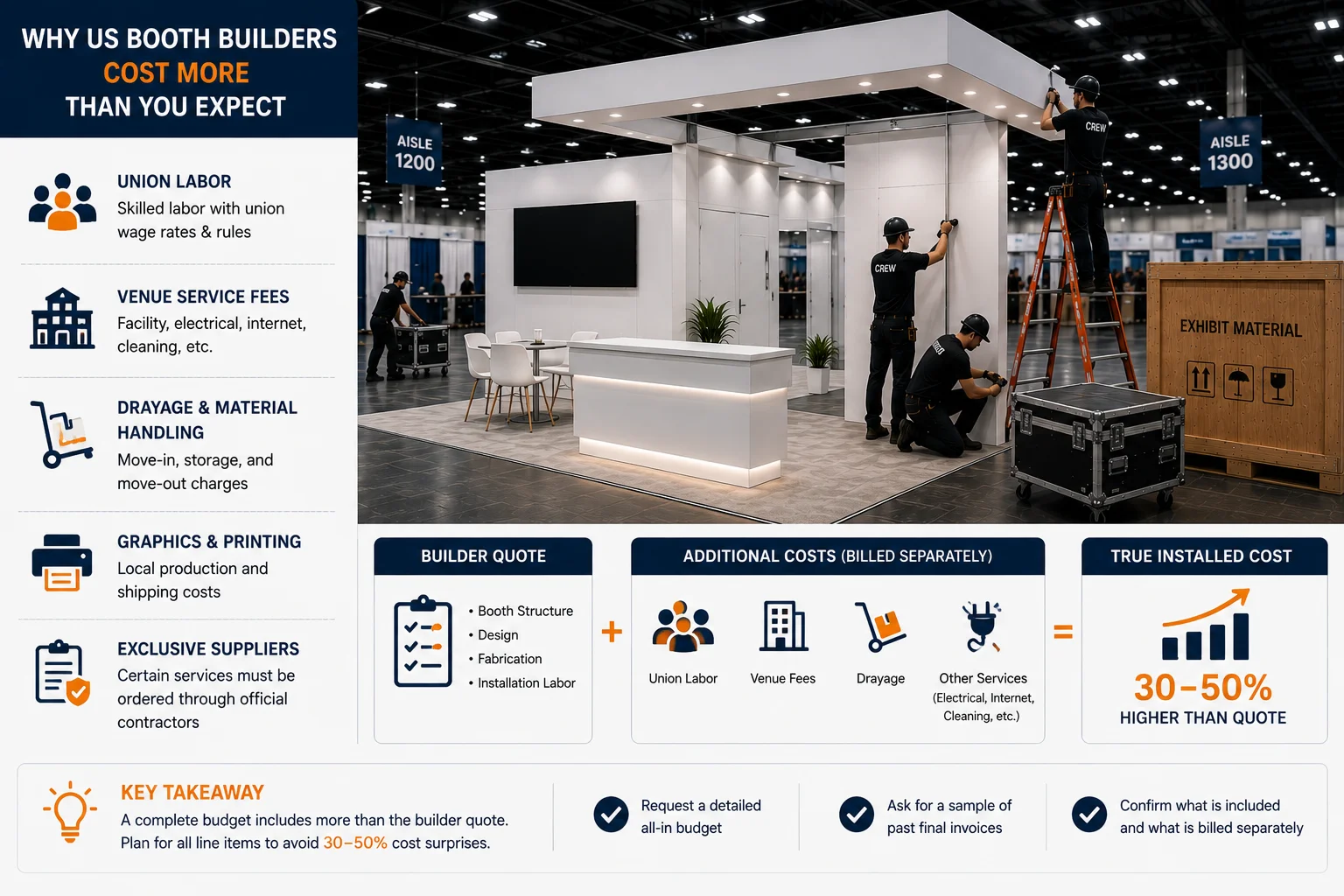
A client from South Korea once asked me why his two-story booth cost 40% more in Las Vegas than the identical design in Seoul. The answer was not inflated pricing. It was the ecosystem.
Union labor is a legitimate line item, not a markup
In major US convention cities—Las Vegas, Chicago, Orlando, New York—union rules govern who can touch what on the show floor.1 Electricians wire the power. Carpenters assemble the structure. Riggers handle anything suspended overhead. Teamsters move materials from the dock to the booth. You cannot hand your portable display to a colleague and set it up yourself in most large venues.2 The jurisdiction rules are enforced at the loading dock. In my experience, overseas exhibitors underestimate these labor costs by 30–50%.
Venue service fees add up quickly
Beyond labor, the venue charges for services you may take for granted at home:
- Electricity and internet access
- Material handling (the official drayage fee for moving crates from dock to booth)
- Cleaning and waste removal
- Lead retrieval systems
- Water, compressed air, and drainage
A typical 10×10 booth might carry $1,500–$3,000 in venue fees.3 A 20×20 booth with power and lead retrieval can reach $6,000–$10,000 before your builder even begins.
The fragmented supplier model
In many countries, one contractor handles everything. In the US, your booth builder often subcontracts electrical, flooring, and rental furniture. Each subcontractor invoices separately. That multiplies administrative overhead and adds coordination risk.
| Cost item | Typical expectation overseas | US reality |
|---|---|---|
| Installation labor | Included in build quote | Separate union labor invoice |
| Electricity | Included | Venue charge per outlet |
| Material handling | Included | Drayage fee based on crate weight |
| Project management | Included | Often billed as a percentage |
| Overtime | Rare | Common on tight timelines |
The solution is simple: ask your US booth builder for a line-item budget that includes union labor estimates and venue fees. If they cannot provide one, treat that as a red flag.
How do US union rules affect your booth installation and budget?
Union rules sound intimidating, especially if your show is in Las Vegas or Chicago. But fear comes from ignorance. I have watched experienced clients panic, and I have watched first-timers adapt quickly. The difference is preparation and clear communication.
US union rules affect booth installation by assigning specific trades to specific tasks and by charging premium overtime rates outside standard hall hours. These rules raise costs but also guarantee skilled, insured labor. Work with a builder who knows the local unions and can schedule installation to avoid overtime charges.
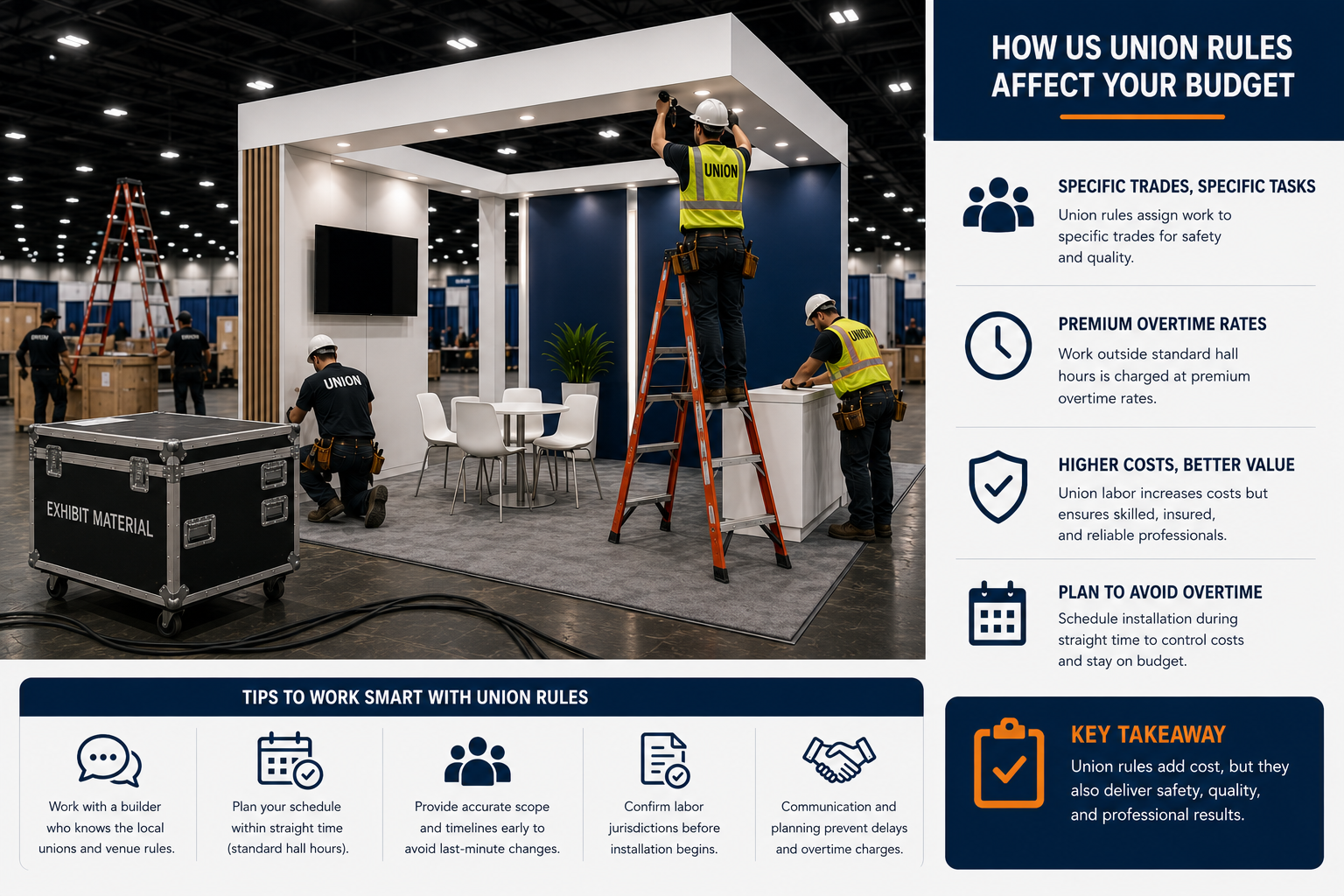
Union rules vary by city and by venue. Las Vegas operates under a well-defined jurisdiction agreement. What applies there may differ in Orlando or Dallas. The key is not to memorize every rule—your builder should do that—but to understand the cost implications.
Jurisdiction determines who does what
In most major halls, the breakdown looks like this:
- Carpenters handle structural assembly, counters, and hard walls.
- Electricians handle all power connections and lighting circuits.
- Riggers handle signage and structures suspended from the ceiling.
- Teamsters transport crates from the dock to your booth.
- Laborers or decorators handle carpet, basic cleaning, and utility connections.
If your overseas crew arrives with drills and ladders, they will likely not use them. US venue safety rules and union agreements restrict who can perform certain tasks on the show floor.
Overtime is where budgets bleed
The single biggest cost driver I have seen is overtime. Most halls operate on a standard workday, often 8:00 AM to 4:30 PM. Labor rates jump by 50% for the first two overtime hours and double beyond that.4
Here is the order of my advice:
- Confirm the hall's "straight time" hours before scheduling installation.
- Ask your builder for a schedule that completes the build within straight time.
- Budget an overtime contingency of 10–15% anyway.
- Never schedule your crew to "help" the union labor. It creates friction and costs you money.
Union rules are not your enemy
View union labor as a predictable part of doing business in the US, not as an unreasonable charge. These rules ensure safety, reliability, and professional results. The clients who get burned are the ones who ignore the rules, hire cheap non-union labor from outside the hall, or attempt the work themselves. Every one of those shortcuts ends with steep fines or a shut-down booth.
What contract terms should overseas exhibitors review with US booth builders?
I have reviewed exhibition contracts in six languages, and the problematic clauses are always the same. Overseas exhibitors sign them because they look standard. Then a dispute arises, and the exhibitor discovers they agreed to terms they never intended.
The contract terms that cause the most trouble for overseas exhibitors are the payment schedule, intellectual property ownership, force majeure, and governing law clauses. Read them carefully and negotiate changes in writing before signing. In a US court, verbal promises carry little weight.
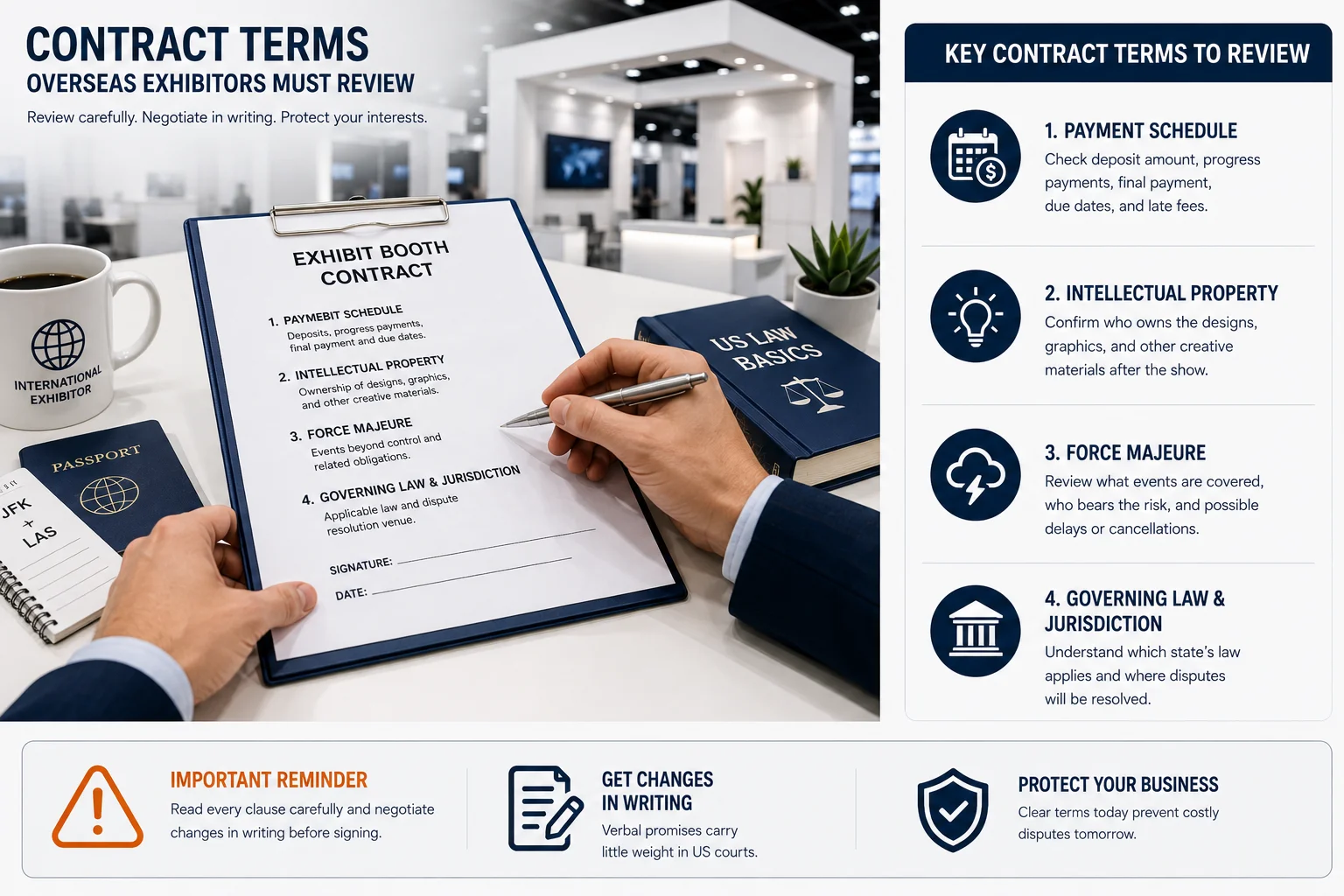
Contracts between an overseas exhibitor and a US booth builder are governed by state law, and they are enforceable regardless of where you sit when you sign. I typically advise clients to scrutinize six clauses.
Payment schedules
Many US builders request a 30–50% deposit to start design and fabrication, a mid-point payment for material approval, and final payment before or at delivery. Some overseas clients expect to pay 100% after the show, which is common in certain Asian markets. That mismatch creates friction.
My advice: agree on a schedule tied to verifiable milestones.
- 30% when you approve the design
- 40% when fabrication begins
- 30% after installation is complete
If a builder demands most of the fee upfront, ask why. Established companies have working credit lines. New or unstable companies need your cash to operate.
Intellectual property ownership
Your booth design is an asset. Your product presentation concept has commercial value. Yet many contracts state, quietly, that the builder owns the design files and any original graphics. If you plan to reuse the design at another show or move it to a different city, that clause matters.
Negotiate this language explicitly: "All design files, engineering drawings, and graphic artwork become the property of the client upon final payment." I have seen clients locked out of their own booth designs because they skipped this single sentence.
Force majeure and show cancellation
COVID-era cancellations taught everyone to read these clauses. Does the contract address show cancellation? Do you receive a partial refund if the venue closes? What happens if the builder completes your booth but the show cancels? Clarify these scenarios in writing before you send a deposit.
Governing law and dispute resolution
If your contract says "This agreement is governed by the laws of the State of Nevada," you are agreeing to litigate there. As an international exhibitor, that is expensive. Negotiate for mediation or arbitration in a neutral venue, and consider a clause requiring both parties to attempt good-faith negotiation before legal action.
How can communication style differences derail your US booth builder relationship?
An email that sounds clear in Shanghai may sound aggressive in Texas. A silence that means "I am thinking" in Tokyo may mean "I agree" in New York. Cultural communication differences are not a soft topic. They are the root cause of most project failures I have handled.
Communication style differences derail projects when overseas exhibitors assume their builder is ignoring them, or when builders misunderstand indirect feedback. Set a fixed meeting cadence, use written approvals for every decision, and assign a single point of contact on each side.
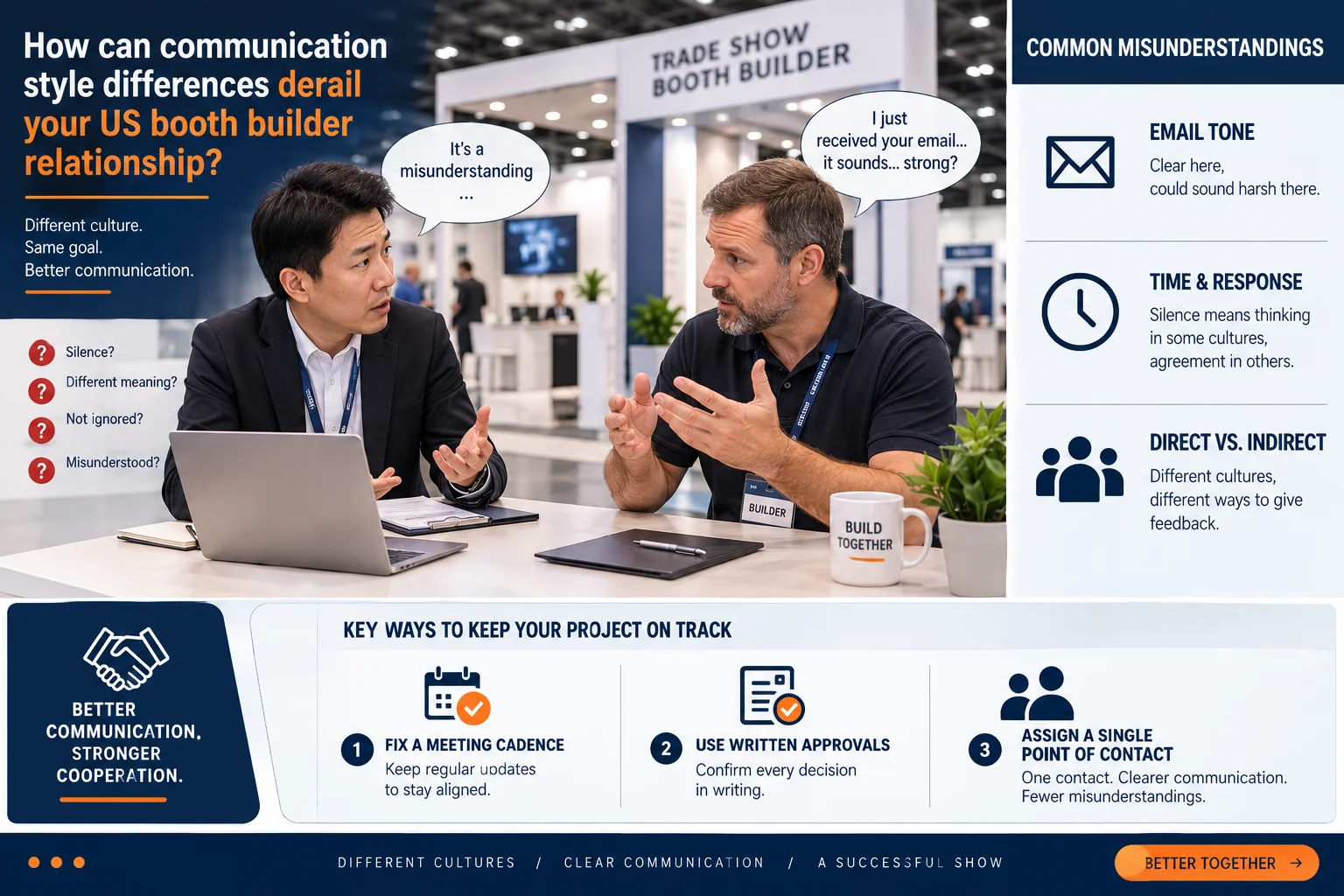
Let me give you a concrete scenario. I once managed a project where a European client sent a strongly worded email criticizing the design. The builder's project manager interpreted it as an intention to cancel and slowed all work. In Europe, the tone was normal. In the US, it came across as hostility.
The directness gap
American business communication is generally direct, but with a layer of friendliness that can confuse outsiders.5 When an American says "That's a great point," they often mean "I heard you," not "I agree with you." Conversely, exhibitors from high-context cultures may soften negative feedback to avoid confrontation. The builder then delivers an approved design that the client actually disliked.
The solution is structure, not nuance. Do not rely on reading between the lines.
Structured communication I recommend to every client
- Weekly video calls at a fixed time, regardless of whether there is news. Silence is a signal.
- Written minutes distributed within 24 hours, listing decisions and action items.
- Formal change orders for anything that alters the original scope. Verbal tweaks passed over email get lost.
- One point of contact per side so that instructions never contradict each other.
Time zones and deadlines
The US spans four continental time zones.6 If your builder is on the West Coast and you are in Germany, the overlap window is small. I recommend scheduling calls in the morning for the US builder and evening for the client. Treat a 24-hour response time as reasonable. Unrealistic expectations cause frustration and unnecessary escalation.
The takeaway: communication breakdowns are not cultural failures. They are planning failures. Build the communication infrastructure into your project plan, just as you would schedule fabrication and shipping.
What should you look for when selecting a US booth builder?
Overseas exhibitors often choose a builder based on a beautiful portfolio or the lowest quote. I understand the instinct. But the best-looking booth in the world will fail if your builder cannot navigate union rules, venue logistics, and international coordination.
When selecting a US booth builder, prioritize proven experience with overseas clients, strong project management, and transparent line-item pricing over design aesthetics alone. Ask for references from international exhibitors, verify their show-floor track record, and confirm they offer full-service logistics from installation to dismantling.
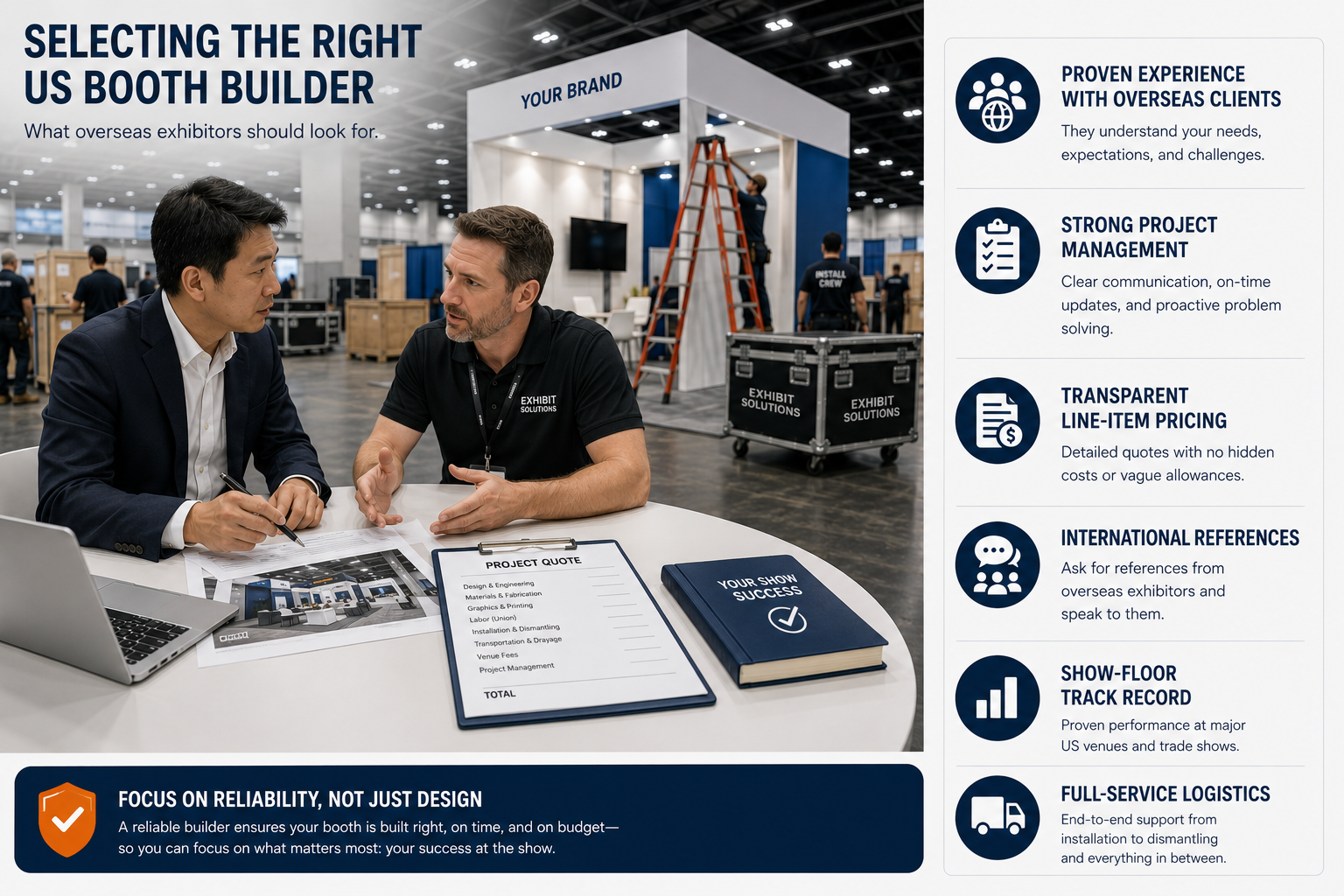
US booth builders are not a monolith. The industry ranges from one-person design studios to full-service manufacturing companies with in-house fabrication shops. Your selection criteria should match your needs, but I recommend screening for five qualities.
1. Verified experience with overseas clients
Ask directly: "How many international clients have you managed in the past two years?" A builder who has guided German, Japanese, or Brazilian exhibitors understands visa timelines, shipping delays, currency considerations, and the anxiety of managing a project from another time zone. Ask for a reference call with a past international client.
2. Full-service capability
Some builders only design and fabricate. The onsite installation is handled by a separate general contractor. That arrangement can work, but it multiplies risk. A builder who offers installation, dismantling, storage, and project management under one roof has single-point accountability. If anything goes wrong, you know exactly who to call.
3. Transparency about what is not included
The line-item budget test I mentioned earlier matters. A reliable builder lists:
- Design and engineering fees
- Fabrication and materials
- Graphics production
- Shipping and drayage
- Union labor estimates
- Venue services
- On-site project management
- Dismantling and disposal
If a quote arrives as one lump sum with no breakdown, ask more questions before signing.
4. Local knowledge at your specific venue
Las Vegas is not Chicago. Union jurisdiction rules differ, and booth height requirements depend on each venue's line-of-sight rules. Choose a builder who has installed at your exact show before. They will know the Show Director's expectations, the local fire marshal's preferences, and the quirks of the loading dock.
5. A fair yet protective contract
You want a builder who is willing to negotiate reasonable terms. A builder who insists on non-negotiable payment terms or refuses to discuss IP ownership is a warning sign. You also want a builder who protects themselves. That balance indicates an experienced professional, not a desperate salesperson.
Evaluation checklist
| Criterion | Good sign | Red flag |
|---|---|---|
| Overseas experience | Can name 3+ international clients | "We can handle it" without specifics |
| Pricing | Line-item budget with notes | One lump sum, no breakdown |
| Services | Design, fabrication, installation in-house | Outsources everything |
| Contract | Open to negotiation, clear IP clause | Take-it-or-leave-it language |
| References | Willing to provide international contacts | No references offered |
How early should overseas exhibitors start planning?
The most heartbreaking email I receive is the one that says: "Our show is in six weeks. Can you build our booth?" The answer is often yes, but the costs are higher, the options are narrower, and the risks of failure multiply. Timing is the one factor that is entirely in your control.
Overseas exhibitors should start planning with a US booth builder at least 4–6 months before the show, and ideally 6–9 months ahead. That timeline allows for design approvals, fabrication, international shipping, customs clearance, and a realistic installation schedule without overtime premiums.
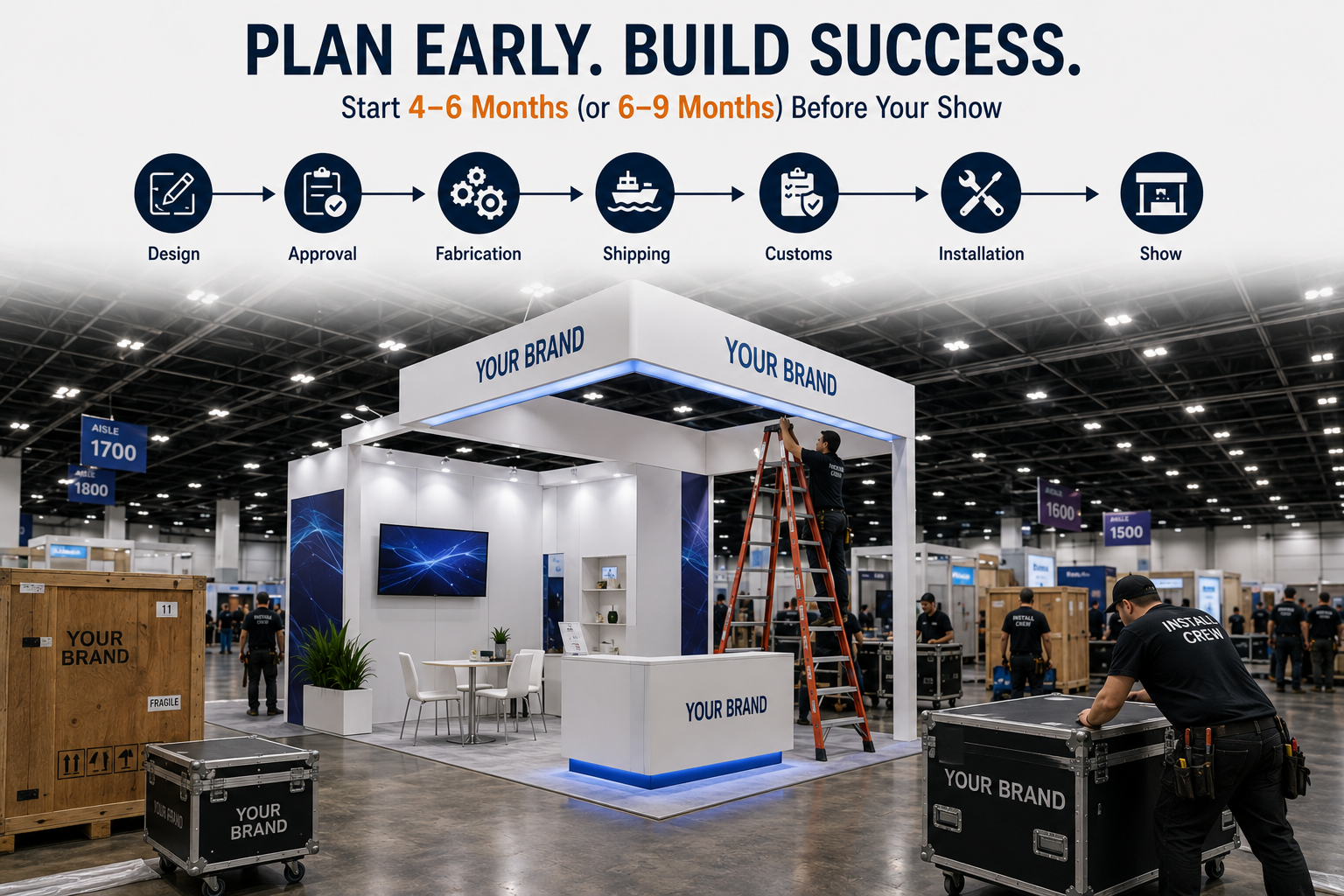
I have built booths in three weeks for clients who had no other option. I have also watched the same design, built with the same materials, cost 25% less and proceed with zero drama when planned six months out. The difference is not the builder's competence. It is the availability of options.
The ideal timeline, month by month
| Time before show | Action |
|---|---|
| 6–9 months | Select show, set budget, shortlist builders, request proposals |
| 4–6 months | Select builder, finalize design, confirm contract terms |
| 3–4 months | Approve fabrication drawings and graphics; book shipping |
| 2–3 months | Fabrication in progress; arrange visas, travel, flights, hotel |
| 4–6 weeks | Crating, shipping, customs documentation |
| 2 weeks | Confirm delivery schedule with venue and builder |
| Show week | Installation, show days, dismantling |
Why overseas exhibitors need more lead time
International shipping alone can consume 3–6 weeks, depending on whether you send cargo by sea or air.7 US customs clearance adds several days.8 If your crate is delayed, your builder installs on an incomplete booth. If your visa is delayed, you miss the show entirely.
Beyond logistics, there is a design consideration. US show rules differ from international norms. Ceiling-height limits, aisle carpet requirements, and fire-safety regulations for materials all affect your booth design. A design approved for a show in Munich may need changes for Las Vegas.9 Those revisions require review cycles, which require time.
The true cost of rushing
When a client compresses a six-month process into six weeks, three things happen:
- Fabrication moves into overtime, increasing labor costs by 25–50%.
- Air freight replaces ocean freight, multiplying shipping costs by 4–6 times.
- Design corners get cut, because there is no time for revision cycles.
None of this is the builder's fault. It is the arithmetic of urgency. Start early, and you control the process. Start late, and the process controls you.
Frequently Asked Questions
How much does a US trade show booth cost for an overseas exhibitor?
A basic 10×10 exhibit rental in the US typically ranges from $5,000 to $15,000.10 A custom 20×20 booth can cost $40,000 to $100,000 or more, depending on design complexity, materials, and location. Always add 20–30% for union labor, venue fees, shipping, and logistics when budgeting from overseas.
Can overseas exhibitors install their own booth in the US?
Usually not in major venues. Union jurisdiction agreements and safety rules restrict who can perform installation tasks in large convention centers. Some smaller shows allow self-installation, but you must confirm with the show organizer. Even then, loading dock and material handling rules still apply.
What insurance or certifications should a US booth builder have?
Reputable US booth builders carry general liability insurance and workers' compensation coverage. Many venues require certificates of insurance naming the venue as an additional insured. Ask your builder for proof of coverage in writing. For electrical components, UL certification is standard in the US market.
Should I rent or buy my trade show booth in the US?
Renting is ideal for first-time exhibitors or those uncertain about returning to the same show. It eliminates shipping and storage concerns. Buying makes sense if you exhibit in the US multiple times per year and can reuse the structure. A hybrid approach—buying a modular system and renting the installation crew—is often the best value.
What happens to my booth after the show ends?
Your contract with the US booth builder should specify the post-show process. Standard options are dismantling and disposal, storage at the builder's facility, or re-crating for return shipping. The show must move out within a strict deadline, typically within hours after closing, or overtime penalties apply.
Conclusion
Overseas exhibitors working with US booth builders face real pitfalls, from union labor costs and venue fees to contract terms and communication gaps. Every one of these challenges is manageable with early planning, a transparent line-item budget, written approvals, and a partner who has guided international clients before. The US market is not impossible. It is simply different. Choose a US booth builder who understands both your goals and the American exhibition ecosystem, and you will walk the show floor with confidence instead of anxiety.
If you are planning your first US trade show, contact our team at Exhibitsmax for a free consultation. We have spent more than 15 years helping international exhibitors succeed in Las Vegas and across the United States, and we would like to help you avoid the pitfalls we have seen far too often.
"Union Work Rules:Jurisdictions", https://eaca.com/wp-content/uploads/2024/07/24-Union-Work-RulesJurisdictions.pdf. Convention-industry guidance, such as exhibitor service manuals and IAEE resources, explains that local union jurisdiction agreements govern booth installation tasks in many U.S. convention centers and that the specific trade assignments vary by venue. Evidence role: mechanism; source type: institution. Supports: Union jurisdiction agreements in major U.S. convention venues assign specific installation tasks to specific crafts.. Scope note: The cited sources do not list every city, and rules can differ from one venue to another. ↩
"Union Labor at Trade Shows", https://www.trisource-exhibits.com/union-labor-at-trade-shows/. Exhibitor service manuals and venue rules for major U.S. convention centers commonly require installation, material handling, and dismantling to be performed by designated labor or approved contractors, and self-installation is restricted. Evidence role: general_support; source type: institution. Supports: Large U.S. convention centers generally require union labor or approved contractors for show-floor installation.. Scope note: Some venues, smaller shows, and certain portable-display situations allow exhibitors to install their own booths, so the rule is not universal. ↩
"Custom Trade Show Booth Builder in Las Vegas & USA | Exhibitsmax", https://exhibitsmax.com/trade-show-booth-builder-in-las-vegas/. Exhibition industry cost research (e.g., CEIR exhibition benchmarks) shows that venue services such as drayage, electricity, and internet are billed separately and can add thousands of dollars to a basic booth budget; exact fees vary by show. Evidence role: statistic; source type: research. Supports: Venue service fees for small booths are a significant, separately billed component of U.S. exhibit budgets.. Scope note: The cited range is illustrative and is not an official rate schedule published by venues. ↩
"Overtime Pay", https://www.dol.gov/agencies/whd/overtime. The U.S. Department of Labor’s overtime guidance states that covered workers must be paid at least 1.5 times their regular rate for hours worked over 40; many collective bargaining agreements provide higher rates, including double time for additional overtime. Evidence role: statistic; source type: government. Supports: Overtime premium rates are standard features of U.S. labor law and union agreements.. Scope note: Federal law does not mandate the exact 50% and double-time thresholds described in the article; those depend on local union agreements. ↩
"High-context and low-context cultures", https://en.wikipedia.org/wiki/High-context_and_low-context_cultures. Edward T. Hall’s work on high-context and low-context cultures, widely used in intercultural communication research, describes American communication as relatively explicit and direct while also recognizing that politeness routines can obscure literal meaning. Evidence role: general_support; source type: paper. Supports: Cross-cultural communication research characterizes American business discourse as relatively direct and low-context, with politeness norms that non-native speakers may misinterpret.. Scope note: Cultural characterizations are averages and do not describe every American speaker or every business context. ↩
"Time in the United States", https://en.wikipedia.org/wiki/Time_in_the_United_States. Standard geographic references list four time zones in the contiguous United States—Eastern, Central, Mountain, and Pacific—while Alaska and Hawaii each have additional zones. Evidence role: definition; source type: encyclopedia. Supports: The contiguous United States covers four standard time zones.. Scope note: The phrase 'continental' can be ambiguous because Alaska is on the North American continent; the four-zone statement is technically accurate for the contiguous U.S. only. ↩
"Transit Time Calculator for Sea, Air & Port To Port Shipping", https://www.freightos.com/freight-resources/transit-time-calculator/. Logistics and maritime trade reports (e.g., UNCTAD’s Review of Maritime Transport) indicate that trans-Pacific ocean services typically take three to six weeks depending on ports and schedules, whereas air cargo is measured in days. Evidence role: statistic; source type: research. Supports: Ocean shipments between major trading regions commonly take several weeks, while air cargo takes days.. Scope note: Transit times vary with origin, destination, carrier, and chosen service; the article’s range is a practical generalization, not a fixed rule. ↩
"Entry Summary and Post Release Processes", https://www.cbp.gov/trade/programs-administration/entry-summary. U.S. Customs and Border Protection regulations require importers to file an entry within a limited period after arrival and allow release only after any examination and duty payment, so adding several days for clearance is consistent with the federal process. Evidence role: mechanism; source type: government. Supports: U.S. customs entry and release procedures require time for filing, examination, and duty payment.. Scope note: Clearance may take less than a day for low-risk automated entries or longer if physical examination is required. ↩
"Navigating Trade Show Booth Regulations Across Europe", https://xsworldwide.eu/navigating-the-complexities-of-exhibit-regulations-across-european-countries/. Industry guidance from international exhibition associations (e.g., UFI and IAEE) notes that show rules are venue- and jurisdiction-specific, so a design compliant in one country may require modifications to meet another venue’s fire, electrical, and structural requirements. Evidence role: general_support; source type: institution. Supports: International exhibition industry guidance recognizes that local fire codes, venue rules, and line-of-sight rules can require design revisions when moving exhibits across countries.. Scope note: This does not confirm the specific Munich-to-Las Vegas changes; it only supports the general proposition that cross-border design revisions are often necessary. ↩
"Custom Trade Show Booth Builder in Las Vegas & USA | Exhibitsmax", https://exhibitsmax.com/trade-show-booth-builder-in-las-vegas/. Exhibit industry market surveys and rental pricing benchmarks put the typical cost of a 10x10 rental booth at several thousand to the mid-teens of dollars, depending on location, labor, and included services. Evidence role: statistic; source type: research. Supports: Rental booth pricing for small U.S. exhibits falls within a broad market range.. Scope note: Prices vary substantially by show, facility, and rental package; the range is indicative rather than a uniform industry price list. ↩