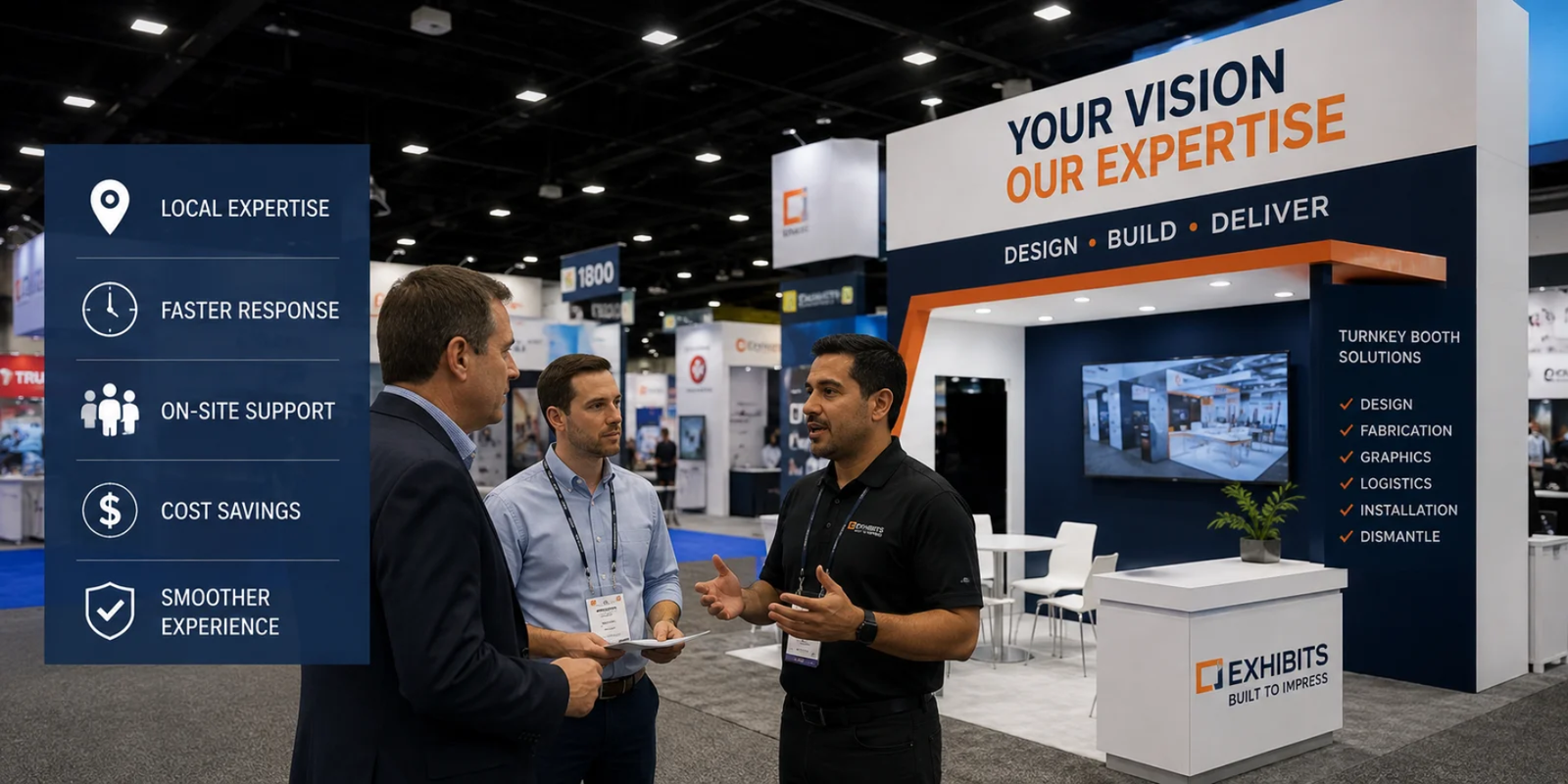
A US local booth builder can feel like an optional extra until the line items start stacking up and the risks become real. The problem is that overseas teams often underestimate American labor rules, show services, and on‑site unknowns. That creates stress and spiraling costs. The solution is to evaluate the decision as risk management and total cost of ownership—not just a quote comparison.
Yes, most international exhibitors benefit from a US local booth builder because the local partner reduces risk, manages US‑specific regulations and union labor, and optimizes total cost of ownership. However, if you have a proven global modular system and a seasoned team, a hybrid approach—global design plus a local I&D partner—can also work.
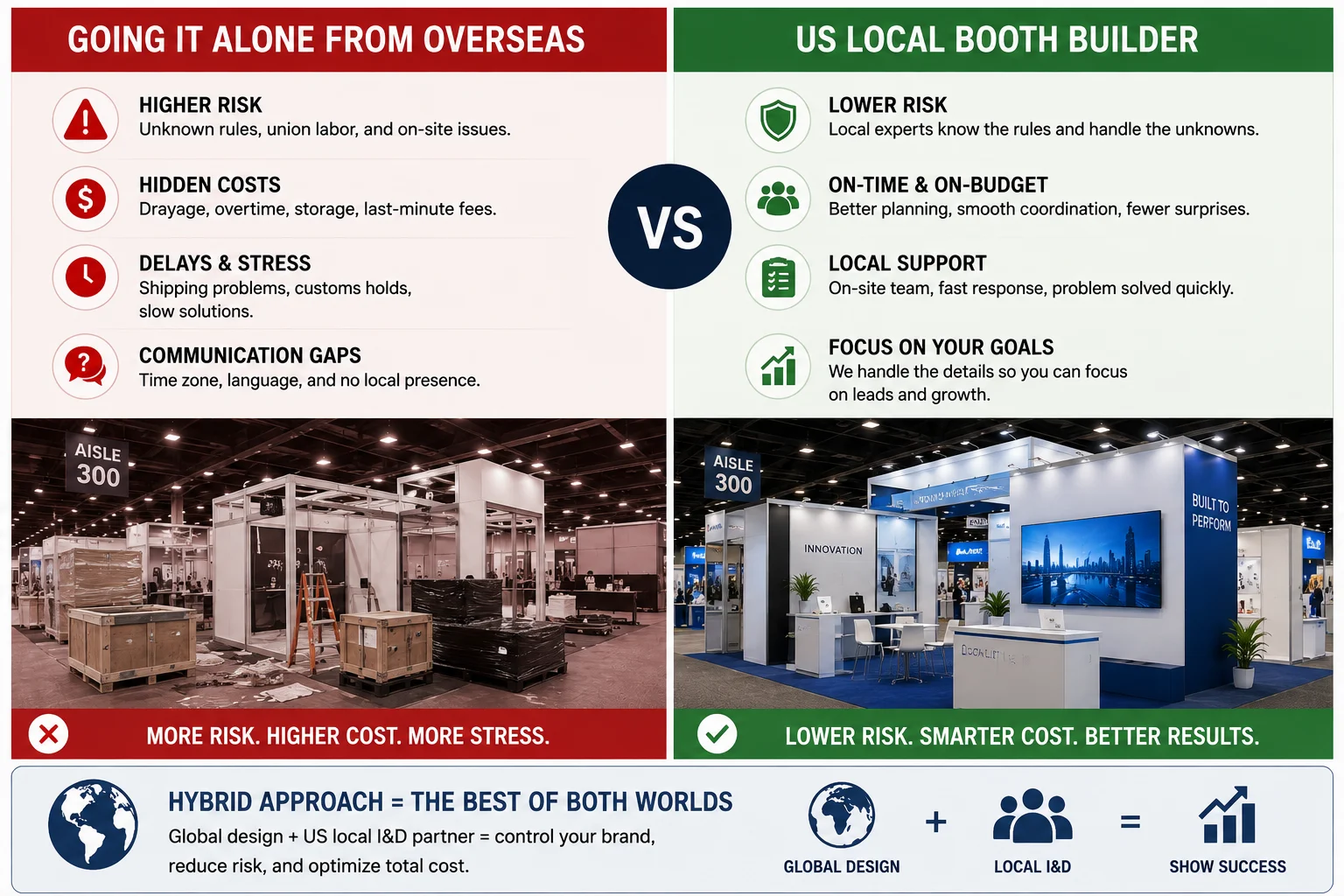
There is more under the surface than “pros and cons.” In this guide, I pull from 15+ years of building exhibits across the United States to show where costs really land, how US rules differ, and when a US local booth builder is the right call versus when a non‑local partner is viable.
What goes into the total cost of ownership with a US local booth builder?
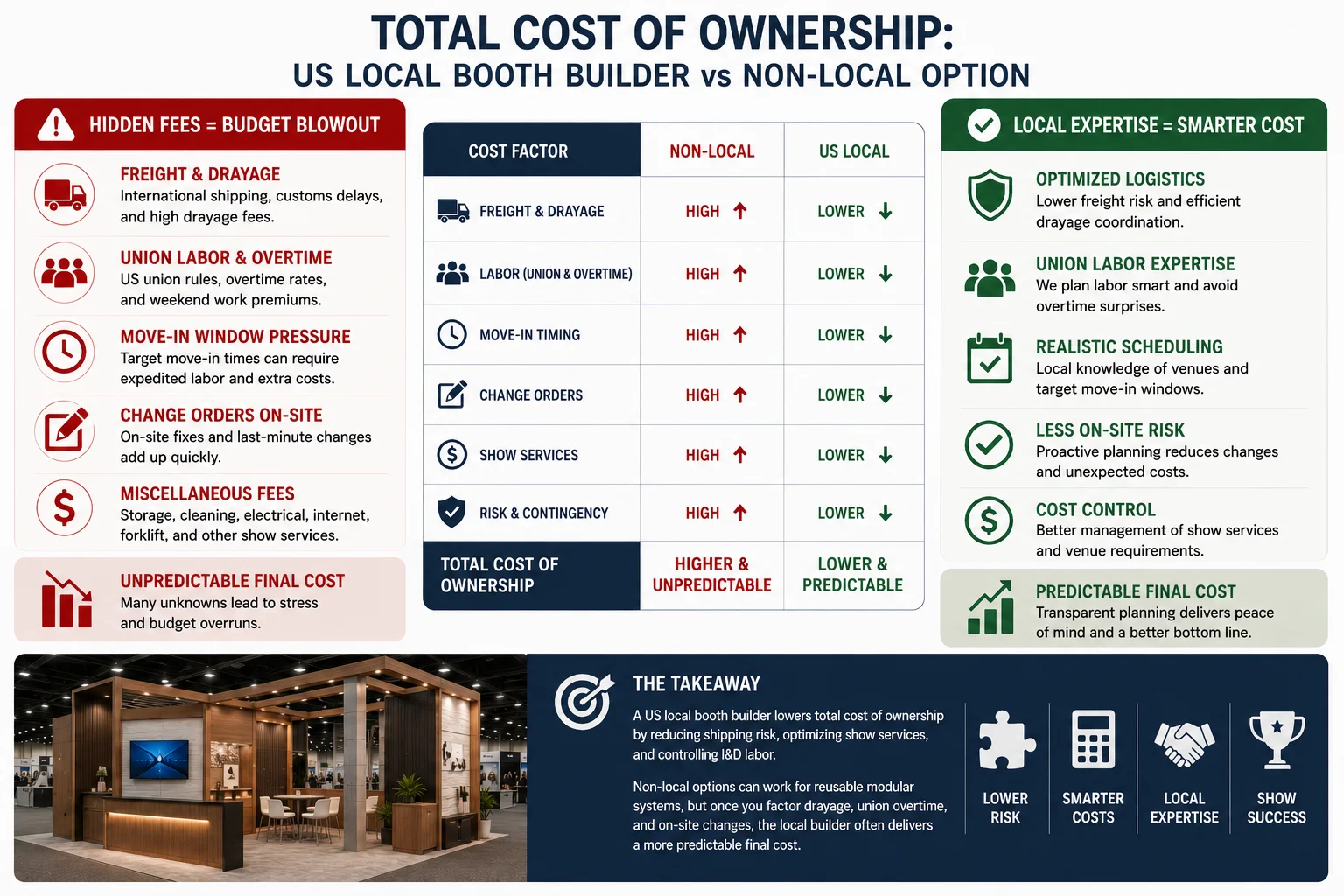
Hidden fees can turn a “great deal” into a budget blowout. The pain begins with underestimated freight, drayage, and union labor. It intensifies when overtime rules, target move‑in windows, and change‑orders hit. The fix is a total cost of ownership model that compares local versus non‑local scenarios across the full delivery cycle.
A US local booth builder lowers total cost of ownership by reducing shipping risk, optimizing show services, and controlling I&D labor. Non‑local options can work when reusable modular kits travel efficiently. However, once you factor drayage, union overtime, and on‑site changes, the local builder often delivers a more predictable final cost.
Dive deeper: TCO is more than the quote
When I review budgets with international teams, I see the same blind spots. The first is material handling (“drayage” in US show terms). Drayage is charged by hundredweight (cwt)1 and can range from $120–$170 per cwt2 for advance shipments, more for direct to show site. Heavy crates and multiple deliveries increase it fast. A US local booth builder designs and packs for US drayage realities, often saving thousands.
- Freight and customs:
- Air vs. ocean cost, plus customs brokerage.
- Tariffs (for example, certain materials fall under Section 301 tariffs3).
- ATA Carnet or temporary import bonds4 to avoid duties. Errors cause delays and storage fees.
- Drayage and marshaling:
- Advance warehouse vs. direct-to-show decision.
- Target move-in times with penalties if missed.5
- Split shipments incur multiple minimums.
- Labor:
- I&D (installation and dismantle) rates vary by city. Overtime and double-time apply outside straight-time windows.6
- Union jurisdictions: you may need separate crews for carpentry, electrical, rigging, and AV.7
- Show services:
- Electrical orders, internet, rigging points, carpet, cleaning, and lead retrieval.
- Late order surcharges can be 20–40%.8
- Change orders:
- On-site modifications at overtime rates.
- Last-minute graphic reprints, rush fees, and courier charges.
Here is a simplified comparison I share in planning meetings:
| Cost Component | Non-Local Builder (Imported Booth) | US Local Booth Builder |
|---|---|---|
| International Freight | High (air/ocean + brokerage) | Low (domestic only) |
| Tariffs/Customs | Possible (varies by materials) | None on domestic goods |
| Drayage (CWT) | Often higher (heavier crates) | Optimized packing reduces units |
| I&D Labor Risk | Higher (learning curve) | Lower (local crews, known SOPs) |
| Show Services Surcharges | Higher (late changes) | Lower (pre-ordered, local checks) |
| On-site Changes | Costly (no shop nearby) | Flexible (shop support) |
| Storage Between Shows | International storage or re-export | Domestic storage options |
In one case, a client shipped a 10x20 custom booth from Europe to Las Vegas. Freight and drayage alone exceeded $18,000, not counting a $4,200 overtime bill after missing the target move-in. The next year we fabricated locally, reduced crate count by 40%, and the final TCO dropped by 22%.
The point is not that imports never work. The point is that TCO trumps initial quotes. A US local booth builder can design for American show math—from crate sizes to labor sequencing—so your “all-in” is predictable.
How do US regulations and unions make a US local booth builder valuable?
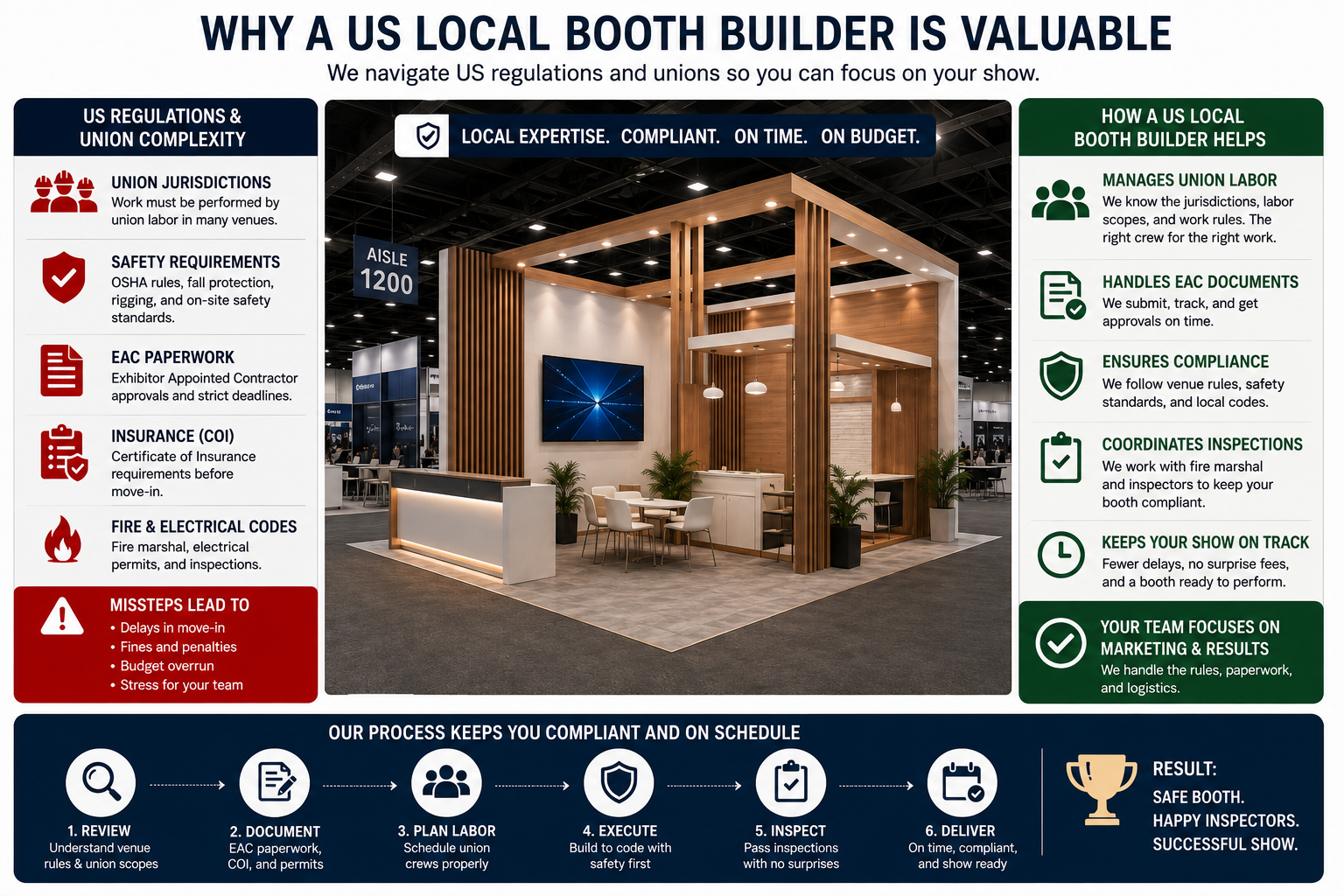
It is frustrating to learn new rules in real time. US exhibits run on union jurisdictions, venue safety requirements, and strict documentation. Missteps delay builds and add fees. A local partner navigates the paperwork, schedules crews correctly, and keeps inspectors satisfied so your team focuses on marketing.
A US local booth builder manages union labor scopes, safety certifications, and venue-specific rules. They coordinate Exhibitor Appointed Contractor (EAC) paperwork, insurance (COI), and compliance with fire marshal and electrical codes. This reduces delays and fines while keeping your booth safe and operational.
Dive deeper: Compliance is a process, not a checkbox
US show floors are governed by a web of rules:
- Union labor jurisdictions:
- Carpentry vs. electrical vs. rigging scopes. You cannot have a carpenter run cables on many show floors.
- Overtime triggers by clock times, not just hours worked.
- EAC and COI:
- If you use a non-general contractor (e.g., not Freeman or GES) for I&D, submit EAC forms.9
- Certificates of Insurance must meet specified limits and name the correct additional insureds.
- Safety and codes:
- Fire marshal approvals for enclosed spaces, fabrics, and double-deck structures.
- Electrical devices often require UL or ETL listing.10 Non-listed devices can be tagged out.
- ADA considerations (e.g., ramp access if there is a platform).11
- Venue-specific rules:
- Suspended elements require engineered drawings and rigging plans.12
- Las Vegas, Chicago, and New York have different labor environments and inspection rigor.
A US local booth builder anticipates these checkpoints. We preflight drawings with the GSC, plan rigging and power drops according to venue grid specs, and sequence trades to avoid jurisdiction conflicts. I have sat in more fire marshal walk-throughs than I can count. The fastest way to fail one is to bring an unfamiliar double-deck without stamped calculations. The fastest way to pass is to engage early, supply the documents, and set an inspection window the day before show open.
Cultural shorthand matters too. When a floor manager says, “You’re out of target,” that signals a drayage scheduling issue, not that you are off-brand. A local team translates these nuances and resolves them quickly. We know which forms matter, which deadlines are hard, and where there is or is not flexibility.
Is on-site coordination reason enough to choose a US local booth builder?
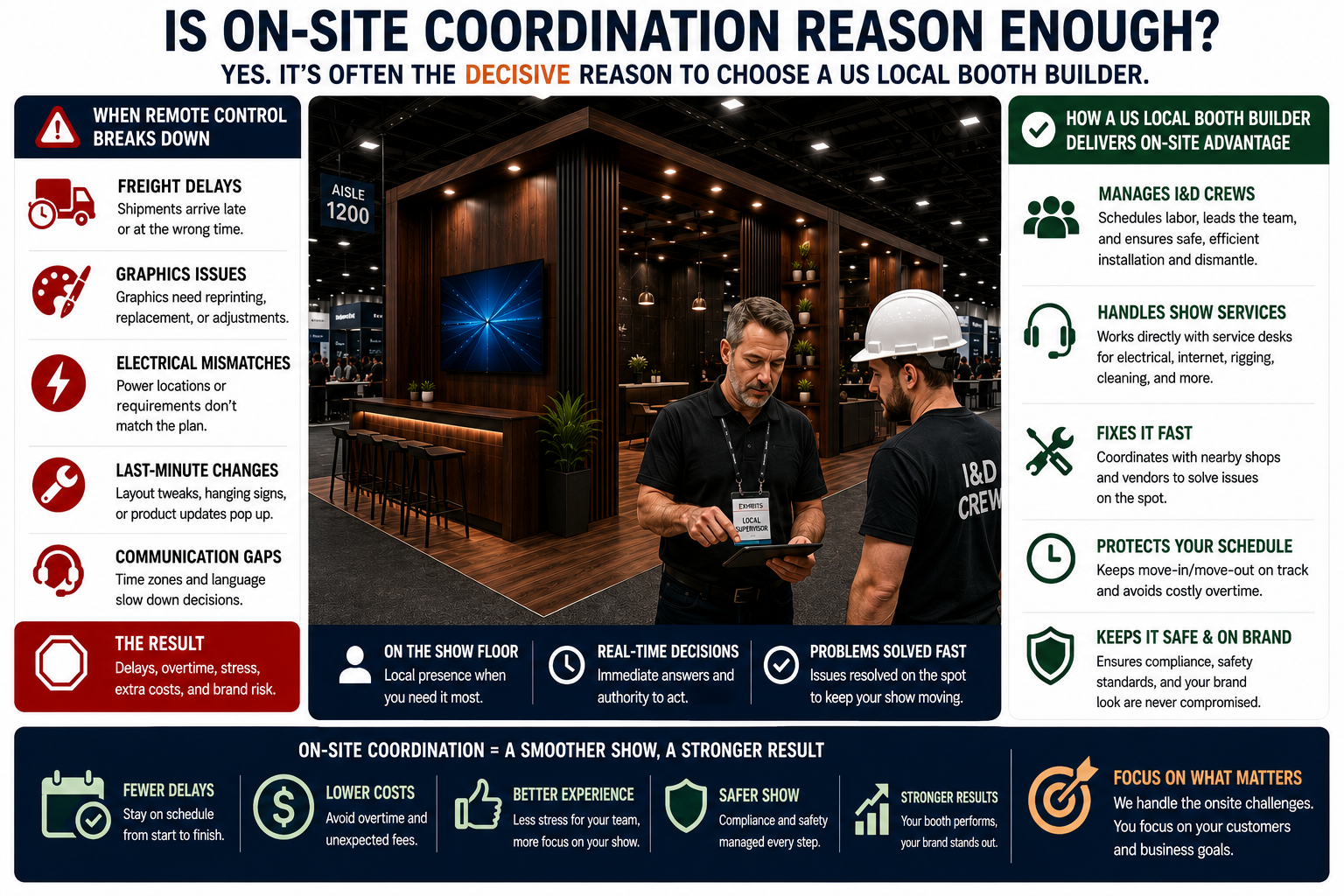
Remote control breaks down under show pressure. The pain shows up when freight is late, graphics need reprinting, or electrical does not match the plan. On-site decisions need authority and tools. A US local booth builder puts a supervisor on the floor who can solve problems in real time.
Yes. On-site coordination is often the decisive reason to hire a US local booth builder. Local supervisors manage I&D crews, handle show service desks, and orchestrate last-minute fixes with nearby shops and vendors. That responsiveness prevents delays, reduces overtime, and keeps the booth safe and brand-correct.
Dive deeper: The unsung hero is the on-site lead
There is a myth that perfect preplanning eliminates on-site surprises. In practice, even the best plans meet reality:
- A crate misses advance check-in and arrives direct.
- The venue relocates a floor port; electrical drops shift.
- Graphics arrive with a millimeter error; seams will show.
- An exhibitor across the aisle claims your hanging sign blocks their line of sight.
- A union steward interprets a scope differently than last year.
A seasoned on-site lead mitigates each scenario:
- Freight recovery: We track shipments at the marshaling yard and escalate with the GSC when freight goes missing. We have hotlines and ticket numbers because we use them every week.
- Electrical coordination: We meet the electrician at the booth, mark drops physically, and adjust cord routing to stay compliant and neat.
- Graphic reprints: We maintain local print partners and can turn same-day panels. I once replaced an entire 20-foot mural overnight in Anaheim after a color shift issue. The client did not miss a beat.
- Rigging disputes: We prepare stamped drawings and work with rigging leads to document clearances. When there is a dispute, we present evidence and propose alternatives that keep branding effective and compliant.
- Labor pacing: We sequence tasks to maximize straight-time. We pull crews off the floor at the right hours to avoid OT creep and return with a focused punch list.
I&D is not just muscle. It is project management in a unionized, time-bound environment. A US local booth builder makes faster decisions because we know the people, rules, and hackable choke points—like when to escalate to the floor manager versus the service desk.
When might a non-local or global builder be the better choice?
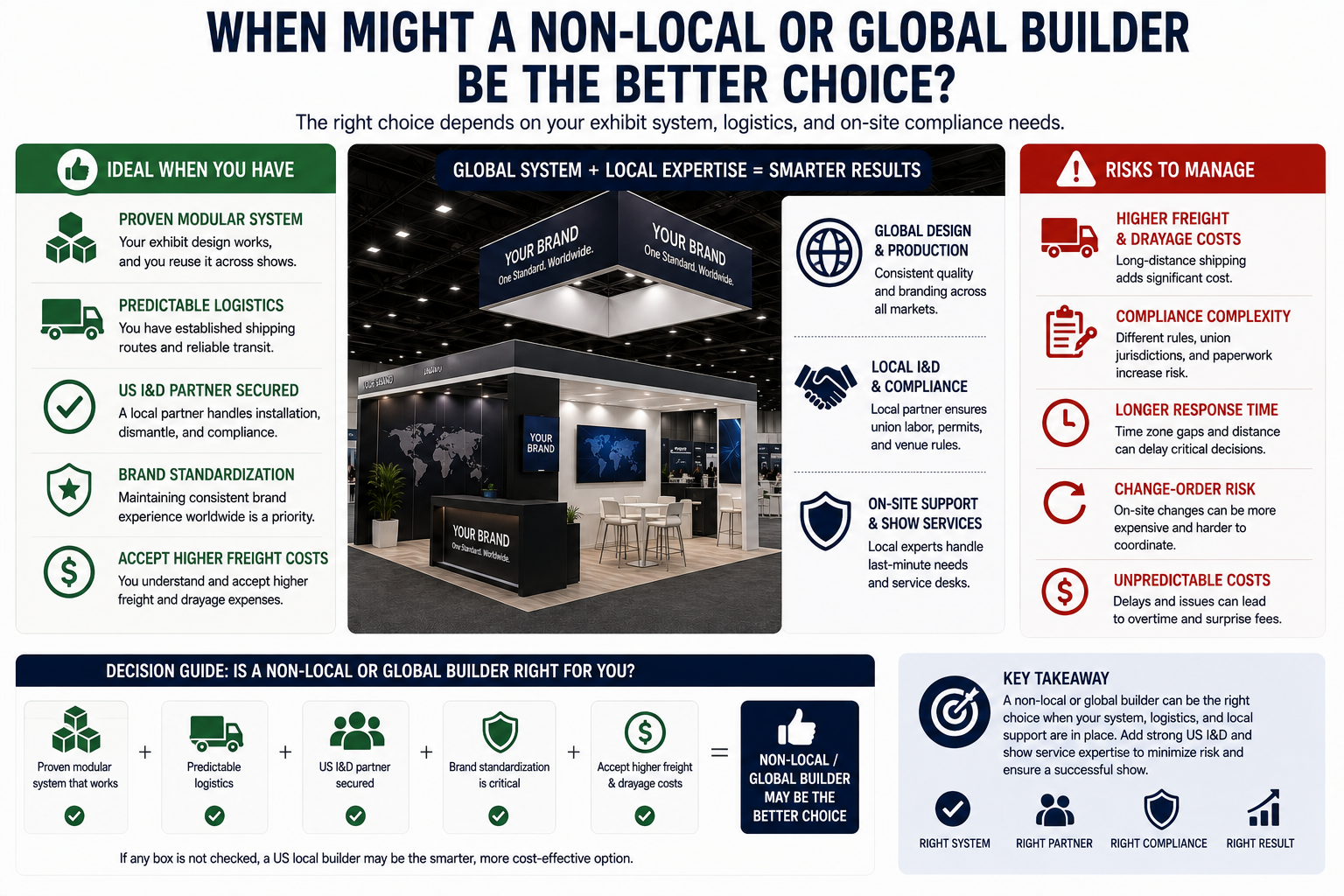
You may not need to change a working model. If you already own a high-quality modular kit that tours globally, a non-local partner can be efficient. The risk is in logistics and compliance. The solution is to add local I&D and show service expertise to complement your global system.
A non-local or global builder makes sense when you operate a proven modular system, have predictable logistics, and can secure a US I&D partner for compliance and on-site work. It also fits when brand standardization across regions is the top priority and your team accepts higher freight and drayage costs.
Dive deeper: Hybrid models and their trade-offs
Global marketing teams often invest in modular aluminum systems (e.g., beMatrix, Aluvision) with standardized graphics and accessories. These systems can travel well and maintain global brand consistency. I have supported many clients on hybrid models:
- Global design and ownership of the booth.
- US-based I&D and show service management.
- Local storage between US shows to avoid repeated imports.
Pros:
- Brand consistency across continents.
- Reuse of assets lowers per-show depreciation.
- Familiar assembly sequences reduce training needs for your team.
Cons:
- Higher freight and drayage due to heavier frames and multiple crates.
- Risk of customs delays; ATA Carnet paperwork must be flawless.
- Limited flexibility for last-minute changes unless you partner with a local shop.
If you go hybrid, mitigate risk with these steps:
- Engage a US EAC/I&D partner 8–12 weeks out. Confirm EAC paperwork and COIs.
- Share detailed assembly guides and bill-of-materials with the local crew.
- Pre-order show services early. Submit accurate electrical and rigging plans.
- Arrange local backup: a print house for emergency graphics, a rental stock list for components that might fail, and a plan for tool and hardware compatibility (metric vs. imperial issues crop up).
- Store the booth domestically between events to cut costs and damage risk.
In Chicago, a client insisted on shipping their European kit for three shows. We agreed to a hybrid plan. They absorbed higher drayage but kept their brand perfect. We provided I&D, local graphics, and storage. Their total cost landed about 8% higher than a fully local build but met their global standards mandate. That was the right trade-off for that team.
How should you evaluate and contract a US local booth builder?
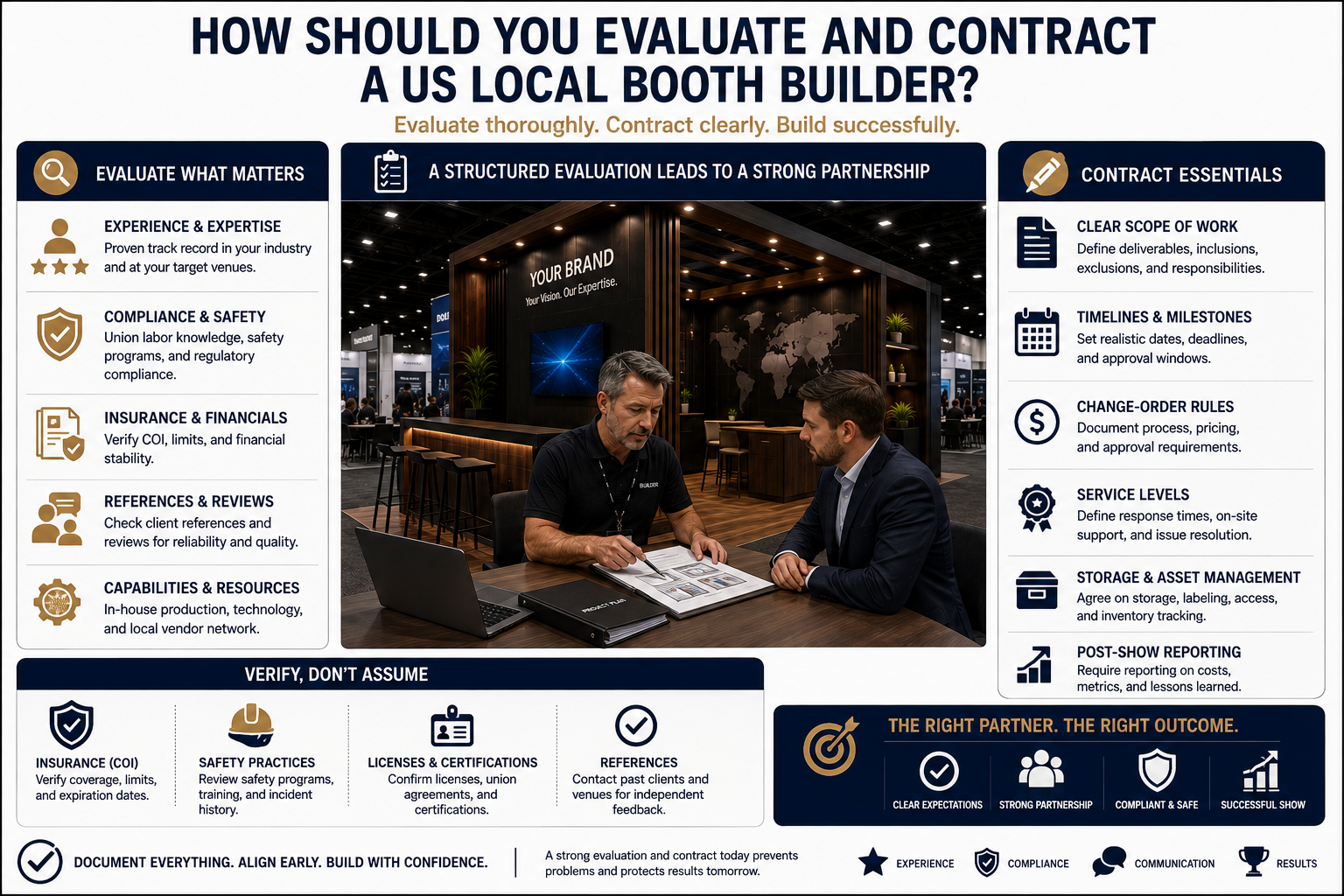
Choosing poorly leads to cost overruns and finger-pointing. The pain is vague scopes and assumptions that surface on-site. The remedy is a structured evaluation, verified documentation, and a contract that defines deliverables, changes, and service levels.
Evaluate a US local booth builder by assessing experience, compliance, and project controls. Verify insurance, safety practices, and references. Define scope, timelines, and change-order rules in writing. Align on storage, asset management, and post-show reporting. Treat certifications as documents to verify, not promises to accept.
Dive deeper: A practical selection framework
I share this checklist with international teams to structure procurement. It balances due diligence with practical execution.
H3: Capability and Experience
- Portfolio fit: Do they build exhibits similar to your size and complexity?
- Market coverage: Can they support multiple US cities (Las Vegas, Orlando, Chicago, NYC)?
- References: Ask for two international client references with similar needs.
H3: Compliance and Safety
- Insurance: Request COI with limits that match typical venue requirements and confirm additional insured wording.
- Safety training: Verify OSHA training for supervisors. Ask for safety SOPs.
- Electrical and rigging: Confirm familiarity with UL/ETL standards and rigging documentation.
H3: Project Controls
- Project plan: Request a timeline with design milestones, shop drawings, and pre-ship inspections.
- Change management: How do they log, price, and approve changes?
- On-site supervision: Who is the lead? What is their authority?
H3: Scope Definition
- Design ownership: Clarify IP and reuse rights for designs and CAD files.
- Fabrication specs: Materials, finishes, and tolerances. Define sample approvals.
- Show services: Who orders power, rigging, internet, cleaning, and lead retrieval? Who attends service desk?
- Logistics: Crate counts, weights, dimensions, and labels to optimize drayage.
- I&D staffing: Crew size, straight-time assumptions, and target schedules.
H3: Costs and TCO Visibility
- Itemized quote: Break out design, fabrication, graphics, rentals, AV, logistics, I&D, and show services.
- Overtime assumptions: State straight-time windows and triggers.
- Contingency: Agree a contingency percentage and decision thresholds.
H3: Post-Show
- Dismantle plan: Labeling, packing, and condition reporting.
- Storage: Location, monthly rates, and access rules.
- Maintenance: Refurb timelines, QC, and photo documentation.
I recommend a simple evaluation grid:
| Criterion | Weight | Notes / Evidence |
|---|---|---|
| Relevant Experience | 20% | Portfolio, references |
| Compliance & Safety | 20% | COI, SOPs, certifications (verify) |
| Project Controls | 20% | Schedules, change logs |
| TCO Transparency | 20% | Itemized costs, assumptions |
| Cultural Fit & Communication | 20% | Responsiveness, clarity |
Finally, set service levels in the contract:
- Response times for emails and urgent calls.
- On-site supervisor presence hours.
- Reporting cadence with photo updates.
- Escalation path for issues.
I will never promise zero surprises. I will promise that we will see them early, communicate clearly, and manage them with your budget and brand in mind.
Frequently Asked Questions
Can I ship my existing booth from overseas instead of hiring a US local booth builder?
Yes, you can. It works best for modular systems designed for travel. Budget for international freight, customs, drayage, and potential tariffs. Mitigate risk by partnering with a US I&D team, pre-ordering show services, and arranging local backup for graphics and replacement parts.
What US union rules should I know before deciding on a US local booth builder?
Expect separate crews for carpentry, electrical, and rigging in many cities. Straight-time, overtime, and double-time rates apply based on hours and days. You may need EAC forms and COIs if you use non-GSC installers. A US local booth builder will sequence trades and paperwork to keep you compliant and on budget.
How far in advance should I engage a US local booth builder?
Engage 12–16 weeks before the show for custom builds and 8–12 weeks for rentals. This window supports design, approvals, fabrication, and pre-show logistics. It also locks in labor and avoids late-order surcharges for electrical, rigging, and other show services that can add 20–40% if ordered late.
Can a hybrid model work—global design with a US I&D partner?
Absolutely. Many clients ship a modular kit and hire a US I&D partner to handle labor, compliance, and on-site coordination. Pairing this with US storage between shows can reduce recurring freight. Ensure detailed assembly guides and a clear division of responsibilities to avoid gaps.
How do I reduce drayage costs whether I use a US local booth builder or not?
Consolidate shipments, reduce crate count, and design lighter components. Ship to the advance warehouse when target windows are tight. Label crates clearly and avoid split shipments. A US local booth builder can also redesign packing and crate sizes to optimize cwt charges and handling time.
Conclusion
Choosing a US local booth builder is less about simple pros and cons and more about risk control and total cost of ownership. For most international exhibitors, a US local booth builder reduces compliance headaches, smooths on-site coordination, and stabilizes budgets. If you want experienced guidance for your next US show, reach out to Exhibitsmax in Las Vegas. We are ready to help you plan, build, and deliver with confidence.
"Material Handling FAQs", https://www.exhibitoronline.com/topics/article.asp?ID. Industry association glossaries and exhibitor guides describe material handling (drayage) as a fee assessed per hundredweight (CWT) for moving freight within the venue. Evidence role: definition; source type: institution. Supports: That U.S. trade show material handling (drayage) is commonly billed by the hundredweight (CWT) rather than per piece.. Scope note: Terminology and exact practices can vary by show contractor and venue. ↩
"Material Handling FAQs", https://www.exhibitoronline.com/topics/article.asp?ID=2808. Recent exhibitor service schedules for large U.S. shows list advance warehouse material-handling charges on the order of $100–$200 per CWT, with direct-to-show rates typically higher. Evidence role: statistic; source type: institution. Supports: That published exhibitor manuals list advance material-handling rates in the roughly $100–$200 per CWT range, consistent with the cited figures.. Scope note: Rates differ by city, event, contractor, and year; example figures are illustrative rather than universal. ↩
"USTR Makes Findings and Proposes Action in 60 Section ...", https://ustr.gov/about/policy-offices/press-office/press-releases/2026/june/ustr-makes-findings-and-proposes-action-60-section-301-investigations-relating-failures-take-action. The Office of the U.S. Trade Representative documents Section 301 actions that add duties to designated imports, which can increase costs for affected materials. Evidence role: general_support; source type: government. Supports: That Section 301 actions have imposed additional duties on specified imported goods, potentially affecting exhibit materials depending on classification and origin.. Scope note: Applicability hinges on the specific HTSUS classification and country of origin for each item. ↩
"ATA Carnet Frequently Asked Question (FAQ's)", https://www.cbp.gov/trade/programs-administration/entry-summary/ata-carnet-faqs. U.S. Customs and Border Protection explains that ATA Carnets and Temporary Importation under Bond procedures enable temporary admission of goods for exhibitions without payment of duties, subject to conditions. Evidence role: definition; source type: government. Supports: That U.S. Customs permits temporary, duty-free entry for certain goods via ATA Carnet or TIB when requirements are met.. Scope note: Eligibility and compliance requirements are strict, and not all goods or situations qualify. ↩
"Exhibitor Freight Procedures", https://ordering.ges.com/083600459/download/keyinstallinfo. Exhibitor logistics guidance describes targeted move-in schedules that assign delivery times; failure to meet targets can lead to rescheduling, additional handling, or overtime fees. Evidence role: mechanism; source type: institution. Supports: That many shows assign targeted freight delivery windows and may impose additional charges or rescheduling if targets are missed.. Scope note: Specific penalties and enforcement differ by general service contractor and event. ↩
"Wages and pay | New York Attorney General", https://ag.ny.gov/resources/individuals/workers-rights/wages-pay. Published venue labor rules, such as those for major convention centers, define straight-time hours and specify overtime and double-time premiums outside those windows. Evidence role: mechanism; source type: government. Supports: That venue labor policies distinguish straight-time from overtime/double-time based on clock hours and days, with premium rates outside straight-time windows.. Scope note: Exact hours, rates, and thresholds vary by city and union agreements. ↩
"Work Rules and Labor Union Regulations - Imgix", https://air-original.imgix.net/2e1fceff-ae40-480e-b724-07a48003abea.pdf?ixlib=react-9.10.0. Convention center policies commonly delineate union jurisdictions, assigning carpentry, electrical, and rigging to different crafts and requiring the appropriate crew for each scope. Evidence role: general_support; source type: institution. Supports: That major U.S. venues outline separate union jurisdictions for carpentry, electrical, and rigging tasks on the show floor.. Scope note: Jurisdiction lines and enforcement differ by venue and union contracts. ↩
"Exhibitor Kit", https://events.educause.edu/nercomp-annual-conference/2018/corporate-participation/exhibitor-kit. Venue and service rate sheets for major convention centers list higher on-site or late-order prices compared to advance rates, frequently amounting to double-digit percentage increases. Evidence role: statistic; source type: government. Supports: That exhibitor service schedules show substantial late/on-site order surcharges compared with advance rates, often on the order of tens of percent.. Scope note: Exact surcharges vary by service type, provider, and event. ↩
"EXHIBITOR-APPOINTED CONTRACTORS (EACs)/THIRD- ...", https://nbaa.org/wp-content/uploads/2020/01/MC-EAC-Guidelines.pdf. EAC policies at major venues state that exhibitors using non-official contractors must submit authorization forms and proof of insurance before move-in. Evidence role: definition; source type: institution. Supports: That exhibitor-appointed contractor policies require advance authorization and certificates of insurance for non-official I&D contractors.. Scope note: Form content, deadlines, and insurance limits are set by each show and may differ. ↩
"Does UL certification still matter for electrical products?", https://www.facebook.com/groups/ElectronicParts/posts/2631531407036178/. Electrical safety guidelines at major U.S. venues specify that devices must carry a recognized testing laboratory listing (e.g., UL or ETL), with non-compliant equipment subject to removal or de-energizing. Evidence role: general_support; source type: institution. Supports: That convention center electrical rules typically require UL/ETL or equivalent listings for devices used on the show floor.. Scope note: Accepted listings and enforcement are determined by the local authority having jurisdiction. ↩
"Chapter 4: Ramps and Curb Ramps", https://www.access-board.gov/ada/guides/chapter-4-ramps-and-curb-ramps/. The 2010 ADA Standards for Accessible Design specify requirements for ramps and accessible routes to address level changes, informing how raised platforms should accommodate access. Evidence role: mechanism; source type: government. Supports: That the ADA Standards for Accessible Design include ramp provisions for level changes in public accommodations, relevant to raised platforms in exhibits.. Scope note: Application to specific exhibits may be subject to local code interpretation and venue policies. ↩
"Rigging Guidelines and Regulations", https://www.paconvention.com/assets/doc/PCC-Rigging-Guidelines-and-Regulations-Updated-December-2020-1a404bc292.pdf. Rigging procedures published by major convention centers commonly mandate engineered drawings and load information before approving suspended signage or structures. Evidence role: general_support; source type: institution. Supports: That venue rigging policies require pre-approval with engineered drawings and load data for suspended elements.. Scope note: Requirements and lead times vary by venue and the complexity of the rig. ↩